



Most farms don't fail because of a single bad event. They stumble because a shock hits, everyone knows something should happen, and then three days evaporate while people argue about who has the authority to act, what the contract actually says, and whether calling the insurer now will hurt them later.
That gap — the time between "we have a problem" and "we're executing a response" — is where margin gets destroyed. A basis blowout, a buyer who suddenly wants to renegotiate delivery terms, a hailstorm two weeks before harvest, a rail delay that strands your grain: none of these are rare anymore. What's rare is a farm that has already decided, in writing, what it will do when they happen.
That's what operational risk management on a farm should actually be. Not a binder nobody reads. A live mapping of the risks you can name to the mitigations you've already approved, so the person on the ground can act inside hours instead of waiting for a meeting.
This framework covers three risk domains — market, contract, and operational — and shows how to build trigger-to-action matrices, three-tier scenario templates, and the buyer and insurer communication scripts that keep you from saying the wrong thing under pressure.
Why farms freeze when the shock actually lands
A farm with $4M in gross revenue usually has decent instincts scattered across the operation. The owner knows the marketing side. The agronomist knows the field risk. The office manager knows the contracts and the insurance paperwork. Each person, individually, could probably make a good call.
The problem is that no single person holds all three, and the shock rarely respects those boundaries. A price collapse triggers a buyer looking for an excuse to walk on a contract, right when your bins are full and you need cash flow. By the time those three people compare notes, the window has already moved.
What we've seen across a lot of mid-size operations is that decision latency — not decision quality — is the real killer. The right answer arrives on day four. It needed to arrive on day one.
The second reason farms freeze: nobody knows their own authority. Can the operations lead sign a spot sale at a $0.15 discount to move grain fast, or does that need the owner? Can they authorize a $6k equipment rental without a phone tree? When authority is undefined, people default to the safest thing available — which is usually waiting. Waiting feels responsible. It's often the most expensive choice on the table.
The three risk domains and how they bleed into each other
You can't build one giant risk plan. You build three linked ones, because each domain has a different owner, a different trigger, and a different clock.
Take control of your farm’s productivity.
Feldsly helps you plan, track, and optimize every farming operation with precision.
- Centralized crop scheduling
- Resource & labor management
- Real-time weather alerts
No credit card required
| Domain | Typical triggers | Clock speed | Primary owner | Where it leaks into other domains |
|---|---|---|---|---|
| Market | Basis move, futures swing, input price spike, export disruption | Hours to days | Owner / marketing lead | Weak prices tempt buyers to renegotiate; tight cash forces operational shortcuts |
| Contract | Buyer requests amendment, delivery dispute, quality rejection, force majeure claim | Days to weeks | Office manager / owner | A rejected load becomes a storage and logistics problem; disputes freeze payment |
| Operational | Weather event, equipment failure, labor gap, storage/logistics breakdown | Minutes to days | Operations lead | Missed delivery windows trigger contract penalties and lost market timing |
The table looks tidy. Real events are not. A wet harvest that pushes grain above contract moisture specs is simultaneously operational (you need dryers running), contract (the buyer can dock or reject), and market (a discounted downgrade eats your basis). The whole point of the framework is that you've pre-decided the moves in all three columns before they collide.
If you've already built financial guardrails around price scenarios, this framework sits right on top of your three-tier financial scenario planning. The scenario planning tells you what a price world does to your P&L. This tells you who does what, and by when, when that world arrives.
Building the trigger-to-action matrix
The core artifact is a matrix. On the left, a specific, measurable trigger. In the middle, the pre-authorized action. On the right, who executes and their spending or decision limit. No essays. If a trigger needs a paragraph to explain, it's not a trigger yet.
The key word is measurable. "If prices drop a lot" is useless. "If new-crop basis widens more than $0.20 below our 5-year average for this delivery month" is a trigger someone can actually watch and act on.
-
Trigger Cash price hits pre-set floor covering total cost + $0.30/bu margin → Action: Sell next 10% increment of expected production → Owner: Marketing lead, up to 20% of remaining bushels without owner sign-off
-
Trigger Basis narrows to within $0.05 of contract-year high → Action: Move stored grain against open cash contracts, prioritize highest-carry storage first → Owner: Operations lead
-
Trigger Input supplier quotes fertilizer up more than 15% vs. locked budget → Action: Trigger buffer-stock draw and activate secondary supplier from scorecard → Owner: Procurement, up to $25k
-
Trigger Diesel jumps above budgeted ceiling for 10 consecutive days → Action: Shift to pre-negotiated bulk delivery contract, re-sequence field ops to cut deadhead miles → Owner: Operations lead
A couple of those actions lean directly on work you should already have done — your buffer formulas and supplier scorecards. If those aren't built yet, the matrix has nowhere to point. That's exactly what a seasonal input procurement playbook gives you: the pre-approved second source and the buffer math the trigger fires into.
A mistake that shows up constantly: triggers with no owner and no limit. A trigger without an authorized executor is just a nicely worded worry. The spending limit is what actually removes the bottleneck — it's the sentence that says you don't have to call me for this.
Here's a simple visual of the trigger→action→owner workflow.
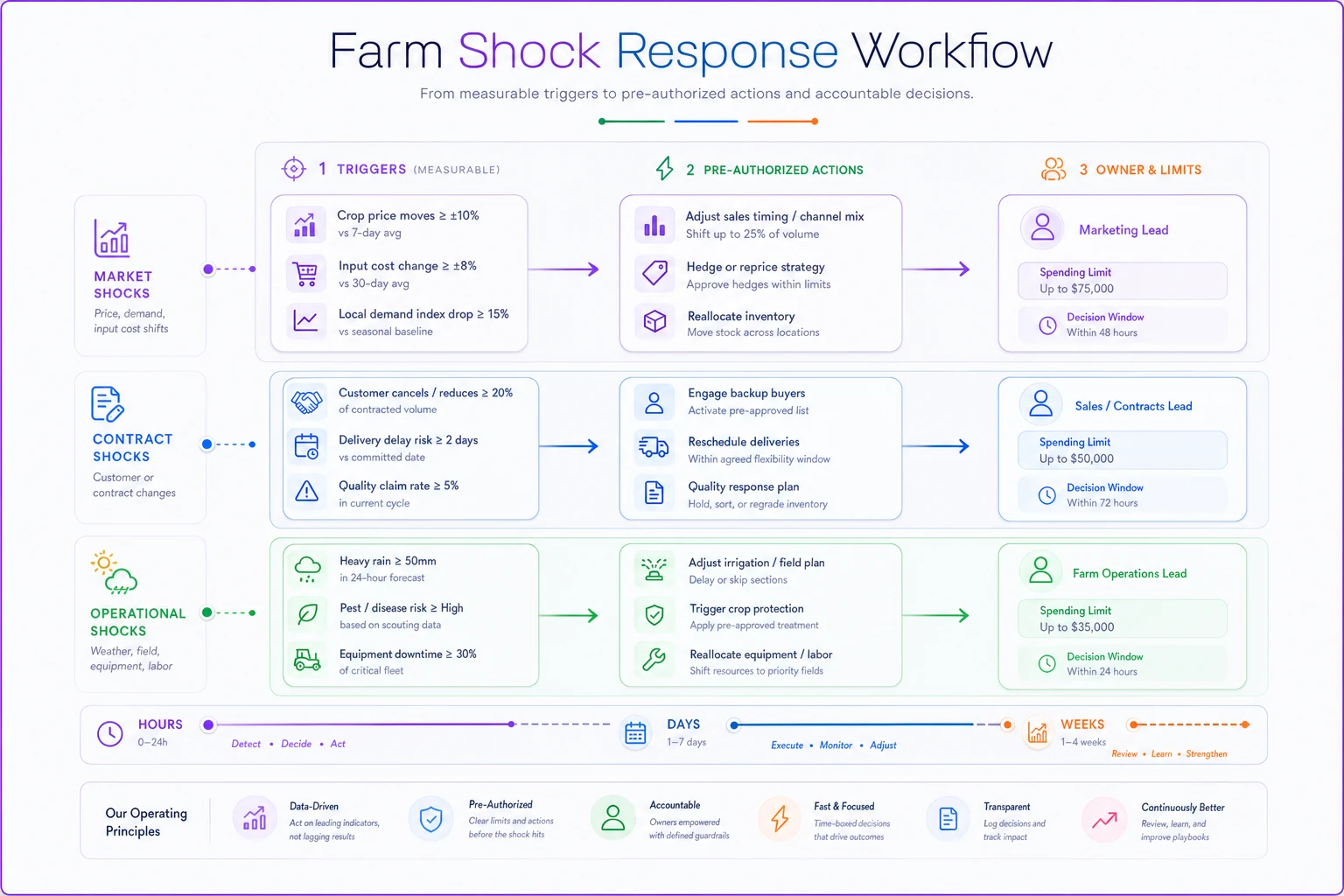
Use it to align your matrix entries and decision limits.
Three-tier scenario templates
For each domain, build three scenario tiers. Not because reality has exactly three flavors, but because three forces you to plan the middle case honestly instead of only imagining "fine" and "catastrophe."
Tier 1 — Manageable / expected volatility. Handled inside normal authority. Matrix actions execute, nobody escalates. Example: basis wobbles, one wet field delays planting a few days.
Tier 2 — Serious / margin-threatening. Requires coordinated action across two domains and an owner sign-off, but the playbook is still pre-written. Example: a buyer flags a quality dispute on a delivered load and holds payment. This is where most farms lose their footing — it's bad enough to matter but not obvious enough to trigger everyone at once.
Tier 3 — Structural / existential. Threatens the season or the balance sheet. Full escalation, insurer involvement, possibly legal. Example: a major buyer declares force majeure on 40% of your contracted volume mid-harvest.
The template for each tier should answer five things and nothing more:
-
Definition — the measurable line that puts you in this tier
-
Who's activated — the exact people, not "the team"
-
Pre-authorized moves — what happens immediately, without a meeting
-
What needs sign-off — the decisions that still require the owner
-
Communication trigger — do we contact the buyer, the insurer, the lender, and when
That fifth line is where farms get burned. People either communicate too early and weakly ("just wanted to flag we might have an issue") or too late and defensively. Both damage the relationship and, with insurers, both can hurt a claim.
The communication templates nobody wants to write in advance
Under stress, wording gets sloppy. A buyer reads panic between the lines and smells leverage. An insurer reads an admission where you meant an apology. This is the least glamorous part of the framework and the one that pays off fastest.
Buyer communication — the goal is to control the frame. You're not asking for mercy; you're proposing a specific path.
> "We're writing to give you early notice of a delivery timing issue on [contract #]. Current situation: [one factual sentence]. Our expected impact: [quantified — bushels, days, quality spec]. What we're proposing: [specific — revised delivery date, partial delivery schedule, blend option]. We'd like to confirm the path by [date] to keep this on track for both of us."
Three principles baked in: it's early, it's factual with numbers, and it arrives with a proposed solution rather than an open-ended problem. Buyers respond to operators who bring options.
Insurer communication — the goal is a clean, documented, timely record. Different discipline entirely.
-
Notify inside the policy's required window, always. A late notice can sink an otherwise valid claim.
-
State observed facts and dates. Avoid speculation about cause, and never guess at fault or dollar figures on the first contact.
-
Start the documentation trail immediately — timestamped photos, field notes, equipment logs — the moment the event occurs, not when you decide to file.
Keep both templates as fill-in-the-blank drafts stored where the office manager and owner can reach them from a phone. The person writing to a buyer at 9pm during harvest should be editing a good draft, not composing from scratch.
A real scenario: the wet-harvest squeeze
A grain operation in the eastern Corn Belt, roughly 3,200 acres, had about 60% of expected soybean production sold on cash contracts with delivery windows through late October. A stretch of rain pushed harvest back and moisture on the first loads came in above the buyer's spec.
Before they had a framework, a situation like this used to play out over a week of scrambling — running dryers reactively, taking whatever downgrade the elevator offered, and one year eating a chunk of a contract penalty because they missed a delivery window nobody was tracking against the contract calendar.
This time the triggers fired in sequence. Moisture readings crossed the pre-set line, so the operations lead activated the drying priority list — highest-value contracts first — without waiting for a call. When the delivery-window trigger crossed, the office manager sent the pre-drafted buyer notice that same afternoon, proposing a two-day revised schedule plus a blend option. Because the buyer got early, specific, solution-forward contact, they agreed to the revised window with only a modest dock instead of a rejection.
The avoided penalty and rejection exposure landed somewhere in the $18k–$25k range on that block of contracts. Drying costs were also lower because they weren't over-drying everything in a panic — they dried to spec, in priority order. The bigger win was less visible: nobody lost two days deciding what to do.
How this scales — and where it breaks
At a small scale, one person holds all three domains in their head and the framework feels like overhead. Fair. Below roughly 1,500 acres with a single decision-maker, keep it light: a one-page trigger matrix per domain and the two communication templates. That's enough.
The framework earns its keep when authority splits across people. Somewhere in the mid-size range, decisions start living in different heads, and that's exactly when latency creeps in. The whole design exists to let a split team act like a single decision-maker.
-
Triggers that were never updated. A basis floor set on last year's cost structure fires at the wrong time. Review triggers every season alongside your budget.
-
Owners who override their own matrix. If you pre-authorize a $25k procurement move and then insist on approving it anyway, you've rebuilt the exact bottleneck you were trying to remove.
-
No single source of truth. If the matrix lives in one person's spreadsheet, the contract terms in a filing cabinet, and the insurance deadlines in someone's email, the framework fragments the moment that person is in a field with no signal.
Review triggers every season alongside your budget.
That last point is where a real workflow platform helps — not as a magic fix, but as the place where triggers, contract terms, delivery calendars, and communication templates live in one system, so an alert about a moisture reading can surface the relevant contract's delivery window and penalty clause in the same view. AI-assisted operational tools earn their keep mostly on the boring, high-value work: watching thresholds you'd otherwise check manually, flagging when a delivery window and a weather delay are about to collide, and putting the right pre-drafted template in front of the right person. The judgment stays human. The monitoring doesn't have to be.
Wiring risk management into the plans you already run
None of this lives in isolation. Your trigger matrix should pull directly from the same forecast data you use for daily allocation — if you've already built an operational weather-risk framework, those forecasts are what fire your operational-tier triggers before the event, not after.
The connective tissue across a farm is what makes risk management work or fail. Market triggers pull from your marketing plan and cost structure. Contract triggers pull from your delivery calendar and quality specs. Operational triggers pull from weather, equipment, and labor status. When those data sources are stitched together, one signal can activate the right response in all three domains at once. When they're scattered, you're back to the four-day meeting.
Where to start
Don't try to build all three matrices in a weekend. Pick the domain that hurt you most in the last two seasons — for most operations that's either market or a weather-driven operational shock — and write ten real triggers for it. Attach an owner and a limit to each one. Draft the two communication templates. Test them mentally against last year's worst week and see where they'd have saved you time.
Then expand. The value compounds, because the second matrix reuses the same structure, and the third feels obvious.
The farms that handle shocks well aren't luckier or smarter. They've just moved the hard thinking to a calm moment, so the stressful moment only requires execution. That shift — from deciding under pressure to executing a decision you already made — is the entire point. Build the matrix once, keep it current, and let the person in the field act like the whole team is standing next to them.
Ready to revolutionize your farm management?
Join 500+ farms using Feldsly to boost yields, reduce waste, and streamline daily farm workflows.