



After building operational software for over 400 agricultural operations, one pattern keeps emerging: farms that survive volatile commodity markets aren't the ones with the best yield predictions or the fanciest equipment. They're the ones running structured scenario templates that trigger specific planting changes at predetermined price points.
The difference between reactive scrambling and systematic adjustment comes down to having break-even maps for each field paired with clear decision gates that kick in before vendor commitments lock you into unprofitable acres.
Commodity crop planning without scenarios
Most farms operate with a single planting plan based on December futures prices and last year's input costs. They might run some back-of-envelope calculations if markets shift dramatically, but there's no systematic framework for evaluating changes.
What typically happens: a 500-acre corn and soybean operation watches corn futures drop from $5.80 to $4.60 between January and March. The owner spends three days frantically recalculating whether to shift acres to beans, but by then the seed order is placed, nitrogen is pre-purchased at winter rates, and the custom applicator is booked for specific fields. The window for meaningful adjustment closed weeks ago.
The operational breakdown happens because farms treat financial planning and field operations as separate activities. The finance side might model different price scenarios, but those models don't translate into specific field-level actions. Meanwhile, the operations side is making commitments based on a plan that assumed prices would hold.
This gets worse as operations scale. A 200-acre farm can pivot relatively quickly—the owner knows every field personally and makes most calls themselves. At 2,000 acres with multiple decision-makers, field managers, and vendor relationships, changing course requires coordination that most operations simply don't have infrastructure for.
Building 3-tier scenario templates that actually work
Effective scenario planning starts with accepting that you need three distinct operational plans, not just three sets of numbers. Each tier represents a complete planting and input strategy that can be executed without major scrambling.
Take control of your farm’s productivity.
Feldsly helps you plan, track, and optimize every farming operation with precision.
- Centralized crop scheduling
- Resource & labor management
- Real-time weather alerts
No credit card required
Base Scenario (Most Likely) Your base scenario uses forward contract prices available today plus a realistic assessment of input costs including any locked-in prices. Not your hope, not your fear—what the market is actually telling you right now.
-
Corn at $5.40/bushel (December futures minus typical basis)
-
Soybeans at $12.80/bushel
-
Nitrogen at $0.58/pound (locked in for 60% of needs)
-
Seed costs up 4% from last year
-
Diesel at $3.45/gallon
Stress Scenario (Protection Mode) The stress scenario assumes multiple negative factors hit simultaneously—something that happens more often than producers like to admit. This isn't doomsday planning; it's acknowledging that markets can stay irrational longer than you can stay solvent.
-
Corn down to $4.20/bushel
-
Soybeans down to $10.50/bushel
-
Nitrogen spot prices spike to $0.75/pound for remaining 40%
-
Diesel hits $4.20/gallon during planting
-
Yield reduction of 8% due to weather pressure
Optimistic Scenario (Expansion Ready) Your optimistic scenario captures what happens when markets break in your favor. This matters because you need predetermined triggers for committing to additional inputs or rented ground that only pencils out at higher price levels.
-
Corn at $6.60/bushel
-
Soybeans at $14.20/bushel
-
Input costs remain at base levels
-
Yield boost of 5% from ideal conditions
The critical difference: each scenario includes specific operational changes, not just different profit projections.
Field-level break-even mapping across scenarios
Generic break-even calculations miss the massive variability between fields. That marginal 40-acre piece two miles from your home farm has completely different economics than your prime 160-acre field with irrigation access.
Here's how break-even shifts across fields in practice:
| Field Name | Acres | Base Break-Even | Stress Break-Even | Optimistic Break-Even | Scenario Trigger |
|---|---|---|---|---|---|
| North 160 | 160 | $4.85 corn | $5.95 corn | $4.45 corn | Always plant corn |
| River Bottom | 240 | $5.10 corn | $6.20 corn | $4.70 corn | Corn unless stress |
| Hillside 80 | 80 | $11.20 beans | $12.80 beans | $10.40 beans | Always beans |
| Rented South | 120 | $5.45 corn | $6.60 corn | $5.05 corn | Stress: return to owner |
| Home 40 | 40 | $4.95 corn | $6.05 corn | $4.55 corn | Flex field |
The "Scenario Trigger" column is what transforms analysis into action. Instead of recalculating everything when markets shift, you already know that River Bottom switches to beans if corn drops below $5.00, and you'll return the Rented South rather than farm it at a guaranteed loss.
This field-level approach also surfaces things whole-farm analysis buries. That Hillside 80 might lose money on corn even in the optimistic scenario—lower yields, higher machinery costs on slopes. Meanwhile, North 160 stays profitable on corn even under stress conditions because of consistent 200-bushel yields and proximity to storage.
Decision gates that prevent expensive lock-in
The most expensive mistakes happen when operational commitments outpace market reality. A decision gate system creates specific trigger points where you reassess and potentially restructure your entire planting plan.
Gate 1: December 1 - Initial Planning Set your three scenarios based on December futures and projected input costs. This establishes your framework but commits nothing.
-
Map all fields to crops under each scenario
-
Calculate total seed needs for each scenario
-
Identify flex fields that could swing either crop
-
Model cash flow needs under stress scenario
Gate 2: January 15 - Input Procurement Lock in fertilizer and chemical prices where favorable, but structure purchases to maintain flexibility.
-
Purchase 70% of nitrogen needs for confirmed corn acres only
-
Book herbicide programs for 100% of confirmed acres
-
Hold off on supplemental fertility for flex fields
-
Negotiate return clauses on seed orders
Gate 3: February 20 - Seed Finalization Last chance for major crop mix changes without significant penalties.
Trigger evaluation at Gate 3:
-
If corn futures < $4.80
execute stress scenario, shift 30% of flex acres to beans
-
If corn futures $4.80-$5.80
maintain base scenario
-
If corn futures > $5.80
execute optimistic scenario, consider additional rented ground
Gate 4: March 15 - Final Commitments Lock in remaining inputs and finalize custom application schedules. Minor adjustments only from here.
Gate 5: April 1-May 15 - Planting Execution Daily micro-adjustments based on weather windows and field conditions, but major mix is set.
Here's a simple workflow to visualize the decision gate process.
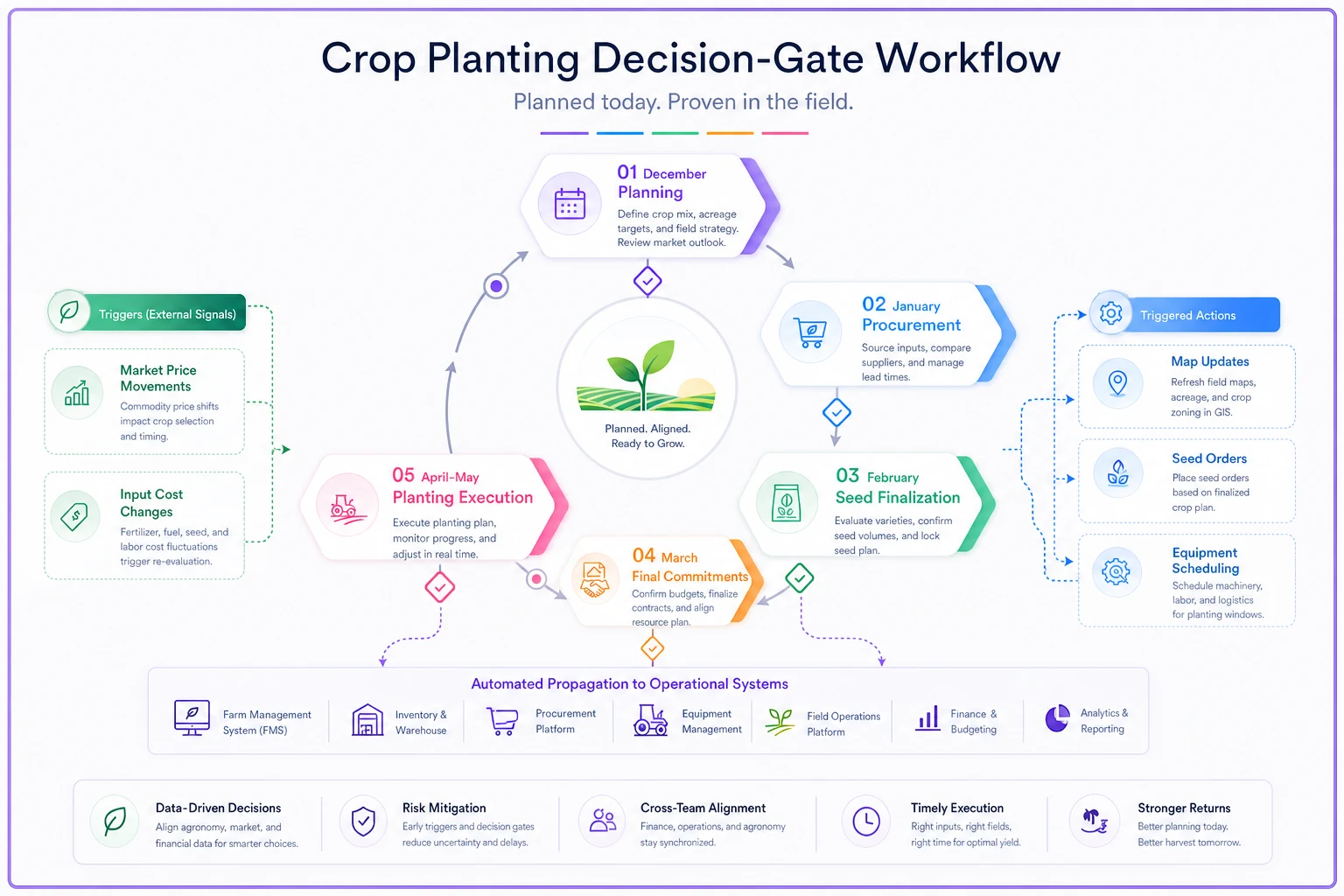
The power comes from having predetermined triggers. When corn drops to $4.75 on February 18th, you don't spend three days in management meetings—you execute the stress scenario you already mapped.
Worked example: Responding to fertilizer shock
Take a 1,500-acre corn-soybean operation that gets hit when nitrogen prices spike from $0.58 to $0.82 per pound in early February.
Starting Position (Base Scenario):
-
900 acres corn, 600 acres soybeans
-
Nitrogen budget
180 lbs/acre at $0.58 = $104/acre
-
Projected corn profit
$145/acre
-
Projected bean profit
$118/acre
Shock Hits: February 8th Nitrogen supplier calls: spot prices jumped to $0.82/pound. Your remaining 40% order will cost $147/acre instead of $104. Total corn production cost increases $43/acre.
Without Scenario Planning: Panic mode. Three days of spreadsheet chaos trying to figure out if you should switch fields to beans, reduce nitrogen rates, or eat the cost. Meanwhile, seed dealers need final numbers and the custom applicator needs confirmation.
With 3-Tier System: This triggers your stress scenario. You already mapped out that at nitrogen costs above $0.75/pound:
-
Flex fields (240 acres) switch from corn to soybeans
-
Reduce corn acres to 660 (your most productive fields only)
-
Increase bean acres to 840
-
Reduce nitrogen application to 160 lbs/acre on remaining corn
The operational changes are specific:
-
Call seed dealer
reduce corn seed order by 240 units, increase soybean order
-
Notify custom applicator
cancel nitrogen application on Fields 7, 9, and 14
-
Adjust herbicide program
switch 240 acres to soybean chemistry
-
Update cash flow
reduced working capital needs by roughly $38,000
Your field managers already have the stress scenario planting maps. They know exactly which fields change and can start adjusting equipment schedules immediately.
Worked example: Capturing price rallies
Different scenario: wheat problems push corn futures from $5.40 to $6.85 in ten days. Your optimistic scenario kicks in.
Optimistic Trigger Actions:
-
Contact landlord about renting additional 200 acres offered in January
-
Increase nitrogen rates to 195 lbs/acre on top fields
-
Add fungicide application to corn program
-
Lock in fuel needs for entire season at current prices
-
Forward contract 40% of expected production at $6.50
These aren't reactive scrambles. You've already modeled that at $6.50 corn, that mediocre 200-acre rental pencils out even with the drive time. You've already calculated that additional nitrogen and fungicide generate positive ROI above $6.20 corn. The decisions are pre-made; you're just executing.
Without this framework, most operations either miss the opportunity entirely or overcommit without understanding the downside risk they're taking on.
Integration with existing operational systems
Scenario planning fails when it lives in isolation. The farms that make this work integrate scenario triggers into their standard workflows.
Your rotation governance system needs to account for scenario-driven changes. If stress conditions force more bean acres this year, your three-year rotation maps need updating to prevent soybean-heavy sequences that invite disease pressure.
Similarly, your fertilizer prioritization matrix becomes even more critical under stress scenarios. When nitrogen costs spike, knowing exactly which fields respond best to reduced rates prevents uniform cuts that sacrifice your most responsive acres while over-feeding fields that plateau at lower rates.
The operational complexity multiplies when you're coordinating scenario changes across multiple systems. A shift from corn to beans on 300 acres ripples through seed orders and return agreements, chemical programs and custom application schedules, storage contracts and grain handling logistics, equipment scheduling and labor allocation, and cash flow timing and operating loan draws. Most of those ripple effects aren't obvious until something breaks.
This is where AI-powered operational software starts to show real value. Instead of manually updating six different spreadsheets and hoping you caught every downstream impact, platforms built with workflow automation can propagate scenario changes across all connected systems. When you trigger the stress scenario, adjusted planting maps, updated input orders, recalculated cash flows, and equipment scheduling conflicts all surface automatically.
The automation is particularly useful for catching non-obvious impacts. A person updating everything manually might remember to adjust seed orders when switching fields to beans, but could easily miss that it changes optimal planting sequence for adjacent fields, affects diesel consumption patterns, and potentially creates issues with crop insurance terms for prevented planting claims.
Common failure points in scenario implementation
Even well-designed scenario plans break down during execution. The problems usually show up in the same places.
Vendor Commitment Misalignment Operations create detailed scenario plans then sign input contracts that lock them into the base scenario. Your nitrogen supplier's early-booking deal kills the flexibility your scenarios require. The fix: negotiate tiered purchase agreements that allow volume adjustments at predetermined gates with modest penalties.
Field Manager Communication Gaps The owner understands the three scenarios. The field managers who actually execute planting have never seen the stress scenario maps until the morning they're supposed to implement them. Regular scenario reviews during winter meetings prevent this.
Partial Trigger Execution Markets give mixed signals—corn prices hit stress levels but fertilizer stays cheap. Teams burn days debating whether to trigger the full stress scenario or build a hybrid. Predefined rules for partial triggers cut that debate short.
Cash Flow Desynchronization The stress scenario assumes reduced operating loan draws from lower input purchases. But your banker doesn't know about the scenario shift, maintains the original draw schedule, and you're paying interest on unused capital while scrambling to cover actual needs later. This one catches people off guard more than you'd expect.
Scaling considerations for different operation sizes
Under 500 acres: Owner-operators often think they don't need formal scenarios because they can adjust on the fly. But this is exactly when scenario planning provides maximum benefit—every acre matters more when you have fewer of them. A simple three-scenario matrix on a whiteboard beats mental calculations during volatile markets.
500-2,000 acres: This range faces the highest complexity relative to resources. Too big for one person to manage everything, too small for dedicated planning staff. Systematic templates and decision gates prevent expensive reaction delays. Focus on the 20% of fields driving 80% of your profitability variation.
2,000-5,000 acres: Multiple decision-makers need to be working off the same plan. The challenge isn't creating scenarios—it's making sure everyone executes the same one. Clear trigger communication and regular scenario review meetings become critical. Document everything, because "I thought we agreed" conversations cost thousands.
Over 5,000 acres: Operational inertia becomes your enemy. Changing course takes weeks, not days. Scenarios need longer lead times and more graduated triggers. Instead of three discrete tiers, you might need five to seven with smaller steps between them. The complexity justifies dedicated software platforms that can model multi-location impacts simultaneously.
The cash flow reality check
Scenarios mean nothing if you can't fund them. Each tier needs its own cash flow model that your lender actually understands and supports.
A typical stress scenario might reduce working capital needs by around $280,000 on a 2,000-acre operation through:
-
Lower seed costs from crop mix changes
$45,000
-
Reduced fertilizer from rate cuts
$125,000
-
Eliminated custom application on flex fields
$35,000
-
Lower chemical costs on bean acres
$40,000
-
Reduced diesel from fewer passes
$35,000
But this also means reduced revenue potential and different timing for operating note paydown. Your banker needs to see these scenarios in December, not when you call in March saying you need to restructure the loan.
The optimistic scenario creates different challenges—suddenly needing an extra $150,000-$200,000 for additional inputs and rental payments. Having a pre-approved line increase that triggers at specific price points prevents scrambling for capital when the opportunity is right in front of you.
Making scenario planning operational, not theoretical
The difference between farms that actually benefit from scenario planning and those that waste time on it comes down to operational integration. Your scenarios need to generate specific, executable actions—not just alternative profit projections.
Every scenario should output:
-
Field-by-field planting maps
-
Detailed input order adjustments
-
Equipment hour projections
-
Labor scheduling changes
-
Storage and logistics requirements
-
Cash flow timing adjustments
This level of detail feels like overkill until markets shift and you need to execute changes across a complex operation in 72 hours. The farms that smoothly transition between scenarios are the ones that treated planning as operations preparation, not an academic exercise.
Most successful implementations start small—pick your most variable 300-500 acres and run three scenarios just for those fields. Get comfortable with the trigger and execution process before expanding to your entire operation. Build the habit of scenario-based decision making before the stakes get higher.
Start your rollout on the 300-500 most variable acres so teams master triggers and execution before scaling farm-wide.
AI-assisted operational platforms make this kind of progressive rollout more manageable too. Instead of maintaining dozens of spreadsheets that may not even reflect the same assumptions, software that automates workflow consistency across planning modules can flag when market conditions are approaching trigger points—so you're not watching the board at 6am trying to remember where your thresholds were.
Markets will stay volatile. Input costs will spike unexpectedly. Weather will disrupt best-laid plans. But operations running structured scenario templates with clear decision gates and field-level break-even maps don't just survive this volatility—they systematically capture opportunities others miss while avoiding commitments others can't escape.
Ready to revolutionize your farm management?
Join 500+ farms using Feldsly to boost yields, reduce waste, and streamline daily farm workflows.