


Most corn and soybean operations run into the same procurement mess every spring. You place your seed order in November, fertilizer in January, then scramble when your supplier calls in March saying they're 20% short on your pre-season order. Meanwhile, your neighbor who ordered late somehow gets their full shipment because they paid spot prices.
The procurement timing trap that kills margins
Every Midwest corn-soy rotation faces roughly the same procurement timeline. Seed decisions by November, fertilizer commitments by January, chemical orders by February. Simple enough until you realize that a 2,400-acre operation needs around 96,000 pounds of seed corn, 360 tons of starter fertilizer, and enough herbicide to cover two application windows. Miss any of those timing gates and you're looking at spot prices that can blow your input budget by $45-60 per acre.
What makes this harder is that procurement timing directly conflicts with harvest operations. You're supposed to lock in next year's inputs while running combines 14 hours a day. Most farms end up making rushed decisions in December, right when suppliers know you're desperate and prices typically peak.
The coordination problem gets worse at scale. A 1,200-acre farm might get by with one supplier relationship and basic spreadsheet tracking. But once you hit 3,000+ acres across multiple fields, you're juggling relationships with three seed companies, two fertilizer dealers, and at least one chemical supplier. Each has different payment terms, delivery windows, and allocation rules when supplies tighten.
The procurement playbook that actually works starts with accepting that you need different strategies for different input categories. Seed requires the longest lead times but has the most predictable availability. Fertilizer prices swing wildly but you can substitute products if needed. Chemicals have the shortest shelf life but the highest profit impact if you miss application windows.
Building buffer formulas that match planting reality
Most farms use the same safety margin for every input — usually something like "order 10% extra of everything." That's how you end up with excess seed corn sitting in the shed while running short on starter fertilizer during peak planting.
Take control of your farm’s productivity.
Feldsly helps you plan, track, and optimize every farming operation with precision.
- Centralized crop scheduling
- Resource & labor management
- Real-time weather alerts
No credit card required
A functional buffer formula needs to account for three things: historical usage variance, supplier reliability, and how hard it is to replace the product quickly. For a typical corn-soy rotation, this breaks down into specific calculations for each input category.
For seed corn, take your planned acres and multiply by 1.08 if you're working with a primary supplier who has delivered 95%+ of orders complete for three seasons. Bump it to 1.12 for newer relationships or suppliers who've shorted you before. Add another 0.03 multiplier for fields with historically high replant rates.
Working example: 1,400 acres of corn, planting population of 34,000, primary supplier with a solid track record, 60 acres with drainage issues that required replanting 2 of the last 5 years.
-
Base need
1,400 acres × 34,000 seeds = 47.6 million seeds (roughly 560 bags at 85,000 seeds per bag)
-
Buffer calculation
560 × 1.08 = 605 bags base buffer
-
Replant adjustment
60 acres × 34,000 × 0.4 probability × 2-year frequency = roughly 7 additional bags
-
Total order
612 bags
Fertilizer buffers work differently because you have substitution options. For anhydrous ammonia, the formula shifts based on application window flexibility. If you can apply across a 20-day window, a 1.05 multiplier usually works. Compress that to 10 days and you need 1.15 to account for weather delays.
Nitrogen sources are somewhat interchangeable if you adjust application rates. Missing your anhydrous window doesn't mean crop failure if you can switch to UAN solutions — but that substitution might cost an extra $35 per acre and requires different application equipment. Your buffer formula needs to account for both the product buffer and the financial cushion for potential substitutions.
Chemical buffers are the trickiest because shelf life matters. Pre-emergent herbicides ordered in February for May application need minimal buffer — maybe a 1.03 multiplier. Post-emergent products for July application ordered in February need 1.10-1.12 to account for weed pressure variations and weather delays that compress spray windows.
Supplier scorecards that predict problems before they happen
Most farms track supplier performance backwards — they remember who burned them last season but don't systematically score reliability. A simple supplier scorecard changes your entire procurement strategy.
The scorecard needs four metrics: order fulfillment rate, delivery timing accuracy, quality issues per season, and crisis response rating. Weight them 40%, 30%, 20%, and 10% respectively for most operations.
| Metric | Weight | Description |
|---|---|---|
| Order fulfillment rate | 40% | % of confirmed orders delivered in full |
| Delivery timing accuracy | 30% | Whether inputs arrive within the promised window |
| Quality issues per season | 20% | Problems per 1,000 units delivered |
| Crisis response rating | 10% | Proactive communication when things go wrong |
Order fulfillment tracks what percentage of confirmed orders actually show up. A supplier promising 500 tons of MAP but delivering 425 tons scores 85% on fulfillment. Anything below 90% should trigger backup supplier activation for next season.
Delivery timing accuracy measures whether inputs arrive within the promised window. Seed arriving two weeks late in April is worse than fertilizer arriving two weeks late in January. Score this on a sliding scale — deliveries within 3 days of promise score 100%, within a week score 85%, within two weeks score 70%, anything later scores 50%.
One 2,800-acre operation discovered their primary fertilizer dealer averaged 82% fulfillment but only 67% timing accuracy. They looked reliable because they eventually delivered most products, but consistent delays meant scrambling every spring. After switching to a supplier with 88% fulfillment and 91% timing accuracy, their planting delays dropped from around 6 days average to 2.
Quality issues include everything from seed germination problems to fertilizer moisture content. One bad batch of starter fertilizer can affect 400+ acres before you notice. Track issues per 1,000 units delivered, whether that's bags of seed or tons of fertilizer.
Crisis response is subjective but matters. When markets tighten or logistics fail, some suppliers proactively communicate and offer alternatives. Others go radio silent until you call five times. Score this 1-10 based on actual experiences, not promises.
The scorecard naturally feeds into procurement decisions. Suppliers scoring above 85% overall get primary orders. Those between 70-85% work as secondary sources. Below 70% only get emergency spot orders if everyone else is out.
Emergency buy decision gates tied to planting windows
The most expensive procurement decisions happen when you realize you're short three days before planting starts. Building formal decision gates prevents most panic buying situations.
For corn planting targeted at April 20th, your decision gates might look like this:
Gate 1 — December 1st: If primary seed supplier can't confirm 100% of order, activate secondary supplier for 25% of needs. Cost impact: typically 5-8% premium over early booking price.
Gate 2 — February 1st: If fertilizer dealer confirms less than 85% of pre-plant needs, begin spot market purchases for the gap. Cost impact: 15-25% premium expected.
Gate 3 — March 15th: Any remaining input gaps trigger immediate procurement regardless of price. This is pure risk mitigation — you're buying the ability to plant on schedule.
Gate 4 — April 10th: Final verification of all inputs on-site or scheduled for delivery within 48 hours. Any gaps trigger emergency procurement including potential product substitutions.
Each gate needs specific actions, not just monitoring. Gate 2 for a 2,000-acre corn operation might trigger purchasing 60 tons of MAP at spot prices if your dealer only confirms 340 tons of your 400-ton order. That's a concrete decision with a clear cost: roughly $18,000 in additional fertilizer expense to keep planting on schedule.
The power of gates is they remove emotion from expensive decisions. When fertilizer prices spike 40% in February, you're not debating whether to wait for prices to drop. If you've passed Gate 2 without securing your needs, you buy at market because planting delays cost more than input premiums.
Worked examples for common Midwest rotations
Scenario 1: 1,800-acre corn-soy rotation (50/50 split)
Corn acres: 900 Soybean acres: 900 Planting window: Corn April 20 – May 5, Soybeans May 10 – May 25
-
Corn
900 acres × 34,000 population = 360 bags (85,000 seeds per bag)
-
Buffer with reliable supplier
360 × 1.08 = 389 bags ordered by November 15
-
Soybeans
900 acres × 140,000 population = 900 bags (140,000 seeds per bag)
-
Buffer
900 × 1.06 = 954 bags ordered by December 15
Fertilizer procurement:
-
Corn starter (10-34-0)
900 acres × 5 gallons/acre = 4,500 gallons
-
Buffer for April application
4,500 × 1.10 = 4,950 gallons ordered by February 1
-
Corn nitrogen (anhydrous)
900 acres × 180 lbs N/acre = 81 tons NH3
-
Buffer
81 × 1.12 = 91 tons ordered by January 15
-
Soybean needs
minimal, only 500 gallons starter for problem fields
Chemical procurement:
-
Corn pre-emerge
900 acres of atrazine + metolachlor; buffer 900 × 1.05 = 945 acres worth ordered by March 1
-
Corn post-emerge
900 acres of glyphosate + dicamba; buffer 900 × 1.08 = 972 acres worth ordered by April 15
-
Soybean chemicals
similar calculations with respective products
-
December 20
Confirm 100% seed allocation or activate 15% backup orders
-
February 15
Lock in any remaining fertilizer at spot prices
-
March 25
Final chemical orders regardless of price
-
April 10
All corn inputs on farm or scheduled
-
May 1
All soybean inputs confirmed
Total input investment: roughly $485,000 with around $31,000 in buffer stock value.
Scenario 2: 3,200-acre operation with 70/30 corn-soy rotation
With 2,240 acres of corn, you're looking at nearly 900 bags of seed corn and 160 tons of anhydrous ammonia. No single supplier wants to commit that volume in tight markets.
-
Corn seed
540 bags from Supplier A by November 1
-
Anhydrous
96 tons from Co-op by December 15
-
Corn seed
270 bags from Supplier B by November 20
-
Anhydrous
48 tons from Regional dealer by January 10
-
Identified but not committed
The procurement strategy shifts to multiple suppliers with staggered commitments:
Buffer formulas also adjust for operational complexity. With more acres, weather delays have bigger impact. Corn seed buffer increases to 1.12. Fertilizer buffers reach 1.15 for products with narrow application windows.
Cost structure changes too. Base input cost around $765,000, but the buffer strategy adds roughly $58,000 in working capital needs. That said, it prevents potential losses from delayed planting that could run $120,000 or more if you miss optimal windows by a week.
Connecting procurement to field operations
The procurement playbook only works when it connects to actual field operations. This is where many farms fall short — solid procurement plans with no coordination against planting sequences.
If you're running a staggered planting schedule across multiple fields, your input delivery needs to match that sequence. Getting all your seed delivered to the home farm when you're starting with fields 20 miles away creates unnecessary logistics work during planting.
-
Delivery scheduling
Match input delivery to planting sequence within 3-5 day windows. If Field Group A plants April 20-25, those inputs arrive April 17-19. Field Group B planting April 26-30 gets deliveries April 23-25.
-
Storage capacity
Buffer stock needs somewhere to go. A 2,000-acre operation with full buffers needs storage for roughly 500 bags of seed, 400 tons of dry fertilizer, and 8,000 gallons of liquid products. Without adequate storage, your buffer strategy fails.
-
Application coordination
Some inputs like nitrogen applications need optimization matrices to maximize ROI when supplies are limited. Your procurement plan needs to account for which fields get priority when you can't fully supply all acres.
-
Cash flow timing
Procurement gates assume you can actually pay when needed. Most operations need operating loans aligned with procurement schedules. Missing a Gate 2 decision because loan approval is pending defeats the entire system.
The integration points that matter drive whether procurement sits idle or actively supports field operations during planting.
Technology and data management in procurement
Modern procurement management generates more data than Excel handles well. A 2,400-acre operation might track 15 suppliers, 40 different products, 200+ purchase orders, and thousands of delivery confirmations per season.
This is where AI-powered operational software starts to make a real difference. Instead of manually checking supplier confirmations against planting schedules, automated systems track order status, flag delays, and trigger decision gates without constant manual monitoring. It's not flashy, but it's the kind of thing that saves hours during the busiest weeks of the season.
Here's a quick visual of the procurement workflow automation.
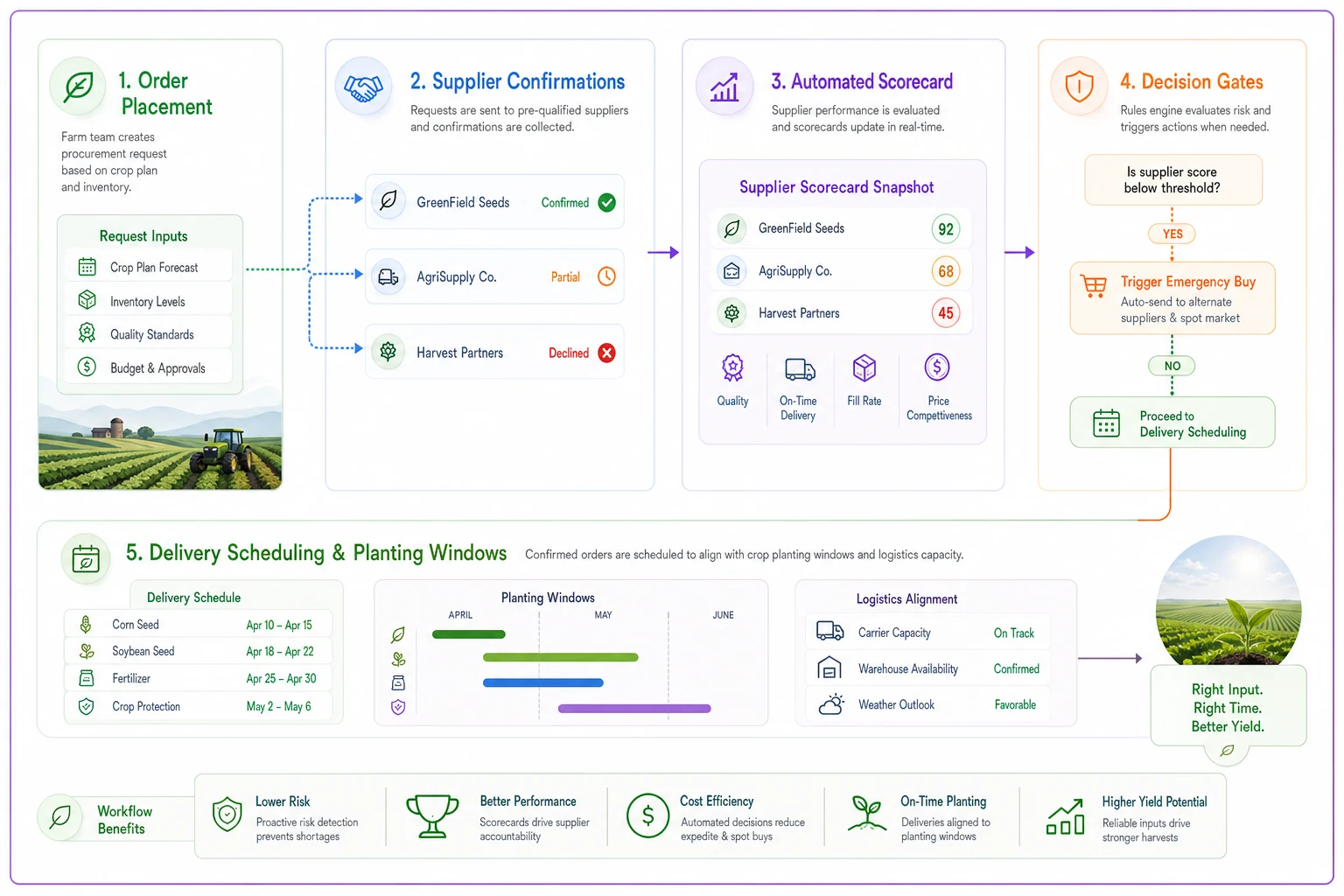
The more meaningful value is pattern recognition across seasons. Good operational software can surface that Supplier B consistently shorts potassium orders by around 8% in tight markets, or that emergence herbicide from a specific manufacturer has significantly higher return rates. Those patterns are hard to spot when you're manually flipping through records from three years ago — and they directly improve how you set buffer formulas going forward.
Centralized platforms also solve coordination problems. When your seed dealer, fertilizer supplier, and custom applicator all work from the same planting schedule and field maps, delivery timing naturally aligns with operational needs. The procurement side sees real-time field status while operations sees input availability — which eliminates most of the communication gaps that cause spring chaos.
Building procurement resilience for the long term
The best procurement systems evolve based on actual performance, not theoretical models. After each season, review what happened versus plan. Did buffers get used? Which suppliers hit their scorecards? Where did decision gates save money or cause problems?
A grain operation that has tracked procurement performance for several seasons builds institutional knowledge that survives personnel changes. When your experienced procurement manager retires, their replacement inherits documented supplier relationships, proven buffer formulas, and tested decision gates instead of starting from scratch.
Farms that run this kind of system tend to see input costs drop 8-12% through better timing and negotiation positioning. More importantly, planting delays from weather and logistics get cut roughly in half because inputs are positioned and ready when windows open.
The difference between farms that execute smoothly and those that scramble every spring isn't luck or better supplier relationships. It's having systematic procurement processes that anticipate problems and provide clear decision frameworks when things go wrong. That's what turns procurement from an annual headache into a genuine operational advantage.
The difference between farms that execute smoothly and those that scramble every spring isn't luck or better supplier relationships. It's having systematic procurement processes that anticipate problems and provide clear decision frameworks when things go wrong. That's what turns procurement from an annual headache into a genuine operational advantage.
Ready to revolutionize your farm management?
Join 500+ farms using Feldsly to boost yields, reduce waste, and streamline daily farm workflows.