


Most farms check weather apps constantly. Every phone has forecasts, every screen shows widgets, and someone's always looking at the radar before lunch. But when Tuesday's 70% rain chance becomes Wednesday's muddy fields, the scramble still happens. Crews show up with nowhere to work. Equipment sits idle while you're still paying operators. Harvest windows slam shut because nobody moved resources ahead of time.
The problem isn't forecast accuracy. Modern predictions nail it within 72 hours. The breakdown happens between seeing "40% precipitation chance Thursday" and actually knowing what that means—should you move tomorrow's fertilizer application? Call backup harvest crews? Shift to different fields entirely?
Farms that consistently dodge weather chaos don't have better meteorologists. They have frameworks that turn probability numbers into real decisions before the weather hits.
Why farms struggle with weather risk despite endless forecast data
Agricultural managers face a translation problem. Weather services pump out increasingly complex data—ensemble models, confidence intervals, precipitation percentages. Farm operations need yes-or-no answers. Do we spray today or wait? Call the harvest crew or send them home? Move equipment north or keep working south?
This creates what I call the "paralysis zone"—that 30% to 70% probability range where most farms freeze up. Below 30%, they ignore it. Above 70%, they react. But most operationally significant weather lives right in that uncertain middle, where being wrong either way costs real money.
A mid-size produce operation outside Sacramento subscribes to three different forecasting services and checks weather religiously. Last season they still lost roughly $47,000 in preventable weather-related costs. Not from surprise storms or unexpected freezes. From weather events they saw coming 48-72 hours out but had no systematic way to convert those probabilities into actual resource moves.
Their crew supervisor put it simply: "We see 60% rain for Wednesday. Do we prep for rain? Keep working? Split the difference? Usually we wait until Tuesday afternoon to decide, then scramble Wednesday morning when it's already too late."
Weather uncertainty cascades through everything
Weather uncertainty doesn't stay contained—it spreads through your entire operation. One ambiguous Thursday forecast impacts:
Take control of your farm’s productivity.
Feldsly helps you plan, track, and optimize every farming operation with precision.
- Centralized crop scheduling
- Resource & labor management
- Real-time weather alerts
No credit card required
-
Labor allocation across the week. Contract crews need 24-48 hour notice. Sending them home costs money. Keeping them during rain costs more. Most farms guess wrong both ways regularly, creating 15-25% labor cost overruns during transition seasons.
-
Equipment positioning and maintenance windows. Moving combines between fields takes hours. Equipment service requires dry conditions. When you react to weather instead of anticipating it, machines end up in wrong spots or miss maintenance windows, cutting seasonal efficiency 20-30%.
-
Input timing and effectiveness. Fertilizer applied 6 hours before surprise rain washes away. Pesticides sprayed in marginal conditions fail. Product timing decisions made without weather integration waste 10-15% of input costs annually through mistiming.
-
Market timing and quality preservation. Delaying harvest even 12 hours can drop produce from premium to standard grade. Rushing harvest ahead of uncertain weather means picking at wrong moisture levels. Price differences between optimal timing and weather-forced timing typically hit 8-20%.
Each weather-uncertainty decision amplifies the next mess. Labor uncertainty creates equipment positioning problems. Poor equipment placement forces input timing compromises. Suboptimal input timing leads to market timing disasters.
Building a weather risk framework that actually works
Working weather risk frameworks share three components most farms miss. They establish decision thresholds before weather events happen. They create specific response playbooks for different probability ranges. They map forecast numbers directly to resource allocation rules.
Decision thresholds: Converting percentages to actions
Start with clear probability thresholds for different operations. Not generic thresholds—specific ones based on your actual risk tolerance and cost structure.
Working threshold system for a diversified row crop operation:
Planting Operations
-
0-25% precipitation
Continue normal operations
-
26-45% precipitation
Pre-position backup equipment, stage supplies at field edges
-
46-65% precipitation
Shift to contingency fields, accelerate current field completion
-
66-100% precipitation
Suspend operations, redirect labor to equipment maintenance
Harvest Operations
-
0-20% precipitation
Standard harvest schedule
-
21-40% precipitation
Accelerate high-value/sensitive crops, defer robust varieties
-
41-60% precipitation
All-hands harvest sprint on critical fields
-
61-100% precipitation
Harvest suspension, prep for post-weather recovery
Chemical Applications
-
0-15% precipitation within 4 hours
Apply as scheduled
-
16-35% precipitation within 4 hours
Apply with sticker agents or defer
-
36-100% precipitation within 4 hours
Mandatory deferral
These aren't suggestions—they're automatic rules. When Thursday's forecast hits 55% rain, the harvest crew knows they're in sprint mode for critical fields. No meetings, no debates, no delayed decisions.
Contingency playbooks: Pre-planned responses for common scenarios
Every probability range needs an associated playbook—specific actions that trigger automatically when forecasts hit certain levels. These eliminate decision paralysis by pre-making choices when you have time to think clearly.
A vegetable operation in the Central Valley built playbooks for their five most common weather scenarios. Their "48-hour rain warning, 50-70% probability" playbook includes:
-
Immediate harvest of all market-ready leafy greens (rain damage risk)
-
Delay scheduled cultivation of fields 7-12 (soil compaction risk)
-
Advance plastic mulch laying in fields 13-15 (installation window closing)
-
Pre-stage harvest bins at field edges (minimize traffic if fields get wet)
-
Schedule equipment operators for compressed Tuesday schedule (maximize pre-rain productivity)
-
Contact wholesale buyers about potential Thursday delivery acceleration
When that forecast probability appears, these actions trigger automatically. The framework eliminates daily "what should we do?" meetings that eat precious response time.
Alert-to-action rules: Removing human delay from critical decisions
The fastest framework means nothing if nobody acts on it. Most farms get weather alerts but treat them as information rather than action triggers. Effective operations create alert-to-action rules that automatically start response protocols.
| Alert Type | Trigger Condition | Required Action | Response Deadline |
|---|---|---|---|
| Frost Warning | <34°F within 48hr | Activate frost protection protocol, notify irrigation team | Within 2 hours |
| Wind Advisory | >25mph sustained | Suspend spray operations, secure equipment | Within 1 hour |
| Heavy Rain Watch | >1.5" expected | Implement field drainage plan, position pumps | Within 6 hours |
| Heat Advisory | >95°F for 48hr | Adjust harvest schedule to early AM, increase irrigation | Within 12 hours |
These aren't notifications—they're commands. When the alert hits, the action happens. No interpretation required.
This workflow diagram shows how forecast inputs move through thresholds and playbooks to trigger automatic operational actions.
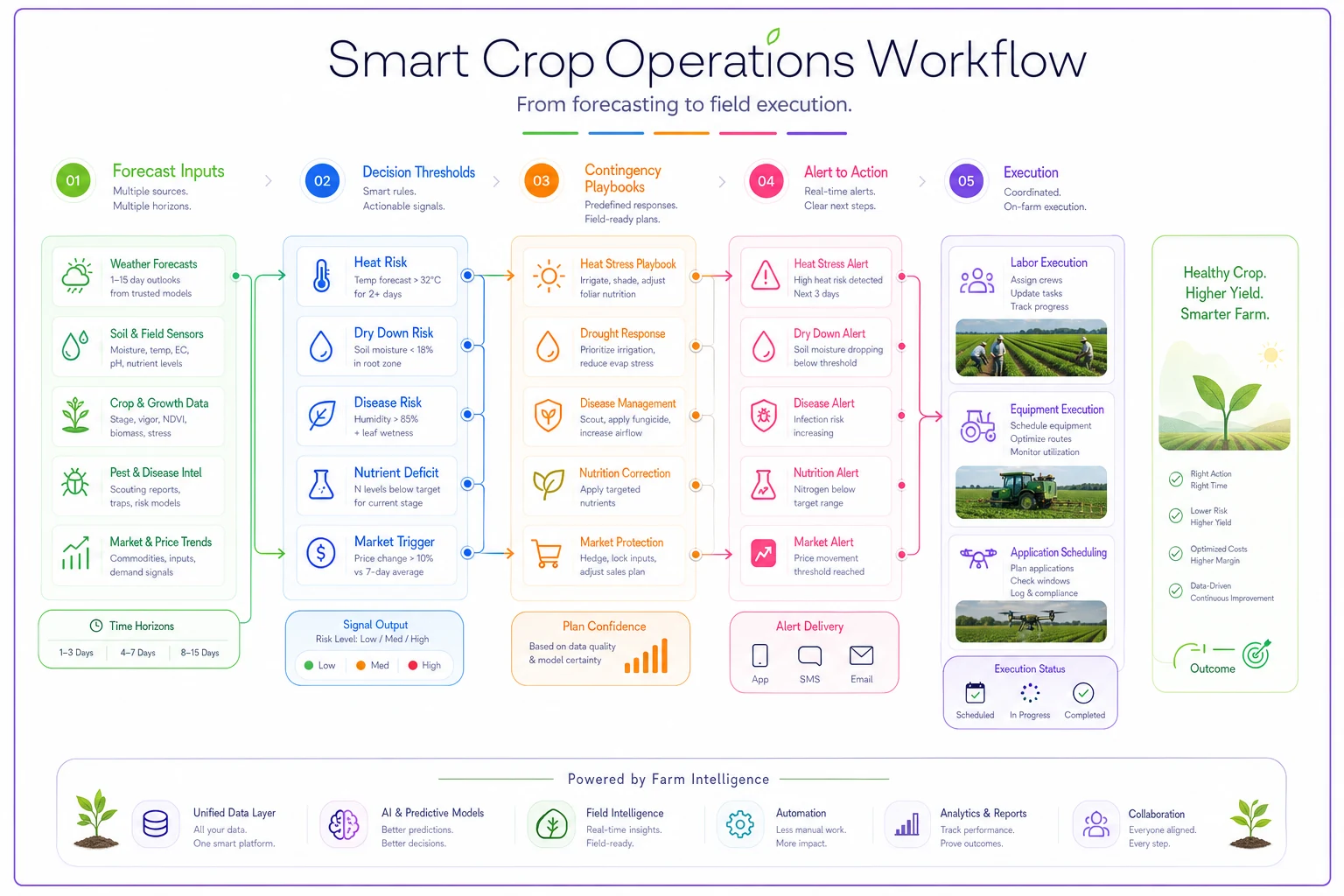
The visual ties the process together: forecasts become thresholds, thresholds map to playbooks, playbooks trigger actions.
Implementing forecast-based allocation without overwhelming your team
The biggest pushback against systematic weather frameworks comes from operational complexity fears. Managers worry about adding another decision layer to already complicated operations. But effective frameworks actually simplify decision-making by converting infinite possibilities into finite responses.
Start with your highest-impact, most weather-sensitive operation. For most farms, this means harvest timing or chemical application. Build thresholds and playbooks for just that one area first.
A strawberry operation started by focusing solely on harvest labor allocation based on rain forecasts. They established simple rules:
-
0-30% rain next day
Full crew
-
31-60% rain next day
70% crew, others to packing shed
-
61-100% rain next day
Skeleton crew only, majority to greenhouse work
After one season, this single framework element saved them approximately $32,000 in labor costs through better allocation. They then expanded to irrigation scheduling, then spray timing, building complexity gradually as each component proved itself.
Start with the single highest-impact process and prove value before expanding to others.
The staged approach keeps teams from feeling overwhelmed and lets the operation adapt processes incrementally.
Common framework failures and how to prevent them
Most weather risk frameworks fail for predictable reasons.
-
Over-complexity kills adoption. Frameworks with seventeen probability bands and forty-three response protocols never get used. Start with 3-4 simple thresholds and basic responses. Add complexity only after the simple version becomes habit.
-
Ignoring forecast horizon accuracy. A 7-day forecast showing 40% rain has vastly different accuracy than tomorrow's 40% forecast. Frameworks must weight responses based on forecast timing. Generally, only forecasts within 72 hours should trigger major operational changes.
-
Failing to account for forecast model variance. Different weather services use different models with different biases. One service might consistently overpredict precipitation while another runs conservative. Track your primary forecast source's actual accuracy and adjust thresholds accordingly.
-
Not considering sequential weather patterns. A 50% rain chance after three dry weeks requires different response than 50% chance after a wet period. Soil moisture, field conditions, and crop stage all affect how the same forecast should trigger different actions.
Understanding these failure patterns helps build more robust systems from the start.
Technology's role in scaling weather response systems
Manual weather monitoring works for simple operations but breaks down as complexity increases. A 500-acre farm might track three weather variables across two field zones. A 5,000-acre operation might need twelve variables across ten distinct microclimates.
Modern operational platforms can ingest multiple forecast sources, apply operation-specific thresholds, and automatically trigger response protocols based on pre-set rules. The transformation happens when weather response shifts from human-initiated to system-initiated. Instead of someone checking forecasts and deciding whether to act, the system monitors continuously and alerts only when action thresholds are crossed. This removes both delay and decision fatigue from weather response.
Some operations have built sophisticated weather response capabilities into their farm management platforms. These systems track forecast evolution, comparing Tuesday's forecast for Friday against Wednesday's forecast for Friday, identifying trend direction and confidence changes. When forecast confidence crosses certain thresholds, the system automatically adjusts resource allocation schedules.
Technology doesn't make weather decisions better—it makes them more consistent. The same threshold triggers the same response every time, removing variability that comes from human interpretation and fluctuating risk tolerance.
When forecast-driven frameworks make sense (and when they don't)
Not every agricultural operation benefits equally from systematic weather frameworks. Understanding where these systems provide maximum value helps prioritize implementation effort.
-
High-value crop operations see immediate returns from weather frameworks. When a single day's harvest timing difference means thousands in revenue variation, the framework pays for itself quickly. Specialty vegetables, berries, and tree fruit operations typically see 15-25% reduction in weather-related losses within the first season.
-
Operations with inflexible labor benefit significantly. If your workforce requires 24-48 hour scheduling notice, weather frameworks become essential. Contract harvesting crews, specialized equipment operators, and seasonal workers all require advance planning that reactive weather response can't provide.
-
Farms with tight market windows need systematic weather response. If you're selling into programs with specific delivery requirements or quality specifications, weather-forced delays or quality issues can mean losing entire contracts. Framework-based response helps maintain consistency despite weather variability.
-
Extensive grazing operations with flexible stocking rates often have enough built-in buffer that formal weather frameworks provide marginal value. If you can easily defer decisions by weeks without significant impact, the framework overhead might not justify benefits.
-
Highly diversified operations with natural risk hedging might find comprehensive frameworks overwhelming. If weather that damages one enterprise benefits another, your built-in diversification might provide adequate risk management without formal frameworks.
Use this guidance to prioritize where to implement thresholds and playbooks first.
From reactive scrambling to proactive weather management
The shift from reactive to proactive weather management fundamentally changes how farms operate. Instead of weather being a constant source of uncertainty and disruption, it becomes just another operational variable with known responses.
A Pacific Northwest berry farm described their transformation: "We used to have panic meetings every time rain was forecast during harvest. Now the forecast triggers automatic protocols. Our harvest supervisor knows exactly when to call extra crews, our packing shed knows when to expect surge volume, and our sales team knows when to alert buyers about potential delivery changes. Weather still happens, but the chaos is gone."
The financial impact extends beyond direct cost savings. Banks and insurers increasingly recognize systematic risk management as a credit positive. Buyers value suppliers who can maintain consistency despite weather challenges. Workers prefer operations where weather doesn't create constant schedule uncertainty.
Most importantly, removing weather-induced chaos frees management attention for actual improvement rather than constant crisis response. When you're not scrambling to respond to every forecast, you can focus on optimizing the operation itself.
Building your weather risk operational framework
Creating an effective weather risk operational framework doesn't require perfection—it requires starting. Pick your single most weather-disrupted process. Establish simple thresholds. Create basic playbooks. Implement clear alert-to-action rules.
Track what works and what doesn't. Adjust thresholds based on actual outcomes. Add complexity gradually as simple systems become automatic. Within a season, you'll have transformed weather from an unpredictable disruption into a manageable operational input.
Farms that thrive despite weather volatility aren't lucky. They're systematic. They've recognized that weather risk isn't really about weather—it's about having clear, automatic responses to forecast information. Once you build that framework, weather becomes just another data input that triggers known responses rather than a source of constant operational uncertainty.
The alternative—continuing to react to each forecast as a new crisis—ensures that weather remains your operation's most persistent source of inefficiency and stress. Weather isn't becoming more predictable, so the only variable you can control is how your operation responds to forecast information. Make that response systematic, and weather shifts from an operational weakness to a competitive advantage against farms still stuck in reactive mode.
Ready to revolutionize your farm management?
Join 500+ farms using Feldsly to boost yields, reduce waste, and streamline daily farm workflows.