

Most of the wasted sensor money on farms doesn't come from buying bad sensors. It comes from buying the right sensors the wrong way — too many at once, on contracts that lock you into a vendor before you know the data is even useful, with no agreed-upon rules for what happens when a node goes dark in July. The hardware isn't the problem. The procurement process is.
If you've already got probes rotting in a back-forty field that nobody checks, you know the feeling. The invoice cleared. The dashboard looked great in the demo. Then the data got flaky, the crew stopped trusting it, and now you're paying a subscription fee for telemetry you ignore. That's not a technology failure. That's a buying failure that happened six months earlier.
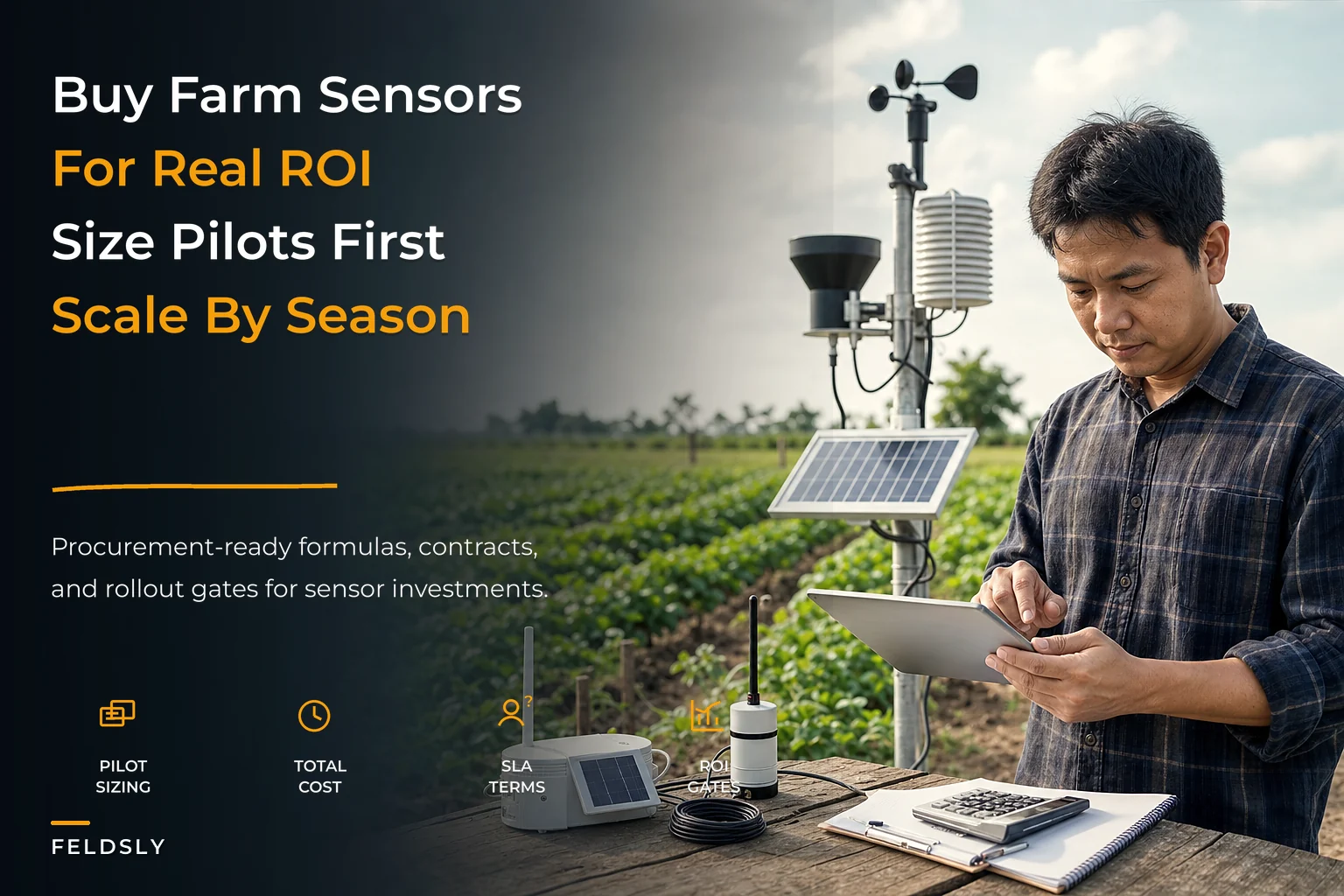
This playbook is built around that gap. Pilot sizing, total cost of ownership, the SLA language that actually protects you, and a staged rollout logic that ties your spend to your seasons instead of to a sales rep's quota. The goal is simple: don't scale a sensor network until it has earned the right to scale.
Why farms overspend on sensors (and it's almost never the price tag)
The overspend pattern is pretty consistent across operations of different sizes, and it rarely shows up as "we paid too much per unit." It shows up as:
-
Buying for the whole operation before proving value on one field. Someone greenlights 80 soil nodes across twelve fields because the per-unit price dropped at volume. Nine months later, half the fields never changed a single irrigation decision based on that data.
-
No exit. The contract auto-renews, the data integration was custom, and ripping it out costs more than keeping the dead system alive.
-
Ignoring the real cost center — maintenance and labor. The sensor costs $180. Sending someone out to re-seat it, replace a battery, and re-calibrate it four times a season costs far more over three years.
The deeper issue is that sensors look like a capital purchase but behave like an operating liability. You don't buy them once — you feed them. Batteries, connectivity, calibration, QA checks, someone's attention, every single season. Treat the purchase like you're hiring a part-time seasonal employee that never quits, and your procurement instincts sharpen immediately.
There's also a trust dynamic that procurement rarely accounts for. The moment a crew catches a sensor lying — a moisture reading that says the field is fine when the crop is clearly stressed — they stop looking at all of them. One bad node can poison confidence in a whole network. That's why deployment quality matters as much as the buy, and it's worth reading the companion piece on building an operational soil-moisture sensor network with QA and maintenance baked in before you sign anything.
Pilot-sizing recipes: how small is small enough to learn something
The two most common pilot mistakes are opposite extremes. Some farms buy three sensors, get noisy inconclusive data, and declare the whole category useless. Others "pilot" 60 units across the operation — which isn't a pilot, it's a full rollout wearing a pilot costume, with full rollout risk.
Take control of your farm’s productivity.
Feldsly helps you plan, track, and optimize every farming operation with precision.
- Centralized crop scheduling
- Resource & labor management
- Real-time weather alerts
No credit card required
A real pilot is sized to answer one decision question with enough statistical breathing room to trust the answer, and small enough that killing it costs nothing emotional or financial.
Here are working recipes by sensor type:
Soil moisture pilot
-
1 to 2 fields, chosen for contrast (one problem field, one reliable field)
-
3 to 5 nodes per field, placed at different soil zones, not clustered
-
One full irrigation cycle minimum, ideally a partial season
-
Decision question
Did this data change at least one irrigation call, and was that call correct?
Weather / microclimate pilot
-
1 station per distinct microclimate, not per field
-
Run against your nearest public weather source to measure the delta
-
Decision question
Is the on-farm reading different enough from free public data to justify the cost? If the delta is trivial, you don't need the hardware.
Equipment / machinery telemetry pilot
-
2 to 3 machines, ideally your highest-hour and your most failure-prone units
-
One peak window (planting or harvest)
-
Decision question
Did it flag a problem early enough to change an outcome?
Write the decision question down before you buy.
The non-obvious rule: a pilot that doesn't change a decision is a failed pilot, even if the data was accurate. Accurate-but-ignored data is the most expensive kind, because it feels like success on the dashboard while delivering zero operational return. Write the decision question down before you buy. If you can't articulate what action the data would trigger, you're not ready to pilot.
The TCO calculator most farms skip
Per-unit price is the number vendors quote and the number that matters least. Here's a three-year total cost of ownership frame that gets you closer to the truth.
| Cost component | What it actually includes | Typical share of 3-yr cost |
|---|---|---|
| Hardware | Sensor, enclosure, mounting | 20–30% |
| Connectivity | Cellular/LoRa fees, gateway, data plan | 10–20% |
| Platform / software | Dashboard subscription, data storage, integrations | 15–25% |
| Maintenance labor | Battery swaps, re-calibration, re-seating, troubleshooting | 25–40% |
| Data QA & reconciliation | Someone checking the data is real and usable | 10–15% |
What surprises people every time: hardware is usually the smallest line item over three years. Maintenance labor and data QA often dwarf it. A probe that's cheap to buy but fussy to maintain can easily cost more over its life than a pricier, rugged unit that just works.
A rough worked example. Say you're pricing a 20-node soil moisture deployment:
-
Hardware
20 nodes at around $170 each = ~$3,400
-
Connectivity + gateway
roughly $900/year = ~$2,700 over three years
-
Platform subscription
about $1,200/year = ~$3,600
-
Maintenance labor
figure 2 touches per node per season, ~20 min each, at loaded labor rates — call it $2,500–$3,500 over three years
-
QA time
a half-day a month of someone reconciling and sanity-checking = another $2,000–$3,000
The $3,400 of hardware turned into roughly $14k–$16k all-in. If you only budgeted the hardware line, you underfunded the real deployment by 4x — which is exactly how sensor networks end up half-maintained and distrusted. Underfunding the maintenance line is the single most common root cause of the sensor graveyard.
SLA and SLO clauses that actually protect you
This is the part most farm procurement teams skip hardest, because the contract shows up as a PDF and everyone's thinking about planting. But the service-level language is where you either keep leverage or hand it over. You don't need a lawyer to improve these — you just need to know what to ask for.
Here are the clause areas that matter most, with sample language you can adapt:
Uptime / data availability
"Vendor guarantees node-level data availability of no less than 95% measured monthly per device. Any node reporting less than 85% availability in a calendar month triggers vendor-funded remediation within 10 business days."
Set the threshold per node, not network-wide. A 95% network average can hide three dead sensors in the fields you care about most, because the healthy nodes carry the average.
Data format and portability
"All raw and processed data shall be exportable in open, non-proprietary formats (CSV/JSON) on demand, with no additional fee. Vendor shall provide a documented data schema and API access for the duration of the agreement."
This clause alone prevents the lock-in trap. If you can get your data out cleanly, switching vendors stays an option — which keeps the vendor honest. How your data stays usable across vendors connects directly to the staged data governance work that makes any of this ROI-positive. Ungoverned data from twenty sensors is just twenty new ways to be confused.
Retention and deletion
"Vendor shall retain historical data for a minimum of 36 months and provide a full historical export upon contract termination at no cost. Upon termination, vendor shall delete farm data within 30 days and provide written confirmation."
Multi-year data is where sensor ROI actually compounds — you can't see a soil trend or a machine degradation curve from four months of readings. Losing your history when you switch vendors quietly destroys the value you spent two seasons building.
Calibration and accuracy standards
"Devices shall maintain stated accuracy within ± [X] tolerance. Vendor shall provide calibration procedures and support, and replace units failing to hold calibration within warranty at no cost."
A quick checklist to run every contract through before signing:
-
[ ] Per-node uptime guarantee, not just network average
-
[ ] Open data export in non-proprietary format, free, anytime
-
[ ] Documented schema and API access
-
[ ] 36-month minimum data retention
-
[ ] Clean data export and deletion terms on exit
-
[ ] Defined accuracy tolerance and calibration support
-
[ ] Remediation timelines with teeth (funded by vendor, not you)
-
[ ] No auto-renewal longer than 12 months without an opt-out window
You don't need a lawyer to improve these — you just need to know what to ask for.
Staged rollout decision matrix tied to seasonality
Even after a pilot succeeds, dumping the full network in all at once is a mistake. The timing of your scale-up should track your season, because a sensor rollout during a peak window competes with actual field work for the same crew hours — and loses.
Here's the staged logic:
Stage 1 — Pilot (off-peak): Install and validate during a low-pressure window so nobody's fighting planting or harvest for attention. This is when you prove the decision question.
Stage 2 — Expand to high-value fields (shoulder season): Roll out to the fields where a wrong decision costs the most — your highest-value crop, your most variable-yield field, your irrigation-constrained ground. Not every field. The ones where data changes expensive decisions.
Stage 3 — Full operational deployment (next off-peak): Only after Stage 2 has survived a real season. By now you know the real maintenance burden and your TCO numbers are grounded in reality, not a sales sheet.
A simple decision matrix for when to advance a stage:
| Condition | Advance? | Hold / Reconsider |
|---|---|---|
| Pilot changed ≥1 correct decision | ✅ advance | — |
| Maintenance burden matched estimate | ✅ advance | ❌ hold if 2x over |
| Crew trusts and checks the data | ✅ advance | ❌ hold if ignored |
| Entering peak window | ❌ wait | hold install to off-peak |
| Data export/QA still messy | — | ❌ fix before scaling |
The seasonality piece is what most farms get wrong. They buy in winter when the deal is good, then try to deploy and learn the system during the exact weeks they have zero spare attention. Procurement timing and deployment timing are two different decisions. Buy when the price is right; deploy when the calendar is quiet.
This diagram shows the staged rollout workflow.
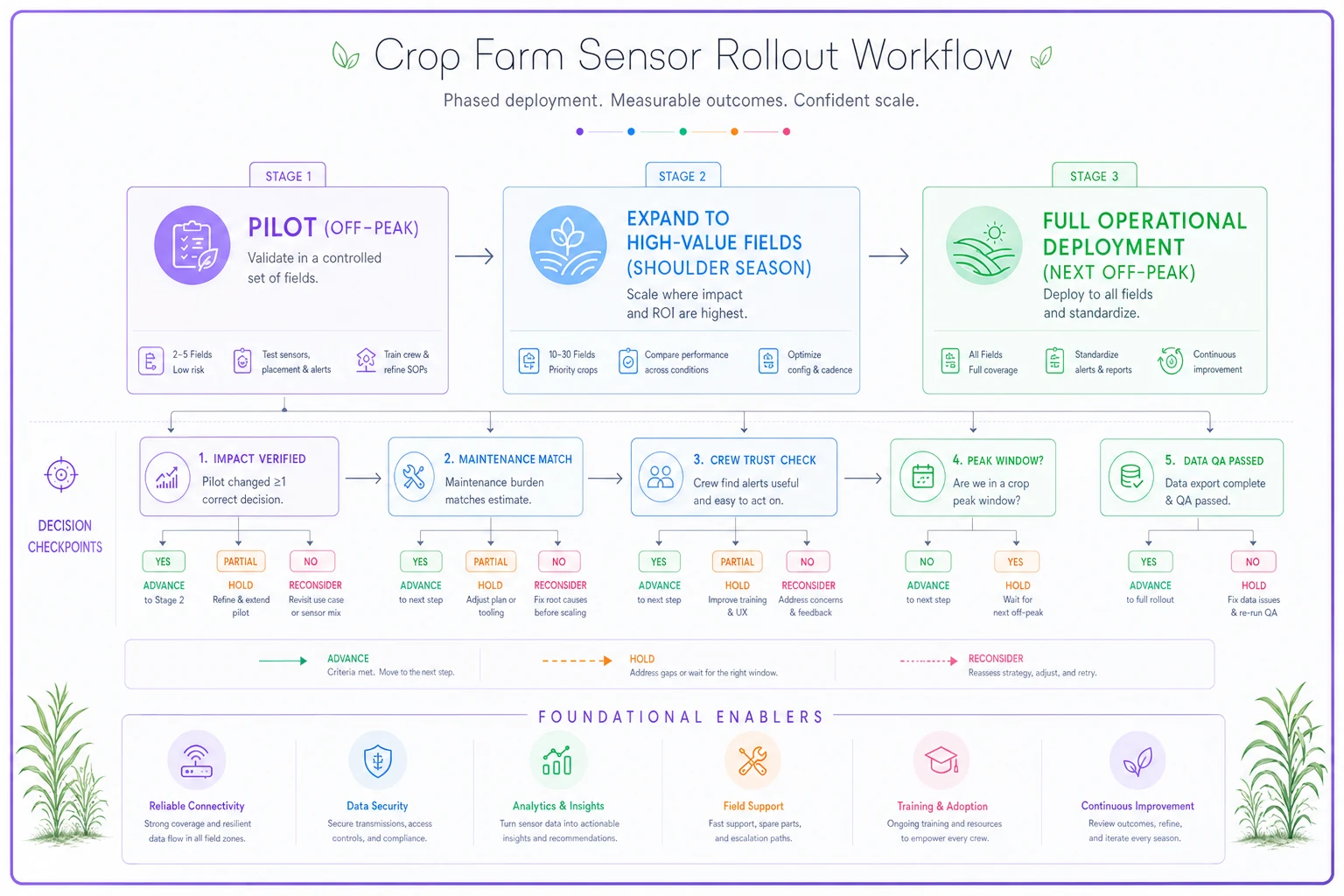
Procurement timing and deployment timing are two different decisions. Buy when the price is right; deploy when the calendar is quiet.
When this makes sense — and when to walk away
When a sensor investment genuinely pays off:
-
You have a recurring decision (irrigation, frost protection, equipment servicing) where guessing currently costs real money
-
Your fields have enough variability that averages hide problems
-
You have — or will fund — the labor and QA to maintain the network
When it's a bad idea:
-
You can't name the decision the data would change
-
Nobody owns the maintenance, so it'll decay by season two
-
The fields are uniform enough that one walk-through tells you as much as 15 nodes
-
You're buying because a neighbor did, not because a decision needs it
Operations with no data governance and no one accountable for sensor upkeep should probably hold off entirely. If telemetry currently goes nowhere and nobody checks it, adding more hardware adds more noise, not more insight. Fix the ownership and security side first — the farm IoT security and resilience playbook covers the groundwork that keeps a growing sensor network from becoming a liability.
A real scenario: a mid-size irrigated operation
A diversified vegetable and row-crop operation — around 1,400 acres across nine fields — wanted soil moisture sensing after a dry year burned them on two late irrigation calls. The initial plan, pushed by a vendor, was 70 nodes across all nine fields on a three-year contract. Quoted hardware was around $12k, with the honest all-in three-year number closer to $45k–$50k once connectivity, platform, and maintenance got counted properly.
Instead they piloted. Two fields — one chronically variable, one reliable — with four nodes each, through one irrigation season. Total pilot cost landed under $3k including the subscription window.
The result wasn't a clean fairy tale. On the reliable field, the data basically confirmed what the manager already knew by feel — no decision changed. On the variable field, the sensors caught a dry zone the surface looked fine over, and it shifted two irrigation calls that season. The manager's honest read: sensors were worth it on variable ground and a waste on uniform ground.
So the full rollout got cut from nine fields to four — the genuinely variable ones. Three-year spend came in around $22k–$25k instead of $48k, with better-maintained nodes because the crew only had half as many to babysit. Fewer sensors, better data, roughly half the cost, and a network the crew actually trusted because it wasn't sprawled across fields that never needed it.
The lesson isn't "buy less." It's that the pilot told them where sensing paid off, and the procurement structure let them act on that instead of being locked into the big number.
Sensor ROI on a farm is decided mostly before the hardware ever ships — in how you size the pilot, how honestly you count the three-year cost, what your contract lets you walk away from, and whether you scale on your season's terms or the vendor's. Get those right and even modest hardware earns its keep. Get them wrong and even excellent sensors become expensive distrust.
Start with one decision question on one or two contrasting fields. Count the full cost, especially the maintenance and QA labor that never shows up in the quote. Hold out for per-node uptime, open data, and clean exit terms. Stage your rollout to your calendar, not to a discount. Do that, and you stop funding sensor graveyards and start funding decisions that actually change what happens in the field.
Ready to revolutionize your farm management?
Join 500+ farms using Feldsly to boost yields, reduce waste, and streamline daily farm workflows.