

Most farm managers didn't sign up to run a network. You signed up to grow crops. But somewhere in the last decade, your operation quietly turned into a small tech company that also happens to plant corn. Moisture probes, VRA controllers, GPS-guided planters, grain-bin monitors, telematics on the sprayer, cameras on the shop, and a farm office laptop still running an operating system from three presidents ago.
That's the real problem. Not that hackers are specifically hunting your 2,000-acre operation — most aren't. It's that your connected gear grew faster than anyone's ability to track it, and now nobody can answer basic questions like "how many devices are actually on our network?" or "who has the login to the irrigation controller?" or "if the grain-drying system got locked up during harvest, what would we actually do?"
This playbook is built around that gap. It's not a cybersecurity lecture. It's an operations document — the kind you can hand to a farm manager who has never heard the word "firewall" and have them still walk away with a working plan. We'll cover the artifacts you actually need: a critical-endpoint inventory, a dead-simple segmentation approach, contractor and vendor access rules, incident-triage templates, and a 12-month resilience calendar that lines up with your planting and harvest windows instead of ignoring them.
Why Farm Systems Break in Ways That Surprise People
The instinct is to think about security as "keeping bad guys out." That framing misses how farm tech actually fails. In real operations, the damage almost never comes from a targeted attack. It comes from fragility that's been building for years:
-
A vendor pushes a firmware update mid-season and half your soil sensors go dark.
-
The one person who set up the Wi-Fi at the pump house left for another job and took the passwords with him.
-
Ransomware lands on the office computer through an email attachment, and because everything shares one flat network, it also reaches the machine controlling grain aeration.
-
A contractor plugs a laptop into your network to configure a new planter monitor, and that laptop was carrying something.
None of these require a sophisticated adversary. They require a system with no inventory, no separation, and no plan. The connected devices on a modern farm are chained together in ways nobody mapped, and when one link fails during a critical window, the cost isn't measured in data — it's measured in acres you couldn't plant or grain you couldn't dry.
The trigger event is almost always small. The blast radius is what hurts. A single compromised laptop should be an annoyance, not a harvest-stopping event. The whole point of a farm IoT security playbook is to shrink that blast radius so that when something breaks — and it will — it stays contained.
What Actually Changes as You Scale
A 400-acre operation with a handful of sensors has a different risk profile than a 6,000-acre operation running multiple crews, leased ground, and three brands of equipment all talking to different cloud platforms. Here's the progression most farms move through, and where things quietly go wrong.
Take control of your farm’s productivity.
Feldsly helps you plan, track, and optimize every farming operation with precision.
- Centralized crop scheduling
- Resource & labor management
- Real-time weather alerts
No credit card required
| Stage | Typical setup | Where it breaks |
|---|---|---|
| Small / single operator | One network, shared passwords, a few sensors | Everything on one flat network; no backups of configs |
| Growing / 2–4 crews | Multiple vendor platforms, telematics, office PCs | Nobody owns device inventory; vendor logins scattered |
| Multi-field / leased ground | Remote sites, cameras, grain systems, contractors | Contractor access never revoked; remote sites unmonitored |
| Large / partly integrated | Data flowing between platforms, some automation | One breach touches many systems; no incident plan |
What most managers miss: risk doesn't grow in a straight line. It jumps every time you add a connection between systems — not just a new device. When your agronomy platform starts pulling data directly from your equipment telematics, you've created a pathway that didn't exist before. Growth in integration is where the real exposure hides, and it's exactly why staged, deliberate data governance matters. If you're thinking about connecting platforms as you scale, the logic behind staged data governance for AI on mid-size and large farms applies directly here — control the connections before you try to exploit them.
If you're thinking about connecting platforms as you scale, the logic behind staged governance applies directly: control the connections before you try to exploit them.
Artifact 1: The Critical-Endpoint Inventory
You can't protect what you can't list. This is the foundational document, and most farms don't have it. Not a spreadsheet buried somewhere — a living inventory that someone actually owns and updates.
Keep it simple. For every connected device, capture:
-
Device name / what it does (e.g., "North pivot controller")
-
Location (field, shop, office, bin site)
-
Vendor / brand
-
How it connects (cellular, Wi-Fi, wired, Bluetooth)
-
Who has login access (names, not "the office")
-
How critical it is during peak windows (High / Medium / Low)
-
What happens if it goes down (one sentence)
That last column is the one that changes conversations. When you write "if this goes down during harvest, we can't monitor grain temp and risk spoilage in three bins," the device stops being an IT line item and becomes an operations priority.
One mid-size operation started this inventory expecting maybe 20 devices. They found 47. Eleven were things nobody remembered installing — old cameras, a weather station from a trial that ended two seasons ago, a router at a leased field still broadcasting an open network. That open router had been sitting there for over a year. The inventory didn't fix anything by itself, but it turned "we think we're fine" into a real list of decisions that actually needed to be made.
Artifact 2: Minimal Network Segmentation (Without the Jargon)
Segmentation sounds technical. The idea isn't. It just means: don't put everything on one network where a problem in one place can reach everything else.
Think of it like keeping your seed, chemicals, and fuel in separate buildings. If one catches fire, you don't lose all three. Same logic applies to your networks.
Here's the minimal version most farms can actually implement:
-
Office / business network — laptops, accounting, email. This is where most infections start, so it should be the most isolated from operational gear.
-
Operational / device network — sensors, controllers, telematics, grain systems. This runs your physical operation and should never share space with email-checking laptops.
-
Guest network — for contractors, visitors, family phones. Completely walled off from the other two.
Three networks. That's it. A competent local IT contractor can set this up on decent equipment in a day. The goal isn't fortress-level security — it's making sure ransomware on the office PC physically cannot jump to the system controlling your irrigation or aeration.
Label the physical network ports or SSIDs on-site so crews and contractors can consistently plug into the correct network without guessing.
The mistake people make is putting operational devices on the same network as everyday computers "because it was easier to set up." It always is easier — right up until it isn't. Once you've got even a rough version of your endpoint inventory, sorting each device into one of these three buckets takes an afternoon, not a technical degree.
Artifact 3: Contractor and Vendor Access Rules
This is the single most ignored risk on connected farms. Precision-ag techs, equipment dealers, irrigation installers, and software vendors all get access to your systems — and almost nobody tracks it, and almost nobody revokes it.
-
No shared "everybody" logins. Each vendor or contractor gets their own credentials so you can see who did what and cut off one without disrupting others.
-
Access is time-boxed. A tech configuring a planter monitor gets access for the job, not forever. Put an expiration on it.
-
Log it in the inventory. When you grant access, note who, what system, and when it should end.
-
Guest network only for their laptops. Nobody plugs an outside device into your operational network. Ever.
-
Off-boarding checklist. When a relationship ends — or a season ends — revoking access is a standard step, same as returning keys.
The uncomfortable version of this: one farm switched precision-ag providers, and the old provider's login still worked eight months later. Not because anyone was malicious — because revoking it was never anyone's job. A simple rule that access gets reviewed at season-end would have caught it. Boring, administrative work that prevents a genuinely bad day.
Artifact 4: Incident-Triage Templates
When something goes wrong, the worst thing that can happen is six people standing in the shop arguing about what to do while the grain heats up. Triage templates exist so the first 30 minutes are decisive instead of chaotic.
Build one card per likely scenario. Keep them one page. Keep them printed — because if your network is down, you can't open a file on the network.
A useful triage card has four parts:
-
What you're seeing (symptoms in plain language
"grain monitor won't load, showing errors")
-
First actions (what to physically do right now — disconnect this, switch to manual on that)
-
Who to call (name, number, and what they're responsible for)
-
Fallback plan (how we keep operating manually while it's down)
That fallback line matters more than anything technical. If your telemetry goes dark, your crew needs to know how to capture data by hand and reconcile it later so you don't lose a day of records. This is exactly the discipline covered in the approach to manual capture fallbacks when telemetry fails — a security incident is just another reason your automated data stream might stop, and the response is the same: keep operating, capture manually, reconcile after.
The scenarios worth building cards for, at minimum:
-
Ransomware / office computers locked
-
Grain or irrigation control system unresponsive during a critical window
-
Sensor network offline (widespread)
-
Suspicious access / stolen or lost device with credentials
-
Vendor cloud platform outage (yes, their outage is your problem too)
Build the cards, print them, and put them somewhere people will actually find them when things are going sideways. A binder in the shop works fine.
Artifact 5: The 12-Month Resilience Calendar
Here's what separates a real farm playbook from generic IT advice: timing. You do not want to be doing a firmware update the week before planting, and you don't want to discover your grain-monitoring system needs a security patch on the first day of harvest.
[WORKFLOW GRAPH: Farm resilience calendar — maintenance and lockdown windows mapped against the crop season, showing update-safe periods in winter and pre-season, freeze windows before planting and harvest, and monitoring-only phases during critical operations]
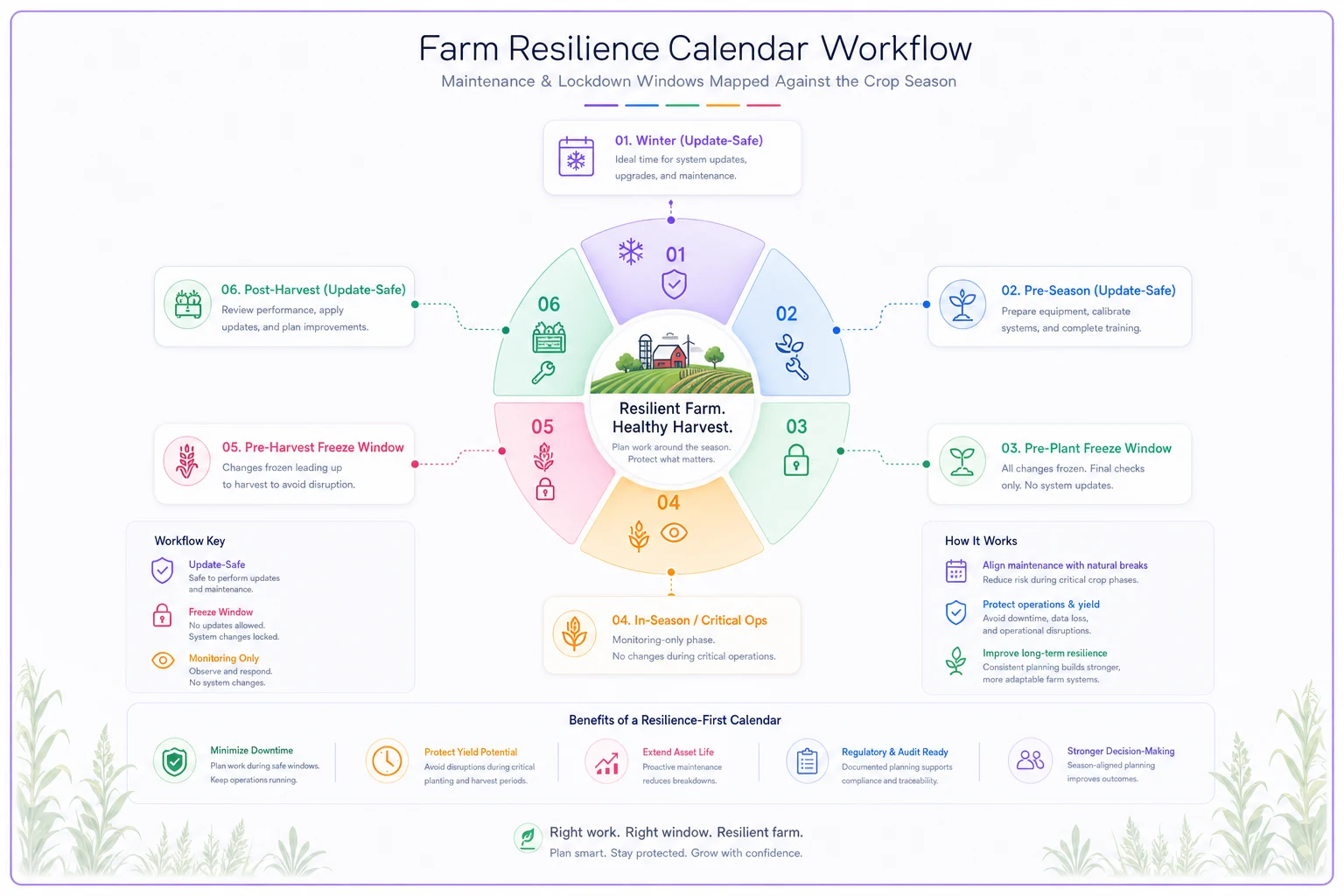
Winter (off-season)
-
Full endpoint inventory review — add new, remove retired devices
-
Review and revoke stale vendor/contractor access
-
Apply firmware and software updates while nothing's at stake
-
Test your triage cards — actually run through one scenario with the crew
Early spring (pre-planting)
-
Freeze major updates 3–4 weeks before planting starts
-
Verify backups of device configurations exist and are current
-
Confirm remote-site connectivity and passwords before crews scatter
Planting window
-
No non-critical changes. Monitoring only.
-
Triage cards printed and posted in the shop and office
Summer (growing season)
-
Mid-season access review (catch the temp contractors from spring)
-
Check on remote sensor and camera sites
Pre-harvest
-
Freeze updates again 3–4 weeks out
-
Verify grain-system and monitoring configs are backed up
-
Walk the crew through the harvest-specific triage card
Harvest window
-
Lockdown mode. Nothing changes unless it's broken.
The principle underneath all of this: change is risk, and risk is only acceptable when you have time to recover. Pushing updates during a slow week means a botched update costs you an afternoon. The same update during harvest can cost you a grade on your grain.
When This Level of Effort Makes Sense — and When It Doesn't
Not every operation needs all five artifacts fully built out on day one.
This full playbook makes sense when:
-
You run multiple connected systems from different vendors
-
You have remote sites, leased ground, or grain systems with automated controls
-
More than one or two people touch your technology
-
A system going down during a critical window would cost real money
You can start lighter when:
-
You're a single operator with a handful of sensors
-
Almost nothing is automated in a way that would stop work if it failed
In that case, just do the endpoint inventory and the contractor access rules. Those two alone eliminate most of the avoidable risk.
If you don't have connected control systems yet — no automated irrigation, no networked grain aeration, no telematics — you don't need three networks and triage cards. You need the inventory and basic password hygiene, and you build the rest as you add technology. The playbook scales with your connectivity, not your acreage.
A Real Scenario
A roughly 3,200-acre corn and soybean operation running two crews had grown its tech stack piecemeal over about six years — moisture sensors, telematics on four machines, networked grain-bin monitoring, and a farm office handling everything from payroll to agronomy data. Everything sat on one network. No inventory. Shared passwords written on a note taped inside a cabinet.
The wake-up call was small: the office computer got hit with ransomware through an email attachment during late summer. Because everything shared one flat network, the grain-monitoring dashboard also went unreachable for the better part of two days right as they were starting to fill bins. No grain was lost — the crew went back to manual temperature checks — but two days of scrambling, plus paying a local IT shop to rebuild the office machine, ran them somewhere in the range of $4k–$6k all in, not counting the stress.
Over the following winter they built the basics: a 40-plus device inventory, split into three networks, wrote per-scenario triage cards, and revoked access for two vendors who no longer worked with them. The next season, when a sensor vendor's cloud platform went down, the crew pulled out the triage card, switched to manual capture for the day, reconciled the data that evening, and kept going. Same category of disruption, completely different outcome — because the blast radius was contained and everyone knew their move.
The difference wasn't better technology. It was having a system.
The Bigger Point
Farm technology isn't going to get simpler. Every season adds another connected device, another cloud platform, another integration between systems that used to be separate. The operations that handle this well aren't the ones with the most sophisticated security setups — they're the ones who treat their connected gear the same way they treat their equipment: inventoried, maintained on a schedule, with a clear plan for when something breaks.
The five artifacts here — inventory, segmentation, access rules, triage cards, and a resilience calendar — are deliberately low-tech to build and maintain. You don't need to become an IT expert. You need to bring the same operational discipline to your network that you already bring to your maintenance shop and your planting schedule.
Start with the inventory this winter. Once you can see everything you've got, the rest of the decisions get a lot easier to make.
Ready to revolutionize your farm management?
Join 500+ farms using Feldsly to boost yields, reduce waste, and streamline daily farm workflows.