


Most multi-field operations treat labor like weather — something that shows up, something you react to, something you complain about in the break room. The crews arrive late, someone quits two days into detasseling, the H-2A paperwork clears a week after you needed bodies in the field, and finance asks why the labor line blew past budget again.
The farms that don't live like this aren't luckier. They've stopped thinking about hiring and started thinking about a people operating model — a connected system where competency, surge capacity, certification, and the calendar all talk to procurement and finance before the season starts, not during it.
That's the whole point of this piece. Not "how to hire better." How the entire labor machine connects to money, timing, and the fields themselves — and where it quietly breaks when you grow.
Why labor breaks differently as you scale
A 400-acre operation can run labor on memory. The owner knows who's reliable, who can run the sprayer, who shows up hungover. The "system" is a guy named Dave and a group text.
Stretch that to 2,500 acres across six fields with staggered planting and three commodity windows, and Dave becomes a single point of failure. The real problem isn't that you need more people — it's that decisions about people now have to be made months before you can see the work, and in coordination with other departments running on completely different clocks.
The pattern repeats itself every spring. Labor planning runs on a gut clock, procurement runs on a supplier lead-time clock, and finance runs on a fiscal clock. Nobody synchronizes them. The farm commits to a planting sequence in February, locks in seed and chemical in March, then discovers in April that the crew it assumed would be there is 30% short because the certification gate for restricted-use pesticide handling wasn't scheduled until after the application window.
That's not a hiring failure. That's a systems failure. The pieces were never wired together.
The four parts of the system (and how they feed each other)
A functioning seasonal workforce operating model has four moving parts. Each one is useless alone. The value is entirely in how they connect.
Take control of your farm’s productivity.
Feldsly helps you plan, track, and optimize every farming operation with precision.
- Centralized crop scheduling
- Resource & labor management
- Real-time weather alerts
No credit card required
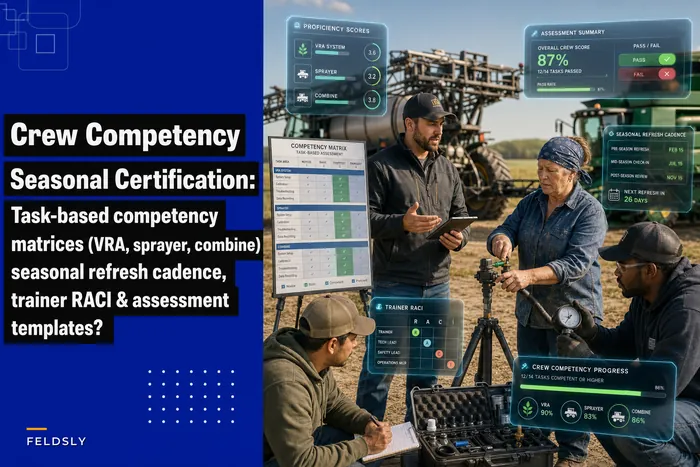
1. The competency pipeline. Your map of what skills exist, where, and at what depth. Not "we have 40 workers" — but "we have 6 people who can run variable-rate equipment, 4 who can be trusted with the grain cart during a tight moisture window, and 22 general-labor bodies who need supervision." If you haven't built this out yet, the crew competency matrix and seasonal certification program is the foundational layer everything else here sits on.
2. The surge pool. Your pre-vetted, pre-onboarded reserve of people you can activate fast — returning seasonal crew, a labor contractor relationship, a shared-crew arrangement with a neighbor, or an H-2A block you've already budgeted. The surge pool is what turns a two-week detasseling panic into a phone call.
3. Certification gates. Hard checkpoints where someone cannot do the work until a credential clears — pesticide applicator licensing, equipment sign-offs, heat-safety training, food-safety handling. Gates are where good labor plans die, because the credential takes longer than the hiring did.
4. The 12-month people calendar. The spine. Every crew need gets plotted against the agronomic calendar and against the procurement and finance decision windows. Without this, the other three float around disconnected.
Back-schedule certification gates early enough that procurement and finance can commit before surge windows.
The insight most farms miss: these aren't an HR concern. They're a procurement and finance concern that happens to involve people. When you treat your labor calendar as a sibling of your input-buying calendar and your cash-flow calendar, the whole thing stabilizes.
Wiring the people calendar to procurement and finance windows
This is where it gets concrete. Below is how the three calendars overlap for a mixed corn-soy-specialty operation.
| Month | Agronomic activity | People need | Procurement window | Finance window |
|---|---|---|---|---|
| Nov–Dec | Post-harvest, planning | Skeleton crew | Early seed/chem booking discounts open | Annual budget lock |
| Jan | Planning, repairs | Core crew + training | Equipment parts pre-orders | Labor budget approval |
| Feb | Certification season | Applicator recert, safety training | — | Surge-contract commitments |
| Mar | Pre-plant | Ramp core to ~60% | Final input delivery scheduling | Operating line draw |
| Apr–May | Planting (surge #1) | Full surge activation | Rental equipment holds | Peak cash outflow |
| Jun | Detasseling/scouting (surge #2) | Second surge pool | — | Mid-season reforecast |
| Jul | Irrigation, heat ops | Sustained full crew | — | — |
| Aug–Sep | Early specialty harvest | Surge #3 begins | Harvest labor contracts finalize | Harvest cash timing |
| Oct | Main harvest (surge #4) | Maximum headcount | Drying/storage capacity | Revenue inflow starts |
Look at February. The certification gate sits two months before the first surge activation and right next to the surge-contract finance window. That's the whole design. If applicator recertification isn't booked and funded in February, you don't have a labor problem in April — you have a compliance problem that stops the sprayer dead.
A pattern worth naming: farms that struggle treat the finance window as the last step — "we'll figure out the money once we know the crew." The farms that run smoothly flip it. Finance commits the surge budget in February so procurement can sign surge contracts, which lets the competency pipeline guarantee who's showing up in April. Money leads, not trails.
The same logic applies when running a true multi-site farm operating model — departments stop operating as separate kingdoms and start working off one shared clock.
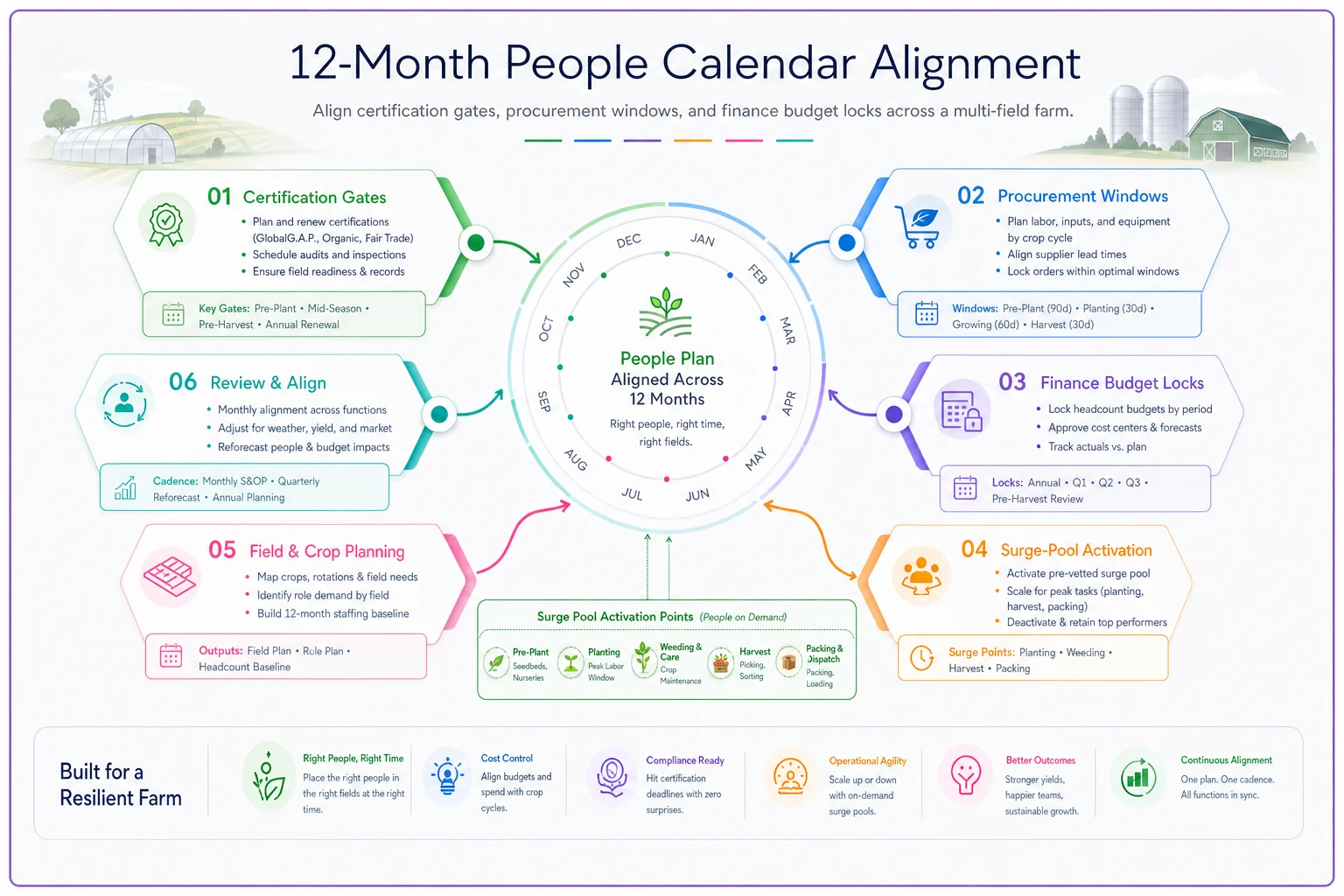
This diagram shows the workflow for aligning certification, procurement, and finance windows across the people calendar.
A worked rostering grid
Here's what the connection looks like at the crew level. Simplified peak-planting week roster for a four-field block, showing how competency tiers and cost lanes map onto actual shifts.
Peak planting week — Fields A/B/C/D
| Role | Competency tier | Count | Cost lane | Shift pattern |
|---|---|---|---|---|
| Planting lead | Certified operator | 2 | Lane 1 (core salaried) | 12-hr, staggered A/B |
| Equipment operator | Certified | 4 | Lane 1 | 12-hr rotating |
| Refill/logistics | Trained seasonal | 3 | Lane 2 (hourly returning) | 10-hr |
| General labor | Entry | 8 | Lane 3 (surge contract) | 8-hr |
| Relief/float | Cross-trained | 2 | Lane 2 | On-call |
The cost lanes matter more than people think. Lane 1 is your fixed, year-round cost — expensive but non-negotiable, and they carry the certifications. Lane 2 is your returning seasonal workforce, higher cost than raw labor but lower risk and shorter ramp. Lane 3 is surge — cheapest per hour on paper, highest coordination and compliance overhead in practice.
The mistake is optimizing purely for Lane 3 because the hourly rate looks good. Every hour of unsupervised entry labor pulls a fraction of a Lane 1 person's attention, and that supervision cost is invisible until a planter runs misconfigured for half a day. Farms "save" a few dollars per hour on surge labor and lose it many times over reseeding a misplanted corner.
Cost lanes, explained properly
Think of your labor spend in three lanes, each with a different risk and coordination profile:
-
Lane 1 — Core committed. Year-round or long-season staff who hold certifications and institutional knowledge. Highest per-head cost, lowest operational risk. Your competency backbone.
-
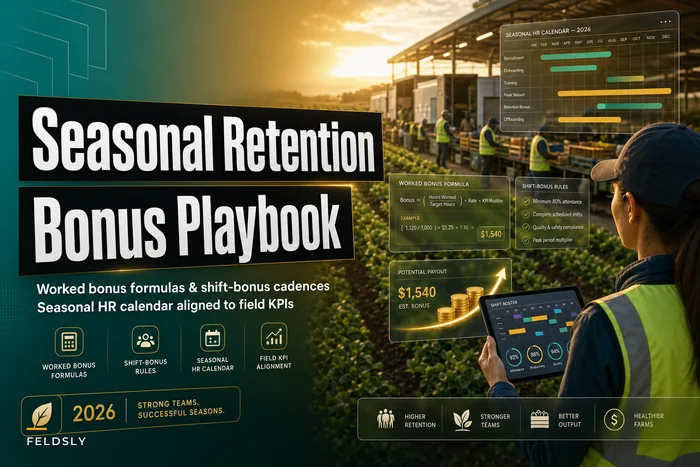
Lane 2 — Returning seasonal. People who've worked your fields before. Known quantities. Moderate cost, short ramp, high reliability. Protecting this lane is why retention matters — the worked bonus formulas and shift-bonus rules in the seasonal retention playbook are basically a Lane 2 defense system.
-
Lane 3 — Surge/contract. Labor contractors, H-2A blocks, shared crews. Lowest nominal cost, highest coordination and compliance load.
As farms scale, they tend to lean harder on Lane 3 because it looks flexible. But every dollar pushed into Lane 3 increases the certification-gate risk and the supervision burden on Lane 1. There's a tipping point — usually around the point where surge labor exceeds your core crew's ability to supervise it — where adding more Lane 3 bodies actually reduces effective output. That's the ceiling nobody plans for.
Sample surge-contract snippets
Surge contracts fall apart when they're vague about activation, scope, and what happens when something goes wrong. A few clauses worth having in writing:
> Activation trigger: "Contractor will provide [X] qualified workers within 72 hours of written activation notice. Activation windows are pre-scheduled for April 15–30 and October 1–20; outside these windows, 7-day notice applies."
> Competency guarantee: "A minimum of [N] workers per crew will hold current [state] restricted-use pesticide handler cards and documented equipment operation sign-offs, verified before first shift."
> No-show / shortfall clause: "If delivered headcount falls below 80% of the confirmed count on any scheduled day, contractor credits [rate] per missing worker-day and farm retains the right to source replacement labor at contractor's cost."
> Certification responsibility: "Contractor warrants all workers meet onboarding and work-authorization requirements. Farm provides site-specific safety orientation; contractor provides trade certifications."
The no-show clause is the one that actually changes behavior. A surge contract without a shortfall penalty is a suggestion. Farms that get burned by labor contractors almost always signed something that treated headcount as aspirational.
A simple sequence for building the whole thing
If you're assembling this for the first time, here's the order that actually works — not the order that feels natural:
-
Map your competency pipeline first. You can't plan surge or gates until you know what skills you already have and where the gaps are.
-
Plot certification gates onto the agronomic calendar. Find every point where a credential blocks work. Note the lead time each credential requires.
-
Back-schedule the people calendar from those gates. If the applicator cert takes six weeks and you need it by April 1, your training window is mid-February. Non-negotiable.
-
Align surge-pool activation with finance windows. Surge contracts get committed when finance can fund them — usually the February budget lock, not April.
-
Build cost lanes into the budget before you set rosters. Decide your Lane 1/2/3 mix at the dollar level, then staff into it.
-
Dry-run one peak week on paper. Walk a single planting or harvest week shift-by-shift and find where the roster breaks.
Step 3 is where most people fail. Certifications get scheduled when someone remembers to, not when the calendar demands. Back-scheduling from the gate is the single highest-leverage habit in the whole model.
A quick readiness checklist
Before each season, run through this:
-
- [ ] Every certification gate has a funded, scheduled training window with lead-time buffer
-
- [ ] Surge contracts signed with activation triggers and shortfall penalties
-
- [ ] Lane 1/2/3 cost mix approved by finance, not just estimated
-
- [ ] Competency matrix updated — who left, who's new, who cross-trained
-
- [ ] Returning-crew retention offers sent before competitors' recruiting starts
-
- [ ] Peak-week roster dry-run completed for your tightest window
-
- [ ] Backup supervision plan if a Lane 1 person goes down mid-surge
Running through this list in January takes a couple hours. Skipping it costs weeks in April.
When this full model makes sense — and when it doesn't
When it makes sense: You're running multiple fields with staggered or overlapping work windows, you've got more than one commodity or crop stage competing for the same crew, and your labor spend is big enough that a 10% coordination improvement is real money. Generally this kicks in somewhere north of 1,500 acres, or any operation where no single person can hold the whole crew schedule in their head anymore.
When it's overkill: Small single-crop operations with a stable, known crew. If Dave genuinely can run it from memory and the stakes of a missed window are low, building a four-part model is bureaucracy you don't need.
Who should hold off: Farms that haven't nailed basic onboarding and competency tracking. The operating model sits on top of those fundamentals. If you don't know who can run what equipment, building a surge pool and cost lanes just adds structure to chaos.
A real scenario
A mixed corn-soy operation running around 2,200 acres across five fields kept blowing its labor budget by double digits every season. Predictable pattern: staff reactively, pull in labor contractors at peak rates during the panic weeks, still miss parts of the planting window because certified sprayer operators weren't available when the window opened.
They rebuilt the labor plan around the four-part model. Competency matrix first, then back-scheduled certification training to February instead of "whenever," committed surge contracts during the February finance lock, and set a defined Lane 1/2/3 mix instead of improvising.
The headline change wasn't a dramatic cost cut — labor is labor, you still have to pay people. The win was predictability. Peak-week emergency contractor hours dropped because surge was pre-arranged instead of panic-bought. Budget variance shrank from double digits to something closer to single digits. The planting window got hit cleanly for the first time in a couple of years because the certification gate stopped being a surprise.
Nothing exotic happened. They wired the pieces together and let money and timing lead instead of trail.
Where tools actually help
None of this requires software to exist — it requires it to scale. A competency matrix lives fine in a spreadsheet at 40 people. At 150 seasonal workers across multiple sites with rolling certifications and overlapping surge contracts, the spreadsheet becomes the bottleneck, because nobody can see in real time who's certified, who's activated, and which gate is about to be missed.
That's the honest case for an operational platform: not to make decisions for you, but to keep the four parts synchronized when volume gets past human memory. Tracking certification expiry dates against the calendar, flagging when a surge window and a finance window are about to collide, keeping the competency matrix current as people come and go — this is coordination work that AI-assisted scheduling and tracking handles in the background, so your Lane 1 people spend their time running crews instead of chasing paperwork.
The model is the valuable part. The tooling just stops it from falling apart at scale.
Putting it together
Seasonal labor on a multi-field farm isn't a hiring problem and it isn't a cost problem. It's a synchronization problem. The crews, the credentials, the surge capacity, and the calendar all have to be wired to the same money and timing decisions — and most farms leave them floating in separate orbits until the season forces a collision.
Build the pipeline, map the gates, fund the surge before you need it, and let the calendar be the spine that holds all of it together. Do that consistently and labor stops being the thing that ruins your spring.
It just becomes another part of the operation that runs on a plan.
Build the pipeline, map the gates, fund the surge before you need it, and let the calendar be the spine that holds all of it together. Do that consistently and labor stops being the thing that ruins your spring.
It just becomes another part of the operation that runs on a plan.
Ready to revolutionize your farm management?
Join 500+ farms using Feldsly to boost yields, reduce waste, and streamline daily farm workflows.