

The hardest part of going from one farm to several isn't buying the land or finding the equipment. It's that everything you used to carry in your head suddenly has to live somewhere other people can find it — and act on correctly when you're 90 miles away during planting.
Most operations that stall at the 2-to-5 farm range don't stall because of money. They stall because the owner is still the operating system. Every procurement decision, every "can we spend this," every "should we plant this field first" routes back through one person. That works at one site. At four sites spread across two counties, it becomes the bottleneck that quietly eats your margins and burns out your best people.
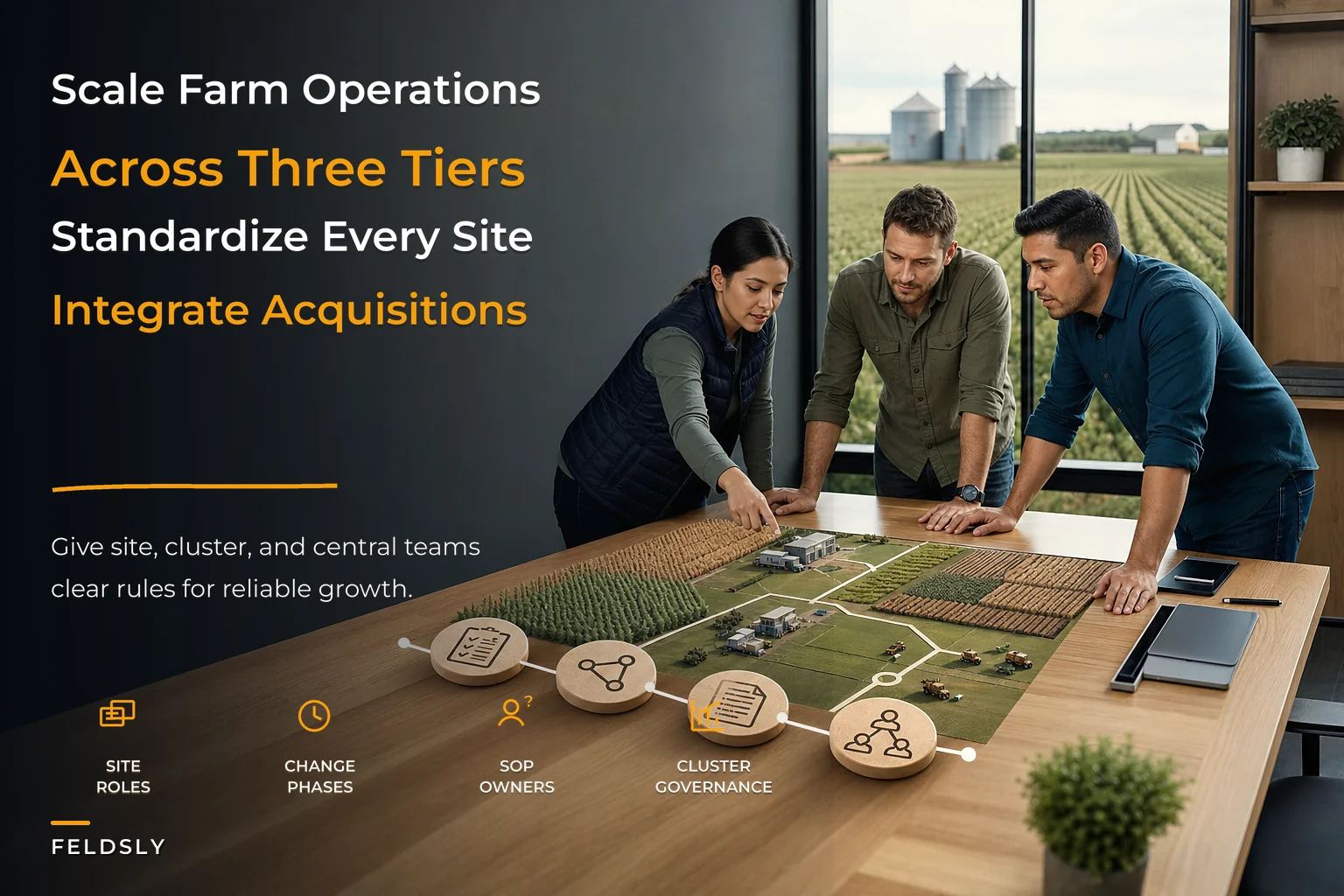
A multi-site farm operating model fixes this by deciding — on purpose — what gets decided where. Not everything should be centralized. Not everything should be local. The three-tier structure (site / cluster / central) is how you draw those lines so the operation can absorb a new farm without re-inventing how it runs.
Why the "one brain" model breaks the moment you add a second location
When you have a single farm, informal coordination is actually efficient. You walk the fields, you know the soil, you text your supplier, you remember which planter had the bearing issue. There's no real overhead because the overhead is you.
The problem is that this model doesn't scale linearly — it scales terribly. Each new site doesn't just add work, it multiplies coordination load. Two sites means comparing two sets of conditions. Three means arbitrating who gets the sprayer first. By the time you acquire a fourth, you're spending more time relaying information between locations than actually making decisions.
-
Procurement fragments. Each site manager buys independently, you lose volume pricing, and you end up with four different seed treatments for no real agronomic reason.
-
Standards drift. The farm you've run for 15 years has tight habits. The one you bought last fall does things its own way, and nobody wrote down which way is "right."
-
Capital decisions get emotional. A site manager swears he needs a new grain cart. Another's been patching a 20-year-old one. Without a shared rule, the loudest voice wins — not the best ROI.
-
Nobody owns the hand-offs. When equipment moves between farms, when crews get shared, when data gets reported up — those seams are where things fall through.
None of this is a people problem. It's a structure problem. You're asking an organization built for one location to behave like one built for five.
The three tiers, and what actually lives at each
The whole point of the model is to push each decision to the level that has the right information and the right incentive. Get that wrong and you either micromanage from central or let every site freelance.
Take control of your farm’s productivity.
Feldsly helps you plan, track, and optimize every farming operation with precision.
- Centralized crop scheduling
- Resource & labor management
- Real-time weather alerts
No credit card required
| Tier | Owns | Decides | Does NOT decide |
|---|---|---|---|
| Site (individual farm) | Daily execution, field conditions, crew tasks, local scouting | Planting sequence within the field, daily labor assignment, in-season observations, minor repairs | Vendor selection, capex over a set threshold, agronomic protocol changes |
| Cluster (2–6 nearby farms) | Shared equipment, shared crews, regional logistics | Equipment allocation across sites, local procurement within approved vendors, crew sharing, rental triggers | Company-wide standards, major capital, banking/insurance |
| Central | Standards, capital, master data, contracts | Capex over threshold, SOP ownership, master vendor list, financing, acquisition decisions | Which field gets planted Tuesday morning |
The cluster tier is the one most owners skip, and it's usually the one that saves them. Sites are too small to justify their own equipment fleet. Central is too far removed to manage a sprayer schedule in real time. The cluster — a handful of farms close enough to share a crew and a machine within a day — is where logistics actually get coordinated.
If you've worked through right-sizing a fleet across peak windows, you already know a single farm almost never justifies owning everything it needs at peak. The cluster is the unit where that math actually works out.
Standardized artifacts: the paperwork that makes the structure real
A tiered model is just an org chart until you back it with artifacts — documents that let a decision happen the same way regardless of who's standing there. You need a small, boring library of these. Boring is the point. They should be so standardized that a newly acquired farm can be plugged into them in about a week.
The core set:
1. The SOP (standard operating procedure). One per repeatable task that matters — planter calibration, tender refill, grain moisture checks, chemical handling. The test of a good SOP isn't completeness, it's whether a competent person who's never worked your farm can execute it without calling you. Most farm SOPs fail this because they're written by the person who already knows the answer.
2. The procurement playbook. This defines who can buy what, from which approved vendors, up to which dollar limit, without escalation. It's what stops four sites from fragmenting your buying power. Your seasonal buying rhythm should feed directly into it — the logic in a seasonal input procurement playbook that ties planting calendars to buffer formulas and supplier scorecards is exactly what the playbook should encode, so a cluster manager is buying against a shared standard instead of guessing.
3. The capex memo. A one-page template for any capital request above the site threshold. It forces the requester to state the problem, the expected return, alternatives considered (including "do nothing" and "rent"), and the downtime cost of not buying. The memo matters more than the number in it — it converts "I want a new one" into a decision you can compare across sites.
A capex memo doesn't need to be fancy. It needs these fields:
-
What's the asset and what problem does it solve
-
Cost to buy vs. rent vs. repair-and-keep
-
Expected useful life and hours/acres per year
-
Downtime cost if we don't act (dollars per day during critical windows)
-
Which tier approves it and by when
This ties directly into how you govern assets over their life. If you've set up capital allocation and asset-lifecycle governance across your fields, the capex memo is the front door into that system — the thing that keeps acquisition-driven spending from blowing up a disciplined replacement schedule.
Tiered asset rules: deciding what each level can spend without asking
Asset decisions are where multi-site operations leak the most money, because they're emotional and infrequent. Nobody buys a combine often enough to get good at it.
-
Site level (under ~$2,500) Routine repairs, consumables, minor tooling. Site manager approves, logs it, moves on. No memo needed.
-
Cluster level (~$2,500–$25,000) Shared implements, significant repairs, short-term rentals. Requires a one-paragraph justification and cluster lead sign-off. This is where rental-vs-repair calls get made during the season.
-
Central level (over ~$25,000) New machines, land, financing, anything that changes the fleet. Requires a full capex memo and a scheduled review — not a hallway yes.
Set the exact numbers to your operation. A 1,200-acre cluster and a 9,000-acre one will draw different lines. The principle holds either way: the threshold should match the level that actually feels the consequence of the decision. A site manager who'll be running the machine should have real input; the central office financing it should have the veto.
Lock down central approval thresholds during planting and harvest to prevent emergency purchases.
One pattern worth flagging: thresholds drift during harvest and planting when everyone's in a hurry. That's exactly when a $30k "emergency" purchase slips through without a memo. The structure has to hold hardest during the windows when it's most tempting to skip it — which is also when a breakdown hurts most. Keeping a disciplined machinery lifecycle and planned-maintenance program running underneath the tiers is what keeps those panic buys rare in the first place.
Change management: how you onboard an acquired farm without breaking it
Buying a farm is the easy part. Making it run like the rest of your operation — without crushing the people who were already there and know things you don't — is where most integrations go sideways.
-
Weeks 1–4
Observe and document.
Don't change anything operational yet. Capture how the farm currently runs — vendors, equipment condition, crew roles, soil history, informal knowledge. This becomes your baseline. -
Weeks 4–8
Align the backbone, not the field work.
Bring the new site onto your master data, procurement approvals, capex thresholds, and reporting cadence. These are low-disruption because they change how decisions route, not how the crew works day to day. -
Months 2–4
Standardize the SOPs that matter most.
Start with safety and compliance, then the tasks where consistency drives yield or cost. Keep local practices that are genuinely better — and write those into your standards. -
Months 4–12
Fold into the cluster.
Share equipment, pool crews, integrate logistics. By now the site trusts the structure and you've learned where it fits.
A simple change-management checklist for each acquired site:
-
- [ ] Baseline documented (vendors, assets, crew, soil, yield history)
-
- [ ] Master data loaded and reconciled
-
- [ ] Procurement thresholds and approved-vendor list communicated
-
- [ ] Capex memo process trained with the site manager
-
- [ ] Safety/compliance SOPs adopted first
-
- [ ] Reporting cadence live (what rolls up, when, to whom)
-
- [ ] Rollback triggers defined — what tells you a change isn't working
-
- [ ] Cluster integration date set and owned
The rollback trigger line is the one people skip. Every change needs a defined "this isn't working, revert" condition, so you're not debating feelings mid-season about whether the new seed program is actually underperforming.
Visualizing the onboarding steps can help make roles and timelines clear.
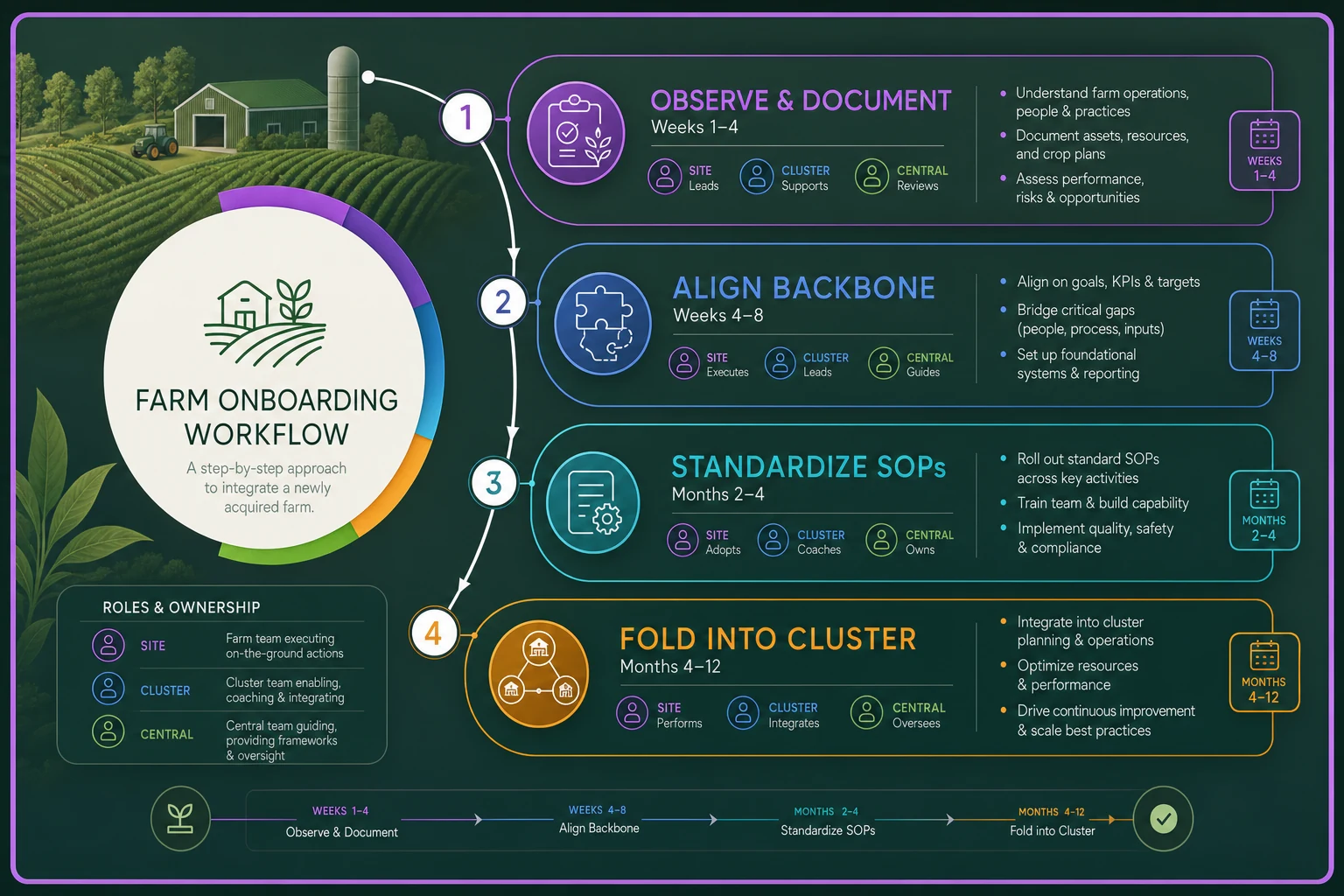
Keep the visualization simple: timeline boxes, responsible tier labels, and clear rollback markers.
A real scenario: four farms, one overwhelmed owner
Consider a corn-soy operation that grew from a home farm of around 2,100 acres to roughly 6,800 acres across four sites over three years — two acquired, one leased. On paper it was working. In practice the owner was fielding 40-plus calls a day during planting, and procurement had quietly fragmented across sites.
The visible symptoms: input costs ran noticeably higher than the volume should have allowed, because each site bought on its own. A late sprayer hand-off between two of the farms cost several days in a tight window. And a site manager bought a used grain cart for around $18k that central would never have approved — it duplicated one sitting idle 20 minutes away.
Putting a three-tier model in place didn't require software or a consultant first. It required drawing the lines: a shared approved-vendor list, a $25k central-approval threshold with a one-page memo, two clusters paired by geography, and a weekly roll-up instead of constant calls.
Within a season, procurement consolidated enough to recover roughly 4–6% on input spend through combined buying. The owner's call volume dropped by more than half because site and cluster decisions stopped routing to him. The idle-asset duplication stopped too, because capex now had a front door. None of those numbers are dramatic on their own — but together they're the difference between an operation that can absorb a fifth farm and one that's already past its limit.
Where the information actually has to live
The structure only works if the artifacts and data are somewhere every tier can reach them. A three-tier model falls apart fast when SOPs are in one person's truck, the vendor list lives in an email thread, and capex memos are stacked on the kitchen table.
This is where an operational platform earns its keep — not as a magic fix, but as the shared surface where standards, approvals, and master data actually live. AI-assisted tooling helps most with the unglamorous parts: flagging a purchase that fell outside the approved-vendor list, surfacing a capex request that duplicates an idle asset in a nearby cluster, reconciling master data when a new farm gets folded in, rolling up site reports into something central can actually read. The structure is the decision. The platform just keeps everyone honest to it.
What it shouldn't do is make the decisions for you. The tiers exist precisely because judgment belongs at specific levels. Good software routes the decision to the right place and keeps the record straight — it doesn't replace the person who should be making the call.
When this model makes sense — and when it doesn't
When it makes sense: You're running three or more sites, or you know you're about to be. You've felt the one-brain bottleneck. You're acquiring, or planning to. Your procurement is fragmenting and you can feel the lost buying power. These are the conditions the three-tier model is built for.
When it's overkill: A single farm, or two adjacent fields you manage as one. Formal tiers and capex memos add overhead you don't need yet. If you can walk every acre in a day and carry the operation in your head without dropping anything, don't build bureaucracy to solve a problem you don't have.
Who should be careful: Operations mid-acquisition with a crew that's nervous about change. Don't lead with structure. Lead with documentation and listening, then introduce the backbone — data, procurement, reporting — before you touch how people do their field work. The model is a tool for scale, not a way to assert control, and crews can tell the difference immediately.
The real payoff
The three-tier operating model isn't about org charts or paperwork for its own sake. It's about making your operation capable of absorbing growth — another farm, another cluster, another season at scale — without your personal bandwidth being the ceiling.
The operations that keep growing are the ones that turned the owner's instincts into shared standards, pushed each decision to the level that should own it, and backed it with artifacts boring enough to survive a new acquisition. The ones that stall are usually still running on one person's memory and good intentions. Both can farm well. Only one can keep adding sites without the whole thing straining at the seams.
Ready to revolutionize your farm management?
Join 500+ farms using Feldsly to boost yields, reduce waste, and streamline daily farm workflows.