

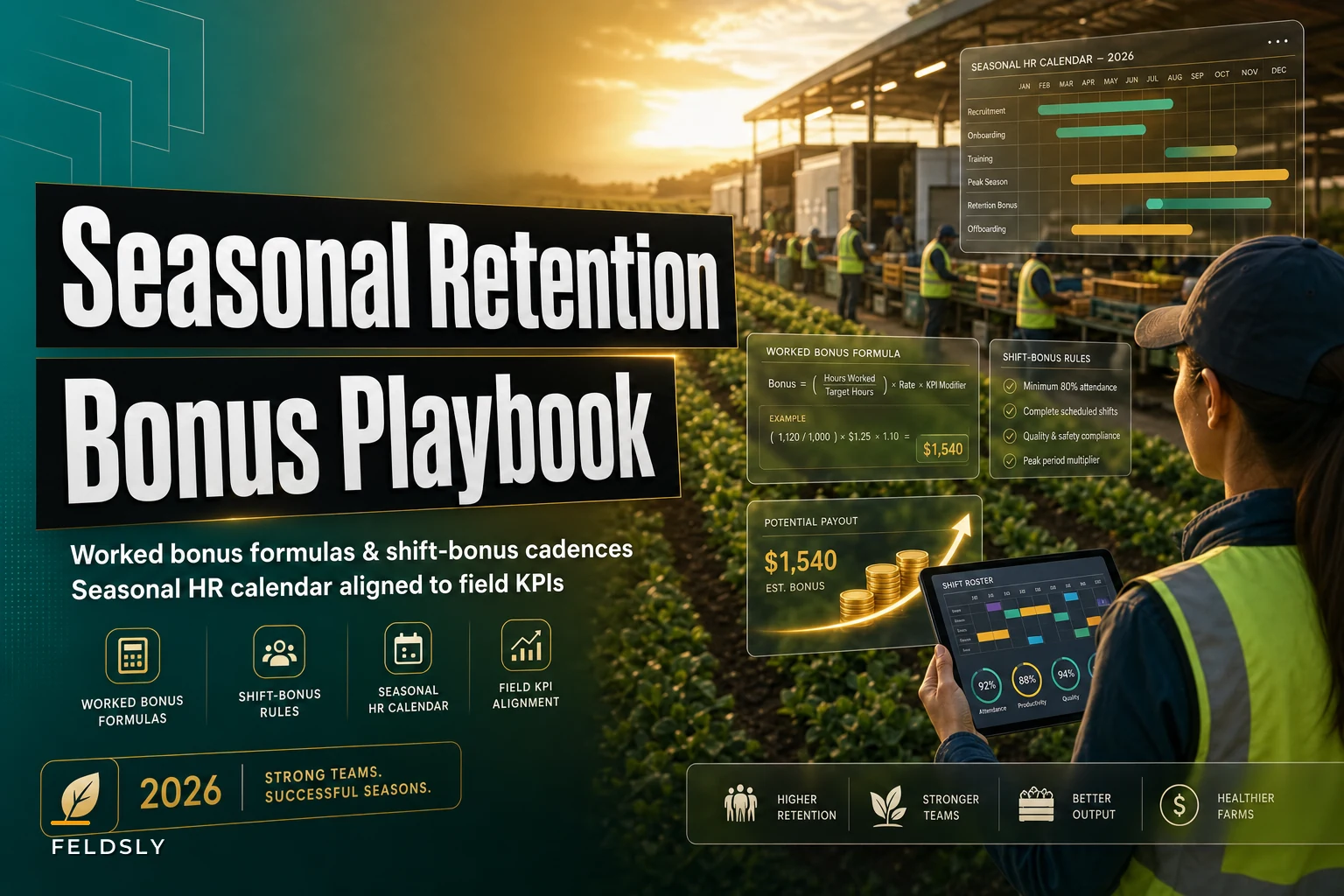

The most expensive worker on a multi‑field farm isn't the one with the highest hourly rate. It's the one who quits on day 4 of a 30‑day harvest window, right when your grain is at moisture and your crew is already thin. You've onboarded them, trained them on your equipment, and now you're a body short during the exact stretch where being short a body costs you real money.
Seasonal farm workforce retention rarely fails because of one big thing. It fails because of a bunch of small design choices in how you structure pay—choices that were probably made years ago and never revisited. A flat hourly rate with no logic behind bonuses tells a good worker there's no upside to staying, and no downside to leaving for the farm two counties over that's paying fifty cents more.
This post is about the pay mechanics specifically: worked bonus formulas that reward the behavior you actually want, shift‑bonus rules that plug the gaps nobody wants to fill, productivity‑linked pay that doesn't turn into a mess of disputes, and an HR calendar that syncs all of it to planting and harvest peaks. No motivational fluff. Just the math and the timing.
Why flat pay quietly bleeds your crew
A pattern you see on a lot of mid‑size operations: everyone gets the same hourly rate, maybe with a vague promise of "a bonus at the end if things go well." That promise does almost nothing to change behavior in week two.
A lump‑sum, end‑of‑season bonus is basically invisible during the season itself. A worker deciding whether to show up Saturday, or whether to take the job that starts Monday, isn't running a discounted‑cash‑flow calculation on a bonus they might get in November. They respond to what's in front of them this week.
A typical example: a farm promises a $600 loyalty bonus for anyone who works the full harvest. Sounds generous. But it's binary—you get it or you don't—so the moment a worker thinks they might miss a few days, the whole incentive collapses. They mentally write off the $600 and start treating your farm like any other day job. One missed shift and the carrot's gone, so why not miss two.
Binary bonuses create cliffs. Cliffs create walkaways. The fix is making the money accumulate visibly and continuously, so every additional day worked has its own tangible reward that can't be wiped out by missing the day after.
Worked bonus formulas that reward the right thing
A worked bonus should pay for the specific behavior that's scarce and valuable during your peak. On most farms that's three things: showing up reliably, staying through the full window, and hitting output without wrecking quality.
Take control of your farm’s productivity.
Feldsly helps you plan, track, and optimize every farming operation with precision.
- Centralized crop scheduling
- Resource & labor management
- Real-time weather alerts
No credit card required
| Bonus layer | What it rewards | Example formula |
|---|---|---|
| Attendance accrual | Reliable daily presence | $8–$12 added per full day worked, paid weekly |
| Window completion | Staying through the peak | 5% of gross seasonal earnings if worked ≥90% of scheduled peak days |
| Output tier | Productivity above baseline | Tiered per‑unit rate once daily output clears a set threshold |
The attendance accrual is the workhorse. Because it pays weekly and adds a fixed amount per day, the worker watches it grow in real time. Miss a day and you don't lose what you already banked—you just don't add to it. That's the opposite of the cliff.
The completion bonus is where you protect the back half of your window, which is usually where farms bleed people. Setting it at 90% of scheduled days rather than 100% matters more than it seems. A 100% threshold means one sick kid or one truck breakdown wipes it out, and the worker knows it. Ninety percent leaves room for real life while still requiring genuine commitment.
The output tier is the trickiest and the one most farms get wrong—more on that below.
The output‑tier trap (and how to set thresholds that don't cause fights)
Productivity‑linked pay is powerful and dangerous. Done well, your strong operators earn more and throughput climbs. Done badly, it turns into a running argument about whose row was rockier, whose field was wetter, and whether the scale was calibrated right.
What you see across a lot of operations is that piece‑rate and productivity bonuses blow up for one reason: the baseline wasn't fair across conditions. A picker in a clean, high‑yield block clears the threshold easily. The same picker in a weedy, low‑density block works just as hard and earns nothing extra. They notice. Morale tanks in exactly the fields where you need effort most.
Two ways to fix this:
-
Set thresholds per‑field or per‑block, not farm‑wide. Adjust the baseline for known yield and condition differences so the effort required to hit the tier is roughly equal everywhere.
-
Pay on a rolling multi‑day average, not single‑day output. One bad‑weather day shouldn't erase a bonus. Averaging over three to five days smooths out the noise and stops people from gaming a single day.
A workable output tier looks like this: baseline is the median daily output for that block over the last two seasons. Anything from 100–115% of baseline earns a small per‑unit kicker. Above 115% earns a larger one. Below baseline earns the normal hourly rate, no penalty. You never dock pay for a slow day—you only add for a fast one. Penalties push good workers out; upside pulls them in.
One more thing people miss: publish the thresholds before the block starts, in writing, on the crew board or wherever the crew actually reads. Ambiguity about the number is what generates disputes, not the number itself.
If assignments and blocks are being staggered across fields, this ties directly into how you sequence adjacent fields and pair crews to equipment—the same block map driving your planting sequence should be driving your bonus baselines too.
Shift‑bonus rules for the hours nobody wants
Every farm has shifts that are genuinely worse: pre‑dawn starts to beat the heat, night runs during a tight moisture window, weekend work when everyone else is off. A flat rate treats a 4:30 a.m. start the same as a 9 a.m. one. Your crew doesn't see it that way.
Shift bonuses are probably the cleanest, cheapest retention lever available because they're targeted. You're not raising your whole labor cost—you're paying a premium only for the specific hours that are hard to staff.
-
Early‑start premium flat $15–$25 for any shift starting before 5:30 a.m.
-
Night‑window premium a per‑hour bump (say $2–$4/hr) for work after 8 p.m. during active harvest windows only.
-
Weekend/holiday premium 1.25–1.5x on the days you genuinely need coverage, not blanket every weekend.
-
Short‑notice premium a flat bonus for anyone who covers a shift called in under 12 hours, which pays for itself the first time it saves your moisture window.
The short‑notice premium deserves some emphasis. When you lose a body unexpectedly mid‑harvest, your real cost isn't the hourly rate of a replacement—it's the throughput you lose while scrambling to find one. Pre‑committing to a short‑notice bonus means you have a standing offer already in place, and someone can just say yes instead of you negotiating under pressure at 6 a.m.
When shift bonuses are a bad idea
If your problem is chronic understaffing across all hours, shift bonuses won't fix it—you're underpaying baseline and no premium patches that. Shift bonuses work when you have enough people overall but struggle to fill specific slots. Diagnose which problem you actually have before adding rules, or you'll spend money without moving retention.
The seasonal HR calendar: syncing pay to the peaks
All these bonuses only work if they're switched on and communicated before the peak, not scrambled together the week harvest starts.
Most farms run HR reactively—hire when short, bonus when panicked. A seasonal HR calendar flips that. You map your labor demand to the crop calendar, then back‑schedule every hiring, onboarding, and pay‑communication task so it lands ahead of the crunch.
| Weeks before peak | HR action |
|---|---|
| 8–10 weeks | Post roles, reconfirm returning crew, lock housing/transport |
| 5–6 weeks | Finalize bonus formulas and thresholds; document in writing |
| 3–4 weeks | Complete compliance onboarding and paperwork |
| 1–2 weeks | Publish shift schedules and bonus rules to crew |
| Peak window | Weekly bonus payouts; daily attendance tracking |
| 1 week after | Pay completion bonuses; run exit conversations |
The exit conversations at the end matter more than people expect. Ten minutes with each departing seasonal worker—what worked, what they'd change, would they come back—gives you your entire returning‑crew list for next year. Returning workers are the single biggest retention win available because they need no training and already know your equipment and fields.
-
Bonus formulas are locked and documented weeks ahead. Nothing kills trust faster than changing the bonus math mid‑season because the numbers came in higher than expected. If you set it, you pay it.
-
Compliance onboarding is done well before peak, not during it. Rushing paperwork during harvest is how audit problems start. The mechanics of doing this cleanly for seasonal and migrant crews are worth a full read on their own—see the workflow for batch onboarding that survives audits.
Lock the bonus formulas and publish them in writing several weeks before peak to avoid mid‑season changes that erode trust.
All these pieces only work if the calendar forces the communication and execution to happen ahead of the crunch, not during it.
A real scenario: 700‑acre mixed grain operation
A family‑run grain farm, roughly 700 acres across several non‑adjacent fields, was running a flat hourly rate plus a $500 end‑of‑season bonus. Their problem was the classic one: they'd lose three to five seasonal workers in the second half of harvest every year, right during their tightest moisture windows, then end up paying overtime and rush‑hire premiums to cover the gaps.
They restructured for one season. The end‑of‑season lump sum got split into a $10/day attendance accrual paid weekly, plus a 5% completion bonus for anyone hitting 90% of scheduled peak days. They added a $20 short‑notice premium and a modest early‑start bump. Total budgeted labor cost went up by a small amount—somewhere in the low‑to‑mid single‑digit thousands for the season.
The result wasn't dramatic on paper but it mattered where it counted. Mid‑harvest walkaways dropped to one, from the usual three to five. They didn't need the rush‑hire scramble that had cost them roughly $4k–$6k in prior years between premium pay and lost throughput. And because they ran exit conversations, they went into the next season with a returning‑crew list that cut their hiring and training load noticeably.
The restructured bonuses more or less paid for themselves through avoided scramble costs. That was the real upside—not a dramatic transformation, just fewer fires and better numbers where it counted.
Where tracking becomes the real bottleneck
Once you layer attendance accruals, per‑block output tiers, rolling averages, and shift premiums, the pay logic gets genuinely hard to run on paper or in a single spreadsheet. This is where a lot of good bonus structures quietly fall apart—not because the formulas were wrong, but because nobody could track them accurately enough to pay them without disputes.
Tracking daily attendance per worker, per‑block output against per‑block baselines, which shifts triggered which premiums, and where each person stands against their completion threshold is a real coordination job. When it's manual, errors creep in, payouts get contested, and the trust you were trying to build with transparent bonuses erodes anyway.
[WORKFLOW: Seasonal Bonus Tracking Flow] Worker logs shift → attendance accrual recorded → output compared to per-block baseline → shift premium eligibility checked → weekly payout calculated → completion threshold progress updated
Visualize this tracking workflow:
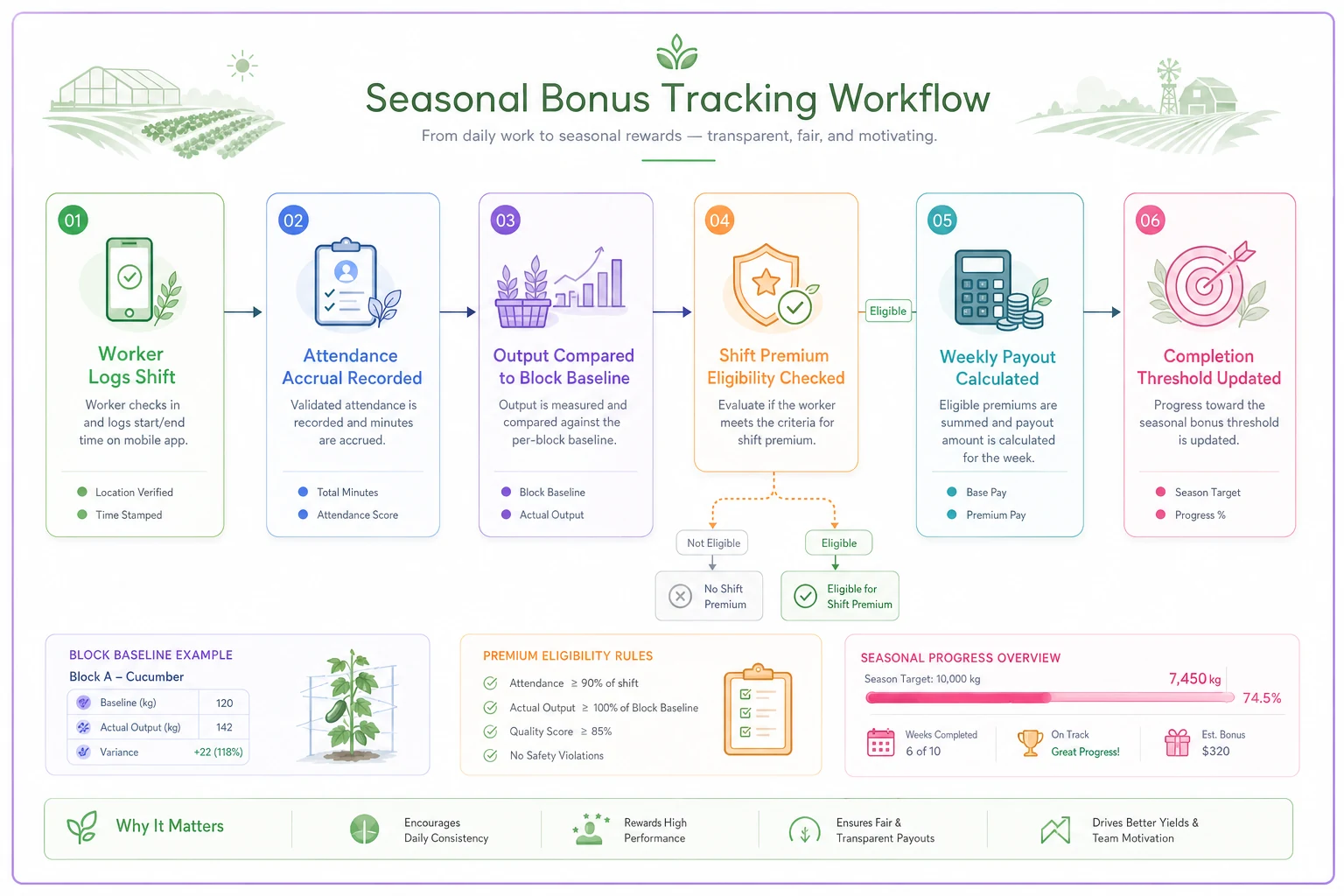
This is the practical case for running crew and pay tracking on operational software with AI automation handling the repetitive parts—logging worked days against thresholds, flagging who's close to a completion bonus, calculating rolling output averages per block, surfacing which shifts qualified for premiums. Not to replace judgment, just to keep the accounting clean and current so weekly payouts are accurate and defensible.
Putting it to work
Start narrow. Pick the single worst retention gap you have—probably the back half of your harvest window—and design one bonus that directly targets it. Most likely that's a weekly attendance accrual plus a 90% completion bonus. Get that one right and paid cleanly before you add output tiers or shift premiums.
Then build the calendar backward from your peak so the formulas are locked and communicated weeks ahead, run the payouts on time every week, and hold the exit conversations that hand you next year's returning crew.
Retention on a seasonal farm isn't about being the highest payer in the county. It's about making the money you already spend visible, continuous, and tied to the exact behavior you need during the exact weeks it matters most.
Ready to revolutionize your farm management?
Join 500+ farms using Feldsly to boost yields, reduce waste, and streamline daily farm workflows.