

Peak windows don't forgive gaps in who-knows-what. You've got six days of fit weather, three machines, and a crew that looks fully staffed on paper. Then the guy who normally handles VRA prescription loading is out with a back injury, his backup "kind of knows it," and you lose half a morning while someone fumbles through controller menus. The field gets the wrong rate on two zones and nobody notices until yield maps come back in the fall.
That's not a labor shortage problem. That's a competency visibility problem. You didn't know, in any documented way, who could actually do the task to standard — and who was faking it.
A crew competency matrix fixes exactly this. Not training for training's sake. A clear, task-by-task record of who is certified, who's in progress, who needs a refresher, and who should not touch a given machine until they're signed off. Paired with a seasonal certification schedule, it turns "I think Diego can run the sprayer" into something you can actually plan around.
Why "everybody kind of knows how" quietly costs you
The dangerous part about skill gaps on a farm is that they stay invisible until the exact moment they're expensive. During slow weeks, overlap hides everything. Three people can fumble through combine calibration together and it works out fine. Nobody times it. Nobody checks whether the grain loss monitor was actually zeroed correctly.
Then harvest hits and suddenly one person is running the combine solo at 9 PM while you're on the phone with a buyer. That's when the gaps show.
What tends to happen across most operations is a predictable pattern: the farm has maybe two genuine experts per critical task, and a fuzzy cloud of helpers who've watched it done but never owned it start to finish. When both experts are tied up — which happens constantly during peak — execution quality drops hard, and nobody can tell you in advance that it's about to happen.
The other piece people miss: skills decay over a long off-season. Someone who calibrated the combine flawlessly last September has forgotten the new moisture-sensor firmware menu by the following August. Without a refresher schedule, you're not training once — you're re-discovering the same gaps every season at the worst possible time.
What actually goes in a competency matrix
Forget vague categories like "machine operation." That's useless. The matrix has to be task-specific enough that a signed-off person can genuinely do the job without supervision.
Take control of your farm’s productivity.
Feldsly helps you plan, track, and optimize every farming operation with precision.
- Centralized crop scheduling
- Resource & labor management
- Real-time weather alerts
No credit card required
Break it down to the level where mistakes actually happen:
-
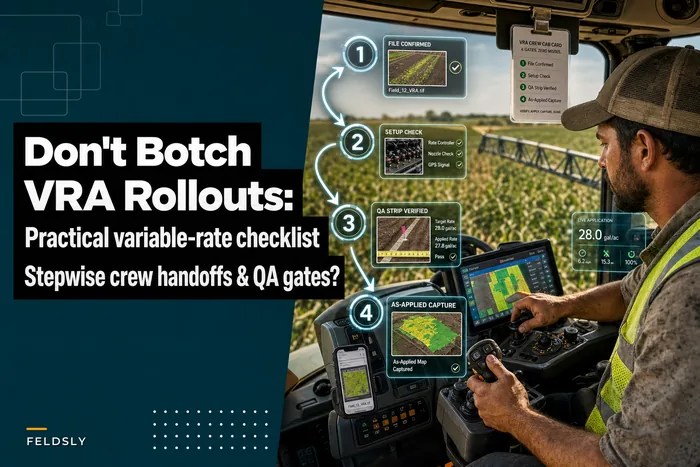
VRA prescription loading and in-cab verification — pulling the right file, confirming zones match the field, checking units, spot-verifying rate on the display before the first pass
-
Sprayer setup and nozzle verification — nozzle selection for the product, boom pressure check, catch test, cleanout between incompatible products
-
Combine calibration — grain loss monitor zeroing, moisture sensor check, concave/sieve settings per crop, test strip and sample weigh-back
-
Planter setup and population check — seed meter check, downforce setting, seed-spacing verification in the field
-
Grain cart and auger operation during unload-on-the-go — the coordination-heavy stuff that eats time when someone's slow
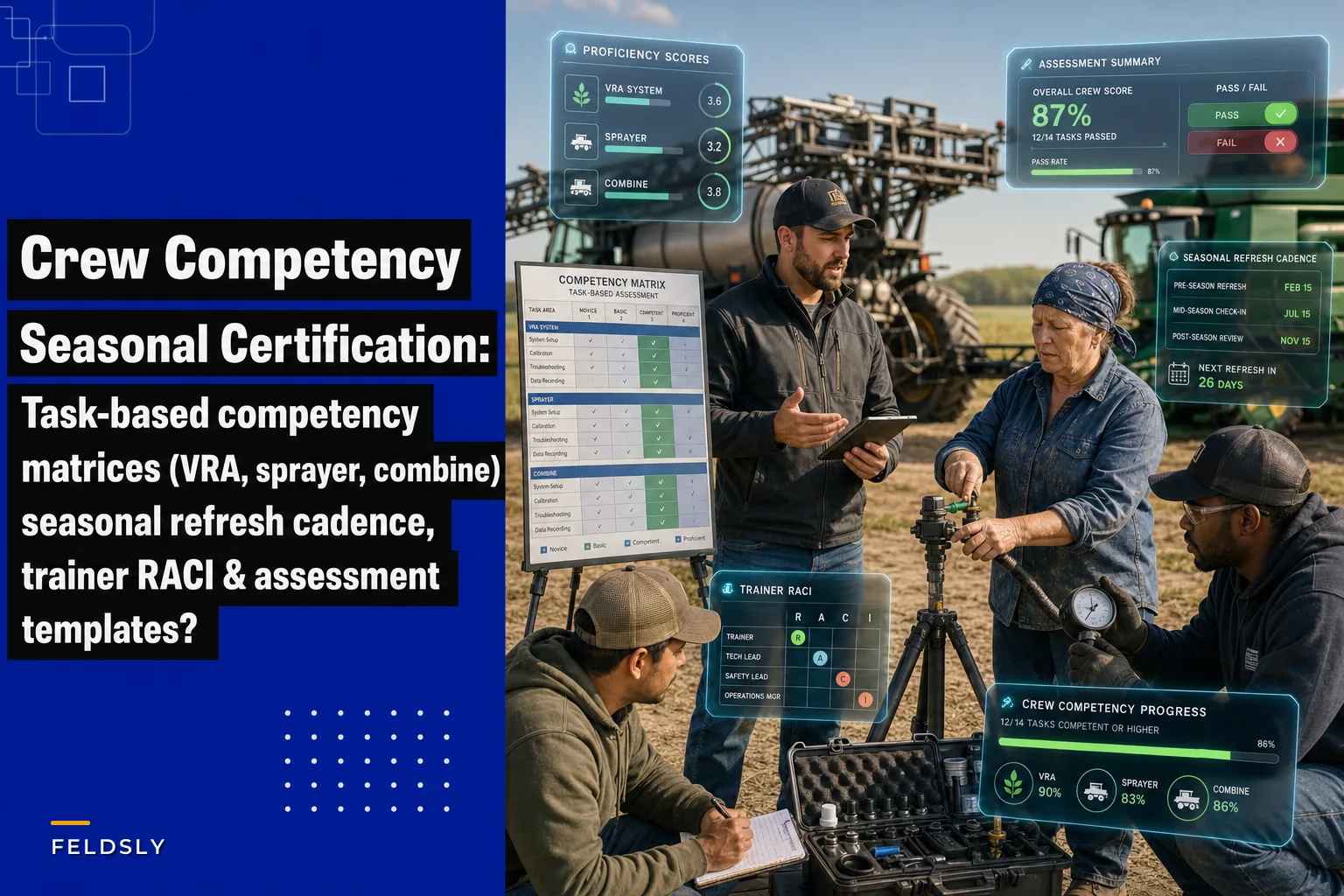
For each task, rate each crew member on a simple four-level scale. Anything more and people start arguing about the middle:
| Level | Meaning | Can they work the peak window? |
|---|---|---|
| 0 – None | No exposure | No |
| 1 – Assisted | Can do it with someone watching | No — needs supervision |
| 2 – Independent | Does it solo, to standard | Yes |
| 3 – Trainer | Does it solo + can certify others | Yes, and can sign off others |
The goal for every critical task is straightforward: at least two people at Level 2 or higher, with no more than one of them being someone likely to get pulled away during crunch. If a task has only one person at Level 2, that task is a single point of failure — and you end up planning the whole season around that one person's calendar whether you admit it or not.
That red/green map is the entire point. When you look at the matrix and see combine calibration has exactly one Level-2 operator, you know in March — not in October — that you've got a problem to fix.
The assessment: how you decide someone is actually a "2"
This is where most farms fall apart. They mark someone as competent because they've "been around" or because the owner feels good about them. That's not an assessment. That's a vibe.
A real assessment is a short, observable checklist tied to the actual task, scored by a trainer watching them do it — on real equipment, not a classroom walkthrough. Keep each assessment to one page. If it's longer than that, nobody actually runs it.
A combine calibration assessment might look like this — pass requires all critical steps correct:
-
Selects correct crop settings for the field being harvested
-
Zeroes the grain loss monitor correctly (critical)
-
Verifies moisture sensor reading against a handheld sample (critical)
-
Runs a test strip and takes a representative sample
-
Adjusts concave/fan based on sample, not guesswork (critical)
-
Re-checks after adjustment and confirms loss is within target
-
Documents final settings where the next operator can find them
If they miss a critical step, they're not a 2 yet. They're a 1 — they need another supervised run. No politics, no feelings. The checklist decides.
The same format works for VRA. If you've already built out an execution standard — and if you haven't, the variable-rate application execution checklist for crews is a solid backbone — your assessment is basically that checklist converted into a scored observation. The person either hits the verification steps or they don't.
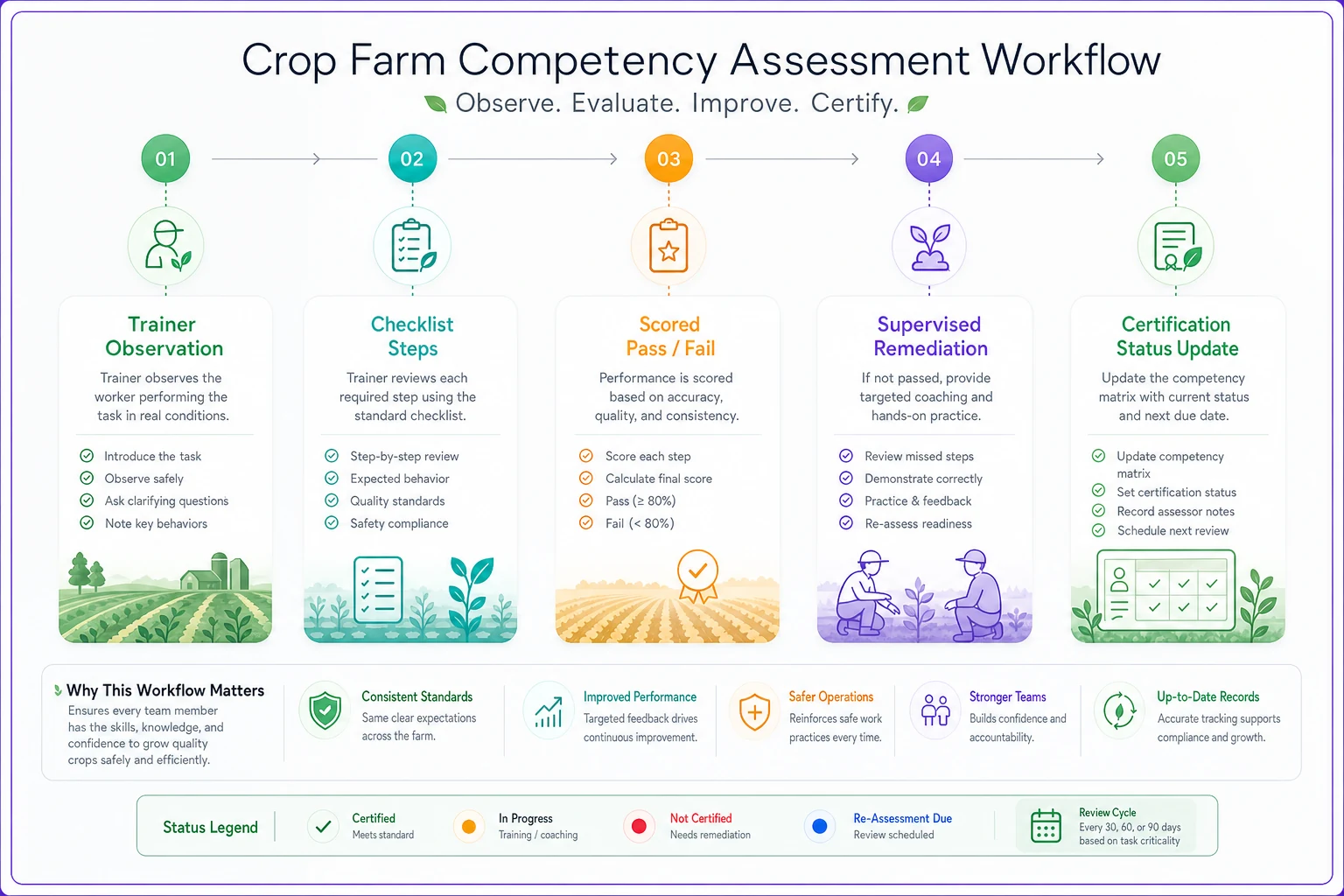
A short visual showing the flow from observation to matrix update helps trainers follow the process without wondering what to do after a failed step.
The same format works for VRA. If you've already built out an execution standard — and if you haven't, the variable-rate application execution checklist for crews is a solid backbone — your assessment is basically that checklist converted into a scored observation. The person either hits the verification steps or they don't.
Who signs off whom: the trainer RACI
One mistake that sinks these programs quietly: everyone assumes "someone" is handling training, so nobody does. The matrix fills up with Level-1 people who never advance because no one is clearly responsible for moving them up.
-
Responsible — the trainer who actually runs the assessment and coaches (usually your Level-3 person for that task)
-
Accountable — the manager who owns whether the farm has enough certified operators before the window opens (usually you or your operations lead)
-
Consulted — your agronomist or dealer tech for tasks like VRA or sprayer calibration where product specifics matter
-
Informed — the whole crew, so everyone knows who to go to when they're stuck mid-season
The accountable role is the one that matters most and the one most farms skip. Somebody has to look at the matrix in spring and say "we're short a certified sprayer operator, fix it by June." Without that named person, the matrix becomes a spreadsheet nobody updates.
One practical note worth mentioning: your best operator is not automatically your best trainer. Some people do a task perfectly but can't explain it, and they rush learners through just to get back to work. If your Level-3 trainer keeps producing Level-1s who fail reassessment, the trainer is the problem, not the trainees.
The seasonal refresher schedule
Certification isn't permanent. Tie refreshers to the calendar so skills are fresh right before they're needed — not six months stale.
-
4–6 weeks before each major window (planting, spray season, harvest): refresher and reassessment for that window's critical tasks. This is when firmware changes, new nozzles, or a new seed meter get worked in.
-
Day-one toolbox reassessment when the window opens
a 15-minute walkthrough on the actual machine for that year, catching anything that changed over winter.
-
Mid-season spot check on the highest-risk task — usually VRA or calibration — to catch drift before it compounds across dozens of fields.
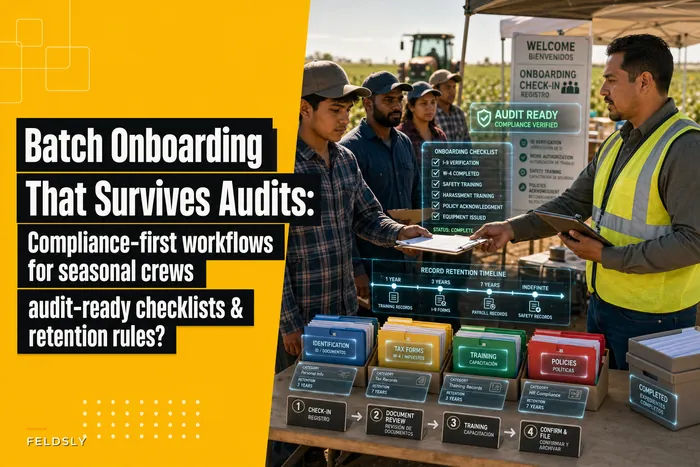
Time it against your planting calendar, not a generic HR calendar. If you stagger fields, your refresher timing has to match when each crew actually hits each task. New hires especially need this baked into their first weeks — the batch onboarding workflows for seasonal and migrant crews approach pairs well here, because onboarding and competency certification are really the same pipeline viewed from two angles.
Make sure day-one reassessments are practical and short so they actually happen on kickoff days.
A real scenario
A roughly 4,200-acre corn and soybean operation in the eastern Corn Belt kept running into the same harvest problem: grain coming in with avoidable loss and the occasional moisture misread that cost them on a few loads. They had five people who could "run the combine" but, when they actually mapped it out, only two who could calibrate it correctly start to finish. One of those two was the owner, who was constantly getting pulled into logistics.
Most days, calibration quietly fell to a Level-1 operator working off memory. The measurable damage was fuzzy but real — they estimated losing somewhere in the low-single-digit bushels per acre on poorly calibrated days, plus two grade downgrades over the season.
They ran a 6-week pre-harvest certification push. Two more operators reached Level 2 on calibration after supervised runs and scored assessments. They built the day-one reassessment into harvest kickoff. The next season, every combine day started with a certified calibrator, no exceptions.
The result wasn't dramatic in a single number — it was consistency. Fewer "why is loss high today" mornings, no repeat downgrades on calibration-related moisture, and the owner stopped being the human bottleneck. Their rough estimate put avoided loss somewhere in the several-thousand-dollar range across the season, for maybe two days of upfront assessment work.
When this is worth it — and when it isn't
Worth it when: you run multiple machines across multiple fields, you lean on seasonal or rotating crew, or you've got critical tasks where exactly one person really knows what they're doing. The more your peak depends on specific individuals, the more a matrix pays off.
Probably overkill when: you're a small operation where the owner personally runs every critical task and always will. If you're the only one touching the combine, you don't need a RACI. Build the refresher checklist for yourself and skip the rest.
Who should not do this half-heartedly: if you build the matrix but never name an accountable person and never run real assessments, you'll end up with a spreadsheet full of generous self-ratings that gives false confidence. That's worse than nothing — because now you think you have two certified sprayer operators when you actually have one and a hopeful guess.
Keeping the matrix alive
The hard part isn't building the matrix. It's keeping it current when the season gets loud. A spreadsheet started in March is usually abandoned by June.
What keeps these programs alive is making the matrix part of how you plan crews day to day, not a separate document you dust off once a year. Some operations fold it into the same system they use for scheduling and assignments, so when you're pairing crew to equipment for a window, you can see certification status right alongside the assignment. That removes the "did we ever actually sign Diego off?" guesswork at 6 AM when you're trying to get moving. Operational platforms that handle crew scheduling can carry this kind of certification data naturally — not because the software is magic, but because competency information is only useful if it's in front of you at the moment you're deciding who does what.
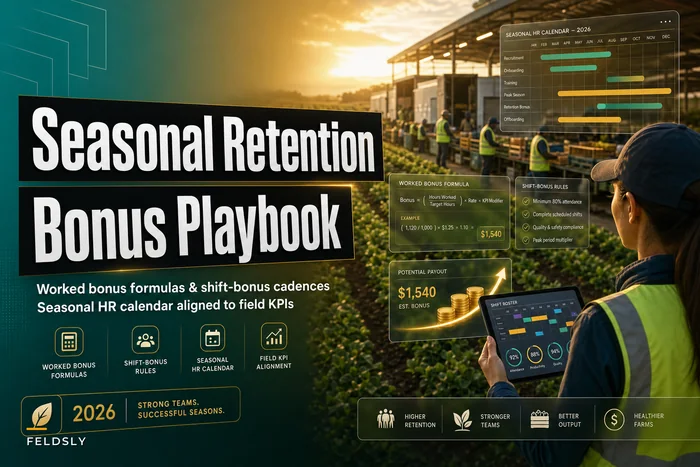
However you store it, the discipline is the same: assess on real tasks, keep at least two certified people per critical job, name someone accountable for closing gaps before the window, and refresh on a schedule tied to your actual calendar. Skills aren't permanent, your crew changes, and peak windows don't wait. And it pairs naturally with the retention side of the equation — keeping your certified people season over season, which the seasonal retention playbook with worked bonus formulas covers in detail, means you're not re-certifying brand-new faces every single year.
However you store it, the discipline is the same: assess on real tasks, keep at least two certified people per critical job, name someone accountable for closing gaps before the window, and refresh on a schedule tied to your actual calendar. Skills aren't permanent, your crew changes, and peak windows don't wait. And it pairs naturally with the retention side of the equation — keeping your certified people season over season, which the seasonal retention playbook with worked bonus formulas covers in detail, means you're not re-certifying brand-new faces every single year.
Ready to revolutionize your farm management?
Join 500+ farms using Feldsly to boost yields, reduce waste, and streamline daily farm workflows.