

A problem that almost never comes up in the precision-ag conversation: most farms treat agronomy outputs — prescription maps, variable-rate scripts, nutrient recommendations — like gifts that show up from an agronomist or software vendor, not like deliverables with acceptance criteria. Someone sends a shapefile. The operator loads it. The crew runs it. And if the as-applied map comes back looking nothing like the prescription, everyone shrugs and blames the monitor.
That gap — between what the prescription says should happen and what the equipment actually did — is where precision ag quietly leaks money. And the fix isn't better software. It's treating these outputs the way a product team treats a release: with service-level agreements, acceptance tests, and verification cadences that catch problems before the crew is sitting in the cab guessing.
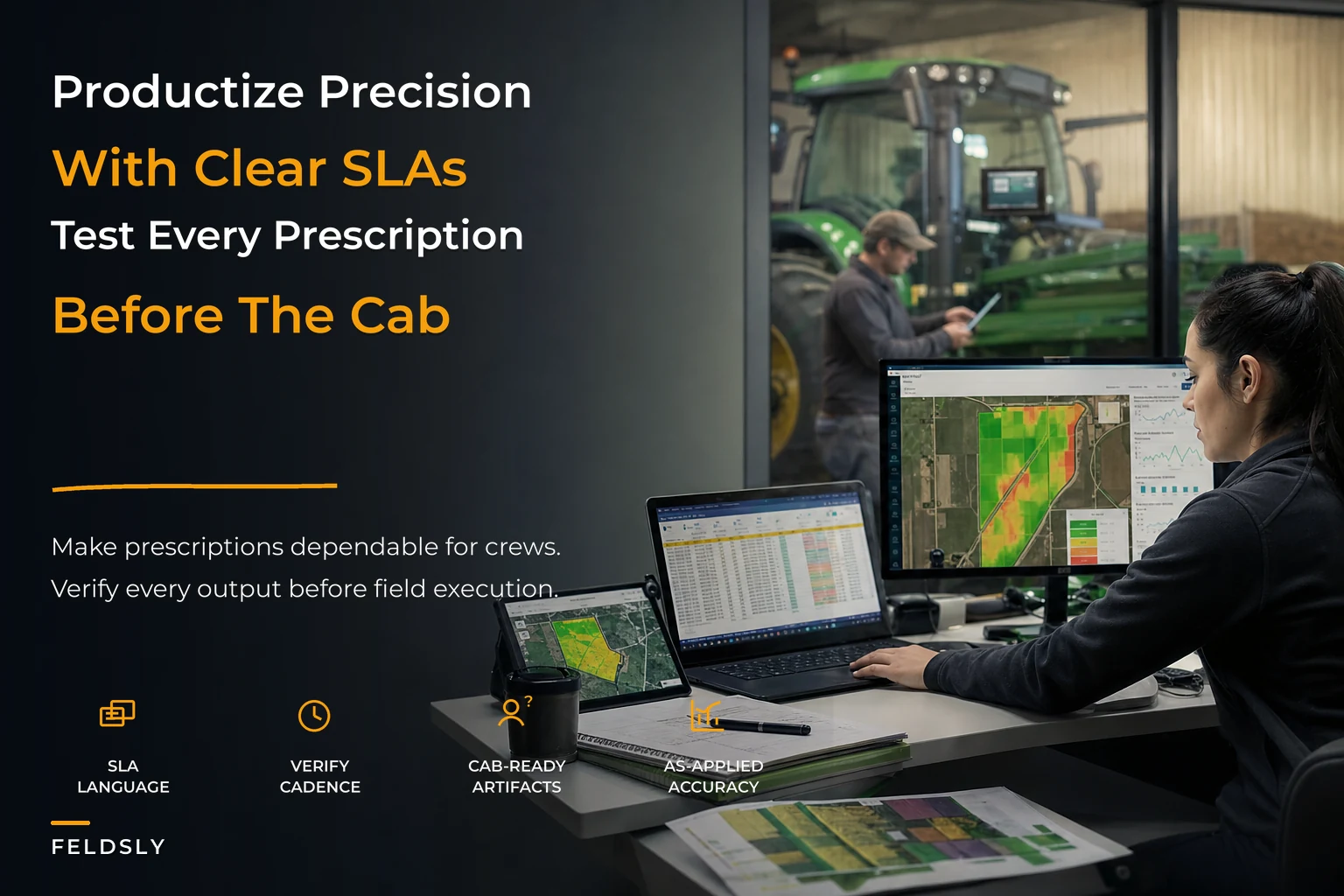
That's what precision ag productization actually means. Not fancier dashboards. Every map, script, and recommendation comes with a contract about accuracy, a test that confirms it's usable, and a schedule for checking that it did what it promised.
Why precision outputs break down even on good farms
The breakdown almost never has anything to do with the quality of the agronomy. You can have a genuinely excellent prescription and still get a bad application, because the output travels through roughly six handoffs before it touches soil and nobody owns the gaps between them.
-
Soil sampling was on a 2.5-acre grid, but the prescription was written as if it were 1-acre resolution.
-
The shapefile was generated in one coordinate system and the controller interpreted it slightly differently.
-
The script assumed a product density the operator didn't actually have loaded.
-
Section control lagged on turns, so headlands got double- or under-applied.
-
The as-applied data was never pulled off the monitor, so nobody could tell any of this happened.
Each one is a small, forgivable error. Stacked, they turn a $14/acre prescription into something that performs like a flat-rate pass — except you paid for the data, the sampling, and the premium product on top.
What makes this a systems problem instead of a one-off mistake is that it repeats every season, across every field, with slightly different failure points each time. The farm never builds a memory of what went wrong because nothing was ever defined as "right" in the first place. There's no spec to fail against.
This connects directly to how farms handle metrics in general. If your operation is chasing numbers that look good on a screen but don't tie to field reality — the issue covered in operational KPI and dashboard governance — then your precision outputs are floating in the same fog. You can't productize what you haven't agreed to measure.
The mental shift: outputs are deliverables, not gifts
The single most useful move is to stop thinking of a prescription map as advice and start thinking of it as a delivered artifact with a spec. A product manager shipping software doesn't say "I hope this works." They say: here's what it's supposed to do, here's how we'll test it, and here's the threshold where we reject it.
Take control of your farm’s productivity.
Feldsly helps you plan, track, and optimize every farming operation with precision.
- Centralized crop scheduling
- Resource & labor management
- Real-time weather alerts
No credit card required
Apply that to a VRA nitrogen script and three questions suddenly become obvious:
-
What accuracy did we promise? (As-applied rate within X% of target on Y% of the field.)
-
How do we confirm it before it runs? (An acceptance test on the file and the equipment setup.)
-
How do we verify it did what it said afterward? (A verification cadence comparing as-applied to prescribed.)
Most farms do zero of these formally. The agronomist delivers, the operator loads, and the only "test" is whether the monitor throws an error. That's not quality control — that's hoping.
The farms that get this right treat the agronomist (or the internal analytics team) almost like a vendor shipping to a spec, even when that agronomist is a trusted partner of 15 years. It's not about distrust. It's about making the invisible gaps visible so they can actually be closed.
Writing an SLA for as-applied accuracy
An SLA here is just a plain-language agreement about what "good enough" means for a precision output. It doesn't need lawyers. It needs numbers everyone agrees to and a consequence when they're missed.
> As-Applied Accuracy SLA — Variable-Rate Prescriptions
-
Delivered scripts will match the agreed management-zone resolution (min. 1.0 ac) and use coordinate system [EPSG:xxxx].
-
On execution, as-applied rate will fall within ±10% of the prescribed rate on ≥90% of mapped acres, excluding headland overlap zones.
-
Headland and point-row application variance will not exceed ±20% across ≥85% of those acres.
-
As-applied data will be returned and reconciled against the prescription within 5 business days of application.
-
Fields failing the accuracy threshold trigger a root-cause review before the next pass is scheduled. No reruns without a documented cause.
Notice what that language forces. It forces someone to define management-zone resolution. It forces the coordinate system to be stated out loud. It forces the as-applied data to actually come off the monitor on a deadline — which in real operations is where half of all failures hide, because nobody pulls the card until December.
A few things worth getting right when you write yours:
-
Set thresholds you can actually hit. ±10% on 90% of acres is realistic for a well-calibrated rig. ±2% on 100% is a fantasy that makes the whole SLA ignorable.
-
Carve out headlands explicitly. Overlap and turn-compensation errors are physics, not negligence. Hold them to a looser standard so the main-field number stays meaningful.
-
Put a clock on the data return. The verification only works if the as-applied file shows up while the season is still fresh.
Set thresholds you can actually hit.
For the internal-team version — where your own analytics group produces the prescriptions — the SLA lives alongside your broader farm analytics operating model. The accuracy promise is just one more output your analytics function is accountable for, the same way they're accountable for yield benchmarks or anomaly alerts.
The acceptance test: catching bad files before the cab
An SLA tells you the standard. The acceptance test is what you run before the script ever gets loaded, so a broken file doesn't become a broken field. Think of it as the pre-flight check between "prescription delivered" and "operator executes."
A practical acceptance-test spreadsheet has one row per delivered prescription and columns that an office person can fill in without agronomy expertise:
| Check | Pass Criteria | Field 14N | Field 22S |
|---|---|---|---|
| File format matches controller | .shp / ISOXML as specified | ✅ | ✅ |
| Coordinate system correct | Matches rig default | ✅ | ⚠️ reprojected |
| Rate column populated, no nulls | 0 blank cells | ✅ | ✅ |
| Min/max rate within agronomic bounds | 0–240 lb N | ✅ | ❌ max 310 |
| Product density matches load | Matches ticket | ✅ | ✅ |
| Zone resolution ≥ 1.0 ac | No sub-acre slivers | ✅ | ✅ |
| Total product = budgeted ± 5% | Within tolerance | ✅ | ⚠️ +8% |
| Boundary matches current field boundary | No drift from last map | ✅ | ✅ |
Field 14N passes clean. Field 22S has three flags — a reprojection note, a max-rate that blows past the agronomic ceiling, and a total product figure 8% over budget. That field does not get loaded until someone resolves those flags. Ten minutes at a desk just prevented a 310 lb N stripe and an $800 product overrun on one field.
The whole point: move the error-catching to the cheapest possible place — a computer in the office — instead of the most expensive place, which is the cab at 6am with the operator already behind schedule. Once a crew is rolling, every correction costs daylight, and daylight during planting is the one thing you can't buy back.
This is the backbone that makes a VRA program survive contact with reality. The in-cab execution side of this is covered in the variable-rate application execution checklist — the acceptance test is what feeds that checklist clean inputs so your crews aren't absorbing upstream mistakes.
Making artifacts cab-ready
A failure mode that's nearly invisible until you watch it happen: the prescription is perfect, the acceptance test passed, and the operator still overrides it — because what showed up on the monitor didn't match what he expected, and he had no way to tell whether to trust it.
Operator overrides are the silent killer of precision programs. Every time a crew member flips to manual or flat-rate because "the map looked weird," your entire data-and-agronomy investment gets thrown out for that pass. And they do it for rational reasons — they don't want to be the one who dumped 240 lb of N where it wasn't needed because a file was wrong.
A cab-ready artifact is the output packaged so the operator can trust it and verify it in seconds. At minimum it includes:
-
A one-page field summary
target rates, min/max, total product expected, zone count.
-
A plain-language note on anything unusual ("Zone 3 bumped high — known sand knob, this is intentional").
-
The expected total product the operator can sanity-check against what's loaded.
-
A clear version number and date so nobody runs last week's rejected script.
That last point matters more than it sounds. In real operations, the most common override trigger isn't a bad map — it's an old map, where a corrected version got made but never reached the controller. Version control on your artifacts eliminates a whole category of "the monitor's acting up" complaints.
When operators have a cab-ready sheet that tells them what to expect and flags the weird-but-intentional zones ahead of time, overrides drop. Not because you've taken away their judgment — because you've given their judgment the context it was missing.
Verification cadences that actually get run
The verification cadence is the part everyone agrees is a good idea and almost nobody does, because by the time the season's over the data card is in a drawer and the fire is out.
The trick is to tie verification to a rhythm that already exists, not invent a new chore. Three layers work well:
Per-pass (same day). Operator confirms the as-applied card was pulled and uploaded. That's it. One checkbox. This single discipline is what makes everything downstream possible, and it's the step that collapses most often.
Per-field (within the SLA window — 5 days). Someone in the office runs the as-applied-vs-prescribed comparison and records the pass/fail against the accuracy SLA. Fields that fail get a root-cause tag: calibration, file error, operator override, equipment lag, product substitution.
Season-level (post-harvest). Roll up every field's pass/fail and, more importantly, the root-cause tags. This is where the pattern shows up — if 70% of your failures tag as "operator override," you have a trust problem, not a data problem. If they tag as "calibration," you have a maintenance problem.
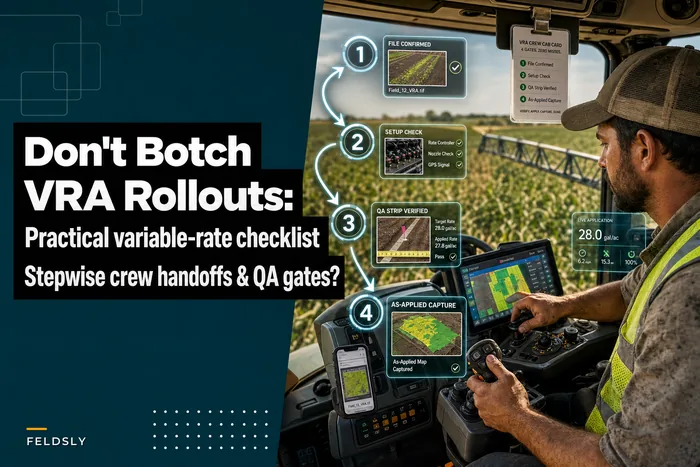
Here's a simple workflow diagram of the verification cadence.
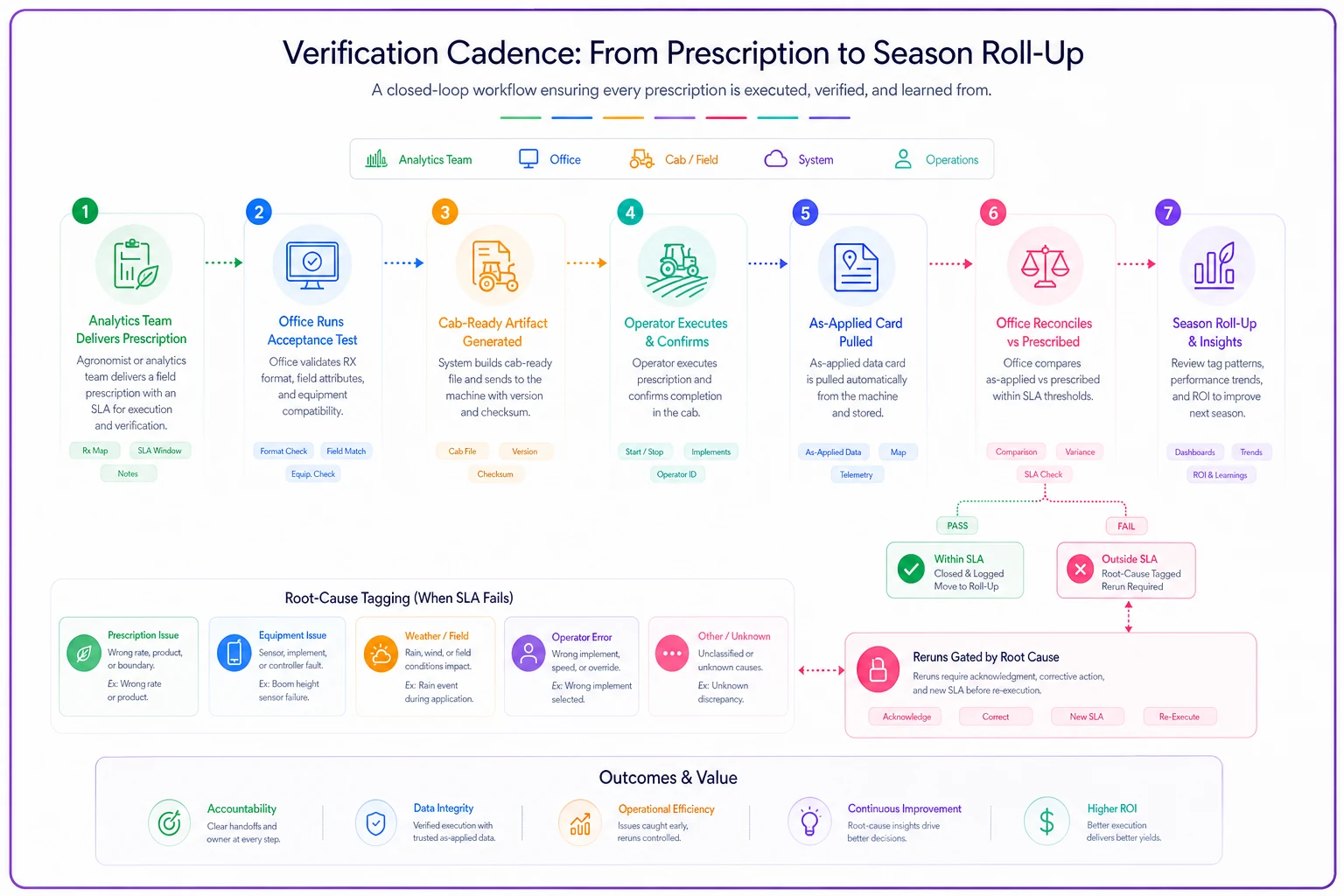
The numbered loop in order:
-
Agronomist/analytics team delivers prescription with SLA attached.
-
Office runs acceptance test → pass, or kick back for fix.
-
Cab-ready artifact generated with version number.
-
Operator executes, confirms as-applied card pulled (per-pass check).
-
Office reconciles as-applied vs prescribed within 5 days (per-field check).
-
Failures get root-cause tagged, reruns gated behind documented cause.
-
Season roll-up reviews tag patterns to fix the system, not the field.
That seventh step is the one that compounds. A farm that root-cause-tags for two seasons stops being surprised. They know their section-control lags on the pivot corners, they know which operator distrusts the fall P maps, they know the co-op's shapefiles always need reprojecting. The knowledge becomes institutional instead of living in one person's head.
A real scenario
A roughly 4,200-acre corn-soy operation in the eastern Corn Belt had been running variable-rate nitrogen and seed for three seasons and couldn't tell whether it was working. Their agronomist was good. Their equipment was newer. But yield maps weren't lining up with the prescriptions and nobody could say why.
When they finally pulled a season of as-applied data and compared it to prescriptions, the results were ugly in an instructive way. On nitrogen, only about 60% of mapped acres fell within ±10% of target. The two biggest culprits: one operator was flipping to flat-rate on any field where the map "looked busy," and a loader density mismatch on the dry-fertilizer rig was skewing rates by around 12% on three fields.
They didn't buy anything new. They wrote a one-page accuracy SLA, built the acceptance-test spreadsheet, started generating cab sheets, and added the three-layer verification cadence. The override problem mostly solved itself once the operator got a cab-ready sheet flagging the intentional high zones — he just needed to know the busy-looking map wasn't a mistake.
By the next season, as-applied-within-tolerance moved from roughly 60% to somewhere in the high 80s. On nitrogen alone, tighter application was worth an estimated $9–$12 per acre between product savings and recovered yield in the previously over-applied zones — somewhere north of $35k across the N program, on a system that cost them a few spreadsheets and a Friday-afternoon reconciliation habit.
When this is worth it — and when it's overkill
This isn't for everyone.
When it makes sense:
-
You're running variable-rate on a meaningful share of acres.
-
You've got multiple operators or multiple equipment setups, so handoff errors multiply.
-
You're paying premiums for data, sampling, or inputs and can't verify the return.
-
You're multi-field or multi-site, where "I'll just check it myself" doesn't scale.
When it's overkill:
-
You're flat-rating most inputs. There's no prescription-to-reality gap to manage.
-
You're a single operator on a handful of fields who loads every script personally. You already are the verification cadence.
Who should not start here: if you can't reliably get as-applied data off your monitors at all, fix that first. An accuracy SLA is meaningless without the as-applied file to check it against. The verification layer is the floor this whole thing stands on.
Where the tooling fits — quietly
Most of this can start in a spreadsheet, and honestly, starting in a spreadsheet is the right call because it forces you to decide what you actually care about before you automate anything.
But the acceptance test and the reconciliation are exactly the kind of repetitive, rules-based checking that gets skipped the moment the season gets busy — which is precisely when you need it most. This is where AI-assisted operational software earns its place: not by making agronomy decisions, but by running the boring checks automatically. A platform that ingests delivered shapefiles, auto-flags null rate cells, out-of-bound maxes, reprojection mismatches, and budget overruns, then pulls as-applied data and runs the ±10% reconciliation without a human remembering to — that's the difference between a verification cadence that survives planting and one that dies in week two.
The same goes for version control on cab-ready artifacts and auto-tagging failure root causes across a season. Not glamorous work. But it's the operational connective tissue that keeps your precision investment from leaking, and it's well suited to automation precisely because it's repetitive and rule-bound. The judgment stays with you and your agronomist. The remembering-to-check gets handled.
The real takeaway
Precision ag doesn't fail because the agronomy is wrong. It fails in the gaps between the prescription and the soil — handoffs nobody owns, files nobody tested, overrides nobody tracked, as-applied data nobody pulled. Treating these outputs as products with SLAs, acceptance tests, and verification cadences closes those gaps by making the invisible visible and assigning someone to care about it.
You don't need more data. You need a contract about what the data you already pay for is supposed to do, a cheap test to catch the failures before they hit a field, and a rhythm for checking that it worked. Do that for two seasons and your precision program stops being an article of faith and starts being something you can actually manage.
Ready to revolutionize your farm management?
Join 500+ farms using Feldsly to boost yields, reduce waste, and streamline daily farm workflows.