

Most farms don't lose yield because they can't spot problems. They lose yield because the problem gets spotted, then sits.
A scout flags a chlorotic patch in Field 7 on a Tuesday. It lands in a group text. The agronomist sees it Thursday. By the time someone decides whether it's nitrogen, sulfur, or standing water, the window where a corrective pass would've paid for itself has already closed. Nobody did anything wrong, exactly. The information just never connected to a decision, and the decision never connected to a crew with a sprayer and an open morning.
That gap — between knowing and doing — is what operational agronomy integration is actually about. Not fancier sensors. Not better satellite imagery. The plumbing that turns an observation into a scheduled, resourced action with someone accountable for it. Once you see it as a system, most of the fixes become obvious.
Why the handoffs break (and why it gets worse as you add fields)
On a single quarter-section with the owner doing most of the work, integration happens in one person's head. You see the yellow stripe, you know your soil, you call your supplier, you spray it. The "system" is a guy on a four-wheeler with a good memory.
That doesn't scale. Somewhere around 1,500–2,000 acres — or when you bring on a second decision-maker — the single-brain model stops working. Information that used to live in one head now has to travel between people: scouts, agronomist, procurement, crew lead. Every handoff is a place where things stall or get distorted.
-
Capture is inconsistent. Different scouts record different things. One sends a photo, another sends a text description, a third just mentions it at lunch. No common format means triage is impossible.
-
Nobody owns the decision. Everyone assumes someone more senior will make the call. The observation becomes a hot potato nobody wants to act on without authority.
-
The decision has no hook into execution. Even when a call gets made — "variable-rate sulfur on the north 80" — there's no clean link to procurement for the product, to the VRA prescription build, or to a crew's schedule. So it waits.
The pattern underneath all three: people treat agronomy as a knowledge problem when at scale it's a coordination problem. You already know enough. The question is whether your knowledge can travel fast enough to matter.
The minimal-data scouting packet
The first fix is counterintuitive. You want scouts to record less, not more — but the same less, every time.
Take control of your farm’s productivity.
Feldsly helps you plan, track, and optimize every farming operation with precision.
- Centralized crop scheduling
- Resource & labor management
- Real-time weather alerts
No credit card required
The mistake most farms make is building an elaborate scouting form nobody fills out completely. Thirty fields and a checklist of forty observations means you get sloppy, partial data from tired people at 6pm. Instead, define a minimal packet: the smallest set of fields that lets an agronomist triage remotely without a follow-up call.
A workable minimal scouting packet:
| Field | What goes in it | Why it matters |
|---|---|---|
| Location | Field ID + GPS pin (not "the back corner") | Lets anyone find it again; feeds VRA zones |
| Growth stage | V-stage / R-stage or crop-specific | Determines whether action is even viable |
| Symptom | One-line plain description | Enables fast pattern-matching |
| Extent | % of field + pattern (stripe/patch/edge) | Separates cosmetic from economic |
| Photo | 1 close-up, 1 standing-back | Close-up for ID, wide for extent |
| Severity flag | Green / Amber / Red (scout's gut call) | Drives which alert tier it enters |
Six fields, 90 seconds. The severity flag is the piece people skip and shouldn't. You're not asking the scout to be right — you're asking them to commit to a first guess, which is what triggers everything downstream.
Worth internalizing: structured-but-small beats comprehensive-but-abandoned. A packet that always gets filled is infinitely more useful than a thorough one that gets filled half the time.
The 3-tier alert-to-action matrix
Once packets are flowing, you need a rule for what level of confirmation each alert deserves before you spend money on action. Not every yellow stripe justifies a lab test. Not every lab-worthy problem can wait for one.
-
Tier 1 — Visual confirmation. A second set of eyes looks at the photo or walks the spot. Cheap, same-day. Resolves the obvious stuff — a sprayer skip, edge-of-field compaction, a known herbicide carryover pattern.
-
Tier 2 — Drone / imagery pass. When extent is unclear or the pattern suggests something spatial (drainage, application error, variable soil), fly it. You get an NDVI or true-color map that tells you how much of the field is affected and whether it's worth a prescription.
-
Tier 3 — Lab / tissue / soil test. When the diagnosis changes what product you buy — nitrogen vs. sulfur vs. a micronutrient — you need confirmation before committing dollars to inputs. Slow, expensive, definitive.
The matrix maps severity flags and symptom types to a starting tier:
| Scout flag | Symptom type | Start at | Escalate if |
|---|---|---|---|
| Green | Cosmetic / small patch | Tier 1 | Spreads week-over-week |
| Amber | Nutrient-like striping | Tier 2 | Imagery confirms >15% area |
| Amber | Pest / disease suspect | Tier 1 → 3 | Visual confirms live pressure |
| Red | Widespread / rapid | Tier 2 + 3 parallel | — (act on both) |
The key point: you escalate tiers based on economic stakes, not curiosity. A lot of managers over-test because a lab result feels reassuring. But a $90 tissue sample that confirms something you'd already decided to act on is wasted money and, worse, wasted days. Run the tier that changes your decision, not the one that confirms your hunch.
For the nutrient-specific side of this — thresholds by growth stage and QA turnaround on lab results — the sampling-to-application workflow in our fix nutrient gaps fast guide pairs directly with this matrix.
Decision gates with RACI (so the hot potato stops)
An alert that's been confirmed still needs someone to authorize action and someone to execute it. Without explicit gates, you get one of two failures: either everything waits for the owner, or crews act on their own and you find out about unbudgeted passes at invoice time.
A decision gate is a defined checkpoint — this confirmed observation, above this threshold, requires this person to approve, and then flows to this person to execute. RACI just makes the roles unambiguous: Responsible (does the work), Accountable (owns the outcome / final sign-off), Consulted, Informed.
| Decision | Responsible | Accountable | Consulted | Informed |
|---|---|---|---|---|
| Triage scouting packet | Agronomist | Agronomist | Scout | Crew lead |
| Approve Tier 2 drone pass | Crew lead | Agronomist | — | Owner |
| Approve corrective input purchase (<$5k) | Agronomist | Agronomist | Procurement | Owner |
| Approve corrective input purchase (>$5k) | Agronomist | Owner | Procurement | — |
| Build & load VRA prescription | VRA tech | Agronomist | — | Crew lead |
| Execute application | Crew lead | Crew lead | — | Owner |
Two things make this work that people usually miss.
First, the Accountable column should almost never be two names. One throat to choke per decision. The moment two people are jointly accountable, nobody is.
Second, the dollar threshold on purchase authority is the single most freeing thing you can install. When your agronomist can commit up to $5k without chasing the owner for a signature, same-day corrective action becomes normal instead of exceptional. Above that, it escalates. That one line removes most of the stalling.
Wiring decisions into procurement, VRA, and crew schedules
A gate that approves an action but doesn't touch the three operational systems is just a nicer-looking stall. Integration means the approved decision generates the downstream work — or at least hands it off with zero re-typing.
The three hooks:
-
Procurement. The approved corrective action specifies product and rate, which means it specifies a quantity to source. If your buffer stock covers it, draw down and flag the reorder. If not, the purchase request goes to procurement the same hour the decision is made, not three days later when someone remembers.
-
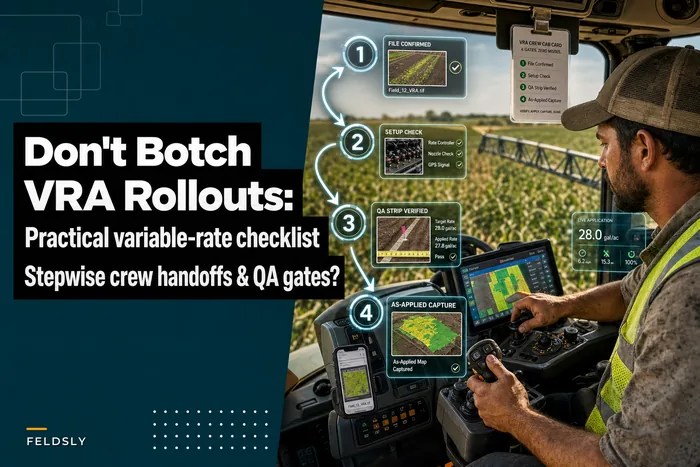
VRA prescription. If the fix is spatial — and most nutrient and population fixes are — the confirmed imagery and field zones feed the prescription build. Getting this handoff clean is its own discipline; the execution checklist in our VRA rollout guide covers the crew-side failure points that quietly ruin otherwise-good prescriptions.
-
Crew schedules. The execution task needs a slot. This is where most corrective actions die quietly — the decision is made, the product is on hand, the prescription is loaded, and then it sits because nobody blocked time on a crew calendar. The gate output should create a schedulable task with a by-when, tied to the agronomic window. A sulfur correction at V6 is worthless at V12.
The workflow, start to finish: scout files minimal packet with Red flag → agronomist triages, runs parallel Tier 2/3 → imagery confirms 20% of field affected, tissue confirms sulfur deficiency → agronomist approves $3,200 ammonium sulfate purchase (under threshold, no owner wait) → procurement draws buffer, flags reorder → VRA tech builds prescription from confirmed zones → crew lead slots the pass for the next open morning inside the window → owner is informed, not consulted. No step waits on a step that didn't need to happen first.
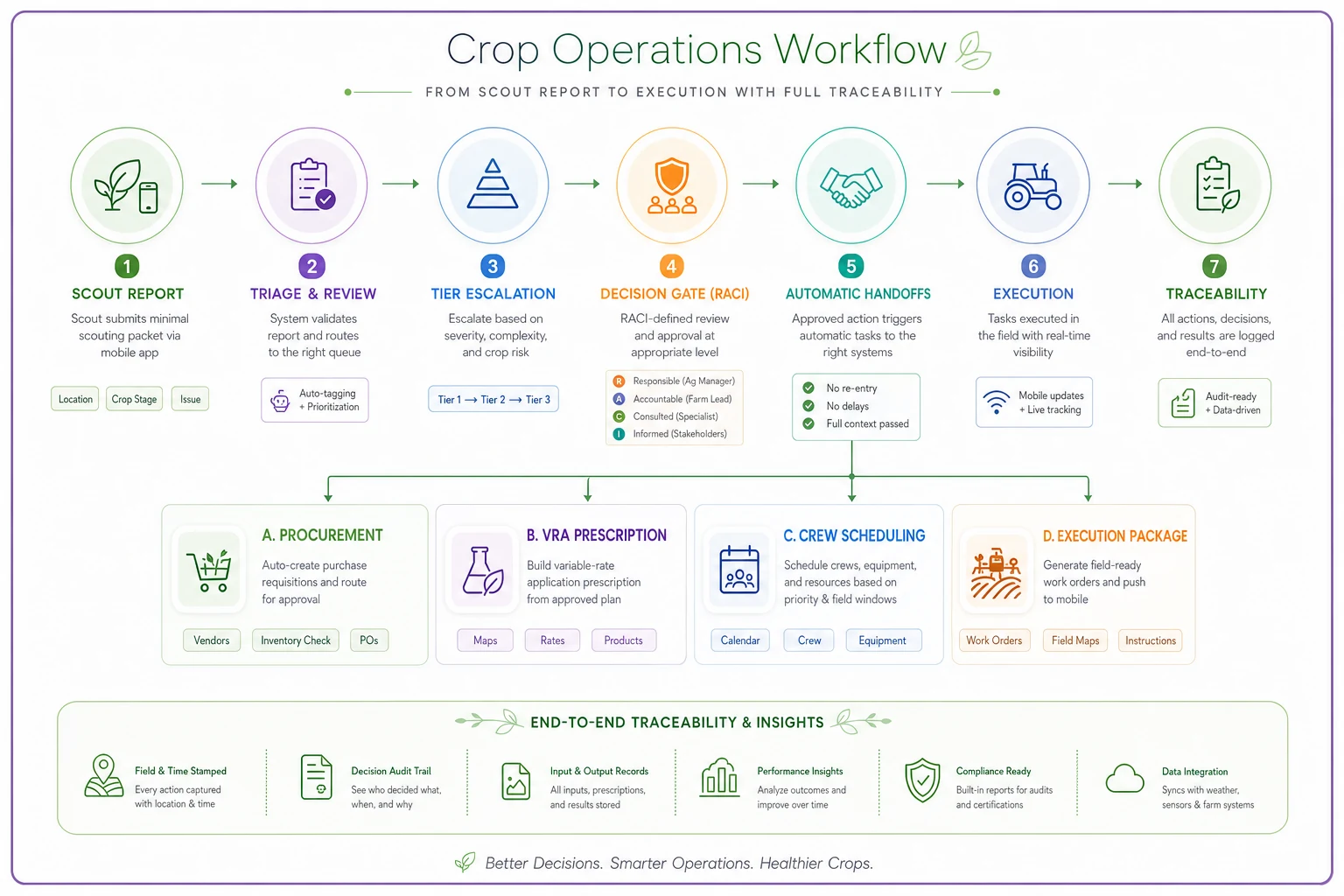
A simple diagram of this flow makes it obvious where information must pass and who gets notified at each step.
Cadence: the rhythm that keeps the system from silting up
Systems don't fail at the moment of crisis. They silt up during quiet weeks when nobody's reviewing anything, and then the backlog hits during the window when you have no slack.
| Cadence | Who | What |
|---|---|---|
| Daily (peak) | Scouts | File packets; flag Reds immediately |
| Daily (peak) | Agronomist | Clear triage queue to zero |
| 2x/week | Crew lead + agronomist | Review open gates, confirm schedule slots |
| Weekly | Procurement + agronomist | Reconcile buffer draws, pending reorders |
| Weekly | Owner | Review Amber-and-above actions + spend |
| Season-end | All | Review closed tickets for patterns |
The non-negotiable line is clearing the triage queue to zero, daily, during peak. An observation that's three days old has usually lost most of its value. Letting the queue build is the thing that turns a good system back into the original problem.
A worked example per failure mode
Failure mode: nutrient deficiency, caught mid-stage. Soybeans, roughly 160 acres, scout flags Amber interveinal yellowing at V5. Starts Tier 2 — drone shows a 25-acre patch tracking an old field boundary. Tissue test (Tier 3) confirms manganese. Agronomist approves a foliar Mn pass at around $14/acre, under threshold. Crew slots it two days later. Without the system, this is the one that sits until R1 and costs 3–5 bu/ac on the affected zone.
Failure mode: suspected disease pressure. Corn, scout flags Red — lesions, spreading. Tier 1 visual that same afternoon confirms live gray leaf spot below ear leaf at a susceptible stage. This skips imagery entirely because the economic clock is faster than a drone can help with. Agronomist approves fungicide, crew scheduled next morning. The gate here is tuned for speed: visual confirmation triggers direct-to-execute.
Failure mode: application error, not agronomy at all. Scout flags Amber striping with suspicious regularity. Tier 2 imagery shows a clean repeating skip pattern — a plugged nozzle or boom-section fault, not a nutrient problem. No input purchase, no prescription. The action is equipment inspection and a possible re-pass. The matrix saved you from buying product to fix a mechanical problem, which is a more common and expensive mistake than most people admit.
Sample ticket and traceability artifact
Every alert should produce a ticket that survives the season, because the end-of-season pattern review is where you actually learn. A minimal ticket:
-
Ticket ID / date / field ID
-
Scout + severity flag
-
Symptom + extent + photos
-
Tier path taken (e.g., 2 → 3)
-
Diagnosis + confidence
-
Decision + who approved (RACI)
-
Action
product, rate, cost, crew, date executed
-
Outcome note (filled at season-end
did it work?)
That last line is what most farms never capture, and it's the whole point of traceability. When you review closed tickets in the off-season and notice sulfur corrections showing up in the same three fields every year, you've stopped treating symptoms and started fixing a soil problem. The same discipline applies when you're deciding whether a corrective practice should become standard — our guide on governing on-farm trials walks through turning those repeated observations into decisions you can actually defend.
When this full system makes sense — and when it's overkill
It makes sense when you're past the single-brain threshold: multiple fields, multiple people touching decisions, and at least one season where a caught-but-ignored problem cost you real yield. If handoffs are where things die, this is your fix.
It's overkill on a tight, owner-operated block where you scout, decide, and spray yourself. Installing RACI tables for a one-person operation is process for its own sake. Keep it in your head until the head gets too full.
Who should not do this: anyone treating it as a one-time setup. A decision-gate matrix that nobody maintains as roles change is worse than none — crews will route around a system they don't trust, and you end up with the illusion of coordination without the substance.
As operations grow, the tracking itself becomes the bottleneck. Spreadsheets of tickets, photos scattered across phones, prescriptions in one tool and schedules in another. That's usually the point where farms move to a shared operational platform — something that keeps the packet, the gate, the procurement hook, and the crew schedule in one thread, so nothing has to be re-typed between steps and the triage queue is visible to everyone at once. The software isn't the system. The handoff discipline is. But past a certain scale, a shared workspace is what keeps the discipline from depending on any one person's memory.
The real takeaway
Integration isn't a technology you buy. It's the set of defined handoffs that let an observation in Field 7 on a Tuesday become a scheduled, resourced, accountable action by Wednesday. The farms that do this well aren't the ones with the best agronomists — they're the ones where a good agronomist's judgment can travel through the organization fast enough to still matter when it lands.
Start with the minimal packet. Add the tier matrix so you spend confirmation dollars only where they change a decision. Nail the RACI gates so nothing waits on authority it didn't need. Then wire the approved decision straight into procurement, VRA, and the crew calendar. Each piece is simple. The value is entirely in how they connect.
Start with the minimal packet. Add the tier matrix so you spend confirmation dollars only where they change a decision. Nail the RACI gates so nothing waits on authority it didn't need. Then wire the approved decision straight into procurement, VRA, and the crew calendar. Each piece is simple. The value is entirely in how they connect.
Ready to revolutionize your farm management?
Join 500+ farms using Feldsly to boost yields, reduce waste, and streamline daily farm workflows.