


Walk into almost any mid‑size grain or row‑crop operation and ask how last season's variety strips or that new biological turned out, and you'll usually get a shrug and a story. "The strip with the new hybrid looked better on the north end, but the ground's better there anyway." That's the whole problem in one sentence. A trial got planted, something got observed, and then nothing binding happened. The product got either quietly dropped or quietly expanded — based on a gut feeling, not a decision anyone could defend when the seed rep or the CFO asked why.
On‑farm trial governance is the missing layer between "we tried something" and "we changed what we buy and plant." It's not about running fancier statistics. It's about building a repeatable path from a hypothesis, through minimum data and QA checks, to a decision gate that actually ties into procurement and the planting plan. Most operations have decent agronomy. What they lack is the discipline that turns a season of scattered observations into a purchase order or a hard no.
Why good trials still produce useless decisions
On the front end, nobody writes down what the trial is actually supposed to prove. Someone says "let's try the new nitrogen stabilizer this year," and a couple of passes get done wherever it was convenient. There's no target, no threshold, no definition of what "worked" even means. When harvest rolls around, you can make the numbers say almost anything because you never committed to what would count as a win.
On the back end, the data sits. Yield monitor files never get cleaned. The strip boundaries don't line up with the as‑applied maps. Somebody meant to pull tissue samples at V6 and forgot. By the time anyone looks, it's December, the seed order is due, and the trial that was supposed to inform the decision is a folder of half‑cleaned CSVs nobody trusts.
A pattern shows up again and again across operations of every size: the trials that get acted on aren't the ones with the best agronomy — they're the ones where somebody happened to remember the story confidently in the sales meeting. That's a governance failure, not a data failure. The confident story wins even when the data underneath it is thinner than the trial that got ignored.
What breaks as you scale from a few strips to a real program
One farm running three strips can get away with running everything out of one person's head. The manager remembers where the strips are, roughly what got applied, and how it looked. It's fragile, but it usually holds. Now stretch that across 8,000–12,000 acres, four or five agronomic zones, a couple of custom applicators, and maybe eight to twelve trials running at once — variety, fertility, biologicals, seeding rate, a fungicide timing test. Suddenly the head‑based system collapses in specific, predictable ways:
Take control of your farm’s productivity.
Feldsly helps you plan, track, and optimize every farming operation with precision.
- Centralized crop scheduling
- Resource & labor management
- Real-time weather alerts
No credit card required
-
Trial drift. The applicator doesn't know a check strip is a check strip and treats it. Now you have no comparison at all.
-
Boundary mismatch. The trial plan says 24 rows; the planter monitor logged something else; the yield data can't be split cleanly.
-
Missing mid‑season data. The one QA step that makes the trial interpretable — a stand count, a tissue sample, a pre‑harvest moisture read — never happened because nobody owned it.
-
Orphaned outcomes. The trial finishes, someone even analyzes it, and then the result never reaches whoever cuts the seed and input purchase orders in time to matter.
That last one is the killer. What shows up across a lot of operations is that the analysis often does get done — it just arrives two weeks after the procurement window closed. A correct answer delivered late is operationally identical to no answer at all.
The five gates that make a trial governable
Think of a trial as passing through gates. It can't advance until it clears each one, and each gate has an owner and a written standard. This is the core of on‑farm trial governance, and it's deliberately boring — boring is what survives a busy season.
| Gate | What it checks | Who owns it | Fails when... |
|---|---|---|---|
| 1. Hypothesis | Is there a written, testable claim with a threshold? | Agronomy lead | "Let's just try it" with no target |
| 2. Design & minimum data | Replication, check strips, required samples defined | Agronomy lead | One strip, no check, no data plan |
| 3. Execution QA | Was it planted/applied as designed? | Applicator / operator | Check strip treated, boundaries off |
| 4. Data QA | Is the harvest data clean and matched to boundaries? | Data owner | CSVs unmatched, gaps ignored |
| 5. Decision | Did it clear the threshold? Buy, drop, or expand? | Owner / manager | Result never ties to procurement |
The point isn't the table. The point is that a trial can be stopped at any gate, and stopping early is a feature. A trial that fails execution QA in June should be flagged in June — not analyzed in December as if the data were valid.
Hypothesis templates: the front gate nobody wants to fill out
The hypothesis template is one paragraph, and it's the highest‑leverage thing on this entire list. It forces you to name the decision before you know the answer, which is the only time you can be honest about it.
A workable template has five fields:
-
Claim "Product/practice X will improve [specific metric] by at least [threshold] versus our standard."
-
Metric and threshold Exactly what you'll measure and the number that counts as a win. Not "better yield" — "≥ 4 bu/ac net of the treatment cost."
-
Decision it feeds "If it clears, we shift 30% of [acres] next season and adjust the seed/input order accordingly."
-
Minimum data required The specific things that must exist for the trial to count — stand counts, matched yield data, applied‑rate verification.
-
Kill condition What makes this trial invalid mid‑season (check strip got sprayed, hail on the block, planter skip).
The threshold field is where people flinch, and that flinch is the tell. If your agronomist can't say what improvement would justify switching products, you're not running a trial — you're running a demo for the seed company. Writing "≥ 4 bu/ac net" up front means a 2‑bushel bump at harvest is a clear no, even if the plants looked greener and everyone got excited. That single number kills a lot of expensive habit‑buying.
Minimum data and QA gates: what has to be true to trust the result
Minimum data isn't "more data." It's the smallest set of measurements that makes the trial interpretable, defined before planting so nobody has to reconstruct it later.
For a variety strip trial, minimum data might be: matched as‑planted and yield boundaries, a mid‑season stand count on each treatment, harvest moisture by strip, and confirmation that no differential treatment happened. That's it. Four things. But if any one is missing, the trial is a story, not evidence.
The QA gates enforce two separate checks that people constantly blur together:
-
Execution QA answers "did we run the trial we designed?" This has to happen during the season, because most execution failures are only fixable in the moment. A check strip that got fungicide in July can't be un‑sprayed in November.
-
Data QA answers "can we trust the numbers?" Cleaned yield files, boundaries that actually match, outliers explained rather than deleted, and a documented reason for any gap.
PRO TIP: Build your execution QA into the same crew communication you're already doing mid‑season. A quick check-in at V6 costs almost nothing. Catching a contaminated check strip in November costs you the whole trial.
Tying this to the trial lifecycle as a whole, the flow from hypothesis through decision looks something like this:
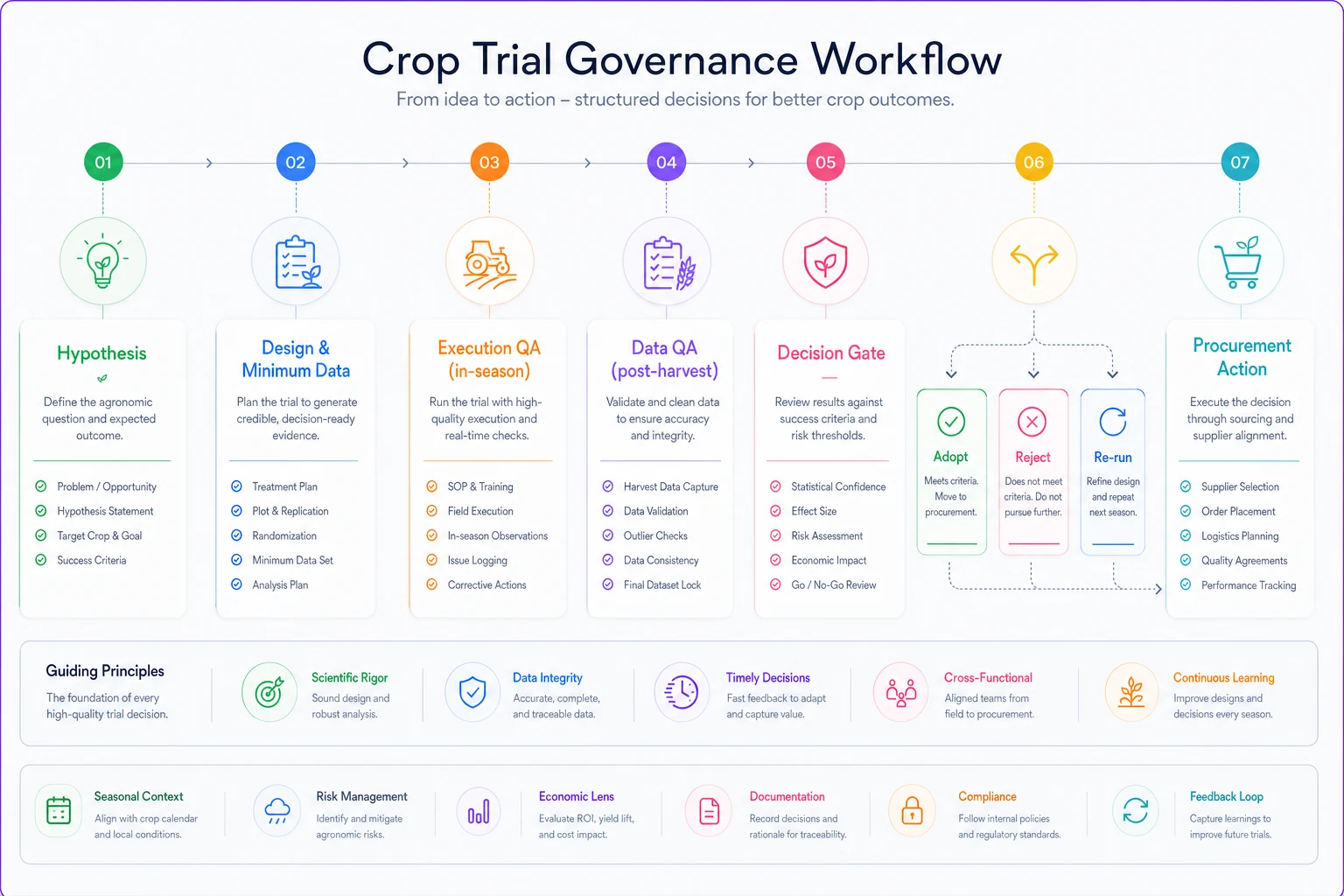
Each step has a named owner and a defined pass/fail condition. If a gate fails, the trial stops there — it doesn't get quietly carried forward into an analysis that pretends the problems didn't happen.
Decision gates: tying the outcome to a purchase, not a feeling
This is where governance either pays for itself or falls apart. A decision gate takes the QA'd result, compares it to the threshold you committed to in the hypothesis, and produces one of three outcomes: adopt, reject, or run again with a change. No fourth option like "keep an eye on it," because "keep an eye on it" is how products live on your farm for six years without ever proving they belong there.
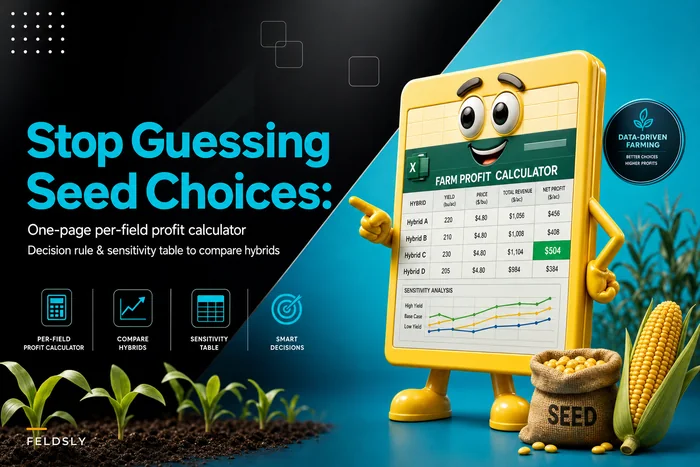
The gate has to be timed to your buying calendar, not your harvest calendar. If seed decisions get locked in November and your variety trial data isn't clean and decided by early November, the gate is useless. Working backward from the procurement deadline is the whole trick — the trial exists to serve a purchase order with a date on it, and everything upstream gets scheduled against that date. This connects directly to how you evaluate seed economics in the first place. A trial result only means something if you can drop it into a per‑field profitability view and see whether the improvement survives contact with cost. If you've already built out a per‑field profitability calculator and decision rule, the trial threshold should feed straight into it — the trial isn't a separate exercise, it's an input to a decision you were already going to make.
Roll‑out checklists: turning a "yes" into acres and orders
An adopt decision that doesn't get executed is worse than no trial, because now you've paid for the trial and the missed change. The roll‑out checklist is what converts a decision gate "yes" into an actual operational shift.
-
[ ] Decision recorded with the metric, threshold, and actual result attached
-
[ ] Acres targeted for the shift identified and mapped
-
[ ] Procurement adjusted — volume, timing, supplier confirmed against the new plan
-
[ ] Planting plan updated so the new product lands where the trial said it should
-
[ ] Applicator and crew briefed on what changed and why
-
[ ] A follow‑up validation trial scheduled to confirm the result holds at scale
-
[ ] Reject decisions logged too, so the same product doesn't get re‑pitched next year as if it were new
Those last two matter more than they look. Adopting at scale without a validation strip means you're betting the whole farm on a small‑plot result, which is its own trap. And logging rejects builds institutional memory — otherwise every retiring agronomist takes a decade of "we already tried that, it didn't clear" out the door with them. The same governance instinct shows up in how the best operations handle multi‑year decisions; a disciplined multi‑year crop rotation system with governance and stress‑tests fails for exactly the same reason a trial program fails — nobody wrote down why the decision was made, so it quietly gets reversed.
A real scenario: the biological that almost got adopted on a feeling
A roughly 9,000‑acre corn and soybean operation ran a foliar biological across parts of six fields, pushed by a strong pitch and a neighbor's good word. No written hypothesis, no defined threshold, check strips left mostly to the applicator's discretion.
At harvest, the treated areas averaged something like 3–5 bu/ac higher than the untreated ground on the same fields. The room was ready to roll it across the whole farm — call it a $12–$14/ac product over 9,000 acres, so a commitment north of $110k for the next season.
Before signing, the manager forced the trial back through the gates it had skipped. Execution QA turned up the problem: on two of the six fields, the "check" strips had actually gotten a different fungicide timing, so the comparison was contaminated. Once those fields were pulled and only the clean comparisons counted, the real difference dropped to about 1–2 bu/ac — under the threshold they would have set if anyone had written one. The net effect after product cost was basically zero, maybe slightly negative.
They didn't adopt it farm‑wide. Instead they ran three clean, properly‑gated strips the next season. The result held near zero, and the product got a documented reject. Governance didn't produce a heroic yield win — it prevented a six‑figure commitment to a product that never actually cleared. That's the more common payoff, and it's the one nobody puts on a highlight reel.
When this level of governance actually makes sense
It makes sense when: you're running enough trials that you can't hold them in one person's head, your input and seed spend is large enough that a wrong adoption costs real money, and you have distinct agronomic zones where "it looked better" is untrustworthy because the ground varies. Past roughly five or six trials a season, or once a single product decision can swing six figures, the overhead pays for itself fast.
It's a bad idea when: you're running one or two strips a year on uniform ground and the manager genuinely is close enough to every acre to catch execution problems in real time. Bolting a five‑gate process onto two strips is bureaucracy for its own sake, and people will route around it.
Who should not do this yet: operations that haven't nailed the basics upstream — clean field boundaries, a working way to capture as‑applied and yield data, someone who actually owns the data. Governance sits on top of reliable data capture. If your yield files are already a mess, fix that first; a governance layer over garbage just formalizes bad decisions.
Where software quietly earns its place
None of this requires software to be correct — you can run the whole thing on a shared spreadsheet and a disciplined manager. What software changes is whether it survives a busy season across a real team.
The predictable breakdowns are ownership and timing: a QA gate with no owner gets skipped, and a decision that lands after the procurement deadline never gets acted on. AI‑assisted operational platforms help mainly by making those two things hard to skip — flagging a trial that's missing its mid‑season stand count before the window closes, matching as‑applied maps to yield boundaries so data QA isn't a manual weekend project, and surfacing decisions against the actual procurement calendar so a "yes" turns into an order on time. The value isn't smarter agronomy. It's that the boring gates get enforced without depending on one person remembering everything at the busiest time of year.
Used that way, the automation stays in the background where it belongs — closing the gap between a trial that finished and a purchase order that changed. The judgment stays with your agronomist. The software just refuses to let a good decision die in a folder of un‑cleaned files.
The gap on most farms isn't between good and bad science — it's between an experiment and a decision. Trials get planted with enthusiasm and abandoned without conclusion, and the products that stick around are the ones with the best sales story, not the best evidence. On‑farm trial governance closes that gap with the least glamorous tools imaginable: a one‑paragraph hypothesis, a defined minimum dataset, two QA checkpoints, a timed decision gate, and a roll‑out checklist that ends in an actual purchase order. Put those five gates between "we tried it" and "we bought it," and your trial program stops being a collection of stories and starts being a system that decides where your money goes.
Ready to revolutionize your farm management?
Join 500+ farms using Feldsly to boost yields, reduce waste, and streamline daily farm workflows.