


The moment a farm crosses from one operating site to two or three, labor stops being a scheduling problem and becomes a routing problem. You have a finite pool of experienced hands, uneven peak windows across sites, and the very real risk that a crew drives 40 minutes to a field that's already overstaffed while another site sits short three people during a cutting window.
A multi-site labor float pool farm setup is supposed to solve that — a shared, movable crew you can deploy across sites as demand spikes. But most farms that try it end up with worse chaos than before, because they move people without the contract language, timekeeping standards, and rostering logic to support it. The crew shows up. The paperwork doesn't.
This post is narrow on purpose. It's about the mechanics of floating crews between sites compliantly — the surge-contract clauses, the rostering heuristics, the cross-site timekeeping rules, and the pre-season cadence that makes it all hold together when you're actually under pressure. If you want the broader structure of how multi-site farms coordinate, the multi-site farm operating model covers the org layer. This is the labor-movement layer underneath it.
Why floating crews breaks down in practice
The idea is simple. The execution falls apart in four predictable places.
The contract wasn't written for movement. Most seasonal hire agreements assume one worksite. When you move someone from Site A to Site C, you've quietly changed their commute, their reporting manager, sometimes their pay rate (if sites have different local wage floors), and occasionally their legal work authorization terms. If the contract doesn't name this possibility, you're improvising — and improvising on labor terms is how you end up in a wage dispute.
Timekeeping doesn't travel. Site A logs hours on a paper sheet signed by one foreman. Site C uses a phone app. A floated worker spends Tuesday morning at A and Tuesday afternoon at C, and now nobody owns the full day. This is where "ghost hours" appear — time that gets double-counted, dropped, or rounded differently at each site. At scale that's not a rounding error, it's a payroll liability.
Rostering is done by gut. A dispatcher mentally tracks who's good at what and sends people around based on memory. That works at one site with twelve people. Across three sites with a 40-person pool, the dispatcher starts defaulting to "whoever's closest" or "whoever answers the phone," and skill-matching collapses. Your best transplanter ends up hand-weeding because that's where the gap was.
Nobody planned the surge before the surge. The decision to float crews gets made the morning you're already short. That's the worst possible time to work out who moves, what they get paid, and whether their contract allows it.
What a surge contract actually needs to say
A surge-ready seasonal agreement isn't longer than a normal one — it just closes the gaps that movement creates. The clauses that matter:
Take control of your farm’s productivity.
Feldsly helps you plan, track, and optimize every farming operation with precision.
- Centralized crop scheduling
- Resource & labor management
- Real-time weather alerts
No credit card required
-
Multi-site assignment clause. Explicitly states the worker may be assigned to any of your named sites within a defined radius, with how much notice (e.g., same-day for emergencies, 24 hours standard).
-
Travel and commute treatment. Whether inter-site travel time during the workday is paid (it usually must be), whether home-to-alternate-site commute triggers any mileage or stipend, and who provides transport.
-
Rate-floor governance. If your sites sit in different wage jurisdictions, the clause should state that the higher applicable floor governs for any day worked across jurisdictions. This single line prevents a mountain of back-pay exposure.
-
Reporting-manager handoff. Names who the worker answers to at the receiving site and who approves their hours that day.
-
Surge-rate trigger. Define the premium (if any) for short-notice floats — a flat per-shift surge bonus is cleaner than fiddling with hourly multipliers.
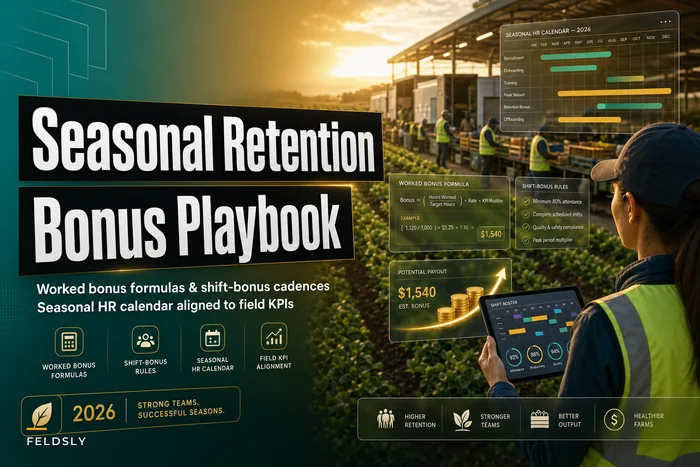
A practical surge-bonus structure pairs well with the broader incentive logic in the seasonal retention playbook. Floated workers who feel the movement is fair — and fairly paid — are the ones who'll say yes next time you need them at 5 a.m.
One mistake worth flagging: farms often set the surge bonus too low to matter but high enough to irritate the non-floated crew. Either make it meaningful or fold it into a transparent seasonal structure. A half-measure buys resentment at both sites.
Cross-site timekeeping standards (the part everyone underbuilds)
If you fix one thing before next season, fix this. Every floated hour needs a single owner and a single record format.
-
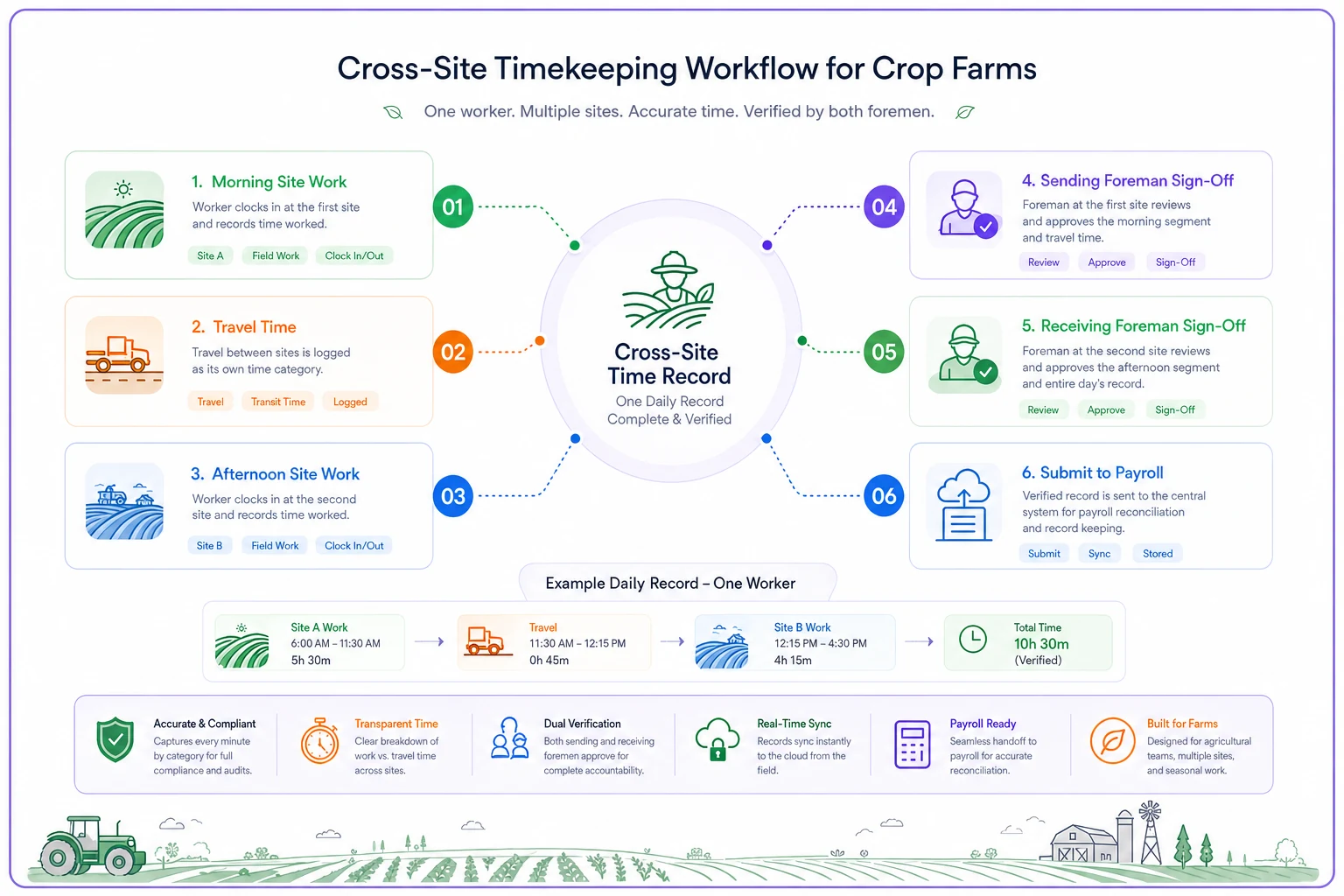
One worker, one daily record — regardless of how many sites they touched. The record is keyed to the worker, not the site.
-
Site segments stamped inside that record. Morning at Site A (3.5 hrs), travel (0.4 hrs), afternoon at Site C (4.0 hrs) — all on one line with clear segment breaks.
-
Travel time logged as its own category, so it's paid correctly and visible in cost reporting.
-
Dual sign-off for split days the sending foreman confirms departure time, the receiving foreman confirms arrival and finish. No gaps.
-
Same rounding rule everywhere. If Site A rounds to the nearest quarter-hour and Site C rounds to the nearest tenth, floated days are a mess. Pick one. Enforce it.
The pattern that shows up constantly: sites each run a "good enough" local system that works fine on its own. The failure only shows up at the seams, on split days — which are exactly the days a float pool creates. Standardize the seam, not just the sites.
This is also where a shared operational platform earns its place. Not as a magic fix, but because a single worker record that both foremen can update from the field — with travel segments and rounding handled the same way everywhere — removes most of the reconciliation problem before it starts. The goal is boring: hours paid match hours worked, no matter how many sites were involved.
A simple workflow for the shared worker record and dual sign-off looks like this.
Enforce the same rounding rule across all sites before you start floating crews.
The goal is boring: hours paid match hours worked, no matter how many sites were involved.
Rostering heuristics that beat gut dispatch
You don't need an optimization engine. You need a few hard rules that stop the dispatcher from defaulting to proximity.
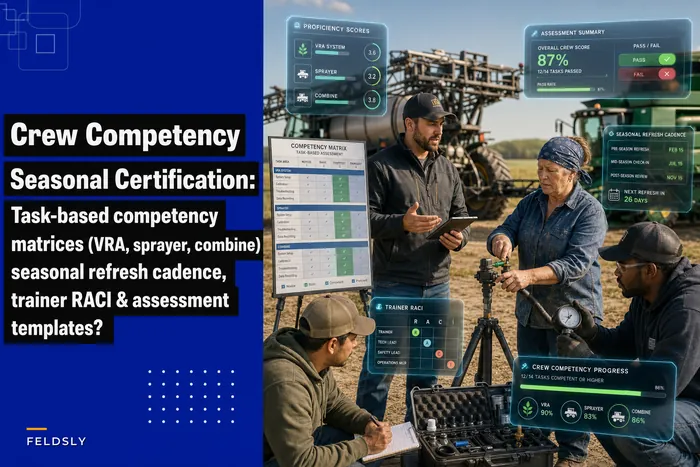
Heuristic 1 — Skill before distance. Match the gap to the capability first, then minimize travel within the qualified pool. A 20-minute drive for the right skill beats a 5-minute drive for the wrong one. This only works if you actually know who's qualified for what — which is what the crew competency matrix is for. No matrix, no real skill-based rostering.
Heuristic 2 — Protect anchor crews. Each site keeps a non-floatable core — usually whoever holds the site-specific knowledge, like the person who knows a particular field's drainage quirks. You float the flexible layer, never the anchor.
Heuristic 3 — Cap float frequency per worker. Rotating the same two people constantly burns them out and signals you under-hired. Spread floats across the flexible pool.
Heuristic 4 — Batch the moves. Moving one person for two hours is almost never worth the coordination and travel cost. Move in blocks of a half-day minimum, or don't move.
A simple rostering grid
| Worker | Home site | Float-eligible sites | Primary skill | Anchor? | Floats used (season cap: 8) |
|---|---|---|---|---|---|
| M. Reyes | A | B, C | Transplanter op | No | 3 |
| J. Okafor | A | — | Drainage/field lead | Yes | 0 |
| L. Tran | B | A, C | Irrigation setup | No | 5 |
| D. Alvarez | C | A, B | General + spray cert | No | 2 |
| S. Bello | C | B | Harvest crew lead | Yes | 0 |
Two minutes with a grid like this and the dispatcher sends the right person instead of the nearest one — and can see at a glance that L. Tran is approaching the float cap and probably shouldn't be the default pick again. That's not a sophisticated system. It's just information that wasn't visible before, made visible.
Worked cost comparison: float pool vs. site-siloed hiring
Say you run three sites and your combined peak needs 48 workers for an 8-day overlap window, but each site's individual peak only needs its base crew plus a handful of extras.
| Line item | Site-siloed (A) | Float pool (B) |
|---|---|---|
| Total seasonal headcount | ~54 | ~44 |
| Base wages (peak window, 8 days) | roughly $118k | roughly $97k |
| Surge/float bonuses | $0 | ~$4.5k |
| Inter-site travel pay | $0 | ~$2.8k |
| Overstaffed idle time (est.) | ~$9k | ~$1.5k |
| Approx. total for the window | ~$127k | ~$106k |
The float pool runs roughly $20k cheaper for one overlap window, mostly by cutting idle overstaffing — not by paying anyone less per hour. The surge bonuses and travel pay are real costs, but they're a fraction of what you save by not carrying ten redundant hands across sites.
The catch: Option B only works if the timekeeping and contracts hold. Blow the payroll accuracy on split days and you can eat that $20k back in corrections, disputes, and the hours your office manager spends untangling it. The savings live in the discipline, not the concept.
Pre-season cadence: do this before you need it
Floating crews is a decision you make in March for pressure you'll feel in July. The cadence that works:
-
8–10 weeks before peak finalize which sites participate in the pool and map their overlapping peak windows on one calendar.
-
6–8 weeks before issue surge-ready contracts to all float-eligible hires. Every float-eligible worker signs the multi-site clause before they ever float.
-
4–6 weeks before build the competency matrix and tag each worker's float-eligible sites and skills.
-
3–4 weeks before standardize timekeeping format across all sites and dry-run a split-day record end to end.
-
2 weeks before brief every foreman on the dual sign-off rule and the rostering heuristics. Receiving foremen need this most — they're the ones approving hours for people they don't normally manage.
-
Ongoing during peak daily float log reviewed each evening, float-cap tracking, and a quick reconciliation of any split-day records before they hit payroll.
The farms that skip steps 1–3 and jump straight to moving people are the ones generating the compliance messes. The paperwork has to lead the people.
When a float pool makes sense — and when it doesn't
It makes sense when:
-
Your sites are within a reasonable drive (roughly 45 minutes or less) so travel doesn't eat the savings.
-
Peak windows are staggered, not perfectly simultaneous — that's what creates the slack to share.
-
You have enough skill overlap that workers are genuinely cross-usable.
It's a bad idea when:
-
Sites sit in wildly different wage jurisdictions and the rate-floor complexity outweighs the savings.
-
Your peaks hit all sites at the exact same time — there's no pool to share, everyone needs everyone at once.
-
Your crews are highly specialized per site with little transferable skill.
Who should skip this entirely: a two-site operation where both sites peak the same week every year. You'll spend more on contract complexity and travel than you'll ever save. Just hire each site to its peak and keep it simple.
A real scenario
A mixed-vegetable operation running three sites about 25 minutes apart kept over-hiring every season — each site staffed to its own peak, which meant two sites always sat overstaffed while the third ran hot. Their office manager spent most of peak week fixing payroll because workers kept getting informally "borrowed" between sites with no clean record of it.
They moved to a float pool of around 10 workers with surge-ready contracts, a shared single-record timekeeping standard, and a one-page rostering grid. The first season wasn't perfect — a few split days still got logged sloppily early on until foremen got the dual sign-off habit down. But by mid-season, borrowed-hour payroll corrections went from a weekly headache to nearly none, and they cut roughly eight redundant seasonal hires across the three sites. The owner's rough estimate was somewhere in the low $20ks saved over the main overlap window, with the bigger relief being that the office stopped bleeding time on reconciliation.
Nothing exotic. They wrote the contracts for movement, made the hours travel with the worker, and decided who floats before the pressure hit.
The thing to remember
A float pool isn't really a staffing tactic — it's a paperwork discipline that happens to save you money. Moving crews between sites is the easy part. The hard part, and the part that actually determines whether you save $20k or lose it, is whether the contract allows the move, whether the hours survive the split day, and whether the dispatcher sends the right person instead of the nearest one. Build those three things before the season turns, and floating crews stops being a scramble and starts being a lever you can actually pull.
Ready to revolutionize your farm management?
Join 500+ farms using Feldsly to boost yields, reduce waste, and streamline daily farm workflows.