


Most crop operations don't fail at capital allocation because the math is hard. They fail because nobody owns the decision. Equipment gets replaced when it breaks. Land gets improved when the neighbor's parcel comes up. Grain storage gets expanded after a bad harvest when everyone's frustrated. Every one of those decisions feels reasonable in the moment, but strung together across five or ten years, they add up to a fleet and asset base that doesn't match the way the farm actually runs.
That's the real problem with farm capital allocation governance — it's rarely a governance system at all. It's a series of reactions. And the bigger the farm gets, the more expensive those reactions become, because you're no longer absorbing a $40k mistake on one combine. You're compounding a dozen small misallocations across fields, equipment lines, storage, and irrigation, none of which talk to each other.
This article is about the connective tissue: how a multi-field farm builds a repeatable way to decide where capital goes, how assets age out, and how one field's spend affects the others. Not a list of budgeting tips. A system.
Why capital decisions drift on multi-field operations
Single-field or single-crop operations can get away with informal capital planning for a long time. There's basically one production system, one equipment set, one timing window. When you add fields — especially fields with different soils, different rotations, and staggered planting windows — the number of competing claims on capital explodes.
What happens in practice: each field manager, or each part of the operation, builds its own mental list of "what we need." The corn ground manager wants a bigger planter. The guy running the river-bottom fields wants better drainage. Whoever handles harvest logistics wants more on-farm storage to stop paying elevator drying premiums. Every single one of those requests is defensible. None of them is being compared against the others on the same terms.
So the decision defaults to whoever pushes hardest, or whatever broke most recently. Operations where the entire capital budget for a year got consumed by two emergency equipment replacements in June aren't uncommon — which meant a drainage project that would've paid back in three seasons got pushed for the fourth year running. Nobody decided that. It just happened.
The core failure is the absence of a shared scoring method. When every request is evaluated in isolation, "urgent" always beats "important." A governance system exists to force those requests onto the same table so they can be ranked honestly.
What breaks as you scale
The failure points aren't evenly distributed. They tend to show up in a predictable order as a farm adds acres and complexity.
Take control of your farm’s productivity.
Feldsly helps you plan, track, and optimize every farming operation with precision.
- Centralized crop scheduling
- Resource & labor management
- Real-time weather alerts
No credit card required
| Scale stage | Typical capital approach | What starts breaking |
|---|---|---|
| 1–2 fields, one crop | Replace on failure, buy on opportunity | Nothing obvious yet — small enough to absorb mistakes |
| 3–5 fields, some rotation | Informal annual list, gut-ranked | Fleet sized for peak of one field, idle elsewhere; timing conflicts |
| 6–10 fields, mixed soils | Spreadsheet budget, still reactive | Depreciation surprises, no replacement schedule, storage bottlenecks |
| 10+ fields, multiple entities | Departmental requests, no common ROI method | Cross-field misallocation, capex fights, cash crunch in procurement season |
The pattern worth noticing: the tools stay roughly the same — a spreadsheet, a gut feel — while the operation triples in complexity. That gap is where money leaks. A budget that worked fine at four fields becomes actively misleading at ten because it can't represent the tradeoffs between fields anymore.
The other thing that breaks is timing. On a small operation, when you buy something rarely matters much. On a large one, procurement timing is its own source of margin. Buying a used tractor in November versus March can swing the price meaningfully, and locking storage or irrigation contracts off-season beats fighting for them in-season. When capital decisions are reactive, you always buy at the worst time — because you're buying when you're desperate.
The building blocks of a real governance system
A working system doesn't need to be complicated. It needs to be consistent. There are four pieces that have to exist and connect: a rightsizing method, a replacement and depreciation schedule, a standardized ROI template, and a procurement calendar. Miss any one and the whole thing gets shaky.
1. Rightsizing before you spend
Before any replacement or expansion decision, you need to know what capacity you actually require at peak — not what you own, not what feels safe. This is where a lot of farms overspend quietly. They size the fleet for the worst planting window they've ever had, then carry that capacity — and its depreciation, insurance, and storage costs — all year across every field.
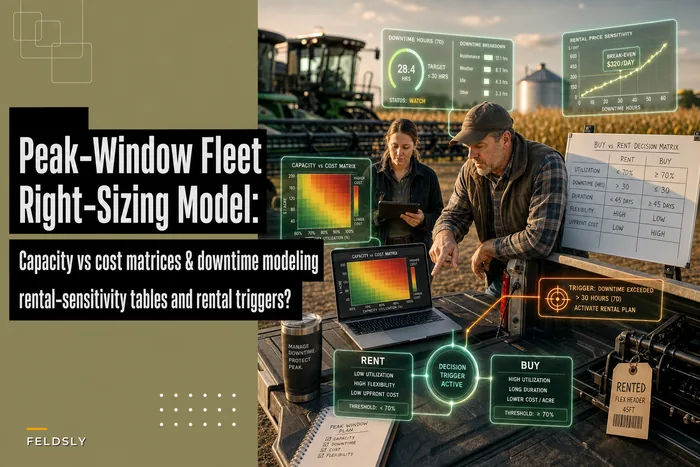
The math here is well-covered in the peak-window fleet right-sizing model, and it's worth working through before making any equipment capital decision. The short version: figure out your true peak-window demand per field, model the cost of downtime against the cost of owned capacity, and be honest about whether rental or shared capacity covers your spikes cheaper than ownership does.
Run the rightsizing model with at least five years of peak-window data to avoid overestimating overlap.
2. A replacement schedule tied to real lifecycle, not failure
Reactive replacement is the single biggest driver of bad capital timing. If you're replacing equipment when it dies, you're replacing it in-season, at full price, under pressure. A governance system replaces the "wait until it breaks" default with a planned lifecycle schedule.
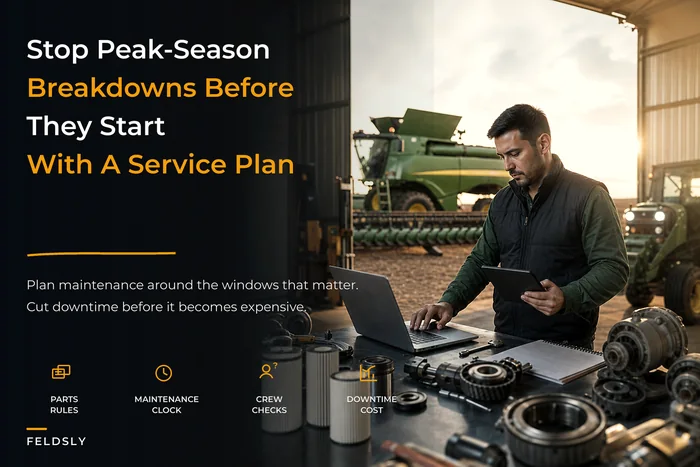
This connects directly to maintenance. A machine on a disciplined maintenance program has a more predictable life and a predictable replacement date — which means you can budget and buy it off-season. Building that discipline is the whole point of a machinery lifecycle governance and planned-maintenance playbook, and it's a prerequisite for capital planning, not a separate topic. You can't schedule replacements if you can't predict when assets wear out.
3. A standardized ROI template every request must use
This is the part farms skip, and it's the part that makes governance actually work. Every capital request — a planter, a grain bin, a tile drainage project, an irrigation upgrade — gets scored on the same one-page template. Same fields, same assumptions, same time horizon.
A workable template captures:
-
Total capital cost, including install and any adjacent costs (electrical for a dryer, pad for a bin)
-
Annual operating impact — fuel, labor hours saved or added, maintenance
-
Direct revenue or cost effect — drying premiums avoided, yield lift, timeliness value
-
Multi-year depreciation using a consistent method across all requests
-
Payback period and a simple multi-year return figure
-
Cross-field impact — does this help one field or several? Does it free capacity elsewhere?
That last line is the one that changes decisions. A grain dryer that only serves one field scores very differently from one that lets three fields harvest at higher moisture and avoid elevator premiums. When every request carries a cross-field impact number, the shared-benefit projects rise to the top naturally, without anyone having to argue for them.
4. A procurement calendar mapped to your season
Once you know what you need and roughly when assets age out, you schedule buying into your off-peak windows. Equipment shopping happens after harvest and through winter, when dealers are motivated and you're not desperate. Contract items — storage, custom application, drying capacity — get locked before everyone else in the county is calling the same suppliers.
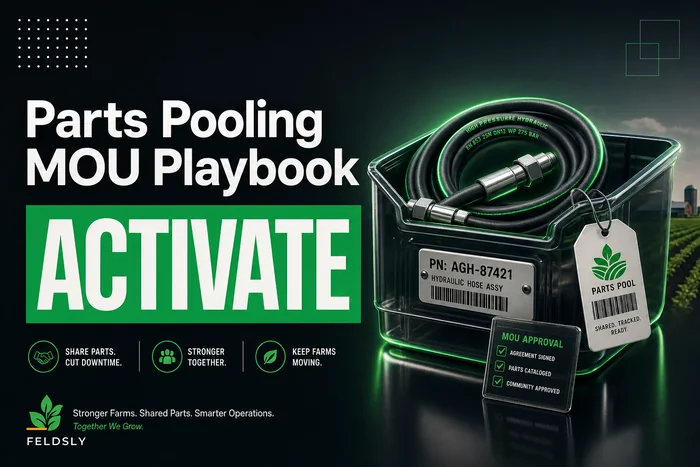
For equipment you deliberately choose not to own, the arrangement needs to be built before the season, not negotiated during it. A parts-pooling MOU with activation triggers and cost-sharing formulas is a good model for how to formalize shared-capacity agreements so they actually hold up when two farms need the same part in the same week.
How the pieces connect: a workflow
These components run together across a year rather than as isolated exercises.
-
Late fall — asset review. Pull every major asset, its age, its maintenance history, and its position on the replacement schedule. Flag anything projected to age out in the next 24 months.
-
Early winter — request intake. Every field or department submits capital requests on the standard ROI template. No template, no consideration. This alone kills a lot of weak requests before they reach the table.
-
Mid-winter — ranking session. Score all requests on the same terms. Rightsizing math feeds the equipment requests; cross-field impact scores separate the shared-benefit projects from the single-field ones.
-
Late winter — capex memo and approval. The ranked list becomes a short board-ready memo. Decisions get made against the actual cash and financing available.
-
Off-season — procurement execution. Approved buys get scheduled into the cheapest windows. Contracts get locked before the in-season rush.
-
In-season — hold the line. The only mid-season capital additions are genuine emergencies, and even those reference the pre-scored list so you're not making a brand-new decision under pressure.
The value isn't any single step. The sequence turns capital from a series of surprises into a predictable annual rhythm. The farm stops buying reactively because the decisions are already made before the season starts.
Here's a simple visualization of that annual workflow.
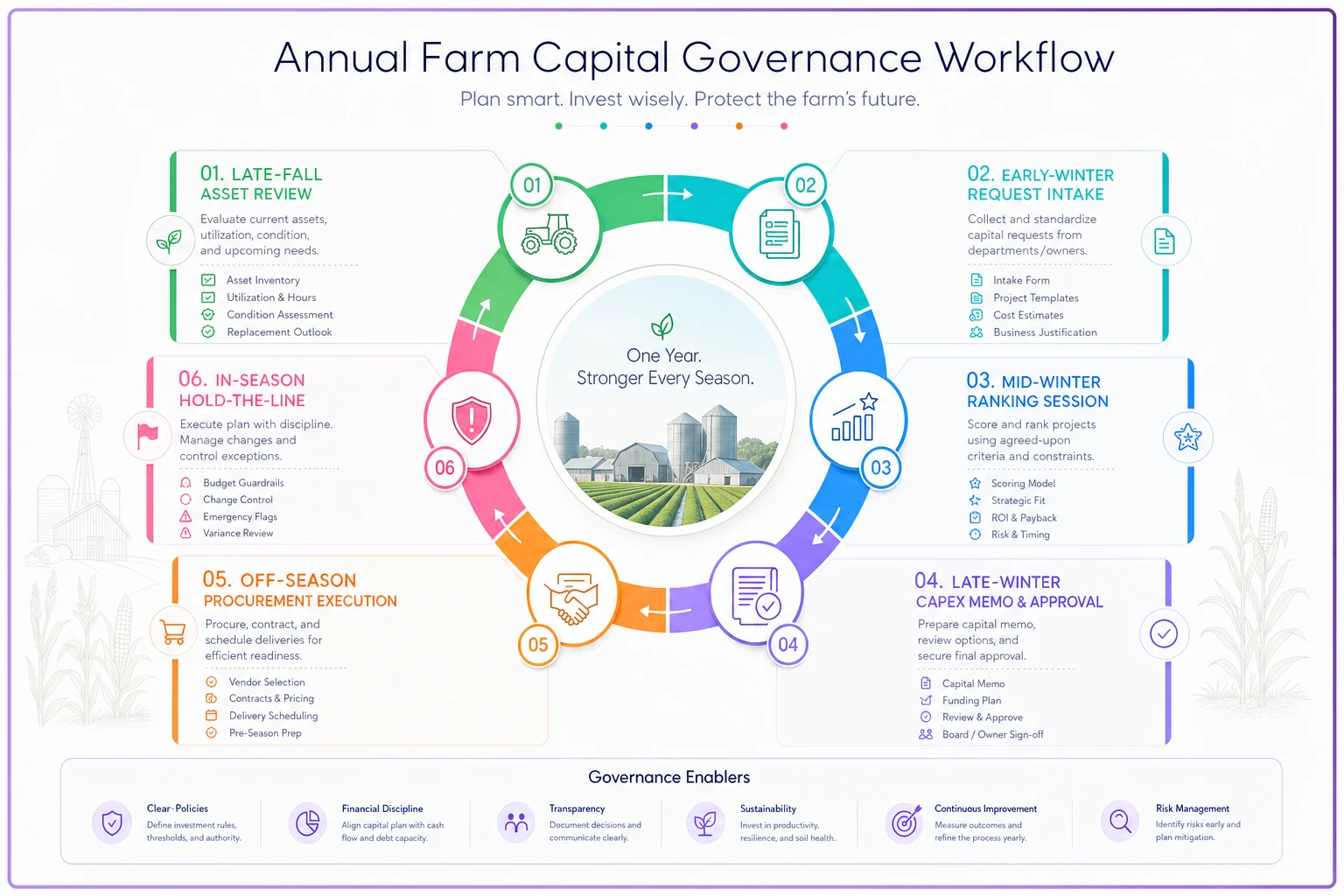
Seeing the steps laid out makes it easier to keep the calendar.
The board-ready capex memo
Even on a family operation with no formal board, writing decisions down as a short memo forces clarity. If you can't explain in one page why this spend beats the alternatives, you probably don't understand the decision well enough to make it.
-
The ask — what, how much, and the financing structure in two sentences.
-
The alternatives considered — including "do nothing" and "rent instead."
-
The ROI summary — payback, multi-year return, from the standard template.
-
Cross-field impact — who benefits and by how much.
-
The risk if you don't — the honest downside of deferring, in operational terms, not scare tactics.
The discipline of writing the "alternatives considered" line is what catches the emotional purchases. A lot of equipment gets bought because it's new and appealing, not because renting or repairing genuinely lost the comparison. Making that comparison explicit on paper is uncomfortable in exactly the right way.
A real scenario
A row-crop operation running about nine fields across corn and soybeans — roughly 3,800 acres — was replacing equipment purely on failure. Over a three-year stretch they'd made four emergency in-season purchases, each one at premium pricing because they were buying in April or September with no leverage. Meanwhile a tile drainage project on two of their wettest fields kept getting deferred, even though the wet ground was costing them stand loss and delayed planting most springs.
When they moved to a scored system, two things surfaced quickly. First, they'd been carrying a second high-capacity planter that the rightsizing math showed they didn't actually need — their peak overlap was narrower than they assumed, and short-term rental covered the rare spike far cheaper than ownership. Selling it and shifting to rental for the peak freed up capital and cut their annual carrying cost noticeably.
Second, once the drainage project got scored on the same ROI template as the equipment requests — with stand-loss and timeliness numbers included — it jumped near the top of the list instead of dying at the bottom every year. The cross-field benefit made it obvious. They funded it, and the wet-field planting delays that had cost them for years mostly went away.
The dollars aren't really the headline. The change was that decisions stopped being reactive. They went from four panicked in-season buys over three years to zero, and every major purchase after that happened off-season at a better price.
When a formal system makes sense — and when it doesn't
This kind of governance is worth the overhead once you're running enough fields and enough capital that misallocation between them becomes a real cost — multiple fields with different production systems, a fleet big enough that carrying cost matters, and enough annual capital spend that ranking decisions actually changes outcomes.
When it's a bad idea: Running one or two fields with a simple, stable setup doesn't need a full request-and-scoring process. You'd spend more time on templates than the decisions justify. A simple replacement schedule and a rough annual budget is plenty at that size.
Who should NOT overbuild this: Operations in the middle of a major transition — buying out a partner, consolidating entities, shifting crop mix — should keep the system lightweight until the dust settles. Building elaborate multi-year models on top of a situation that's about to change is wasted effort. Get the rightsizing and replacement schedule solid first; add the full scoring layer once the operation is stable enough to plan five years out honestly.
Where the whole thing tends to fall apart
Even farms that build a good system watch it decay in predictable ways. The template gets skipped "just this once" for a request someone really wants. The replacement schedule doesn't get updated after a hard year and stops reflecting reality. The ranking session gets skipped because winter got busy, and by spring everyone's back to reacting.
The common thread is that the information lives in too many places — one person's spreadsheet, another's memory, a maintenance log in the shop. When asset history, ROI templates, and the replacement schedule sit in separate files owned by different people, keeping them current becomes nobody's job.
Centralizing the operational data — asset records, maintenance history, capital requests, and their scoring — into one place that the whole team actually works from makes a real difference. Not because software makes the decisions, but because it keeps the inputs current and comparable, so the annual ranking session is based on real numbers instead of half-remembered ones. AI-powered operational platforms that flag when an asset is approaching its replacement window, or when maintenance patterns suggest a machine is aging faster than scheduled, quietly keep the whole system honest between planning cycles. The system only works if it's maintained, and it only gets maintained if the maintenance is easy.
Bringing it together
Capital allocation on a multi-field farm isn't really a math problem — the math is the easy part. It's a coordination problem. The farms that do this well aren't smarter about ROI; they're more disciplined about forcing every competing claim onto the same table, at the same time of year, scored the same way, before the season starts and the pressure hits.
Rightsize before you buy. Replace on schedule, not on failure. Score every request identically, including its effect on other fields. Buy off-season. Write the decision down. None of it is complicated on its own. The value is entirely in doing all of it, consistently, as one connected system — so that five years of small decisions add up to an asset base that matches how your farm actually runs, instead of one that reflects whatever broke last June.
Capital allocation on a multi-field farm isn't really a math problem — the math is the easy part. It's a coordination problem. The farms that do this well aren't smarter about ROI; they're more disciplined about forcing every competing claim onto the same table, at the same time of year, scored the same way, before the season starts and the pressure hits.
Rightsize before you buy. Replace on schedule, not on failure. Score every request identically, including its effect on other fields. Buy off-season. Write the decision down. None of it is complicated on its own. The value is entirely in doing all of it, consistently, as one connected system — so that five years of small decisions add up to an asset base that matches how your farm actually runs, instead of one that reflects whatever broke last June.
Ready to revolutionize your farm management?
Join 500+ farms using Feldsly to boost yields, reduce waste, and streamline daily farm workflows.