

Most farm calendars are decoration. They hang in the shop, live in a spreadsheet nobody opens after April, and list what should happen without ever forcing the question of what happens when it doesn't. A planting window that says "corn: April 15–30" tells you nothing about what to do when soil temp is still at 48°F on the 22nd, who's authorized to push the date, or which three downstream systems need to know within the hour.
The gap between a calendar that displays and a calendar that decides is where most mid-size operations bleed money. Not during the easy years — during the compressed springs, the wet falls, the years when every decision has a 36-hour fuse and three people each assume someone else pulled the trigger.
This is a system article, not a planting-date guide. The point is to show how finance, procurement, and labor actually connect across a season, where those connections snap under pressure, and how to build one calendar that holds the whole thing together with explicit pass/fail gates and automated handoffs.
Why most seasonal calendars quietly fail
The failure almost never looks like failure in the moment. Here's the pattern across operations running 2,000 acres and up:
The agronomic calendar lives with the agronomist or operations lead. The cash-flow calendar lives with the owner or bookkeeper. The labor calendar lives in somebody's head and a group text. Procurement runs off whatever the input supplier reminded them about last week. Each of these is internally reasonable. The problem is they're never the same calendar, so they never force a decision at the same moment.
What breaks is coordination, not planning. A typical example: the plan calls for side-dress nitrogen at V6. The agronomic calendar is fine with that. But the labor calendar has two of your four applicator operators scheduled on a different field, procurement ordered UAN assuming a later window, and finance hasn't released the payment that triggers delivery. Nobody did anything wrong. The calendar just never connected those four facts into a single go/no-go moment with a named owner.
At smaller scale you get away with this because one person holds all four calendars in their head. The owner knows the cash position, knows which operators are where, knows what's been ordered, and knows the fields. The whole operation runs on that one person's working memory. It works until it doesn't — usually the first season you add enough acres or rented ground that no single person can hold the full picture anymore.
That's the real scaling break. Bigger farms don't necessarily have harder problems. They've just lost the single human who used to be the integration layer, and nothing replaces them.
The three calendars that have to become one
Before you can build decision triggers, you have to be honest about which calendars you're actually running. Most operations have three, and they run on completely different clocks.
Take control of your farm’s productivity.
Feldsly helps you plan, track, and optimize every farming operation with precision.
- Centralized crop scheduling
- Resource & labor management
- Real-time weather alerts
No credit card required
The finance calendar runs on cash events: operating-loan draws, input payment terms, insurance premium dates, landlord rent, payroll cycles, and the revenue timing of grain sales or contract deliveries. Its natural unit is the month and the payment-terms window.
The procurement calendar runs on lead times and buffer formulas. Seed, chemical, fertilizer, fuel, and parts each have their own order-to-delivery lag, and each has a point of no return where substituting becomes expensive or impossible. If you've already worked through your buffer logic — and if you haven't, the seasonal input procurement playbook is where to start — you know this calendar runs weeks ahead of everything else.
The labor and equipment calendar runs on daily and hourly capacity: who's certified for what, how many machine-hours each operation needs, where the bottleneck crews are. This is also the calendar most likely to live nowhere formal.
The core idea of an enterprise seasonal planning farm operational calendar is that these three stop being separate documents and become one timeline with shared decision points. Not three tabs in a workbook — one calendar where a single trigger date simultaneously appears as a cash event, a procurement deadline, and a labor commitment. Where missing one automatically flags the other two.
Decision triggers, not dates: building pass/fail gates
A date is a hope. A gate is a decision. The difference is that a gate has three things a date doesn't: a measurable condition, a pass path, and a fail path.
Here's what a real gate looks like versus the calendar entry it replaces.
| Calendar entry (weak) | Decision gate (strong) |
|---|---|
| "Begin corn planting ~April 18" | GATE P-1: Soil temp ≥50°F at 2" for 3 consecutive mornings AND 5-day forecast shows no soil-saturating event. PASS → release planter crews, confirm seed delivery, draw loan tranche 2. FAIL → hold 48h, re-check, escalate to owner if hold exceeds 7 days past target. |
| "Side-dress N in June" | GATE N-3: Crop at V5–V6 AND UAN delivered AND applicator operators available AND field trafficable. All four = PASS. Any fail = named owner resolves within 24h or triggers contractor-applicator contingency. |
| "Fall grain delivery per contract" | GATE H-7: Grain moisture within contract spec AND transport capacity confirmed AND storage-vs-ship decision made. FAIL on transport → activate backup carrier before harvest crew rolls. |
Notice what the gate version does. It names the condition in numbers. It defines both branches. It assigns a human. And every PASS or FAIL ripples into the other calendars — releasing cash, confirming delivery, committing labor.
The mistake most operations make when they first try this: they write the pass path in careful detail and leave the fail path blank. But the fail path is the whole point. You already know what to do when everything goes right. The calendar earns its keep on the bad days, when a gate fails and you need to know — immediately, without a meeting — who decides and what moves.
Assigning ownership: RACI that survives a wet spring
A gate with no owner is a group text at 5 a.m. The fix is a RACI assignment on every gate — Responsible, Accountable, Consulted, Informed — with exactly one Accountable name per gate. Not a team. A person.
-
Responsible Field lead who executes (gets the applicators rolling)
-
Accountable Operations manager — the single neck if the window is missed
-
Consulted Agronomist (is the crop actually at the right stage?), procurement (is the UAN on-site?)
-
Informed Owner, bookkeeper (because a missed window changes the yield assumption behind the cash plan)
The pattern worth stealing: Consulted roles are where your cross-calendar connections live. The agronomist and procurement being consulted on a labor-execution gate is exactly how you stop the three calendars from drifting apart. If procurement isn't a consulted party on the nitrogen gate, you've rebuilt the silo you were trying to kill.
Where this breaks at scale: operations duplicate the Accountable role across fields or regions "for coverage." Now two people each think the other owns the gate. Resist it. One Accountable per gate, with a named backup who only activates on documented escalation — never a shared default.
Automated handoffs: where the calendar stops being paper
A gate that passes should do something in your downstream systems without a human re-keying it. This is the part that separates a good planning document from an operating system.
Think through the handoff chain on a single planting gate passing:
-
Gate P-1 passes (soil temp condition met, forecast clear)
-
Procurement handoff seed and starter fertilizer delivery confirmed to field, not warehouse
-
Finance handoff the loan tranche tied to planting start is flagged for draw, and the input invoice moves into the pay queue per terms
-
Rostering handoff planter operators and tender-truck drivers get committed to the schedule, and the standby contractor list moves to "on-call"
-
Rental handoff if your fleet math says you're short, the rental reservation converts from "hold" to "confirmed"
Each of those used to be a separate phone call made by a person who had to remember to make it. When one doesn't get made — the rental hold expires, the delivery goes to the wrong location — you lose field days you can't get back.
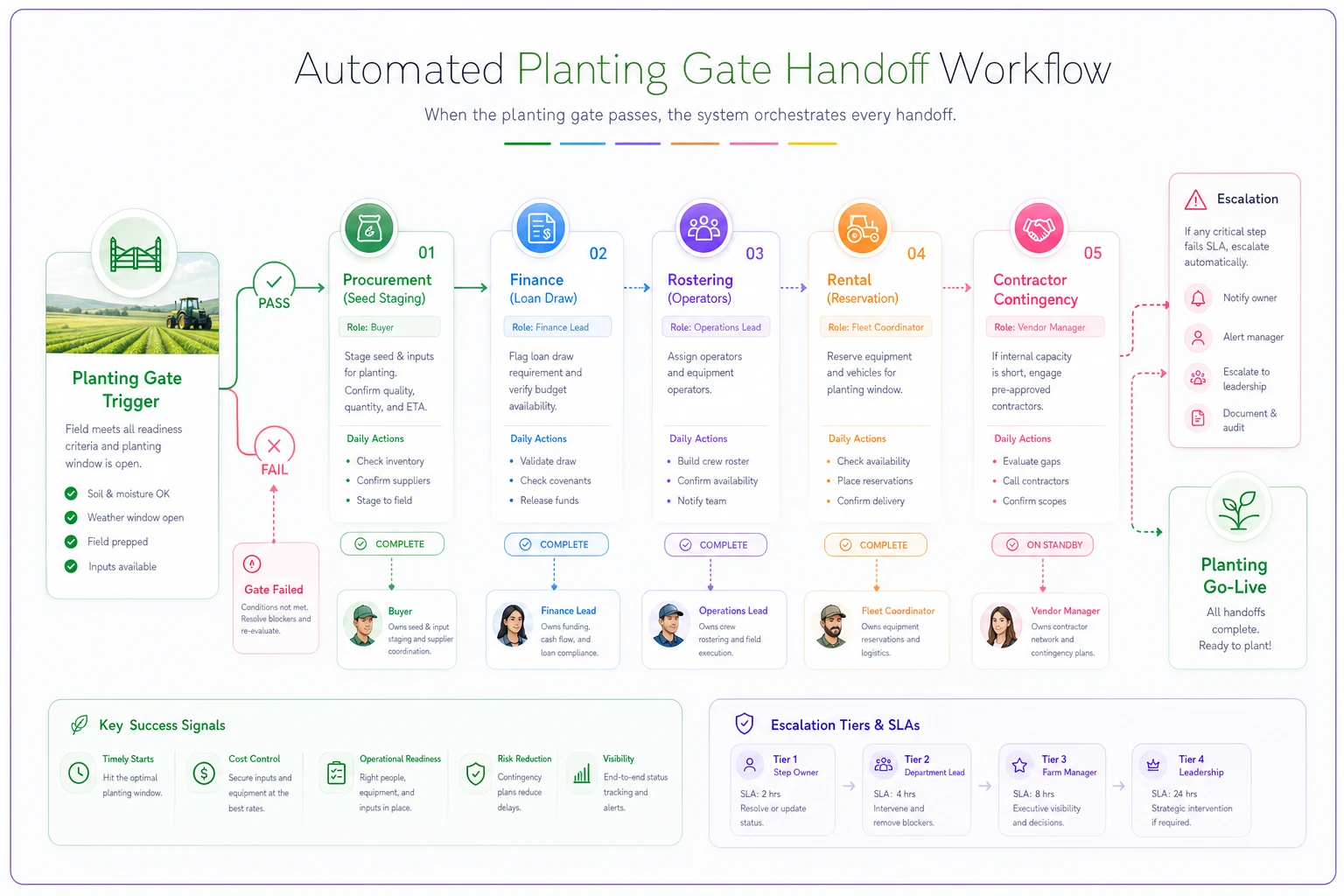
The diagram maps the handoff chain and the escalation points.
This is where operational software that connects your planning calendar to procurement, rostering, and rental systems quietly earns its place. Not as a dashboard to admire, but as the thing that fires the handoffs the moment a gate clears — so a passed gate can't silently fail downstream because someone was busy. The value isn't automation for its own sake. It's that the handoffs stop depending on one tired person remembering them during the busiest week of the year. AI-assisted handoff logic helps most on the exception path: flagging when a gate passes but a downstream condition (say, rental availability) is at risk, so the manager sees the conflict before the crew rolls, not after.
Model rental capacity versus cost before automating rental handoffs.
The rental handoff in particular is worth getting right, because rental decisions are a cost-versus-downtime tradeoff that shifts week to week. If you haven't modeled where your own fleet runs out of capacity, the peak-window fleet right-sizing model gives you the capacity-vs-cost logic that should sit behind the rental trigger.
A worked example: compressed spring on a corn-soy operation
Consider a roughly 3,400-acre corn-soy operation — four full-time operators plus seasonal help — running a planting window that in a normal year opens around mid-April.
This spring it rains through the back half of April. The agronomic target blows past. Here's where the calendar-as-system earns back its build cost versus the three-separate-calendars version.
Without integrated gates: The planting-start loan draw sits unreleased because nobody connected it to a now-moving date. Seed is at the warehouse, not staged to fields. Two operators took on side work assuming planting wouldn't start until May. When a 60-hour dry window finally opens, the operation burns the first 10 hours of it staging seed, recalling operators, and chasing a loan draw. Call it somewhere in the range of $8k–$15k in lost field capacity and overtime scramble — the kind of number that never shows up on any invoice but absolutely shows up in fall yield.
With integrated gates: GATE P-1's fail path has been running the whole time. Each failed morning check auto-holds the crews and keeps the rental reservation on "hold" rather than canceling it. Seed delivery was pre-staged to field locations on the first 3-day forecast that looked plausible. When the condition finally passes, all five handoffs fire together: operators were on-call and knew it, the loan draw was pre-flagged, the rental converted to confirmed. The crew hits the dry window in the first hour, not the tenth.
The difference wasn't better weather forecasting or smarter agronomy. It was that the fail path kept all three calendars aligned during the hold, so the pass moment didn't trigger a scramble.
The cash-timing side of this — how loan draws and input payments should be staged against planting gates in the first place — is its own discipline. The operational financial scenario planning framework covers the tiered templates and decision gates that the finance column of your calendar should be built on.
The build checklist: what a dropped-in calendar needs
If you're building this to hand to managers, here's the minimum it has to contain before it's actually usable:
-
- [ ] Every major seasonal milestone written as a gate, not a date, with a numeric pass condition
-
- [ ] A fail path for every gate — not just the happy path
-
- [ ] Exactly one Accountable person per gate, with a named escalation backup
-
- [ ] Consulted roles that deliberately cross calendars (procurement consulted on labor gates, agronomy consulted on finance gates)
-
- [ ] Defined handoffs for each pass
what fires in procurement, finance, rostering, rental
-
- [ ] Escalation timing written in hours, not "ASAP" (e.g., "owner notified if hold exceeds 7 days")
-
- [ ] A print layout that fits on one page per month and survives being taped to a shop wall
-
- [ ] A sign-off block — the manager who owns the season dates and initials it, because an unsigned plan is a suggestion
That last point matters more than it looks. A calendar nobody signed is a calendar nobody owns. The sign-off is what converts it from a planning exercise into an operating commitment.
When this is worth building — and when it isn't
When it makes sense: You're running enough acres, rented ground, or separate fields that no single person can hold the full finance-procurement-labor picture in their head anymore. You've had at least one season where a missed handoff cost you real field days. You have more than two or three people who need to act on the same decision. Those are the conditions where the integration work pays for itself in a single compressed spring.
When it's overkill: A tight single-operator or family operation where one person genuinely holds all three calendars and the handoffs are three conversations across a kitchen table. Building formal RACI and automated handoffs for that is ceremony without benefit. Don't impose enterprise structure on an operation that's small enough to run on shared presence and trust.
Who should not start here: If your master data is a mess — fields named three different ways across your records, no clean operator certification list, procurement living in a vendor's head — fix that first. Gates and handoffs built on inconsistent underlying data just fail faster and more confidently. The calendar is the integration layer; it assumes the layers underneath it are clean.
The real shift
The move from a calendar that displays to a calendar that decides is really a move away from depending on one heroic person to hold everything together. For a lot of operations, that person is the owner, and the quiet cost of running on their memory shows up as burnout and as the handful of missed handoffs nobody can trace afterward.
Build the gates. Write the fail paths. Name one owner per decision. Wire the handoffs so a passed gate can't die quietly downstream. Then sign it, print it, and tape it up. The season that proves it worth the effort won't be an easy one — it'll be the wet spring or the compressed fall when every decision has a 36-hour fuse, and for once, everyone already knows who lights it and what moves next.
Build the gates. Write the fail paths. Name one owner per decision. Wire the handoffs so a passed gate can't die quietly downstream. Then sign it, print it, and tape it up. The season that proves it worth the effort won't be an easy one — it'll be the wet spring or the compressed fall when every decision has a 36-hour fuse, and for once, everyone already knows who lights it and what moves next.
Ready to revolutionize your farm management?
Join 500+ farms using Feldsly to boost yields, reduce waste, and streamline daily farm workflows.