

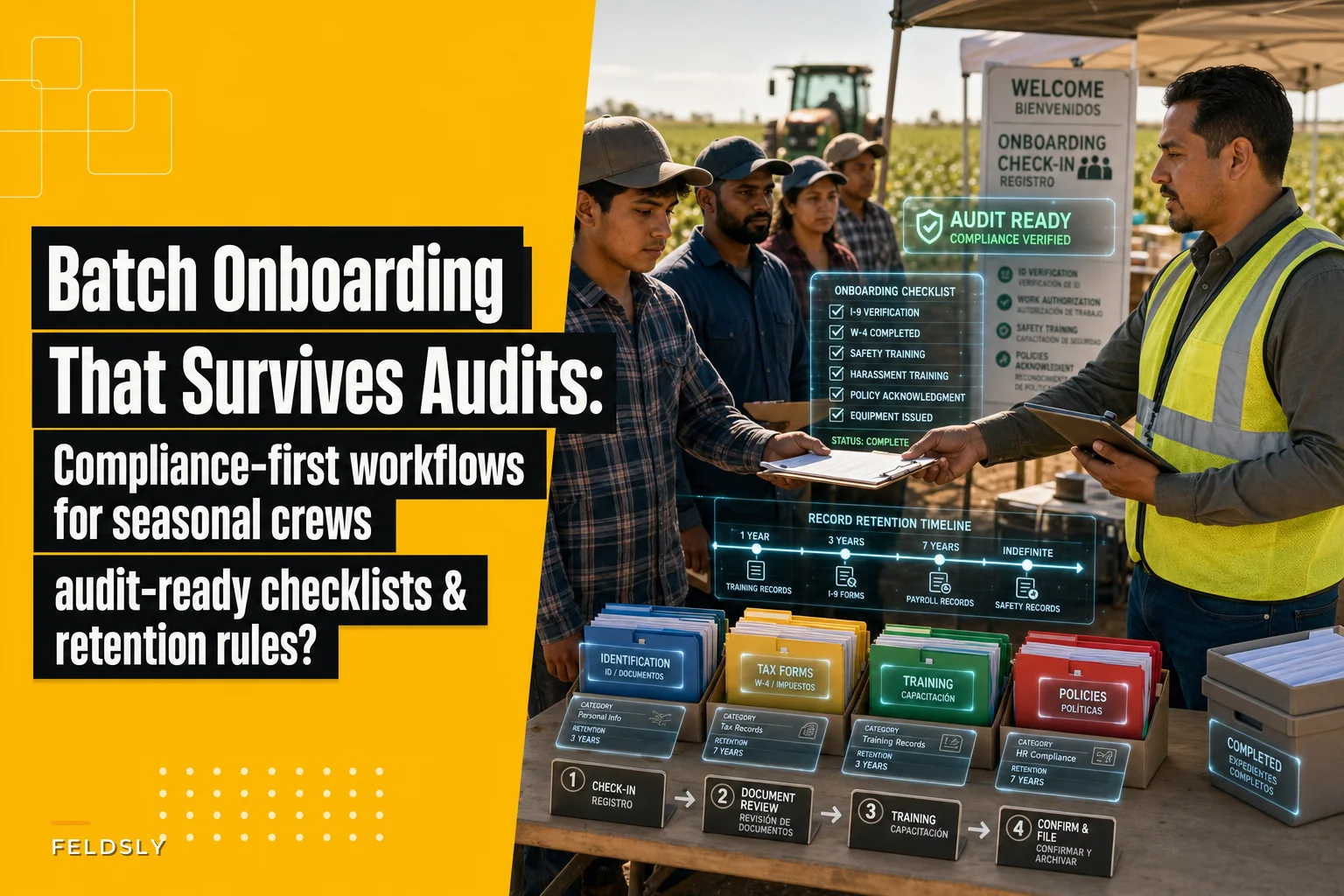

Running a 2,400-acre berry operation means onboarding anywhere from 180 to 270 seasonal workers every spring. The Department of Labor showed up at a California strawberry farm last May and found missing I-9s for 42 workers hired just eight weeks earlier. The fine started at $234 per missing form but escalated to $2,340 per worker because of "willful violations" - basically, the farm couldn't prove they even tried to maintain proper records.
That farm lost $98,280 in fines. Not because they hired undocumented workers. Because their filing system collapsed under the weight of batch hiring.
The compliance trap that kills most seasonal onboarding systems
Agricultural operations face a unique regulatory squeeze. You need to onboard massive crews within a 72-hour window while maintaining documentation standards designed for office environments where HR processes one person at a time.
Federal requirements alone demand seventeen different documents per worker. State agricultural labor laws add another eight to twelve forms depending on your location. Housing provisions trigger additional paperwork if you provide dormitories or transportation. H-2A programs multiply the documentation by roughly 3x.
Most farms tackle this by printing stacks of paper forms and setting up folding tables in the equipment barn. Workers line up, fill out paperwork by hand, someone photocopies IDs on an old machine that jams every twentieth page. By day three of onboarding, you've got milk crates full of partially completed forms, no systematic way to track what's missing, and zero confidence you could survive an audit.
The real problem isn't the volume - it's the retention rules. I-9 forms need three years of storage or one year after employment ends, whichever is longer. Workers' compensation documents require five years in most states. Payroll records need seven years for IRS compliance. Housing agreements under H-2A programs need permanent retention.
When you're hiring the same seasonal crew positions year after year, with 40% returning workers and 60% new faces, tracking which retention clock applies to which document becomes impossible without a real system.
Building the seasonal farm labor onboarding checklist that works
After watching dozens of agricultural operations scramble through audit preparations, farms that survive share one characteristic: they build their entire onboarding workflow around compliance checkpoints, not convenience.
Take control of your farm’s productivity.
Feldsly helps you plan, track, and optimize every farming operation with precision.
- Centralized crop scheduling
- Resource & labor management
- Real-time weather alerts
No credit card required
Start with document grouping by retention period:
90-day documents:
-
Emergency contact forms
-
Uniform/equipment sign-outs
-
Parking permits
-
Temporary housing assignments
1-year documents:
-
Direct deposit authorizations
-
Benefits enrollment (if declined)
-
Training acknowledgments
-
Safety briefings
3-year documents:
-
I-9 forms and supporting documentation
-
W-4 tax withholding
-
State tax forms
-
Employment eligibility verification
5-year documents:
-
Workers' compensation forms
-
Injury reporting procedures
-
Safety training certifications
-
Pesticide handler agreements
7-year documents:
-
Wage agreements
-
Payroll authorizations
-
Tip reporting agreements (for u-pick operations)
-
Piece-rate disclosures
Permanent retention:
-
H-2A documentation
-
Immigration paperwork
-
Housing agreements (for employer-provided)
-
Transportation agreements
-
Any discrimination or harassment claims
| Retention Period | Documents |
|---|---|
| 90-day | Emergency contact forms; Uniform/equipment sign-outs; Parking permits; Temporary housing assignments |
| 1-year | Direct deposit authorizations; Benefits enrollment (if declined); Training acknowledgments; Safety briefings |
| 3-year | I-9 forms and supporting documentation; W-4 tax withholding; State tax forms; Employment eligibility verification |
| 5-year | Workers' compensation forms; Injury reporting procedures; Safety training certifications; Pesticide handler agreements |
| 7-year | Wage agreements; Payroll authorizations; Tip reporting agreements (for u-pick operations); Piece-rate disclosures |
| Permanent | H-2A documentation; Immigration paperwork; Housing agreements (for employer-provided); Transportation agreements; Any discrimination or harassment claims |
This grouping system means you can physically separate documents into different filing systems from day one. The 90-day stuff goes in one filing cabinet that gets purged quarterly. The permanent documents go into banker boxes that move to long-term storage after the season.
The three-station workflow that processes 200 workers without breaking
Station design matters more than technology. You can run this with clipboards and filing cabinets if the flow works correctly.
Station 1: Identity and Eligibility (15 minutes per worker)
Physical setup: Two tables in an L-shape. One person verifies documents, another person makes copies and enters data.
-
Worker presents ID and work authorization
-
Verifier checks documents against I-9 list
-
Copier scans or photocopies everything
-
Data entry person logs information into master spreadsheet
-
Worker receives colored folder based on visa status (green for citizens, blue for permanent residents, yellow for H-2A, red for other work permits)
The colored folder system seems basic but it prevents downstream confusion. Payroll needs different processing for H-2A workers. Safety training varies by visa status. Housing assignments depend on program participation. The folder color tells everyone downstream exactly which path this worker follows.
Match clipboard stickers to folder colors so station operators can instantly route workers.
Station 2: Agreements and Disclosures (10 minutes per worker)
This station handles everything that requires a signature but doesn't need explanation. Pre-print everything in duplicate. Worker keeps one copy, farm keeps another.
Critical efficiency trick: Create packets based on job type, not individual forms. A harvest worker packet contains fourteen documents pre-collated. An equipment operator packet has eighteen documents including additional safety certifications. Packaging house workers get twelve documents focused on food safety.
Each packet has a checklist cover sheet. As workers sign documents, they check boxes on the cover sheet. The station operator verifies all boxes are checked before sending the worker forward. This catches missing signatures before workers leave the onboarding area.
Station 3: Safety and Assignment (20 minutes per worker)
-
Safety video viewing (can run continuously for groups)
-
Basic safety quiz (verbal or written depending on literacy)
-
Work assignment and crew placement
-
Housing assignment if applicable
-
Equipment or uniform distribution
-
First day reporting instructions
Keep a laptop here running a simple slideshow of key safety points in multiple languages. Workers watch while waiting their turn for individual processing. This satisfies OSHA training requirements without creating bottlenecks.
Here’s a simple diagram of the three-station flow.
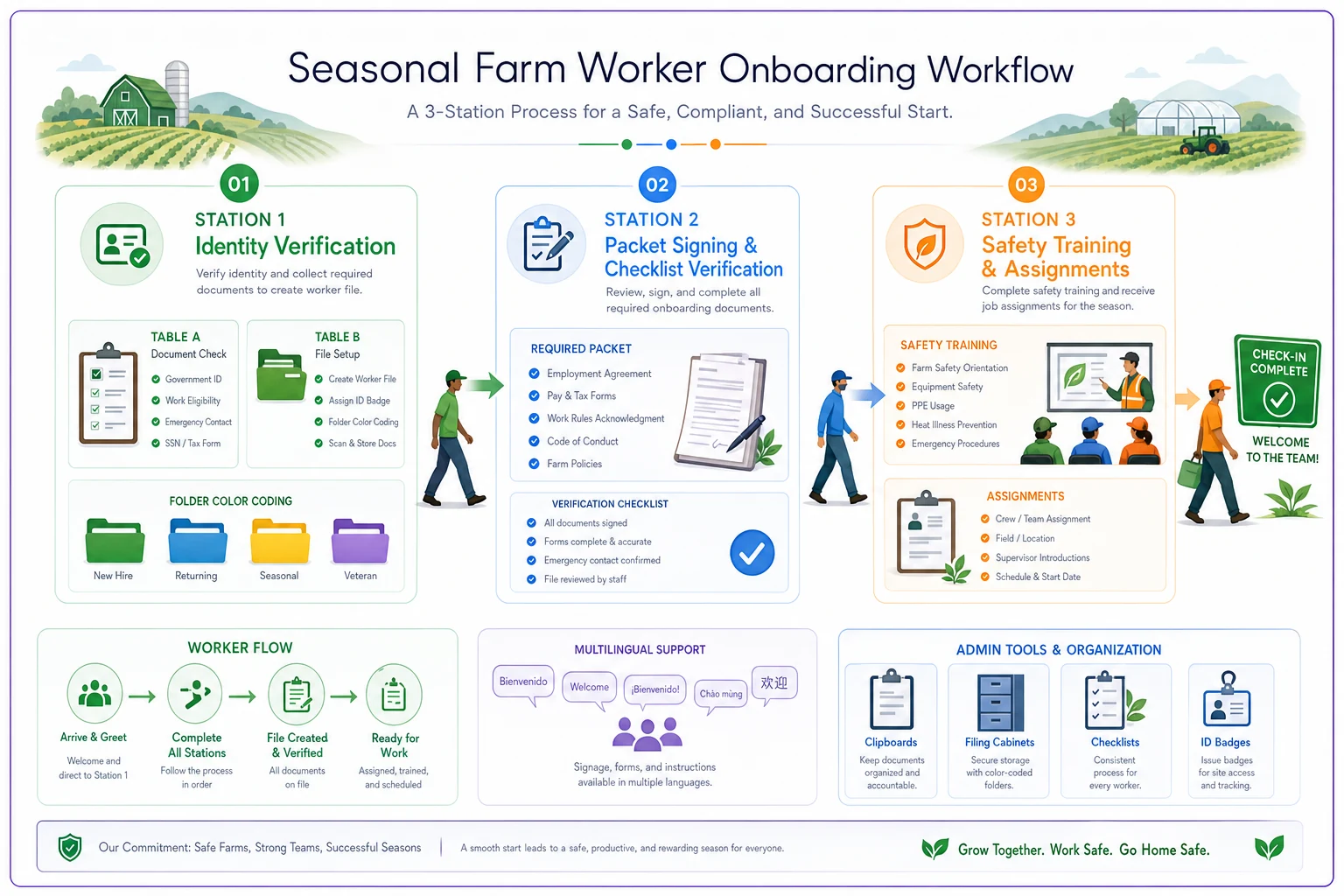
The workflow diagram highlights how workers move from identity checks to packet signing to safety and assignment, reducing bottlenecks.
Record retention without drowning in banker boxes
The biggest farms using paper systems dedicate about 120 square feet to records storage per 100 seasonal workers hired. That physical footprint doubles every three years until you start purging expired documents.
Physical separation by retention period works without going fully digital:
-
White
90-day retention
-
Green
1-year retention
-
Yellow
3-year retention
-
Orange
5-year retention
-
Blue
7-year retention
-
Red
Permanent retention
Write the destruction date directly on each folder with a thick Sharpie. "DESTROY AFTER 06/30/2027" is impossible to misinterpret.
Store different retention periods in completely different locations if possible. The 90-day files stay in the office. One-year files go to the storage closet. Everything three years and beyond goes to a climate-controlled storage unit or dedicated records room.
Set calendar reminders for document destruction. First Monday of each month, someone spends an hour pulling and shredding expired documents. This prevents the accumulation problem that makes farms just keep everything forever because sorting becomes overwhelming.
For farms ready to add some technology, a basic scanner and folder system on a computer reduces physical storage by about 85%. You still need paper originals for certain documents, but digital copies make retrieval during audits painless. Scan everything at Station 1, organize digital folders by worker name and year, back up to cloud storage weekly.
Audit-proofing through systematic verification
Labor audits typically provide 72-hour notice. Sometimes less. Farms that survive don't scramble to find documents - they run periodic self-audits to catch problems before they become federal cases.
Every two weeks during peak season, pull ten random worker files. Check against this verification list:
Identity and Work Authorization:
-
I-9 form completely filled out
-
Supporting documents copied and attached
-
Dates align with actual start date
-
E-Verify confirmation (if applicable)
Wage and Hour Compliance:
-
Signed wage agreement on file
-
Piece-rate disclosure if applicable
-
Overtime acknowledgment
-
Break waiver if applicable
Safety Documentation:
-
Safety training attendance record
-
Pesticide handler agreement if applicable
-
Heat illness prevention training
-
Equipment operation certification if applicable
Housing and Transportation:
-
Housing agreement if provided
-
Transportation agreement if provided
-
Condition inspection forms
-
Occupancy limits documented
Found a gap? Fix it immediately. Track down the worker, get the signature, document why it was initially missed. Better to have a corrected document with notes than a missing document.
Create an audit binder that lives in the farm office. Include:
-
Current workforce roster with hire dates
-
Document retention schedule
-
Compliance calendar showing all requirements
-
Contact list for legal and HR support
-
Copies of all blank forms currently in use
-
Written onboarding procedure
When auditors arrive, hand them this binder first. It demonstrates systematic compliance effort, which influences how aggressive they'll be in finding violations.
The technology bridge that makes sense for agricultural operations
Most farms aren't ready for full digital transformation, but targeted automation in specific bottlenecks changes everything. The sweet spot sits between paper chaos and expensive enterprise systems.
Operational software designed for seasonal onboarding can cut processing time by roughly 60% while maintaining the paper trail auditors expect. Workers still sign physical documents, but the system tracks what's missing, when documents expire, and who needs what training.
This approach works because it doesn't try to eliminate paper - it organizes it. Station operators use tablets or phones to check workers through each step. The system knows that Jose Martinez needs pesticide handler training but Maria Gonzalez already has certification from last season. It automatically generates the right packet of forms for each worker type.
Real example: A 180-worker strawberry operation in Ventura County reduced their three-day onboarding marathon to eight hours of structured processing. They still maintain paper files, but the digital system tells them exactly what's missing and when documents expire. Their last DOL audit took four hours instead of three days because they could immediately produce any requested document.
The AI automation handles repetitive verification tasks. Matching names across documents, flagging expiration dates, identifying missing forms, generating compliance reports. The system sends alerts when documents need renewal or when audit patterns suggest increased scrutiny in specific areas.
This hybrid approach costs about $400-800 monthly during peak season for a typical 200-worker operation. Compare that to a single missed I-9 fine of $2,340 or a wage-and-hour violation that can hit $50,000.
Beyond onboarding: maintaining compliance through the season
The onboarding system is just the foundation. Agricultural operations need continuous compliance management as workers move between crews, take on different roles, or require additional certifications.
Track changes religiously. When a picker becomes a crew leader, that triggers new documentation requirements. When someone moves from general harvest to pesticide application, they need handler certification. When workers switch from hourly to piece-rate payment, new disclosures are required.
Build a simple change form that captures any role modification. Date, previous role, new role, required documentation, completed documentation, filed by whom. This paper trail proves you actively managed compliance rather than hoping nobody would notice.
Seasonal exits need as much attention as onboarding. Final paycheck documentation, return of equipment, housing checkout if applicable, exit interview records if conducted. Create an offboarding checklist that mirrors your onboarding process. Workers who return next season will remember how professionally you handled their departure.
Making peace with agricultural compliance reality
Perfect documentation doesn't exist in agricultural operations. Weather changes disrupt schedules. Workers arrive at unexpected times. Equipment breaks during peak harvest. The goal isn't perfection - it's demonstrable effort toward compliance.
Auditors understand agricultural realities better than most farmers assume. They've seen the difference between good-faith effort and willful negligence. A farm with organized systems, even if imperfect, gets treated differently than one with milk crates full of random paperwork.
The seasonal farm labor onboarding checklist isn't about checking boxes. It's about building a sustainable system that protects your operation while respecting the workers who make harvest possible. Every farm that survives long-term figures out their version of this system.
Start with the three-station workflow. Add the retention period filing system. Run monthly self-audits. Consider targeted automation for the biggest bottlenecks. Most importantly, document everything - not because auditors require it, but because organized operations run more profitably regardless of regulatory requirements.
The California strawberry farm that lost $98,280 in fines? They now run one of the tightest onboarding operations in the Central Valley. Sometimes expensive lessons create the best systems. Better to learn from their experience than pay for your own education at DOL rates.
Perfect documentation doesn't exist in agricultural operations. Weather changes disrupt schedules. Workers arrive at unexpected times. Equipment breaks during peak harvest. The goal isn't perfection - it's demonstrable effort toward compliance.
Ready to revolutionize your farm management?
Join 500+ farms using Feldsly to boost yields, reduce waste, and streamline daily farm workflows.