


Most of the money you sink into "just in case" spare parts never earns anything. A $1,800 planter row-unit gearbox, a spare hydraulic pump, a set of final drive seals for the combine — they sit on a shelf, depreciate, and maybe get used once every three seasons. Meanwhile the part that actually fails during your planting window is the one nobody stocked, and you're paying overnight freight plus a dealer premium while the ground dries out.
A farm parts pooling agreement fixes a narrow but expensive version of this problem: high-cost, low-frequency OEM parts that multiple nearby operations all need available during the same peak windows, but almost never need at the same moment. Instead of four farms each buying a $9k spare, one pool buys it and everyone shares access under clear rules.
The catch is that "let's just share parts" collapses the first time two farms need the same part on the same Tuesday in April. So this piece is about the boring stuff that actually makes pooling survive a real season: what triggers access, who pays what, and how you write it down so nobody's arguing over a $600 sensor come August.
Why informal parts sharing falls apart (and why it's worth formalizing)
Neighbors already lend each other stuff. That's not new. What breaks is scale and timing. Informal sharing works fine when it's a $40 chain on a slow Saturday. It falls apart when it's a $4,200 shared assembly and both farms hit their critical window in the same 72-hour stretch.
The failure pattern is pretty predictable. Two farms verbally agree to split the cost of a spare high-pressure fuel pump for their identical tractors. Farm A pays more upfront because they had the cash that month. The pump lives at Farm A. When Farm B's pump dies mid-planting, Farm A is also two days from finishing their own field and "needs it just in case." Now there's a standoff, the friendship takes a hit, and Farm B buys one at full retail anyway — so the whole point of pooling evaporated.
The fix isn't more trust. It's a short written MOU that answers three questions before the season starts:
-
When can someone pull a part from the pool? (activation triggers)
-
How is the money split — both the purchase and the usage? (cost-sharing formulas)
-
What happens when two members want the same part at once? (priority and conflict rules)
Get those three right and pooling becomes genuinely cheaper and faster than each farm carrying oversized spare inventory. Skip them and you've built a lawsuit with a shelf.
Which parts actually belong in a pool (and which don't)
Not everything is poolable. The whole model only works for parts that are expensive, shared across compatible equipment, and rarely needed simultaneously.
Take control of your farm’s productivity.
Feldsly helps you plan, track, and optimize every farming operation with precision.
- Centralized crop scheduling
- Resource & labor management
- Real-time weather alerts
No credit card required
Here's the rough sorting logic for deciding what goes in:
| Part type | Typical cost | Failure frequency | Pool it? | Why |
|---|---|---|---|---|
| Combine final drive / gearbox | $6k–$11k | Very low, seasonal | Yes | High cost, rare, shared platforms |
| Planter row-unit meter assembly | $1,200–$2,500 | Low, clusters in spring | Maybe | Poolable if farms plant staggered |
| Hydraulic pump (tractor) | $2,800–$4,500 | Low | Yes | Expensive, cross-compatible |
| Common wear seals / bearings | $30–$200 | High | No | Cheap, everyone should stock own |
| Air/oil/fuel filters | $15–$90 | High, predictable | No | Consumable, buy in bulk instead |
| Proprietary ECU / display module | $2,500–$6k | Very low | Careful | Poolable only if part numbers match exactly |
The mistake that keeps coming up: farms try to pool consumables because they're cheap and easy to agree on. That's backwards. Pooling a $40 filter creates administrative overhead for almost no savings, and you'll run out during peak anyway. Pool the parts that actually hurt — the ones that cause a full day of downtime and a four-figure invoice. That's where sharing pays.
One more filter before a part goes in the pool: compatibility has to be exact. Same OEM part number, same model year range, same firmware if it's electronic. "Close enough" is how a shared module bricks a combine at 11pm.
The three activation triggers your MOU needs
An activation trigger is the written condition that allows a member to remove a part from the pool. Without it, the part goes to whoever asks first or yells loudest. You want objective triggers, not judgment calls.
Trigger 1 — Confirmed failure, not suspected failure. A member can pull a part only after a documented failure: a photo, a fault code, or a mechanic's note. This stops "I think mine's about to go, let me grab the spare as insurance" behavior, which is what empties a pool before anyone actually needs it.
Trigger 2 — Active critical window. The requesting farm has to be inside a defined operational window — planting, spraying, or harvest — where downtime carries real yield cost. A failure in the off-season doesn't get pool priority; that farm orders a part normally. This keeps the pool reserved for moments where speed genuinely matters.
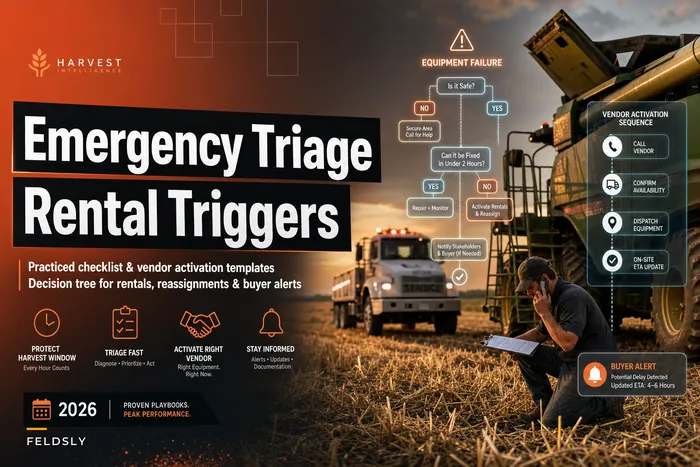
Trigger 3 — No reasonable local alternative within the response threshold. If the dealer can deliver same-day, the pool isn't needed. The trigger fires only when the failure would otherwise cause downtime beyond an agreed threshold — say, more than 12 hours during planting. This ties naturally into your broader breakdown response; if you've already built an emergency equipment-failure playbook with triage and rental triggers, the pool becomes one more option in that decision tree rather than a separate process.
All three conditions should be true before a part leaves the shelf. Write it that way in the MOU. That single rule prevents most of the disputes that kill informal arrangements.

A simple flow like this helps members follow the written trigger steps during busy windows without arguing.
Cost-sharing formulas that don't start fights
There are two separate money questions in any pooling arrangement, and farms constantly blur them. Keep them separate.
Question 1: Who pays for the part upfront?
The cleanest approach is equal shares regardless of farm size. Four farms, a $9,000 gearbox, everyone pays $2,250. Simple, and it feels fair because access rights are equal. Splitting by acreage or equipment count sounds more equitable but creates endless arguing about whose 900 acres counts more than whose 600. Simplicity wins in year one.
Question 2: Who pays when a part actually gets used?
This is where pooling either builds trust or destroys it. When a member pulls a part and installs it, that part is now consumed or worn. Two workable models:
Model A — Usage replacement. Whoever uses the part is responsible for replacing it (or paying the replacement cost into the pool fund). Best for consumable-ish parts like seals or filters if you insist on pooling them.
Model B — Depreciation buy-in. For durable parts that get reinstalled and returned, the user pays a usage fee based on wear, not full replacement. A formula that's easy to defend:
> Usage fee = (Part cost ÷ Expected service life in uses) × uses consumed + any damage cost
So a $9,000 gearbox rated for roughly 8 install cycles before rebuild costs about $1,125 per use. The member who pulls it pays that into the pool fund, and the pool builds a replacement reserve over time. Nobody eats the full $9k, and the fund stays capitalized.
The piece people most often forget: the pool needs a small cash float. Collect an extra $150–$250 per member per season into a shared fund for freight, unexpected replacement, and admin. Without it, the first real usage event turns into a fresh round of "okay everyone Venmo me" — which is exactly the friction pooling was supposed to eliminate.
A worked example: four corn/soy farms pooling planter and tractor parts
Picture four operations within about 25 miles of each other, all running the same tractor platform and near-identical planters. Their planting windows overlap but aren't identical — one runs lighter, faster-drying ground and typically starts three to four days ahead.
They pool three parts:
-
One tractor hydraulic pump — around $3,600
-
One spare planter row-unit meter assembly — around $1,900
-
One high-pressure fuel pump — around $2,100
Total pooled inventory: roughly $7,600, split four ways at about $1,900 per farm.
Before pooling, at least two of the four farms were each carrying their own spare hydraulic pump "to be safe" — $3,600 sitting idle on two separate shelves, $7,200 of dead capital doing nothing most seasons. A third farm had no spare and got burned the prior spring paying dealer rush freight, losing close to a day and a half of planting on drying ground. Depending on conditions, that timing cost lands somewhere in the $2k–$4k range in yield impact.
After pooling, each farm's parts exposure dropped to about $1,900, the shared fund covered freight, and because the lighter-ground farm plants first, the timing conflict they feared mostly didn't materialize — peak demand naturally staggered. Over two seasons, the pump got used twice, the meter assembly once, and the fuel pump never. Every usage was covered by the depreciation formula, and nobody scrambled for a same-day dealer order.
The honest read: savings weren't dramatic in raw dollars year one — maybe a few thousand across the group. The real payoff was avoided downtime during the window that actually determines yield, plus not having four separate piles of depreciating metal. That's the pattern worth chasing.
The conflict rule: what happens when two farms need it at once
Every pool eventually faces the simultaneous-demand scenario. Your MOU has to answer it before it happens, in writing, or it implodes the first time it comes up.
-
First documented failure wins. Timestamp on the failure photo or fault code decides it. Objective, not political.
-
If truly simultaneous, the member deeper into their critical window gets priority. The farm with wetter ground closing fast beats the farm with three dry days of buffer.
-
The member who loses priority gets pool-funded expedited sourcing. The float pays the rush freight for the second farm's own replacement.
That third rule is what keeps pooling from feeling like a lottery. A member who "loses" still gets help, so nobody hoards the part next season out of fear.
When pooling makes sense — and when it doesn't
When it works well:
-
Farms within a short drive of each other (parts have to be physically reachable fast)
-
Genuinely compatible equipment — matching OEM part numbers, not "similar" machines
-
Staggered peak windows, even by a few days, because of soil type or crop mix
-
Three to five members — coordination cost climbs fast past that
When it's a bad idea:
-
Everyone runs the exact same ground and hits the identical window on the same day — demand isn't staggered, so collisions are frequent
-
The parts in question are cheap enough that everyone should just stock their own
-
The group has unresolved trust issues or existing bad blood — pooling amplifies tension, it doesn't fix it
One type of member that reliably breaks these arrangements: someone who treats the "confirmed failure" trigger as optional and grabs the spare as insurance. One person doing that repeatedly empties the pool for everyone. If you can't commit to the triggers, carry your own spare and skip the arrangement.
Keeping the paperwork alive during the season
The MOU only helps if the tracking behind it is real. The place where pooling quietly dies is record-keeping — nobody remembers who has the pump, whether the usage fee got paid, or whose failure photo came in first.
You don't need anything fancy. A shared spreadsheet or a simple operational tracker works, as long as it captures four things for every pooled part:
-
Current physical location and who has it
-
Every usage event with date, member, and fault documentation
-
Fund balance and outstanding usage fees
-
Condition and return status after each use
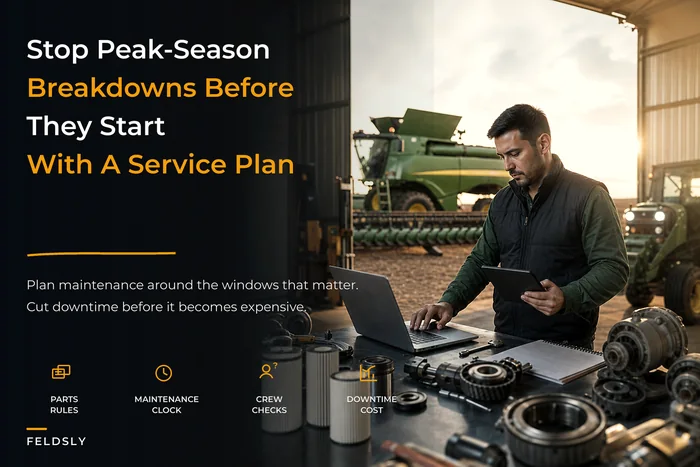
Farms already running a maintenance system have an advantage here — pooled parts slot into the same logs you'd keep under a proper machinery lifecycle and planned-maintenance approach, so the shared inventory isn't a separate orphaned process.
Log every pull and payment the day it happens to avoid disputes and keep the float accurate.
Whether that lives in a shared sheet or an operational platform matters less than the discipline of logging every pull and every payment the day it happens. A confirmed-failure timestamp is worthless if it only exists in someone's memory.
A one-page MOU checklist to start from
Before your group signs anything, make sure the document covers:
-
[ ] List of pooled parts with exact OEM part numbers and current value
-
[ ] Named members and equal (or agreed) cost shares
-
[ ] The three activation triggers, written as required conditions
-
[ ] The chosen cost-sharing model (usage replacement or depreciation buy-in) with the actual formula and per-use figures
-
[ ] Seasonal fund contribution amount and what it covers
-
[ ] The conflict priority order, including pool-funded expedited sourcing for the member who loses priority
-
[ ] Physical storage location and access process
-
[ ] A return-condition standard and who pays for damage
-
[ ] A simple exit clause — how a member leaves and gets their share value back
-
[ ] Who maintains the tracking record and how usage gets logged
Keep it to a page or two. A long, lawyered MOU that nobody reads is worse than a short one everyone actually follows.
Bottom line
Four farms each guarding their own idle $3,600 pump is a lot of dead capital. A parts pooling agreement turns that into shared, cheaper, faster-to-deploy coverage — but only if the boring rules get written down first: clear triggers, a defensible cost formula, a small cash float, and a conflict rule that doesn't leave anyone stranded mid-window.
Start small. Pick two or three high-cost, exactly-compatible parts, run it with three or four farms whose windows don't perfectly overlap, and log every pull the day it happens. The dollar savings in year one might be modest — but the first time a confirmed failure gets solved in an hour instead of two days of rush freight during planting, the arrangement pays for itself and the trust to expand it starts to build.
Start small. Pick two or three high-cost, exactly-compatible parts, run it with three or four farms whose windows don't perfectly overlap, and log every pull the day it happens. The dollar savings in year one might be modest — but the first time a confirmed failure gets solved in an hour instead of two days of rush freight during planting, the arrangement pays for itself and the trust to expand it starts to build.
Ready to revolutionize your farm management?
Join 500+ farms using Feldsly to boost yields, reduce waste, and streamline daily farm workflows.