

Most farms that invest in measurement, reporting, and verification end up sitting on a pile of data that never translates into a single extra dollar at the contract table. The soil carbon numbers exist. The nitrogen management records exist. The irrigation logs, the cover crop timing, the yield-to-input ratios — it's all there, usually scattered across three systems and a shoebox of field notes. And yet when the buyer's sustainability team asks for proof, the whole thing either falls apart or gets handed over so loosely that the premium evaporates in negotiation.
The gap isn't the data. It's the packaging. A grain buyer, a food-company sourcing team, or a carbon aggregator doesn't pay premiums for "we track our emissions." They pay premiums for evidence they can defend to their own auditors, their own board, and their own regulators. If your MRV output can't survive that chain of scrutiny, it functions as a cost center instead of a revenue line.
This article is about the system that sits between your field data and the buyer's checkbook — the evidence-packet recipes, pricing gates, contract clauses, negotiation steps, and delivery cadence that actually commercialize farm MRV buyer premiums. Not the measurement itself, but the commercial machinery that turns measurement into money.
Why most MRV data never becomes a premium
The pattern keeps showing up: a farm builds decent measurement discipline, often because a buyer or program asked them to. The data collection becomes routine. But nobody ever builds the second half of the loop — the part where data gets structured, verified, priced, and delivered on a schedule a buyer's procurement team can actually plan around.
What happens instead is a one-off scramble. The buyer asks for documentation in Q3. Someone pulls records together over two frantic weeks, exports a few spreadsheets, writes a cover email, and sends it. The buyer's team glances at it, finds three gaps, asks follow-up questions, and by the time the back-and-forth settles the contract is already signed at the base price. The premium conversation never had a chance because the evidence showed up late and loose.
A few structural reasons this keeps happening:
-
The data is operational, not commercial. It was collected to run the farm, not to prove a claim to a third party. Those are different formats with different rigor requirements.
-
Nobody owns the handoff. Agronomy owns the measurement. Sales or the owner owns the buyer relationship. The translation layer between them is nobody's job.
-
There's no pricing logic tied to the evidence. The farm knows its practices are better but has no framework for what a given level of verified performance is actually worth per bushel or per ton.
-
Delivery is reactive. Instead of a predictable cadence, evidence goes out only when asked, which signals to the buyer that it's an afterthought.
If you've already built your measurement backbone — and if you haven't, the Farm sustainability MRV playbook is the place to start — the work ahead is almost entirely commercial and operational, not technical.
The evidence packet is the product you're actually selling
Stop thinking of the buyer conversation as "selling grain with a sustainability story." Start thinking of the evidence packet as a product in its own right. It has a spec, a quality bar, a version, and a delivery date. When you treat it that way, everything downstream gets easier.
Take control of your farm’s productivity.
Feldsly helps you plan, track, and optimize every farming operation with precision.
- Centralized crop scheduling
- Resource & labor management
- Real-time weather alerts
No credit card required
A buyer-facing evidence packet is a self-contained document (or structured bundle) that lets a buyer's sustainability or sourcing team verify a specific set of claims without coming back to you for clarification. The test is simple: could someone who has never spoken to you read this packet and confidently defend the premium to their own auditor? If yes, you have a product. If no, you have raw material.
Sample evidence packet checklist
-
Cover summary — one page
operation name, acreage covered, crop(s), reporting period, the specific claims being made, and the verification level (self-reported, third-party verified, program-certified).
-
Scope definition — exactly which fields, which practices, and which time window the packet covers. Ambiguity here is where premiums die.
-
Practice evidence — dated records for each claimed practice (cover crop establishment, reduced tillage passes, nitrogen rate and timing, etc.) with supporting documents: application records, as-applied maps, seed tags, invoices.
-
Quantified outcomes — the actual numbers
emissions reduction, carbon intensity score, nutrient use efficiency, or whatever metric the premium is keyed to, with the calculation methodology named.
-
Data provenance — where each number came from, how it was captured, and the chain from raw field data to reported figure.
-
QA attestation — who reviewed the packet internally, what they checked, and sign-off date.
-
Supporting appendix — sensor logs, lab results, weather records, equipment data — the backup you only need if someone digs.
-
Version and contact block — packet version number, generation date, and a named point of contact.
The single most common failure here isn't a missing document — it's weak provenance. A buyer's auditor will accept a reasonable number with a clear trail long before they'll accept a perfect number with no explanation of where it came from. If you've built a disciplined emissions reporting workflow with a seasonal data cadence, your provenance section almost writes itself, because the trail was captured as you went instead of reconstructed afterward.
The single most common failure here isn't a missing document — it's weak provenance.
If you've built a disciplined emissions reporting workflow with a seasonal data cadence, your provenance section almost writes itself, because the trail was captured as you went instead of reconstructed afterward.
Pricing gates: knowing what each tier of evidence is worth
This is the part most farms skip entirely, and it's where real money leaks. You cannot negotiate a premium you haven't priced. "We'd like something for our sustainability practices" is not a position — it's a wish. A pricing gate is a pre-defined threshold that says: at this level of verified performance, the premium should be at least X.
The logic works in tiers, because buyers pay for verification confidence as much as for the underlying practice. A claim backed by third-party verification is worth meaningfully more than the identical claim backed only by your own records, even if the farming is exactly the same.
Worked pricing-threshold example
Say you're selling corn into a food company's low-carbon sourcing program. The program pays on carbon intensity (CI) improvement against a regional baseline. Here's how a tiered pricing gate might look for a given delivery volume:
| Verification tier | CI improvement vs baseline | Evidence requirement | Target premium (per bu) |
|---|---|---|---|
| Tier 0 — unverified | Any claimed | Self-reported only | $0.00 (no credible claim) |
| Tier 1 — self-documented | 5–10% | Complete records + provenance | $0.08–$0.12 |
| Tier 2 — third-party verified | 10–18% | Tier 1 + external verification | $0.18–$0.28 |
| Tier 3 — program-certified | 18%+ | Tier 2 + registry certification | $0.30–$0.45 |
The gate works like this: you don't open negotiation above the tier your evidence actually supports. If your packet only clears Tier 1, you anchor at $0.10 and don't bluff toward Tier 2 numbers you can't defend — because the moment the buyer's auditor pokes the packet, you lose the whole premium and some credibility along with it.
A realistic way to run the math: on a 1,200-acre corn block averaging around 190 bu/acre, that's roughly 228,000 bushels. The difference between clearing Tier 1 ($0.10) and Tier 2 ($0.22) is about $27k in premium on the same crop — the only variable being whether you invested in third-party verification. That delta is your decision gate for whether verification pays. If verification costs you $8k–$12k and moves you a full tier on enough volume, it clears easily. On a 200-acre block, the same verification cost probably doesn't pencil.
Contract-clause snippets that protect the premium
A premium that lives only in a verbal agreement or a side email tends to disappear at reconciliation. The premium has to live in the contract, with language that survives both parties' legal review. You don't need to be a lawyer to draft starting points — you need to know which clauses to insist on and have counsel refine them.
Premium trigger clause. Ties the payment explicitly to the verified tier. Example framing: "Buyer shall pay a premium of $0.22/bu above the base contract price for all delivered volume certified at Verification Tier 2 or above, as evidenced by the Seller's quarterly evidence packet accepted per Section X."
Evidence acceptance clause. Defines what counts as acceptance and how long the buyer has to raise objections. Without this, buyers can sit on a packet indefinitely and then dispute it at payment time. Something like a 15-business-day review window with deemed acceptance after that.
Cure and dispute clause. Spells out what happens if the buyer flags a gap — your window to supply additional documentation before the premium is forfeited. This is the clause that saves you when a single missing record surfaces.
Data-use and confidentiality clause. Controls what the buyer can do with your operational data. Buyers will happily use rich MRV data for their own reporting; you want to control whether they can republish it, share it with competitors' aggregators, or retain it after the contract ends.
Volume-attribution clause. Clarifies exactly which delivered loads the premium applies to, especially when verified and unverified grain commingle at the elevator. This is a quiet source of disputes — specify the attribution method up front.
Nearly every premium dispute traces back to a clause that wasn't written, not one that was poorly written. Buyers rarely try to cheat outright. They default to the base contract when the premium terms are vague, because that's the safe interpretation for their own finance team.
A negotiation checklist for the premium conversation
The negotiation itself should feel almost boring if the earlier work is done. You're not persuading — you're presenting a priced, evidenced position and walking the buyer through why it holds. Run through this before you sit down:
-
Confirm your real verification tier. Not your aspirational tier. What can the packet actually defend today?
-
Set your anchor and walk-away. Anchor at the top of your defensible tier's range; know the number below which the premium isn't worth the reporting cost.
-
Pre-empt the three likely gaps. Buyers' teams check the same things — provenance, scope boundaries, and methodology. Have answers ready before they ask.
-
Bring the packet to the table, not after. Handing over complete evidence in the room shifts the conversation from "can you prove it" to "what's it worth."
-
Separate the premium from the base-price negotiation. Don't let a tough commodity-price conversation drag your sustainability premium down with it. They're different value streams.
-
Get the acceptance window in writing. Verbal "sounds good" means nothing at reconciliation.
-
Document what the buyer committed to for next cycle. The premium you want is recurring, not one-off.
The mistake most farms make is leading with the farming story. Buyers' sustainability staff have heard a thousand farming stories. What they don't often get is a clean, pre-verified packet with a defensible number attached. Lead with the evidence and the price; the story is backup, not the pitch.
Operational QA before anything leaves the building
An evidence packet that goes out with a mistake does more damage than no packet at all, because it trains the buyer's team to distrust everything you send afterward. QA isn't optional polish — it's what protects the recurring premium.
A workable QA flow runs like this: raw field data gets captured during operations, flows into your reporting system, and then before any packet is assembled, a reviewer checks three layers. First, completeness — are all claimed practices backed by dated records? Second, consistency — do the numbers reconcile across sources (do your as-applied maps match your invoices match your reported rates)? Third, defensibility — would each number survive a pointed question about where it came from?
Here's a short visual of that flow:
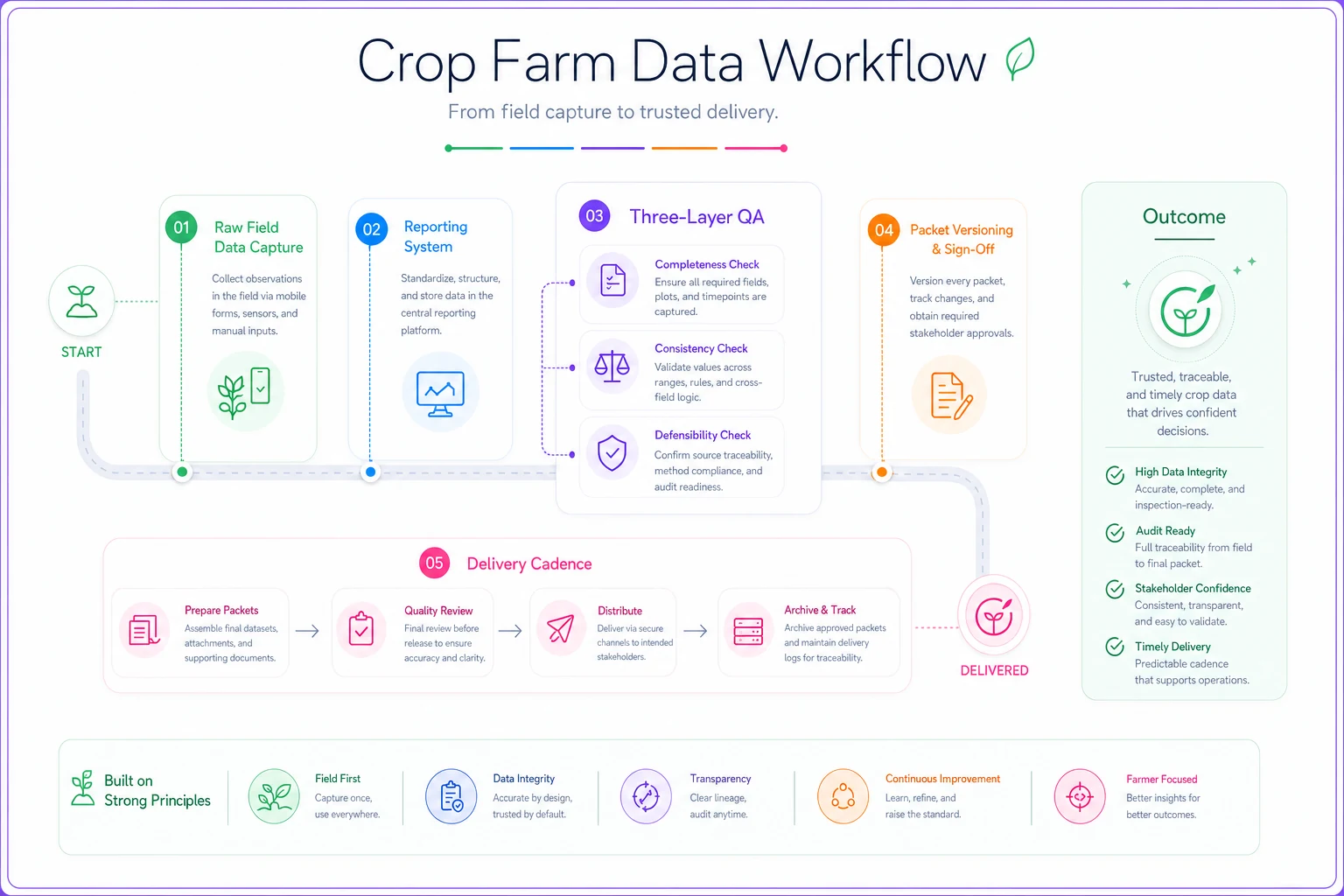
Only after those three layers clear does the packet get a version number and a sign-off. The sign-off matters because it creates accountability — someone's name is on the statement that this packet is accurate. That single step quietly eliminates most of the sloppy errors that kill premiums.
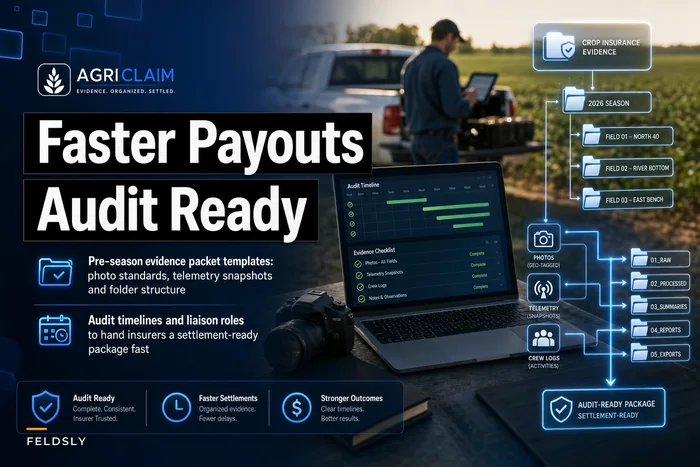
This discipline isn't new to anyone who's assembled documentation for other high-stakes purposes. The same rigor that goes into pre-built evidence packets for crop insurance settlements — dated records, chain-of-custody, audit-ready timelines — transfers almost directly to buyer-facing MRV packets. If you've already built that muscle for claims, you're reusing a process, not inventing one.
The recurring delivery cadence that turns premiums into revenue
A one-time premium is a bonus. A recurring premium is a revenue line you can plan around, borrow against, and build the farm's economics on. The difference is cadence — delivering evidence on a predictable schedule that the buyer's procurement cycle can depend on.
The cadence should map to how the buyer buys and reports. Most food companies and aggregators work on quarterly or annual reporting cycles. If your evidence arrives two weeks before their reporting deadline, every cycle, you become the easy supplier — the one whose documentation never causes a fire drill. That reliability has real value, because the buyer's team starts planning volume around you instead of hoping you come through.
A simple cadence structure:
-
Pre-season confirm the verification tier you're targeting and the evidence requirements for the coming contract period.
-
In-season capture provenance as operations happen — this is the step that makes everything else cheap later.
-
Post-harvest assemble, QA, and version the packet.
-
Pre-buyer-deadline deliver the packet inside the acceptance window, proactively, before being asked.
-
Post-delivery confirm acceptance in writing and lock the next cycle's terms.
The farms that commercialize MRV successfully treat this cadence like harvest itself — a non-negotiable seasonal rhythm. The ones that struggle treat it as an errand to run when a buyer nudges them.
When this makes sense — and when it doesn't
When it makes sense:
-
You have enough volume that a per-bushel or per-ton premium produces a meaningful dollar figure.
-
You sell into channels that actually pay for verified sustainability — food companies, specialty aggregators, carbon programs.
-
You already have, or can build, reliable measurement discipline.
-
Your practices genuinely clear a credible improvement threshold.
When it's a bad idea:
-
Your volume is small enough that the reporting and verification cost eats the premium. On a few hundred acres selling into a commodity elevator with no premium program, the packet work won't return the hours.
-
You're selling into a pure spot market with no buyer who pays for verification. No amount of packaging creates a premium the channel doesn't offer.
-
Your measurement is too thin to survive a provenance challenge. Fix the measurement first; a premium built on shaky data is a liability waiting to surface in an audit.
Who should wait: farms still stabilizing basic operations and data capture. The commercial layer sits on top of solid measurement. Build the foundation before you try to sell the roof.
A real scenario
A mid-sized corn-soy operation — roughly 2,600 acres, selling a portion of its corn into a food company's low-carbon sourcing program — had been collecting good practice data for two seasons but treating the buyer conversation as reactive. Each year they'd scramble to assemble documentation when the buyer asked, hand it over loosely, and settle for a thin, inconsistent premium somewhere around $0.06–$0.08/bu, often disputed down at reconciliation.
The change wasn't more measurement — it was building the commercial layer. They standardized a packet, defined three pricing tiers, invested about $9k in third-party verification for the enrolled acreage, got premium-trigger and acceptance clauses into the contract, and moved to a quarterly delivery cadence timed to the buyer's reporting cycle.
The result over the following year: the verified portion cleared a solid Tier 2 and held a $0.20–$0.24/bu premium that stuck through reconciliation, because the evidence was clean and the contract language was tight. On the enrolled volume, that moved the sustainability premium from a disputed few thousand dollars to a dependable line in the mid five figures. Maybe more importantly, the buyer started treating them as a priority supplier for the next cycle. The farming didn't change. The packaging and the cadence did.
The bottom line
Measurement is table stakes. Plenty of farms measure. Very few build the commercial machinery that turns that measurement into premiums buyers will honor cycle after cycle.
The evidence packet is your product. The pricing gates tell you what it's worth. The contract clauses protect it. The QA keeps it credible. The delivery cadence is what converts a one-time bonus into a revenue line you can actually build on. If your MRV data has been sitting idle because nobody ever built the bridge between the field and the contract table, that bridge — not more sensors, not more reports — is where the next real dollar is hiding.
Ready to revolutionize your farm management?
Join 500+ farms using Feldsly to boost yields, reduce waste, and streamline daily farm workflows.