

Nobody tells you this about crop insurance: the adjuster's visit isn't really where the claim gets decided. By the time they're walking your field with a clipboard, most of the outcome has already been locked in by what you can and can't prove. The hail event, the flood, the wind that flattened 200 acres of corn — that's the easy part to document emotionally. The hard part is proving the field was in good shape before the loss, that your management was reasonable, and that the damage timeline matches what you're claiming.
That's where farms lose money. Not because the loss wasn't real, but because the evidence was scattered across three phones, two spiral notebooks, and a telemetry dashboard that nobody exported before the dealer's trial license expired.
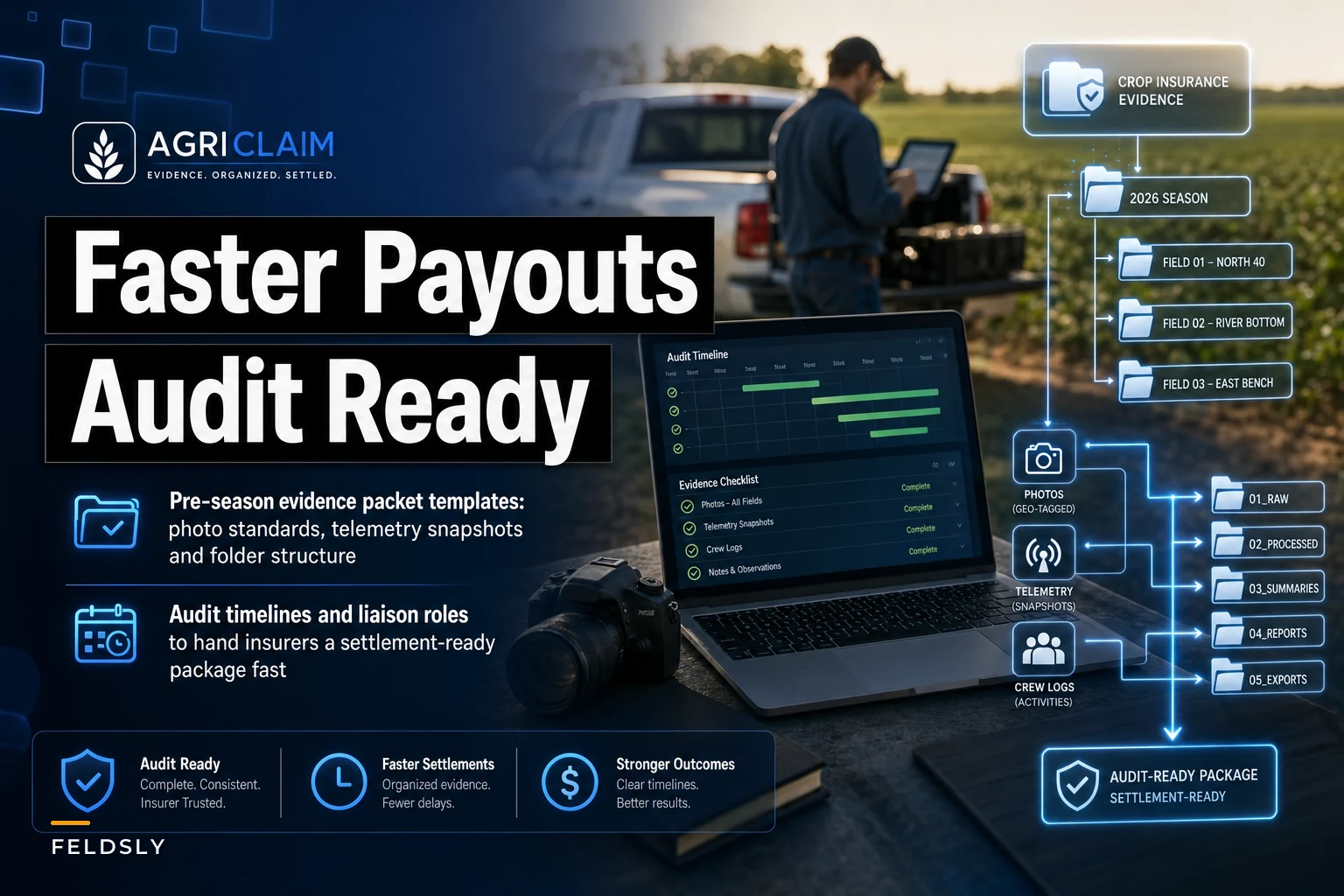
This post is about one narrow thing: building a crop insurance claims checklist and a pre‑season evidence packet so that the moment a loss happens, you hand your adjuster an audit‑ready package instead of scrambling to reconstruct the season from memory.
The real failure isn't the loss — it's the reconstruction scramble
A farm takes a legitimate hit. The owner calls the agent within the deadline, does everything right on the reporting side. Then the adjuster asks for three things:
-
Dated photos showing crop stage and condition before the event
-
Records showing planting dates, inputs, and stand counts
-
Something — anything — that establishes the field's baseline productivity
And the farm has some of it. Planting dates are in the FMS. A few photos exist but they're undated, cropped, or shot in a way that could be any field on the place. Stand counts were done but written on a note that's now sitting in a glovebox. Yield history is solid, but pre‑loss condition is a gap.
That gap gets filled by the adjuster's judgment. And adjuster judgment, under pressure and volume, trends conservative. A production loss that should have paid at a certain level gets trimmed because the file has holes. Nobody's acting in bad faith — the file just doesn't make the case strongly enough, so it gets the benefit of the doubt in the carrier's favor.
The frustrating part is that every piece of missing evidence existed at some point during the season. It just wasn't captured in a form that survives to claim day.
What an audit‑ready packet actually contains
An evidence packet isn't a shoebox of photos. It's a structured record built during the season, with the specific purpose of answering an adjuster's questions before they're asked. Think of it as a file you assemble whether or not you ever file a claim — because you won't know which field gets hit.
Take control of your farm’s productivity.
Feldsly helps you plan, track, and optimize every farming operation with precision.
- Centralized crop scheduling
- Resource & labor management
- Real-time weather alerts
No credit card required
The packet breaks into four categories:
| Category | What it proves | When you capture it |
|---|---|---|
| Baseline condition | The field was healthy and well‑managed pre‑loss | Emergence, V‑stages, key growth milestones |
| Management records | Reasonable practices, inputs applied, decisions documented | Rolling, throughout season |
| Telemetry snapshots | Moisture, as‑applied, weather exposure, machine logs | Exported on a schedule, not left in the cloud |
| Loss documentation | The event, damage extent, timeline | Within 72 hours of the event |
Most farms only think about the last row. The first three are what actually move settlement amounts, because they're what the adjuster can't easily dispute when they're done right.
Photo standards that hold up
Undated, context‑free photos are nearly worthless in a claim. A clean photo standard fixes most of this and takes about 30 extra seconds per shot. Here's a standard your crew can actually follow:
-
Shoot wide, then tight. One frame showing the field entrance or a recognizable landmark, then a close‑up of the crop or damage. The wide shot establishes which field.
-
Include a scale reference. A ruler, a tape, a boot next to a plant — anything that gives the adjuster a size anchor on stand or damage.
-
Capture the whole field, not the worst spot. Adjusters are suspicious of files that only show the single ugliest square meter. Document representative areas and the bad areas separately.
-
Lock location and timestamp. Use the phone's native camera with location services on, so GPS and time are embedded in the file metadata. Screenshots and forwarded images strip this out — originals only.
-
Name the file or log it immediately. Field ID, date, growth stage. A photo you can't attribute is a photo you can't use.
One operational note: train your crew to shoot the same vantage points at emergence, mid‑season, and if a loss occurs. A before/after from the identical corner of the field is dramatically more persuasive than two random angles. Consistency is the whole game.
Telemetry snapshots: export it or lose it
This is the quiet one that burns people. Soil moisture readings, as‑applied maps, weather station logs, and machine data all live in vendor dashboards. Those dashboards are great until:
-
A trial subscription lapses after harvest
-
You switch providers and lose historical access
-
The data's there but you can't export it in a format the adjuster accepts
-
The account was tied to an employee who left
If the loss happened in July and you're trying to pull June moisture data in October from a platform you no longer pay for, you're stuck. The fix is to treat telemetry like financial records: export on a schedule and store your own copies.
A workable cadence looks like this. At the end of each month during the growing season, export:
-
As‑applied maps for any application that month (PDF plus the raw file)
-
Weather station or nearest‑station summaries (rainfall, temp extremes, wind events)
-
Soil moisture readings at a weekly rollup
-
Any equipment logs relevant to field operations
Drop them into your own storage. Yes, it's redundant. Redundancy is the point — the whole reason you keep it is for the one season you need it. This connects directly to broader risk discipline; if you want the framing, our piece on turning market and contract shocks into operational risk management treats insurance recovery as one lever in a larger resilience plan rather than an afterthought.
A folder structure your crew can't mess up
Evidence doesn't help if nobody can find it. The folder structure matters as much as the content, because under claim pressure you need to locate files fast and your adjuster needs to navigate them without a tour.
/2025Season /Field12NorthQuarter /01Baseline emergencephotos/ standcountrecords/ /02Management plantingrecord.pdf inputapplications/ /03Telemetry moistureexports/ asappliedmaps/ weatherlogs/ /04LossEvent eventphotos/ adjuster_correspondence/ timeline.pdf
Two rules make this survive real use. First, one folder tree per field per season — don't mix years or fields, because that's exactly where things get lost. Second, name consistency is non‑negotiable. If one person writes "N Quarter" and another writes "North 12," your search breaks. Lock the field naming convention once and enforce it everywhere, the same way you'd standardize naming in any records system.
Here's a simple diagram of the per‑field folder workflow.
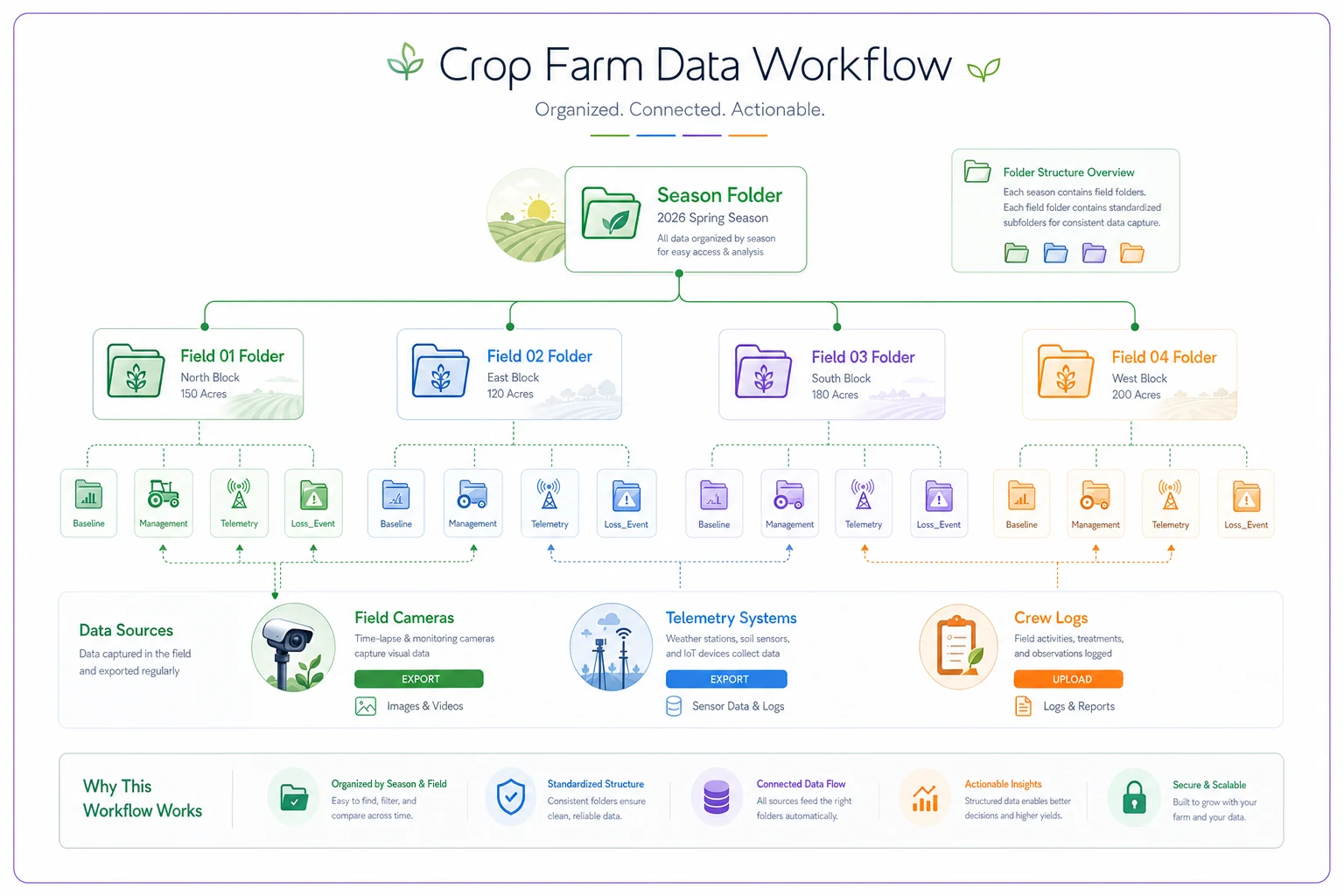
Use this as a quick reference when training the team on where to store exported telemetry and photos.
The audit timeline: what happens in the first 72 hours
When a loss hits, the clock matters and the sequence matters. This is the operational timeline that separates clean claims from messy ones:
Within 24 hours:
-
Notify your agent/carrier (don't let this slip — it's a hard deadline on most policies)
-
Do NOT destroy evidence by tilling, replanting, or clearing the affected area until released
-
Begin event photo documentation using your photo standard
Within 48 hours:
-
Pull and save the baseline folder for the affected field so it's ready to hand over
-
Export current telemetry — moisture, weather, as‑applied — before anything rolls off a dashboard
-
Write a plain‑language event timeline
what happened, when you noticed it, what you did
Within 72 hours:
-
Assemble the full packet in the field's folder tree
-
Confirm who your single point of contact with the adjuster will be
-
Review the packet for the three holes adjusters probe most
pre‑loss condition, management reasonableness, damage extent
The "don't destroy evidence" line deserves emphasis. Farms under pressure to get back into a field sometimes clear or replant before the adjuster releases it, and that single move can gut an otherwise valid claim. When in doubt, document heavily and wait for the release.
Define the liaison role before you need it
The last piece people skip: who talks to the adjuster. When five people are all texting the adjuster different versions of events, the file gets noisy and inconsistencies creep in. One person giving one account against your organized packet is far stronger.
The liaison role, defined pre‑season, should cover:
-
Single point of contact. All adjuster communication routes through one named person.
-
Authority to pull records. The liaison has access to every folder and every telemetry export without hunting for passwords.
-
A communication log. Every call, email, and visit gets dated and summarized. This matters if there's ever a dispute about what was agreed.
-
A backup. If the primary liaison is unavailable during a peak window, someone else is pre‑authorized.
Defining roles ahead of a stressful event is the same discipline that makes crew paperwork survive scrutiny — the same thinking behind compliance‑first onboarding workflows that survive audits. Decide who owns what, write it down, before the pressure hits.
A real scenario: the undated‑photos problem
A corn‑soy operation running around 1,800 acres took a July hail event across a few fields. The loss was real and the owner reported on time. But the only pre‑loss evidence was a handful of photos shot on a crew member's personal phone, forwarded over text — which stripped the metadata — and a couple of stand‑count notes nobody could reliably tie to the right field.
The adjuster couldn't confirm pre‑loss condition on one of the fields, so that portion of the settlement came in lighter than the actual damage warranted. The gap on that single field worked out to somewhere in the low‑to‑mid four figures — not catastrophic, but entirely avoidable.
The following season they changed three things: a locked photo standard (native camera, GPS on, originals only), monthly telemetry exports into a per‑field folder tree, and one named liaison. When a wind event hit a different field the next year, the packet was handed over inside 48 hours. The adjuster had nothing to dispute on baseline or management, and the claim moved through noticeably faster with no condition write‑down. The actual work added up to maybe an hour or two a month during the season.
When this is worth the effort — and when it isn't
When it clearly makes sense: multi‑field operations, anywhere you carry meaningful coverage, and any region with recurring weather exposure — hail belts, flood‑prone bottoms, drought‑risk ground. The more fields and the higher the coverage, the more a weak file costs you.
When it's lighter touch: a small single‑field operation with low coverage can run a stripped‑down version. A consistent photo habit and a once‑a‑month export is probably enough.
Who should not overbuild this: if you're spending more time maintaining the system than it could ever return in a claim, you've over‑engineered it. The packet should be a byproduct of normal recordkeeping, not a second job. The goal is to capture evidence as you already work, not to create a parallel documentation bureaucracy.
Where tooling quietly helps
None of this requires software. You can run it with a phone, a naming convention, and a disciplined folder habit. The friction is consistency — crews shoot photos wrong, exports get forgotten, files land in the wrong folder.
That's the narrow spot where a workflow platform earns its keep: enforcing the photo standard at capture, reminding someone to run the monthly telemetry export, and filing evidence into the right per‑field folder automatically so the packet builds itself during the season. The value isn't the technology — it's that the packet actually exists and is complete on the day you need it, instead of being something you meant to organize and never did.
Bottom line
The claim is won or lost in the records you keep before anything goes wrong. Build the packet in the calm part of the season — lock a photo standard, export telemetry on a schedule, stand up a clean folder tree per field, and name your liaison. When a loss comes, you're not reconstructing a season from a glovebox. You're handing over a file that answers the adjuster's questions before they ask them — and that's what gets claims paid faster and fuller.
Ready to revolutionize your farm management?
Join 500+ farms using Feldsly to boost yields, reduce waste, and streamline daily farm workflows.