


Most crop operations don't fail at sustainability reporting because the science is hard. They fail because every request comes formatted differently, asks for overlapping-but-not-identical data, and lands during the exact weeks nobody has time. One grain buyer wants a carbon intensity number. A state cost-share program wants soil sampling records. A processor's sustainability team wants water use per acre and a nitrogen story. Each one shows up with its own spreadsheet, its own definitions, and a deadline that assumes you've been tracking all of this in a clean, exportable format.
You haven't. Almost nobody has. So the season ends, the requests pile up, and you either scramble through shoeboxes of receipts and application logs or you pay someone $8k–$15k to reconstruct data you technically already collected. The frustrating part is that the underlying numbers usually exist somewhere on the farm — they're just scattered across the sprayer monitor, a fuel log, a fertilizer invoice, and a soil lab PDF sitting in someone's email.
This playbook is about building the opposite of that mess: one MRV (measurement, reporting, verification) architecture that captures the minimum data per metric, stores it in a way that survives audits, and produces buyer and regulator packets on demand. Not a perfect academic system. A working operational one that a farm manager can actually maintain across a season.
Why MRV requests break down across almost every farm
The core problem isn't collecting data — it's that sustainability data lives at the intersection of three departments that never talk to each other in a structured way: agronomy, equipment/operations, and finance.
Emissions data depends on fuel burned, fertilizer applied, and field passes made — that's operations and finance. Soil carbon depends on sampling protocols and lab results — that's agronomy. Water metrics depend on irrigation records and meter readings — operations again, sometimes with a separate irrigation contractor in the mix. No single person on most farms owns all three streams, so when a request needs all three, someone has to go hunting.
The pattern that shows up repeatedly: farms treat each sustainability request as a project instead of an output. A project means starting from zero, gathering everything, formatting it, submitting it, then forgetting about it until the next request forces another round. An output means the data already flows into a structured place, and generating the packet is just filtering and exporting.
The difference in labor is enormous. A project-mode farm spends 30–60 hours per major request. An output-mode farm spends an afternoon. Same underlying data, completely different operating cost.
The minimal-dataset principle: stop collecting everything
The biggest mistake operations make when they get serious about MRV is over-collecting. Someone reads a methodology document, sees 40 possible data fields, and tries to track all of them. Within one season the system collapses because nobody can maintain 40 fields across every field and every pass.
Take control of your farm’s productivity.
Feldsly helps you plan, track, and optimize every farming operation with precision.
- Centralized crop scheduling
- Resource & labor management
- Real-time weather alerts
No credit card required
The smarter move is identifying the minimum viable dataset per metric — the smallest set of fields that lets you calculate the number and defend it if questioned. Most methodologies are built to accommodate the messiest possible farm, which means they include fields you can safely default or estimate.
A realistic minimal breakdown across the three metrics most buyers and programs actually ask about:
| Metric | Minimal fields to capture | Capture source | Frequency |
|---|---|---|---|
| Emissions (fuel/energy) | Diesel/gas volume by operation, field passes count, electricity kWh (irrigation/drying) | Fuel logs, invoices, utility bills | Per fill-up / monthly |
| Emissions (fertilizer/N) | Product type, N content %, rate applied, acres | Application records, invoices | Per application |
| Soil carbon | Sample location (GPS), depth, lab SOC %, bulk density, sample date | Lab reports + sampling log | Per sampling event (1–3 yrs) |
| Water | Irrigation volume or hours, meter reads, precipitation credit, acres irrigated | Meter logs, pump run-time, weather data | Per irrigation event / weekly |
Notice how short each list is. You don't need soil texture triplicates and hourly moisture curves to produce a defensible water metric. You need volume, area, and dates. The over-engineered version dies in month two; the minimal version survives because someone can actually maintain it during planting and harvest.
One insight worth internalizing: the field you skip is easier to explain than the field you collected inconsistently. A regulator will accept a documented default or estimate with a clear method. What raises flags is a field that's filled in for some records and blank for others, because it looks like you're hiding the inconvenient values.
Calculation and archival recipes: make the math boring and repeatable
Once you know your minimal fields, you need a fixed "recipe" for turning raw captures into the number a buyer wants. The goal is that anyone on the team could follow the recipe and get the same answer. If your carbon intensity number changes depending on who calculated it, you don't have MRV — you have opinions.
A recipe has four parts:
-
Inputs — exactly which captured fields feed the calculation
-
Conversion factors — the emission factors, N₂O coefficients, or unit conversions you're using, with the source and version noted
-
Formula — the actual arithmetic, written out once
-
Output + archive location — where the result and its supporting raw data get stored
That last part matters more than people expect. The number you submit is worthless if you can't reproduce it 18 months later when a buyer's auditor asks "how did you get 0.9 tCO₂e per acre?" Every calculated metric should be archived alongside a snapshot of the raw inputs and the factor versions used at the time. Emission factors get updated; if you re-run an old calculation with new factors, your historical numbers won't match your old reports, and that mismatch is exactly what triggers verification headaches.
A clean archival structure that holds up:
-
Raw captures (fuel logs, invoices, lab PDFs) — stored by season, immutable
-
Factor library — every conversion factor with source and date, versioned
-
Calculation worksheets — one per metric per season, referencing the raw captures and factor version
-
Submitted packets — the exact PDF/spreadsheet you sent each buyer, dated
If you already run a real data backbone, this fits naturally on top of it. The farms that handle MRV well almost always have their master data management sorted first — consistent field IDs, consistent product names, consistent units. Without that, your emissions worksheet can't reliably join a fertilizer invoice to the right field.
Here's a simple visual of the calculation and archival workflow.
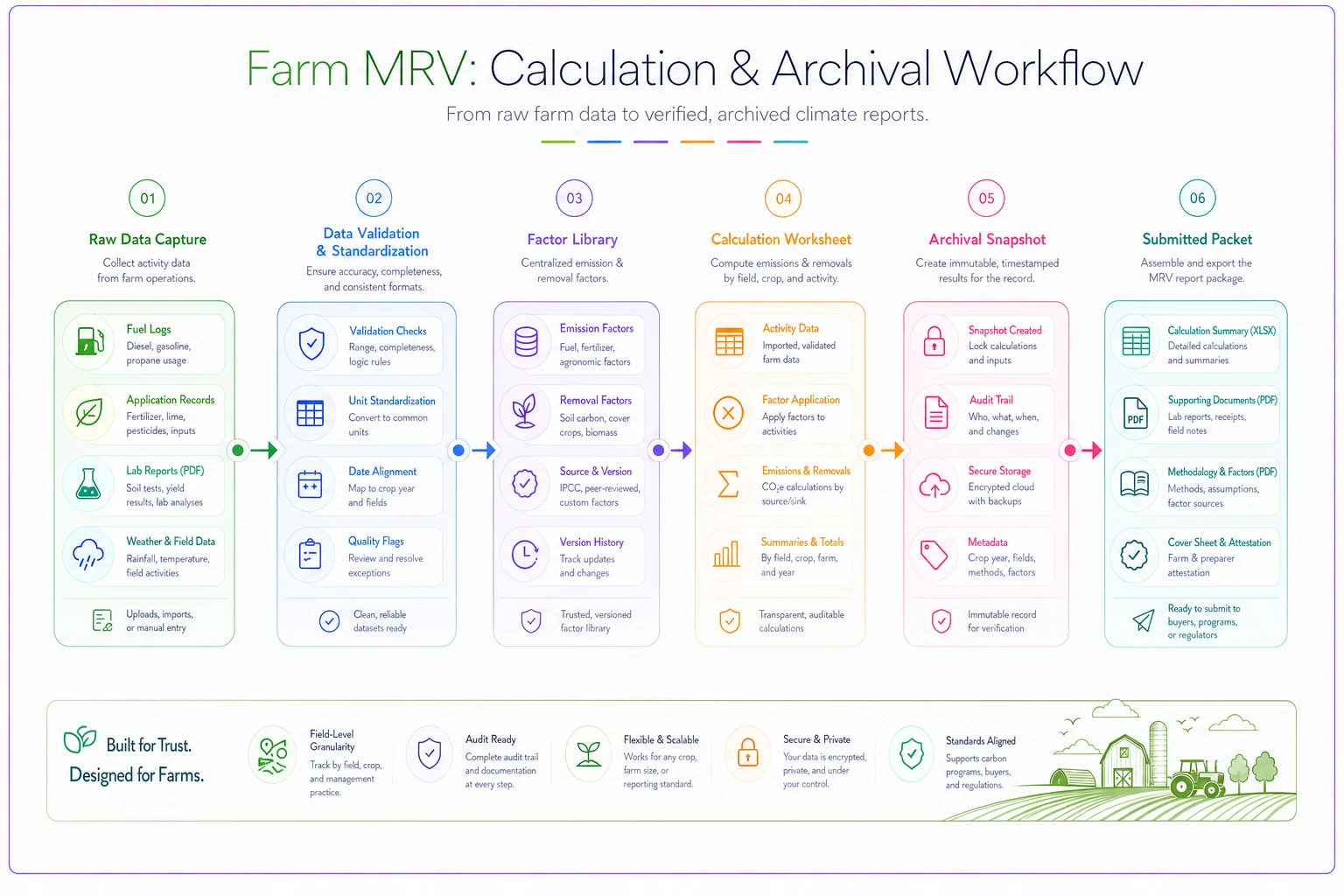
That visual ties the inputs, factors, formula, and archive together so anyone can follow the provenance of a reported number.
Snapshot factor versions alongside each calculation so historical reports reproduce exactly.
Emission factors get updated; if you re-run an old calculation with new factors, your historical numbers won't match your old reports, and that mismatch is exactly what triggers verification headaches.
Seasonal capture cadence: catch data when it's cheap
The reason project-mode farms suffer is that they try to capture data after the event, when memory and paper trails have degraded. The fix is a capture cadence tied to the operational calendar, so data gets logged when it's still cheap and accurate — meaning right when the work happens.
Three tiers of frequency:
-
Event-triggered captures happen the moment something occurs and can't be reconstructed later without loss: - Fertilizer/chemical applications (rate, product, acres) — logged at application - Irrigation events (hours or volume) — logged same day - Fuel fills — logged at the pump or from the delivery ticket
-
Weekly/monthly reconciliation catches the slower stuff
- Reconcile fuel logs against invoices - Reconcile meter reads against pump run-time estimates - File lab reports as they come back
-
Seasonal close-out is when you actually calculate and archive
- Run each metric's recipe - Snapshot factors used - Pre-build the buyer/regulator packet before anyone asks for it
That last habit — building the packet before it's requested — is what separates farms that dread MRV season from farms that treat it as routine. This same seasonal cadence thinking underpins a minimal emissions reporting workflow, and the logic extends cleanly to soil and water metrics.
Worth noting: the farms that reconcile weekly almost never have the "our numbers don't add up" problem at season's end. The ones that let it pile up spend the winter arguing with their own records.
Buyer and regulator packet templates
Different audiences want the same underlying data framed differently. A buyer's sustainability team wants a clean summary with per-acre intensity numbers and a short methodology note. A regulator or cost-share program wants raw records, sampling protocols, and chain-of-custody-style documentation. If you build one flexible packet structure, you can serve both by toggling what you include.
A workable universal packet has these components:
-
Cover summary — farm/field IDs, reporting period, metrics included, headline numbers
-
Methodology note — which recipes and factor versions you used, one paragraph per metric
-
Metric detail sheets — the calculation worksheet per metric
-
Supporting evidence appendix — raw captures, lab PDFs, invoices (included for regulators, referenced for buyers)
-
Contact + attestation — who prepared it and a signature line
Buyers want to trust you quickly; regulators want to verify you thoroughly. Design for both by keeping the summary and methodology identical, and just attaching or detaching the evidence appendix. Never rebuild the packet from scratch per audience — that's how errors and version drift creep in.
A real scenario: a mixed row-crop operation, ~2,400 acres
A corn and soybean operation running roughly 2,400 acres across a dozen fields had three sustainability-linked requests hit in the same fall: a grain buyer's low-carbon premium program, a state water-use survey, and a cost-share soil health report.
The first year, they handled it in full project mode. The manager and a part-time bookkeeper spent close to 50 hours reconstructing fuel use from a year of invoices, chasing down soil lab PDFs, and estimating irrigation because nobody had logged pump hours consistently. They also paid an outside consultant around $9k to package the carbon number for the buyer program. Two of the three submissions came in late, and the water numbers were flagged as estimates because they couldn't back them up.
The following season they rebuilt around minimal datasets and a capture cadence. Fuel got logged at every delivery, applications got recorded at the sprayer, and pump run-time got noted weekly. At season close they ran fixed recipes and pre-built a single packet.
The second-year request cycle took roughly a day and a half of internal time, no consultant, and all three submissions went in on time with defensible numbers. The soil carbon record was strong enough that the cost-share program approved without a follow-up request. The savings weren't just the ~$9k consultant fee — it was the 40-plus hours of peak-season labor they got back.
The difference was entirely capture cadence and having recipes ready before the requests arrived.
When a lightweight MRV system makes sense — and when it doesn't
This approach makes sense when:
-
You're getting more than one sustainability-linked request per year
-
You're pursuing a carbon or low-carbon premium program with real dollars attached
-
You have multiple fields and can't hold the data in your head
-
You want to stop paying consultants to reformat data you already own
This is overkill when:
-
You have a single, simple annual request with three fields
-
You're not participating in any premium or cost-share program and none of your buyers ask
-
Your operation is small enough that one spreadsheet genuinely covers it
Who should NOT rush into this: Farms without basic data consistency yet. If your field names change between the fuel log and the agronomy record, building MRV on top of that will just formalize the chaos. Fix the foundation first. Getting your data governance staged properly is what makes everything above actually work — and it's also what makes it possible to layer automation on later, so that reconciliation and packet-building stop eating your time.
Where automation quietly earns its keep
None of this requires fancy software to start — a disciplined spreadsheet system beats an unused platform every time. But the labor drain in MRV is real and repetitive, which is exactly the kind of work worth automating once your foundation is solid.
The high-value automation targets are narrow and specific: pulling fuel volumes off delivery tickets, matching fertilizer invoices to the right fields by ID, flagging missing captured values before season-end instead of after, and generating the buyer packet by filtering data you've already structured. Operational platforms with AI-assisted data capture handle the tedious reconciliation and formatting so the manager's time goes toward decisions, not data cleanup. The point isn't to replace judgment — it's to remove the 40 hours of scrambling that made MRV feel impossible in the first place.
The bigger point
Sustainability MRV isn't really a science problem for most farms — it's a coordination and archival problem dressed up as one. The farms that struggle are treating each request as a fresh emergency. The farms that handle it calmly built a small, boring, repeatable system: minimal fields per metric, fixed calculation recipes, a capture cadence tied to the season, and one packet structure that flexes between buyers and regulators.
Start with three metrics, the shortest field list you can defend, and one archive location. Run it for a season, tighten it, and you'll never pay someone $9k to reconstruct your own records again.
Start with three metrics, the shortest field list you can defend, and one archive location. Run it for a season, tighten it, and you'll never pay someone $9k to reconstruct your own records again.
Ready to revolutionize your farm management?
Join 500+ farms using Feldsly to boost yields, reduce waste, and streamline daily farm workflows.