



Every March, I watch multi-field operations slam into the same wall. You've got 2,400 acres to plant, three planters, and maybe 10 days of decent weather. Crews work 14-hour days, equipment breaks from overuse, and you're still behind when the rain hits.
The problem isn't crew size or equipment count. It's sequencing.
Most farms approach planting like a sprint—hit every field as fast as possible with all available resources. But after watching planting operations across corn and soybean farms ranging from 800 to 15,000 acres, there's a pattern that consistently reduces equipment strain and labor overtime by 30-40% without sacrificing planting windows.
The solution treats adjacent fields as sequential stages rather than simultaneous targets, then builds crew-equipment pairings that rotate through these stages on offset schedules.
Why Adjacent Field Sequencing Beats the "All Hands" Approach
Traditional planting pushes all crews and equipment toward completion as fast as possible. Makes sense on paper. Operationally, this creates three expensive problems that compound each other.
Equipment concentration becomes a nightmare. When you send multiple planters to adjacent fields simultaneously, they compete for the same staging areas, fuel trucks, and seed tenders. I tracked a 3,200-acre operation last spring where two planters working adjacent quarter sections lost 90 minutes daily just from logistics overlap—one waiting while the other refilled seed, both trying to turn around in the same access point.
Labor peaks get unmanageable. Running all planters simultaneously means peak demand for operators, tender drivers, and mechanics all hit at once. When a planter goes down (and one always does around day four), you're pulling operators off other units to help troubleshoot, creating a cascade of delays.
Soil condition mismatches get ignored. Adjacent fields rarely have identical moisture levels or soil temperatures. That low spot in Field 7 might need three more days to dry out, but when you're pushing to plant everything at once, someone's going to mud it in because "we're here anyway."
A staggered planting schedule changes this dynamic completely. Instead of treating your 12 fields as one massive block, you sequence them based on practical factors: soil readiness, equipment routing efficiency, and labor distribution.
Building Your Field Sequencing Matrix
Start with a simple assessment of your fields along four factors that actually matter for sequencing decisions.
Take control of your farm’s productivity.
Feldsly helps you plan, track, and optimize every farming operation with precision.
- Centralized crop scheduling
- Resource & labor management
- Real-time weather alerts
No credit card required
Soil temperature variance tracks which fields warm up first. South-facing slopes with good drainage might hit 50°F soil temperature a week before north-facing bottoms. Map this across your operation—you'll find patterns. One Illinois operation discovered their fields had a consistent 4-6 day spread in reaching optimal planting temperature just based on elevation and aspect.
Access complexity determines equipment routing. Some fields share access roads, others require moving equipment across public highways. Fields with shared access points should never run simultaneous operations. Too many near-misses with loaded grain carts and planters trying to use the same field entrance.
Historical dry-down rates show you which fields can handle equipment first after rain. Sandy loam fields might be workable 24 hours after a half-inch rain, while clay-heavy bottoms need 3-4 days. This isn't about soil type classification—it's about actual equipment mobility windows.
Proximity to staging areas affects tender efficiency. Fields within two miles of your seed staging can share tender support efficiently. Fields 10+ miles out need dedicated support or you're burning hours in transit.
Prioritize fields with shared access when sequencing to prevent staging overlap.
The actual field assessment looks like this:
| Field Group | Soil Ready Date | Access Type | Staging Distance | Sequence Priority |
|---|---|---|---|---|
| South 1-4 | April 18-20 | Shared road | 2-3 miles | First wave |
| East 5-7 | April 22-24 | Separate entries | 5-7 miles | Second wave |
| North 8-10 | April 24-26 | Highway crossing | 8-10 miles | Third wave |
| West 11-12 | April 26-28 | Direct access | 1-2 miles | Final wave |
This isn't about perfect optimization. It's about avoiding the obvious conflicts that burn time and diesel.
Crew-to-Equipment Pairing Rules That Actually Work
The typical approach assigns one operator to one planter for the season. Simple, but inefficient. Better operations use dynamic pairing based on field conditions and operator strengths.
Create primary and secondary pairings. Your most experienced operator gets the newest planter for the most challenging fields—those with irregular shapes, multiple soil types, or drainage issues. Your steady, methodical operator gets the reliable older unit for straightforward rectangular fields.
But here's what makes the difference: overlap zones.
Design your schedule so crew transitions happen in the middle of fields, not between them. When Operator A finishes the east half of Field 6 at 6 PM, Operator B (starting their shift) picks up the west half. The planter never stops, but you avoid the overtime and fatigue that leads to skipped rows or improper depth settings.
A 4,800-acre corn operation in Indiana implemented this approach last year. They ran two 16-row planters with four operators in overlapping 10-hour shifts instead of two operators pulling 14-hour days. Result: planted 4% more acres per day with 35% less overtime pay.
Document handoff protocols. Not complicated—just consistent. Current depth setting and down pressure, remaining seed in hoppers, any adjustments made for field conditions, which GPS line to resume on.
The Three-Stage Template for Multi-Field Operations
After watching dozens of planting seasons play out, the most reliable approach breaks your operation into three stages, regardless of total acreage. This isn't about dividing fields equally—it's about managing operational complexity.
Stage 1: High-Confidence Fields (Days 1-3) Start with your best fields—those that dry quickly, have simple access, and rectangular shapes. You're working out equipment kinks, getting operators back in rhythm, and establishing your daily acre targets. These fields should represent about 30% of total acres but only 20% of operational complexity. Run at 80% capacity here. Equipment problems always surface in the first 72 hours. Better to discover that hydraulic leak or GPS calibration issue while you have buffer time.
Stage 2: Complex Operations (Days 4-7) Move to irregular fields, those requiring more turning, or with variable soil types. You've got your rhythm now, equipment is debugged, and operators are sharp. This represents 40-45% of your acres and about 60% of your complexity. Run full capacity but with built-in maintenance windows. Every 250-300 acres, schedule a 90-minute maintenance block—check chains, clean sensors, grease points that get missed during quick field checks.
Stage 3: Cleanup and Catchup (Days 8-10) Final fields, wet spots that have dried, replanting sections from Stage 1 if needed. This is 25-30% of acres but requires maximum flexibility. Run selective capacity—maybe one planter on cleanup while another hits remaining full fields. A staggered planting schedule really pays off here, as you're not scrambling to finish everything simultaneously.
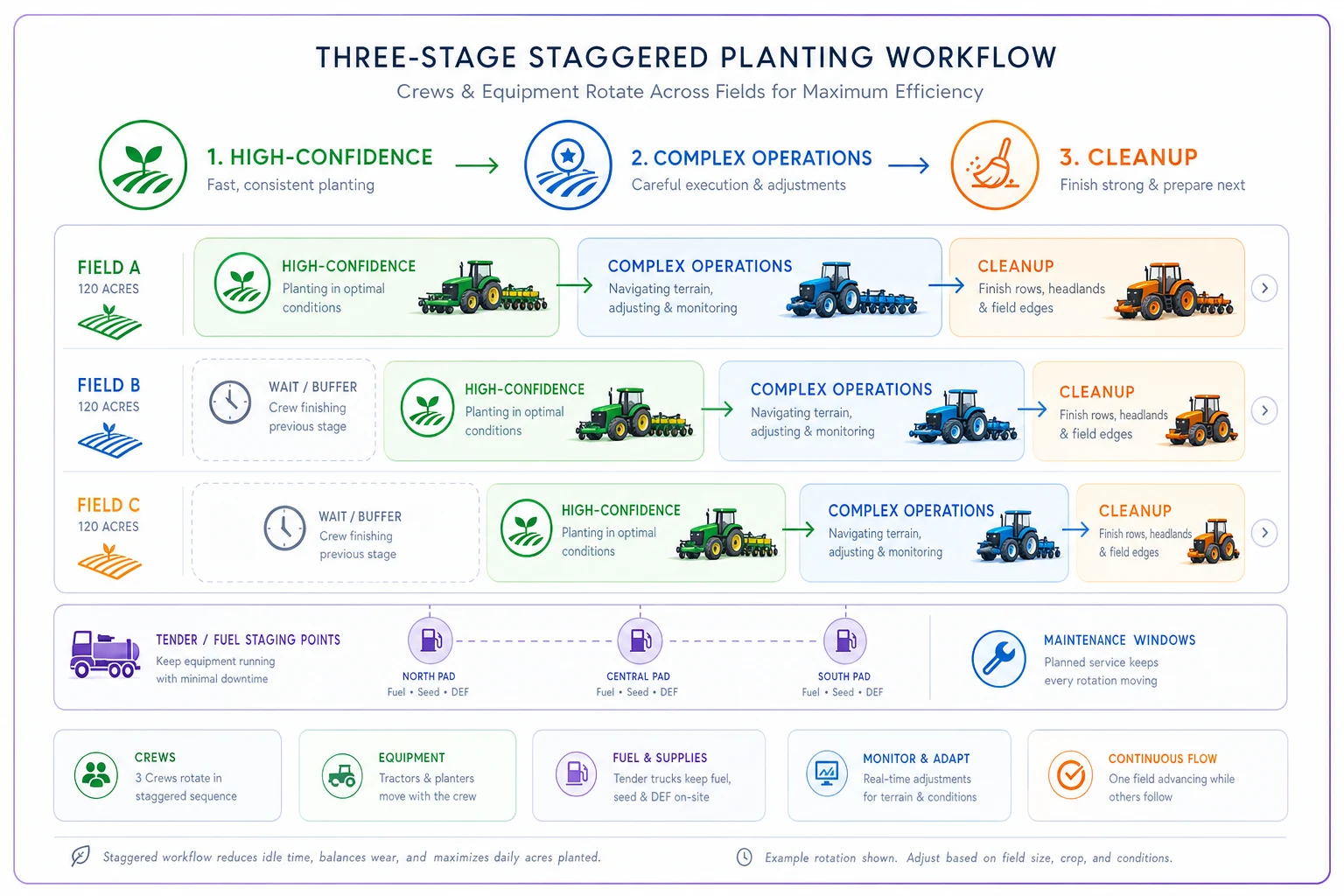
A simple visual like this makes handoffs, tender routing, and maintenance timing easier to communicate to crews.
A Real Sequencing Schedule That Cut Overtime 40%
A central Iowa operation with 3,600 acres across 15 fields made this shift two seasons ago. Previously, they ran three planters flat-out for 8-10 days, averaging 11-hour operator days with frequent equipment conflicts.
-
Days 1-2 Three fields (720 acres) closest to staging, all with separate access points. Two planters running, third on standby for breakdowns. Operators work standard 9-hour shifts.
-
Days 3-5 Six fields (1,400 acres) in two clusters, each cluster worked by dedicated planter/tender team. Staggered start times (6 AM and 9 AM) to avoid morning staging conflicts.
-
Days 6-7 Four fields (1,100 acres) including irregular shaped fields and those with wet spots. All three planters running, but one designated as "flex unit" for difficult sections.
-
Days 8-9 Final two fields (380 acres) plus replanting of any washed-out sections from early planting.
Results: Completed planting in 9 days instead of 10, with average operator days of 9.5 hours instead of 11 hours. Diesel consumption dropped 12% from reduced equipment positioning. Most importantly, they had zero major equipment failures from overuse—previous years averaged 1-2 significant breakdowns requiring parts runs.
The difference was clear by day six when neighboring operations started falling apart.
Calendar Integration and Daily Decision Points
The biggest mistake is treating the planting calendar as fixed once the season starts. Weather, equipment, and field conditions all shift. Your calendar needs clear decision points.
Build morning assessment gates. At 5:30 AM daily, before crews arrive, evaluate overnight rainfall amounts by field, morning soil temperature readings, equipment status from previous day, and weather forecast for next 48 hours.
Then make the call: proceed as planned, shift to alternate fields, or call a maintenance day.
One Nebraska operation tracks this on a simple whiteboard matrix—fields on one axis, dates on the other, with color codes: green (go), yellow (assess), red (wait). Takes 10 minutes to update each morning, saves hours of misdirected effort.
Your afternoon checkpoint at 3 PM evaluates tomorrow's plan. Can you extend today's operation if conditions are perfect? Should you prep different equipment for tomorrow's fields? Are seed deliveries positioned for morning loading?
After a few seasons, you'll spot the signals that indicate when to push hard versus when to pull back.
Managing the Bottlenecks Nobody Talks About
Beyond equipment and labor, three operational bottlenecks consistently disrupt even well-planned sequencing.
Seed variety placement becomes complex with multiple fields in various stages. That 108-day corn might be perfect for Field 4, but if Field 4 is in Stage 3 of your sequence and rain delays hit, you're planting full-season corn in late May. Build flexibility into your variety placement—have backup fields for each maturity group.
Fuel and DEF logistics multiply with staggered operations. Running planters in three different field clusters means three fuel routes instead of one. Solution: pre-position fuel tanks at Stage 2 and 3 locations during Stage 1 operations. Extra coordination, but beats having a planter sit idle waiting for diesel delivery.
Parts and maintenance float gets stretched with sequential operations. When planters work different fields, your mechanic can't quickly check all units during lunch break. Build maintenance into the sequence—plan which fields allow easy equipment access for mid-day service runs.
Who Should Actually Use This Approach (And Who Shouldn't)
This sequencing system works best for operations with 2,000-10,000 acres across 8+ fields. Below that, the coordination overhead isn't worth it. Above that, you need more sophisticated logistics.
It's particularly valuable when you have mixed soil types requiring different planting windows, fields spread across 10+ miles, limited equipment relative to acres, and experienced operators who can handle handoffs.
Skip this approach if you're under 1,000 acres or have all fields in one block. Also skip it if you're chronically short-staffed—the handoffs and sequencing require consistent crew availability.
The operations seeing the best results run 3-6 planters with 4-10 operators across fields with varying soil types and multiple access constraints. They're big enough to benefit from optimization but not so large that they need enterprise-level scheduling systems.
Tracking What Actually Matters
Forget tracking acres per day as your primary metric. With staggered planting, daily acres vary by design. Instead, monitor three numbers that indicate whether your sequencing is working.
Equipment hours per acre tells you efficiency. Good sequencing should show 0.15-0.20 hours per acre including transport and maintenance. If you're above 0.25, you're losing time to logistics.
Operator overtime percentage should stay below 20% of total hours. The whole point of sequencing is smoothing labor demand. If overtime is still high, your stages need adjustment.
Replant percentage by field reveals if you're pushing fields too early or late in the sequence. Under 3% replant is normal. Above 5% means your field readiness assessment needs work.
Track these weekly, not daily. Daily variation is normal with weather and equipment. Weekly trends show whether your sequencing strategy is working.
Software That Makes Sequencing Manageable
Manual sequencing works for basic operations, but even moderate complexity benefits from software assistance. Most farm management software treats planting as a single activity, not a sequenced operation.
Modern operational software designed for agriculture can map out field sequences based on your specific constraints—soil types, equipment positioning, crew availability. More importantly, it adjusts sequences dynamically as conditions change.
After one season, AI-enhanced platforms identify your operation's unique patterns—which fields truly dry first, how long equipment repositioning actually takes, where bottlenecks consistently occur. This intelligence makes next season's sequencing more precise.
For multi-field operations, AI automation helps coordinate the moving pieces. When rain delays Field 4, the system automatically suggests alternative sequences that keep crews working without creating downstream conflicts. It tracks seed variety placement across fields, ensuring you don't strand specialty hybrids in fields that might not get planted until conditions deteriorate.
The coordination aspect matters most. When three planters work different stages simultaneously, keeping everyone informed requires constant communication. Operational software centralizes this—operators see updated field assignments, tender drivers know delivery sequences, mechanics track equipment locations.
These platforms excel at maintenance scheduling within sequenced operations. By tracking actual equipment hours by field, not just calendar days, they trigger maintenance alerts that align with your field transitions. That 50-hour service happens when you're moving between field clusters, not in the middle of peak planting.
Weather integration adjusts sequences preemptively. Instead of reacting to morning moisture, the system projects field workability 3-5 days out and suggests sequence adjustments that maximize planting windows while respecting soil conditions.
Making It Through the First Season
Your first year using staged sequencing will feel awkward. Operators accustomed to flat-out planting question why they're "holding back" on good weather days. The schedule feels overly complex when everyone just wants to plant.
Stay disciplined about the fundamentals. Sequence based on field readiness not convenience. Maintain crew rotation schedules even when it seems easier to extend shifts. Document actual times for everything—you'll need this data next year.
The payoff comes around day 6 when traditionally everything starts breaking down. While neighbors are dealing with exhausted operators and overworked equipment, your operation is humming along at steady pace. Equipment is maintained, operators are fresh, and you're actually ahead of schedule because you haven't lost days to breakdowns.
By season end, the numbers tell the story. Most operations see 25-35% reduction in overtime costs, 15-20% lower fuel consumption, and 30-40% fewer equipment failures. But the real win is operator retention—crews prefer predictable schedules and maintained equipment over heroic sprint efforts that lead to burnout.
Staggered planting schedules aren't about perfection or complex algorithms. Smooth, consistent operations outperform frantic sprints every time. Build your sequence, pair crews thoughtfully, respect field conditions, and watch your planting season transform from annual chaos to manageable progression.
Ready to revolutionize your farm management?
Join 500+ farms using Feldsly to boost yields, reduce waste, and streamline daily farm workflows.