


Most farms treat crop rotation like a suggestion rather than an operational system. They'll switch corn to soybeans when yields drop, plant cover crops when they remember, and wonder why their fields produce less every decade despite better seeds and equipment.
The real problem isn't the rotation itself—it's running rotations without governance structure, measurable checkpoints, or stress-tested contingencies. When fertilizer costs spike 40% or drought hits year three of your five-year plan, the whole rotation collapses into reactive decisions that compound soil problems instead of fixing them.
After watching dozens of mid-size grain operations stumble through informal rotations, the pattern becomes obvious: farms without structured multi-year crop rotation systems lose roughly 8-12% yield capacity every five years. Not from bad farming. From operational drift.
Why informal rotations guarantee yield decay
Walk through any 500-acre corn and soy operation in Iowa, and you'll find the same rotation story. The owner knows they should rotate. They've got a mental plan—corn, corn, soybeans, maybe wheat if prices look good. But operational reality destroys that plan by year two.
Field 12 stays in continuous corn because it's closest to the grain elevator. Field 7 gets soybeans three years straight because the tenant prefers them. The back forty acres stay fallow an extra season because equipment breaks during planting window. Each deviation seems minor, justified by immediate economics or logistics. Together, they create systematic soil degradation that shows up as declining yields three to five years later.
The breakdown accelerates when operations grow beyond what one person can track mentally. A 200-acre farm might survive informal rotation. At 800 acres across multiple fields with different soil types, planting windows, and lease agreements, informal rotation becomes operational chaos. You're making 50+ field-specific decisions each season without documentation, governance, or performance tracking.
This shows up in the numbers. Operations running informal rotations typically see nitrogen requirements increase 15-20 pounds per acre every three years. Weed pressure doubles. Water retention drops. They're spending more on inputs to get less output, and they can't pinpoint why because there's no baseline to measure against.
The governance framework nobody teaches
Real multi-year crop rotation systems need three layers of operational control that ag schools rarely cover: decision gates, override protocols, and audit triggers.
Take control of your farm’s productivity.
Feldsly helps you plan, track, and optimize every farming operation with precision.
- Centralized crop scheduling
- Resource & labor management
- Real-time weather alerts
No credit card required
Decision gates force evaluation at specific points rather than letting momentum carry bad rotations forward. Every November, before seed orders, you run each field through a structured review: soil test results, previous three-year history, pest pressure indicators, and economic projections. The gate either approves the planned rotation or triggers a formal deviation process.
The deviation process matters more than the original plan. When drought hits or commodity prices swing, you need predetermined rules for rotation adjustments. Field 8 might shift from wheat to soybeans, but only if soil nitrogen exceeds 40 ppm and soybean futures stay above $11. These aren't suggestions. They're operational rules that prevent emotional decision-making during stressful seasons.
Override protocols handle the exceptions that break every system. Sometimes you genuinely need continuous corn for contract obligations. Sometimes weather forces impossible planting decisions. The protocol documents who can approve overrides, what documentation they require, and what remediation actions follow. A two-year corn override might trigger mandatory cover crop requirements and supplemental soil testing. No exceptions.
Audit triggers create accountability across seasons. Most farms never review whether their rotation decisions actually worked. Set automatic reviews when:
-
Any field drops below 80% of county average yield
-
Input costs exceed 35% of gross revenue per field
-
Pest management costs increase 25% year-over-year
-
Soil organic matter decreases 0.3% between tests
These triggers force examination before problems compound into permanent yield loss.
Building KPIs that actually predict problems
Standard farm metrics tell you what already happened. Bushels per acre, input costs, net margins—all backward-looking. Multi-year rotation systems need forward-looking KPIs that signal problems before they cost money.
Start with soil organic matter trend lines, not absolute values. A field at 2.8% organic matter might seem healthy, but if it measured 3.2% three years ago, you're watching active degradation. Track the rate of change across your rotation cycle. Anything declining faster than 0.1% annually signals rotation failure, regardless of current yields.
Weed seed bank pressure provides another early warning most operations ignore. Count and identify weed species during a standardized walking pattern each spring before herbicide application. When species diversity increases or resistant populations appear, your rotation isn't providing adequate biological disruption. This shows up 18 months before yield impacts.
Nitrogen cycling efficiency reveals whether your rotation builds or depletes soil biology. Calculate pounds of applied nitrogen per bushel of yield for each field across three-year windows. Increasing ratios mean your soil's losing its ability to naturally cycle nutrients—a $30-50 per acre hidden cost that rotation should prevent.
Track these quarterly, not annually:
-
Soil moisture retention at 6-inch depth (weekly during growing season)
-
Microbial activity via CO2 burst tests (monthly)
-
Aggregate stability scores (after major rain events)
-
Compaction readings at plow layer (before and after harvest)
The measurement frequency matters. Annual soil tests miss the operational signals that predict next season's problems. Monthly or quarterly tracking reveals patterns while you can still adjust.
Scenario planning beyond weather
Every farm runs weather scenarios, but weather represents maybe 30% of what breaks rotation plans. The real system-killers hide in operational and market scenarios nobody plans for.
Run your multi-year crop rotation system through these stress tests:
Labor shortage scenario: Your primary operator gets injured during planting. Temporary help can only handle simple corn or soybean planting, not complex cover crop integration or specialty grain rotations. Which fields get simplified? How do you remediate next season? Document specific field priorities and simplified backup rotations before you need them.
Market dislocation scenario: Chinese soybean tariffs cut demand 40%. Corn prices spike due to ethanol policy changes. Your carefully planned 50/50 rotation becomes economically impossible. Build trigger points—if corn-soy spread exceeds $3.00, these five fields convert. If it drops below $1.50, these three fields switch. Remove emotion from market-driven rotation changes.
Input unavailability scenario: The specialty cover crop seed you've built your soil health program around becomes unavailable due to supplier bankruptcy. Or phosphorus fertilizer gets allocated to larger operations during shortage. Map alternative inputs for every rotation component. If crimson clover isn't available, cereal rye goes here, hairy vetch goes there, based on specific field needs.
Equipment failure cascade: Your no-till drill breaks during the narrow cover crop planting window. Repair takes three weeks. Which fields skip cover crops this year? Which get aerial seeding despite lower germination? Which shift rotation timing entirely? These decisions need documentation before breakdowns happen.
Test these scenarios against your five-year rotation calendar. Where does the system break? What fields become vulnerable? Build contingency rotations for each scenario that protect soil health even when original plans fail.
Templates that survive real operations
Generic rotation templates from extension offices assume perfect conditions and unlimited flexibility. Real operations need templates that account for messy reality—split ownership, equipment limitations, labor constraints, and contract obligations.
Structure your rotation calendar with these operational layers:
Base rotation layer: The ideal sequence for each field based on soil type, drainage, and historical performance. This layer focuses purely on agronomic optimization without operational constraints.
Constraint overlay: Equipment windows, labor availability, storage capacity, and infrastructure access that limit rotation options. Field 15 might need soybeans year two because that's when you're updating corn headers. Back sections might exclude small grains due to combine limitations.
Contract commitment layer: Locked-in obligations that override optimal rotation. Seed corn contracts, organic certification requirements, conservation program enrollment. These become immovable anchors that other fields rotate around.
Flexibility zones: Designated fields that can shift rotation to accommodate system stress. Usually 20-30% of total acreage. These fields maintain simpler rotations that can pivot quickly when scenarios trigger.
Here's a working template structure for a 1,200-acre corn/soy/wheat operation:
| Template Part | Details |
|---|---|
| Year 1 Planning | Fields 1-4 (400 acres): Corn (contract locked) Fields 5-7 (300 acres): Soybeans with cereal rye cover Fields 8-10 (300 acres): Wheat/double crop soy Fields 11-12 (200 acres): Flexibility zone - corn or soy based on markets |
| Year 2 Forward View | Document planned rotation for all fields Identify deviation triggers Set soil testing schedule Mark decision gate dates |
| Quarterly Reviews | Compare actual vs planned rotation Update constraint overlay Adjust flexibility zones Document deviation rationale |
Build separate templates for different ownership structures. Owned land might run aggressive five-year rotations with cover crops. Rented land might need conservative three-year rotations that maintain yields for lease renewal. Share-crop arrangements might require specific crop sequences for equitable division.
Where automation prevents operational drift
The complexity of managing multi-year rotations across dozens of fields creates natural points where AI-powered operational software transforms tracking into actual management.
Instead of spreadsheets that show what you planned three years ago, operational platforms now connect rotation plans directly to daily decisions. When you're ordering seed, the system shows exactly which fields are scheduled for which crops, their historical performance in that rotation position, and deviation impacts on future years.
Pattern recognition across seasons catches systematic problems like equipment bottlenecks or labor constraints before they cascade. The system might notice you've delayed cover crop planting on 30% of fields for two consecutive years, signaling an operational constraint that needs addressing rather than just missed targets.
A visual of the automation workflow helps tie these concepts together.
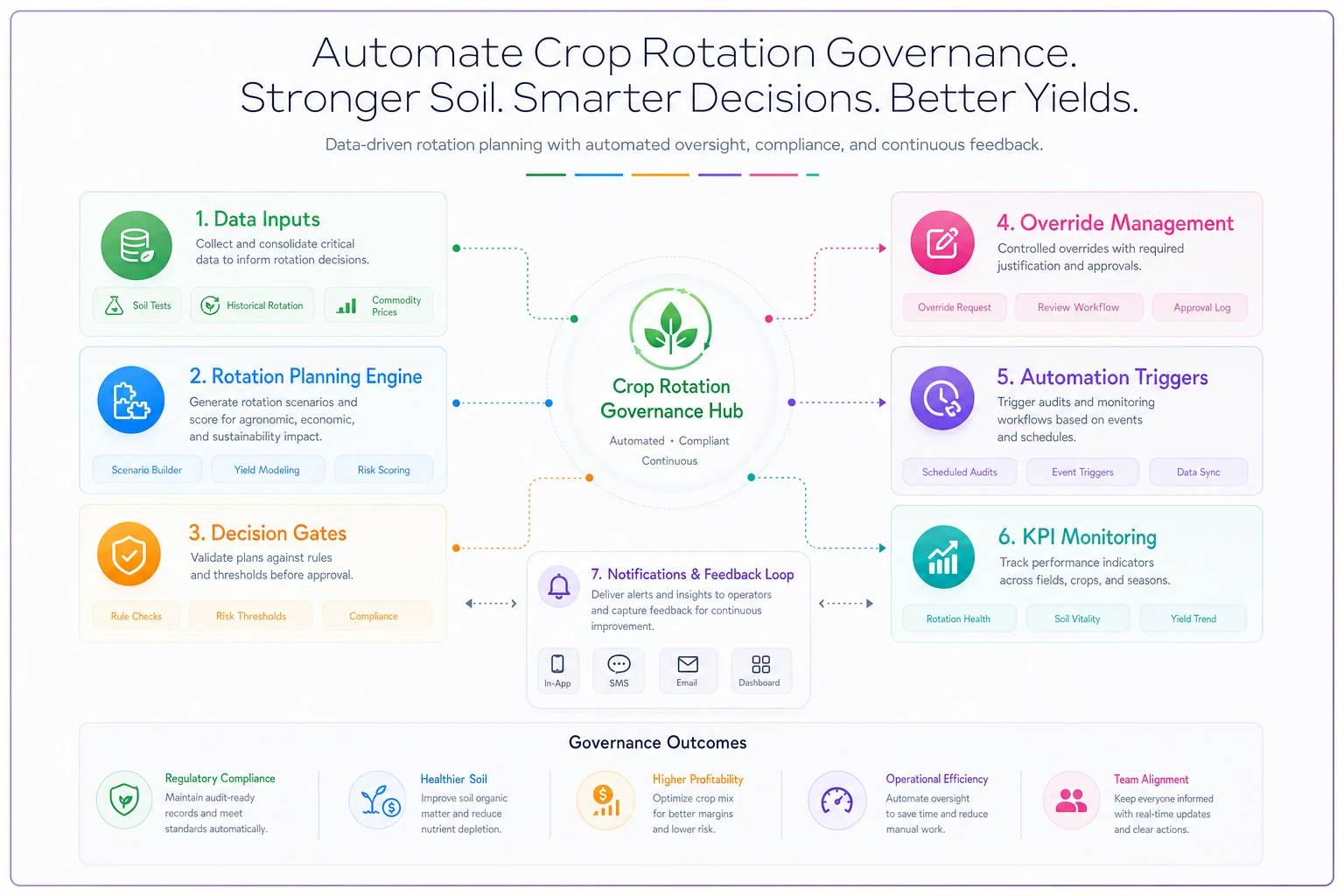
Governance gates become automatic rather than calendar reminders everyone ignores. When soil tests arrive, the platform compares results against rotation expectations and triggers reviews for fields showing degradation. When commodity prices shift beyond predetermined spreads, it generates rotation adjustment scenarios with economic projections.
This isn't about replacing management decisions—it's about ensuring those decisions actually follow the framework you've built rather than getting lost in daily operational chaos.
Making the system stick
The difference between farms that maintain soil health and those that watch yields slowly decline isn't knowledge—everyone knows rotation matters. It's operational discipline maintained across years and management transitions.
Start implementation with historical reconstruction. Map what actually happened in each field over the past five years, not what you planned or remember. This baseline reveals your true rotation patterns and problem fields. Most operations discover they've been running 2-3 year rotations while believing they had 4-5 year systems.
Start with fields that will give you quick operational wins and measurable KPIs within a single season.
Pick 20% of your acreage for strict governance implementation first season. Full-farm transformation fails. Partial implementation with careful measurement builds confidence and reveals system adjustments needed for your specific operation. Choose fields with different characteristics—owned vs rented, irrigated vs dryland, high vs marginal productivity.
Document every deviation from planned rotation with specific rationale and expected remediation. This historical record becomes invaluable for improving the system and training new managers. After three years, you'll have enough operational data to identify which deviation triggers actually matter versus which were overcautious.
Set up monthly rotation reviews that take 30 minutes, not quarterly marathons everyone dreads. Check three things: current season execution against plan, next season preparation status, and any triggered governance gates. Quick, consistent reviews prevent the drift that kills long-term soil health.
The compound effect nobody measures
Farms running structured multi-year crop rotation systems with proper governance see impacts beyond simple yield improvement. The operational discipline required to maintain rotation governance strengthens other management systems—input purchasing, equipment maintenance, labor planning.
After 3-4 years, these operations typically report:
-
25-30% reduction in panic purchases during planting season
-
40% fewer equipment conflicts during critical windows
-
15-20% decrease in herbicide resistance issues
-
Better loan terms due to documented operational systems
The soil health benefits everyone expects—improved organic matter, better water retention, reduced input needs—still develop. But they're accompanied by operational improvements that make the entire farming business more resilient.
Most farms will continue running informal rotations, watching yields gradually decline while input costs rise. They'll blame weather, markets, or soil type while ignoring the operational framework that could reverse the trend. But for operations willing to build and maintain proper rotation governance, the competitive advantage compounds every season. The question isn't whether structured rotation systems work—it's whether you'll implement them before your soil forces the decision.
Ready to revolutionize your farm management?
Join 500+ farms using Feldsly to boost yields, reduce waste, and streamline daily farm workflows.