


The planter runs dry 2.3 miles from the nearest road access. Your tender truck sits at the field entrance while the operator drives the empty planter across rough terrain at 4 mph. Twenty-eight minutes gone. Then another twenty-eight minutes back after refilling. That's nearly an hour of planting time lost because nobody calculated where to stage the tender based on actual field geometry and planter capacity.
This happens on roughly 60% of mid-size corn and soybean operations during peak planting windows. Not because farmers don't understand logistics – they absolutely do – but because refill planning usually gets handled on the fly when every minute counts toward beating incoming weather.
The geometry problem nobody talks about
Most planting operations treat refill points like gas stations on a highway – you pull off when you're running low. Except fields aren't highways. They're irregular polygons with limited access points, soft corners that slow equipment, and waterways that block direct routes.
Take a typical 320-acre field shaped like an elongated rectangle. Standard practice puts the tender at the main entrance because that's where the gravel meets the field edge. Makes sense until you realize the planter empties most often at the far end, turning each refill into a 1.8-mile round trip instead of a potential 400-yard jaunt if you'd positioned a temporary refill point along the back fence line.
The math gets worse with modern 24-row planters carrying 110-bushel central fill hoppers. At 32,000 seeds per acre and standard corn populations, you're covering about 13.5 acres per fill. On that 320-acre field, you need 23-24 refills. If poor tender placement adds just 15 minutes per refill, you've burned 6 hours of planting time.
One 4,000-acre operation near Champaign ran this exact scenario across eight fields last spring. Their planters averaged 47% active planting time during a critical 4-day window. The rest? Transit to refills, waiting for tenders, and repositioning between fields. They planted 1,840 acres when equipment capacity suggested they could have finished 2,600.
Load cycles that actually match field reality
When farms finally map out proper refill routing, you start with simple load-cycle math but adjust for field-specific constraints.
Take control of your farm’s productivity.
Feldsly helps you plan, track, and optimize every farming operation with precision.
- Centralized crop scheduling
- Resource & labor management
- Real-time weather alerts
No credit card required
Basic load cycle components:
-
Planter capacity (bushels/boxes)
-
Seeding rate (seeds per acre)
-
Field speed (acres per hour)
-
Refill time (minutes)
-
Transit time to refill point (minutes each way)
But real fields throw in complications. That low spot that's always wet in spring? Your planter slows to 3.5 mph instead of 5.5 mph. The terrace strips? Another speed reduction. The headland turns? More time lost.
Example Load Cycle Calculation:
| Component | Standard Assumption | Field-Adjusted Reality |
|---|---|---|
| Planter capacity | 110 bushels | 110 bushels |
| Coverage per fill | 13.8 acres | 11.9 acres (accounting for overlaps) |
| Time to plant full load | 2.3 hours | 2.7 hours (speed variations) |
| Refill time | 12 minutes | 12 minutes |
| Transit to main entrance | 8 minutes each way | 8 minutes each way |
| Transit to optimized point | N/A | 3 minutes each way |
| Total cycle time | 2.6 hours | 2.9 hours (main) vs 2.4 hours (optimized) |
The optimized refill point saves 30 minutes per cycle. Across 24 refills, that's 12 hours of recovered planting time.
Worked routing maps for three field scenarios
Actual routing plans for common field configurations. These aren't theoretical – they're based on operations across Illinois and Iowa that needed real fixes.
Here's a visualization of how temporary tender staging and planter paths interact across typical scenarios.
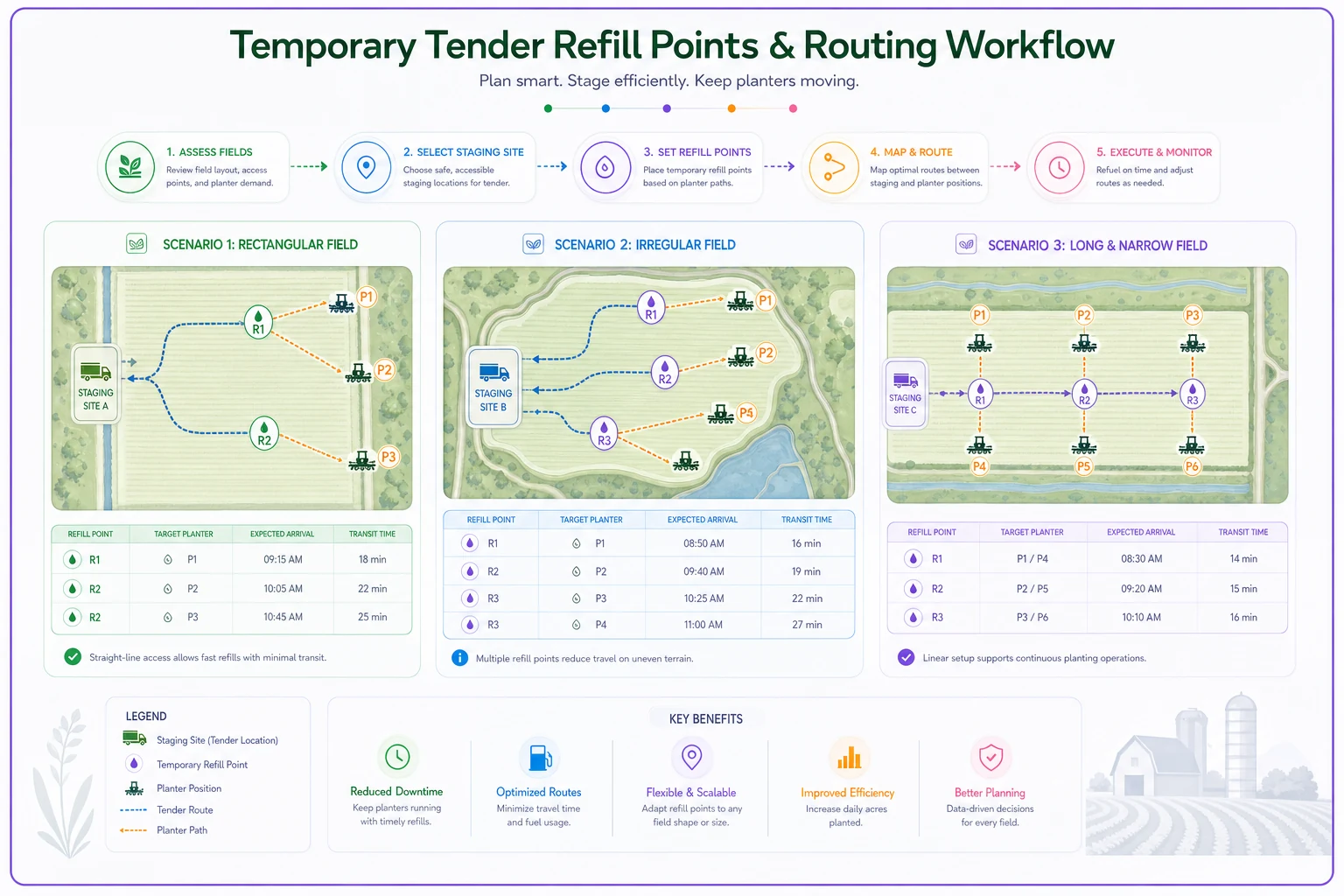
This routing map highlights tender staging, planter paths, and recommended transit times for each scenario.
Scenario 1: Long rectangular field (160 acres)
-
Shape
1 mile x 0.25 mile
-
Access
Single entrance at northwest corner
-
Standard approach
Tender at entrance
-
Problem
Planter empties at southeast corner (0.7 miles away)
-
Optimized routing
-
Create temporary access point at midfield using existing waterway crossing
-
Position tender at minute 75 of each 135-minute plant cycle
-
Reduces average transit from 12 minutes to 4 minutes
-
Saves 3.2 hours per field
Scenario 2: L-shaped field complex (240 acres)
-
Shape
Two connected rectangles forming an L
-
Access
Road on west side, field road on south
-
Standard approach
Single tender location at main entrance
-
Problem
Dead zones in the eastern extension
-
Optimized routing
-
Primary tender point at intersection of the L
-
Secondary staging every third fill at eastern edge
-
Coordinate with sequential field planning to minimize tender movement
-
Cuts transit time by 65%
Scenario 3: Irregular field with pivot corners (220 acres)
-
Shape
Square with four pivot corners cut out
-
Access
Two entrances, north and south
-
Standard approach
Alternate between entrances
-
Problem
Confusion about which entrance to use when
-
Optimized routing
-
Map planter position at 20% capacity remaining
-
Pre-assign tender positions based on quadrant
-
Use simple visual markers (flags) for operators
-
Implement the same communication system used during moisture-sensitive harvest windows
Each routing map includes specific GPS coordinates for tender staging, expected planter position at refill time, and backup positions if primary spots become inaccessible due to wet conditions.
Refill-point siting heuristics that work
Forget complex optimization algorithms. Practical refill siting follows straightforward rules that operators can implement without software.
The 70/30 rule works for most rectangular fields: Position your primary refill point 70% of the field length from the main entrance. This typically aligns with where planters hit low capacity on return passes.
For irregular fields, use the "three-corner method":
-
Identify the three points farthest from road access
-
Calculate average planter position when hitting 15% capacity
-
Find the closest accessible point to that average
-
Test with one full planting cycle, then adjust
Soil conditions change everything. A theoretically perfect refill point becomes useless if the tender gets stuck reaching it. Build contingency positions into your plan – typically one firm-ground backup for every two primary points.
Mark practical tender spots with stakes and test them during one full planting cycle before committing for the season.
Some operations overthink this with detailed spreadsheets and mapping software. The farms seeing real improvements just walk their fields before planting season, mark practical tender spots with stakes, and adjust based on actual conditions. Simple beats perfect when you're racing weather.
Crew assignments that prevent tender bottlenecks
The best refill routing plan fails when your tender operator doesn't know where to be when. This killed efficiency at a 6,000-acre operation until they implemented clear crew assignments.
They run three planters and two tender trucks. Without assignments, tenders constantly guessed wrong about which planter needed service next. Planters sat idle for 20-30 minutes waiting for available tenders.
Their fix: Each tender owns specific fields for the entire day. Tender A handles fields 1-4, Tender B handles fields 5-8. When a tender finishes their fields, they become floater support. No confusion, no overlap, no planters waiting.
-
"Blue planter at 30%" (warning call)
-
"Blue planter ready for refill at point 2" (positioning call)
-
"Blue planter serviced, returning to pattern" (completion call)
During compressed planting windows, one person coordinates all tender movements from a central point – usually whoever's monitoring weather and field conditions. They track planter cycles on a basic whiteboard showing field numbers, planter positions, and next refill times.
The hidden cost of amateur refill logistics
Poor refill routing costs more than just time. There's fuel burn from unnecessary transit, soil compaction from crisscrossing fields, and operator fatigue from constant position changes.
But the real killer? Missed planting windows. A 2,000-acre corn operation typically gets 10-12 optimal planting days per season. If refill inefficiency costs 30% of potential daily acres, you're short 600-720 acres of timely planting. At 15 bushels per acre yield drag from late planting, plus current corn prices, that's roughly $45,000 in lost revenue.
One Illinois operation tracked every minute of planter downtime across their 2023 season. Refill-related delays accounted for 34% of non-weather downtime. They weren't broken down or stuck – just poorly routed. The next season, after implementing structured refill routing, they cut that to 11%.
Simple load-cycle calculators without the complexity
Farms don't need sophisticated software to calculate load cycles. A basic spreadsheet with four inputs gets you 90% of the optimization.
Inputs needed:
-
Field acres
-
Planter hopper capacity
-
Population rate
-
Average field speed
The calculation:
-
Acres per fill = (hopper capacity × 2,150) ÷ seeds per acre
-
Time per fill = acres per fill ÷ acres per hour
-
Refills needed = field acres ÷ acres per fill
-
Total refill time = refills × (refill duration + transit time)
Keep one calculator sheet for each field. Update it seasonally based on actual performance. After two seasons, you'll have dialed-in numbers for every field on your operation.
Adapting routes when conditions change
The Tuesday morning plan never survives Thursday afternoon rain. Smart operations build flexibility into their planter refill routing from the start.
Wet conditions typically force two adjustments: moving refill points to firmer ground and accepting longer transit times. Mark your "wet weather" tender positions before the season starts. These might add 5-8 minutes of transit, but that beats getting a tender stuck and losing the truck for hours.
When fields partially dry, resist the temptation to plant just the dry areas and come back later. The refill logistics become a nightmare. You're better off waiting another day for uniform conditions than trying to manage refills across scattered dry patches.
Some farms try to get clever with multiple small tenders instead of fewer large ones during marginal conditions. Usually backfires. More vehicles mean more coordination complexity and more chances for someone to get stuck.
Technology that helps (and what's just noise)
GPS guidance on planters changed the game for consistent patterns. But for refill routing? Most technology solutions overcomplicate simple logistics.
Useful tech:
-
Basic GPS tracking to see real-time planter location
-
Simple messaging apps for crew coordination
-
Spreadsheet templates for load-cycle math
Unnecessary complexity:
-
Elaborate routing optimization software
-
Automated dispatch systems
-
Real-time fill level monitoring
The operations seeing the most improvement don't use fancy systems. They use paper maps with marked refill points, laminated and hung in every tender truck. Operators know exactly where Point A, Point B, and Point C are in each field. No confusion, no screen time, just clear visual references.
That said, modern operational platforms can help by centralizing these plans digitally and making them accessible to all crew members. When everyone can see the same field map with marked refill points on their phone, coordination becomes automatic. AI automation handles the routine scheduling and alerts, leaving operators to focus on actually running equipment.
Building your own refill routing system
Start with your five largest fields. Map them out, calculate load cycles, and identify two refill points for each. Run these optimized routes for a full day and track actual time savings.
Most operations see 20-35% reduction in refill-related downtime just from this basic optimization. Once crews get comfortable with the system, expand to all fields over 80 acres. Smaller fields rarely justify detailed routing plans – the standard "tender at the entrance" approach works fine.
-
Field maps with marked refill points
-
Load-cycle calculations for each field
-
Crew assignment templates
-
Wet-weather contingency positions
Update these each season based on what actually happened. That field where you thought the northeast corner would make a good refill point but proved too soft? Mark it off permanently. The waterway crossing that worked perfectly? Highlight it for future seasons.
Making refill routing stick
New systems fail when they're too complex for stressed operators during planting season. Your planter refill routing plan needs to be simple enough that a brand-new operator can follow it with five minutes of explanation.
The best implementation approach:
-
Walk through the plan with all operators before planting starts
-
Run a half-day practice session on one field
-
Adjust based on operator feedback
-
Lock in the system for the season
Don't constantly tweak mid-season. Consistency matters more than perfection when crews are pushing hard through tight planting windows.
Write down your standard operating procedure in plain language. Not a 20-page manual – a single page with bullet points covering where tenders stage, how operators communicate, and who makes decisions when plans change.
The compound effect of better routing
Optimized refill routing seems like a minor efficiency gain until you calculate the compound effect. Save 30 minutes per field across 40 fields, and you've recovered 20 hours of planting time. In a compressed window, that could mean the difference between finishing planting in optimal conditions or pushing into late May.
Beyond time savings, operators report less stress when refill logistics run smoothly. They focus on planting quality instead of wondering when the tender will arrive. Tender operators know exactly where to be instead of making educated guesses.
After two seasons of disciplined refill routing, most operations can predict their daily planted acres within 5% accuracy, weather permitting. This predictability helps with everything from seed delivery scheduling to crew time management. The farms that excel at planting season logistics don't rely on heroic efforts from operators. They build systematic approaches to predictable challenges like refill routing. When the basics run automatically, you can focus on the decisions that actually require judgment – like whether those clouds mean quit now or push another two hours.
Ready to revolutionize your farm management?
Join 500+ farms using Feldsly to boost yields, reduce waste, and streamline daily farm workflows.