


Grain moisture windows don't negotiate. You hit them or you don't.
The brutal reality of harvest crew shift planning for moisture-sensitive grains comes down to this: corn at 14.5% moisture gets you full contract price. Corn at 18% gets you docked $0.45 per bushel. That same corn sitting in the field another three days because your crew couldn't get there? Now you're looking at 12% moisture and brittleness penalties. A 2,400-acre operation can watch $65,000 evaporate over a weekend of poor scheduling.
Most farms still run harvest like they did twenty years ago — morning meetings, paper maps, and whoever's available goes wherever seems urgent. That approach worked when you had stable weather patterns and could afford to leave money in the field. Modern harvest windows demand something different.
The moisture window reality check
During peak harvest on farms running 3,000+ acres of moisture-sensitive crops, chaos is the default.
Your combine operators show up at 6 AM. The dispatcher looks at yesterday's moisture tests, checks the weather, and starts assigning fields. By noon, you realize Field 47 is drying faster than expected while Field 23 is still too wet. But Tom's already halfway through Field 31, and moving him means losing two hours of harvest time.
Meanwhile, your grain cart operators are running between fields based on radio calls. Someone forgets to tell the new guy that the south entrance to Field 19 floods after any rain. He gets stuck. Now you've got a combine sitting idle for 90 minutes during peak moisture conditions.
The weather forecast shows a front moving in Thursday night. You need Fields 12, 15, and 22 done by then — they're all at different moisture levels, different distances from the elevator, and require different combine settings. Your night shift lead calls in sick. The backup doesn't know which fields have compaction issues that limit cart traffic patterns.
Every operational hiccup cascades. A delayed combine means carts sitting empty. Empty carts mean trucks waiting at the elevator. Waiting trucks mean you're paying drivers to do nothing while moisture levels keep changing.
The traditional response? Throw more equipment at it. Rent another combine. Hire more drivers. Except now you're coordinating even more moving parts with the same broken communication system.
Why standard shift planning fails during harvest
Traditional shift templates assume predictable work. Clock in at 7, work your zone, clock out at 3. Harvest doesn't work that way.
Take control of your farm’s productivity.
Feldsly helps you plan, track, and optimize every farming operation with precision.
- Centralized crop scheduling
- Resource & labor management
- Real-time weather alerts
No credit card required
Moisture levels shift hourly. A field that's perfect at 10 AM might be too dry by 2 PM. Weather windows compress and expand. What looked like a five-day harvest window on Monday becomes a 36-hour sprint by Wednesday.
Standard scheduling also ignores field-specific knowledge. Your veteran operator knows Field 8's northwest corner stays wet three days longer than the rest. He knows the combine settings that prevent header loss in Field 14's lighter soil. But if he's assigned to the wrong fields because the schedule says it's his turn in the south section, all that knowledge sits unused.
Distance between fields kills efficiency. Most schedules optimize for fairness — everyone gets equal hours, everyone rotates through easy and difficult fields. Nobody optimizes for minimum transition time. A combine spending 40 minutes traveling between fields is 40 minutes not harvesting.
There's the expertise mismatch too. Your best operator for high-moisture corn might be running beans because that's what the rotation says. The new guy who's still learning combine settings gets assigned to your most valuable wheat fields because they're closest to where he lives.
Equipment breakdowns make everything worse. When Combine 2 goes down, whoever's nearby fills in. Doesn't matter if they know that field's quirks or if moving them creates a cascade of inefficiency elsewhere.
Building a loss-prevention scoring system
Forget fairness-based scheduling. Build assignments around loss risk.
Start with field-level moisture mapping. Not just one reading per field — multiple sample points tracked daily. Field 18 might show 16% average, but if the north end is 14% and the south is 18%, you're planning two different harvest strategies.
Score each field on three factors:
-
Current moisture vs. optimal range
-
Rate of moisture change (some fields drop 0.5% daily, others hit 1.2%)
-
Weather vulnerability (low spots that flood, areas that don't dry after rain)
-
Contract penalties for being outside spec
Field 22 might be at 15.8% moisture (low risk) but dropping fast (high risk) with rain coming (extreme risk). That field gets priority over Field 30 at 16.5% but stable and on higher ground.
Buyer window alignment:
Your elevator wants corn at 15.5% but only takes 300,000 bushels per week. The ethanol plant 30 miles away takes it at 14% with no delivery limits but pays $0.20 less. Some fields match certain buyers better — factor delivery slots and price differences into your scoring.
Equipment optimization zones:
Combine 1 handles tough conditions better. Combine 3 is faster in ideal conditions. Field conditions change which machine should go where. Wet spots need tracks, not wheels. Heavy residue needs different headers.
Build a scoring matrix. Update it twice daily during harvest. Mathematics beats gut feel when you're dealing with thousands of dollars in potential losses.
Assignment maps that actually work
Paper maps in the combine cab don't cut it when conditions change hourly.
Create visual assignment systems that show:
-
Current operator locations
-
Next field assignments
-
Moisture status by zone
-
No-go areas (too wet, obstacles, etc.)
-
Grain cart routes
-
Truck staging areas
The key: make updates visible to everyone immediately. Not through radio chatter that gets missed. Not through morning meetings that become obsolete by noon.
One operation laminated field maps and used colored magnets in the main office. Green meant go, yellow meant check moisture first, red meant no entry. Combine operators had matching colored flags they'd move as they progressed. Simple but visible to everyone.
Digital mapping takes this further. Tablets in combines showing real-time assignments. Color-coded moisture zones updated as samples come in. Predetermined routes that avoid soft spots and minimize road time.
The real difference comes from predetermined contingency routes. When Field 15 gets too wet, everyone knows Field 23 is the backup. When Combine 2 breaks, Combine 1's operator knows exactly which fields to prioritize. No discussion, no delays, no confusion.
Your assignment map should answer: Where is everyone now? Where do they go next? What's the backup plan? Which fields can't wait?
Routing heuristics that minimize transition waste
Most farms route equipment based on proximity. Closest field next. Except that ignores everything that matters during harvest.
Smart routing considers moisture windows first. Field 12 might be farther but needs harvesting NOW. Equipment limitations matter too — sending a wheeled combine through Field 9 to reach Field 10 means getting stuck. Elevator runs need timing with truck schedules. Operator expertise trumps everything else when your most experienced driver needs to handle the challenging field even if it means more travel.
Build standard routes for different scenarios. Dry conditions follow Route A. After rain, switch to Route B. Night shift runs Route C because visibility limits certain field entrances.
The math gets complex. Field 14 to Field 15 is 0.8 miles. Field 14 to Field 18 is 1.3 miles. But Field 15 requires combine adjustments that take 20 minutes while Field 18 runs the same settings as Field 14. Which saves more time?
Add grain cart coordination. Cart 1 is dumping at Field 14's east end. Sending the combine to Field 15 means the cart travels 1.5 miles to catch up. Keeping the combine in Field 18 means the cart's already positioned.
Some operations create "harvest blocks" — groups of fields that get harvested together regardless of individual moisture readings. If Fields 22, 23, and 24 all fall within acceptable moisture ranges, run them as a unit. Saves massive transition time even if Field 30 technically has slightly better moisture.
The 24-hour shift template for tight windows
When you've got 48 hours to harvest 1,200 acres before rain, standard shifts don't work.
Build overlapping coverage that maintains machine operation from 6 AM to 2 AM. Not just bodies in seats — the right expertise at the right times.
Morning shift (6 AM - 2 PM): Your most experienced operators start here. Dew usually burns off by 8 AM, so they're making critical moisture decisions. They set the pace for the day.
Afternoon shift (2 PM - 10 PM): Peak harvest hours. Moisture is usually optimal. This needs your fastest operators who can cover maximum acres. They inherit clear fields from morning shift — no time wasted on decisions.
Night shift (6 PM - 2 AM): Overlap with afternoon gives continuity. Night operators need different skills — dealing with dew coming back, limited visibility, fatigue management. They're usually finishing fields, not starting new ones.
The overlap hours (2-6 PM and 6-10 PM) are critical. That's when knowledge transfer happens. Morning shift tells afternoon shift about field conditions. Afternoon shift briefs night shift on equipment issues.
But operator specialization beats rotation.
Tom runs high-moisture corn best — he stays on those fields regardless of shift timing. Sarah knows the sandy fields — she handles those even if it means unusual hours. Mike troubleshoots equipment fastest — he overlaps multiple shifts as the on-call problem solver.
Some operators work split shifts during critical windows. 6 AM to noon, break, then 6 PM to midnight. Sounds brutal but it puts experience at both moisture transition periods.
Moisture data that drives decisions
Testing moisture once per field per day is gambling with your profit margins.
You need multiple data points across each field. Field entrance tests first to dry, first to harvest. Field center gives representative averages. Low spots reveal the last areas to dry and highest risk zones. Previous problem zones show you where you've had issues before.
Test frequency depends on conditions. Stable weather? Twice daily is enough. Conditions changing? Every 4 hours. Rain coming? Test immediately before and after.
Raw moisture numbers don't tell the whole story. Track moisture change rates. Field 12 dropping 0.8% per day means you've got three days. Field 15 dropping 1.5% daily gives you 36 hours. Same current moisture, completely different urgency.
Cross-reference with weather data. Not just "rain coming Thursday" but actual details. How much rain? Wind speeds after rain affect drying. Cloud cover predictions impact drying rates. Temperature swings create condensation risk.
Your moisture tracking needs to feed directly into assignments. No point collecting data if it sits in a spreadsheet while operators guess in the field.
One farm created a simple moisture board. Magnetic numbers for each field, updated after each test. Green background meant "harvest now," yellow meant "watch closely," red meant "too wet/dry." Everyone could see field status at a glance.
When automated coordination beats radio chatter
Radio communication during harvest is chaos. Three conversations happening simultaneously. Someone's combine is too loud to hear. Critical information gets lost.
The solution isn't better radios. It's removing the need for constant communication through better operational structure.
AI-powered operational software changes this dynamic completely. Instead of radioing about field moisture, the system tracks all readings and automatically updates priority scores. When Field 15 hits optimal moisture, every operator sees their updated assignment immediately.
Instead of calling grain carts when nearly full, combines trigger automatic dispatch based on fill rates and cart positions. The cart operator sees exactly when and where they're needed. No discussion required.
Quick workflow visual:
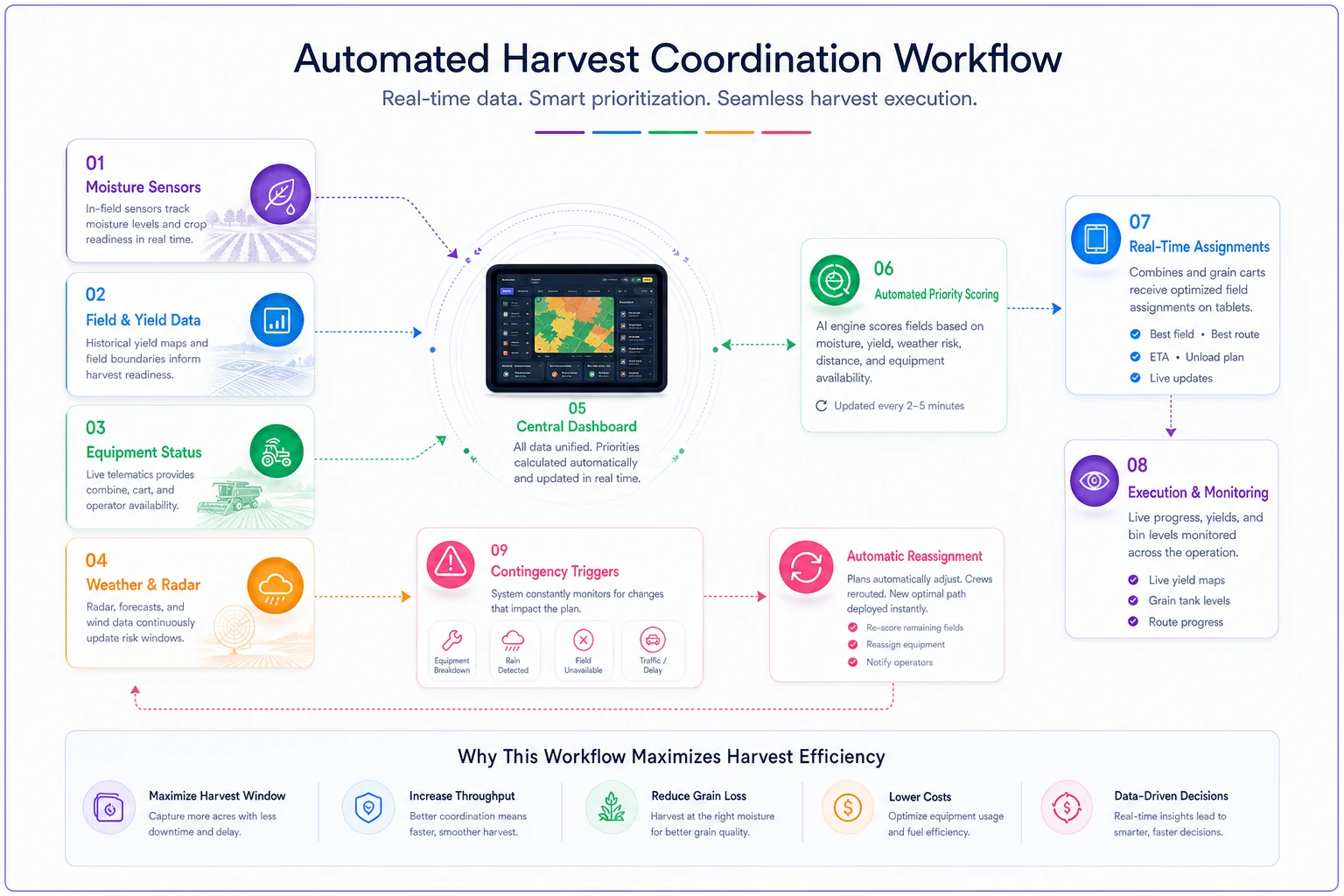
Equipment breakdowns automatically trigger contingency plans. Combine 2 goes down? The system immediately reassigns fields based on remaining capacity, moisture windows, and operator expertise. Everyone sees their new assignment on their tablet.
Weather changes prompt instant strategy adjustments. Radar shows rain arriving four hours earlier than expected? The system recalculates field priorities and sends new routes to all operators. No meeting, no debate, no delay.
This coordination platform eliminates the "telephone game" of harvest communication. Information flows directly from source to action without interpretation delays. Moisture test results update assignments. Equipment status changes routes. Weather data adjusts priorities. All automatically, all immediately.
The improvement comes from capturing institutional knowledge. When Tom notes that Field 8's northwest corner needs different combine settings, that's stored and automatically applied regardless of who's operating. When Sarah identifies a soft spot in Field 15, every grain cart route automatically avoids it.
Building your moisture window harvest system
Start with realistic assessment. How many acres can you actually harvest per day in perfect conditions? In moderate conditions? In challenging conditions?
| Conditions | Acres per Day per Combine |
|---|---|
| Perfect | 180 acres |
| Moderate | 140 acres |
| Challenging | 85 acres |
Now map your fields against typical moisture windows. If you've got 2,400 acres of corn and a five-day optimal window, you need 480 acres per day. That's two combines running perfect conditions for five straight days. Not realistic.
This means you need either more equipment, longer operating hours, or accepted losses on some acres. Most farms choose a combination.
Next, identify your bottlenecks. Combine capacity means can't harvest fast enough. Transport capacity puts grain carts or trucks limiting flow. Elevator capacity creates delivery delays. Operator availability leaves equipment sitting idle.
Fix the actual bottleneck, not the visible problem. If trucks are waiting at the elevator, more trucks won't help. You need delivery slot optimization or alternative buyers.
Design your contingency triggers. At what moisture do you start 24-hour operations? When do you call in reserve operators? What weather forecast triggers equipment rental? Decide before you're in the situation.
Your harvest system needs clear ownership. Someone monitors moisture twice daily. Someone updates assignment maps. Someone coordinates with elevators. Someone manages operator schedules. In smaller operations, this might all be one person. But the responsibilities must be explicit.
Track performance metrics that matter:
-
Acres per day by moisture range
-
Transition time between fields
-
Equipment utilization rates
-
Moisture penalty costs
-
Overtime hours triggered
This data drives next year's improvements. If Field 12 consistently causes delays, maybe it needs different treatment. If night shift productivity drops 40%, maybe you need different lighting or operators.
Making it actually work
The best harvest plan falls apart without execution discipline.
Daily briefings matter, but keep them under ten minutes. Cover only changes: new moisture readings, updated priorities, equipment issues, weather updates. Everything else should already be systematized.
Operator autonomy within guidelines works better than micromanagement. Give your combine operator a prioritized field list and let them decide exact timing based on conditions they see. But the priority list is non-negotiable.
Some farms resist this systematization, thinking it removes flexibility. Actually the opposite happens. When everyone knows the standard plan, adjustments become easier. "We're running Route B instead of Route A" means something. "Just figure it out" means chaos.
The hardest part is often changing established patterns. Operators who've run the same fields for years resist new assignments. Explain the why: this isn't about fairness or favorites, it's about capturing maximum value during narrow windows. Show them the math — how much money better coordination saves.
Most importantly, refine continuously. Every harvest teaches lessons. Document them. That soft spot in Field 19 that caught the grain cart? Mark it permanently. The combine setting that reduced losses in Field 24? Record it. The route that saved 30 minutes? Make it standard.
Harvest windows for moisture-sensitive grains keep getting tighter. Weather patterns are less predictable. Buyer specifications get stricter. Margins shrink. The old way — throwing labor and equipment at the problem — doesn't scale anymore.
But farms that build actual systems around moisture windows, assignment optimization, and coordinated execution consistently capture more value. They're not harvesting more acres. They're harvesting the right acres at the right time with the right equipment. In today's grain markets, that precision makes the difference between profit and loss.
Ready to revolutionize your farm management?
Join 500+ farms using Feldsly to boost yields, reduce waste, and streamline daily farm workflows.