

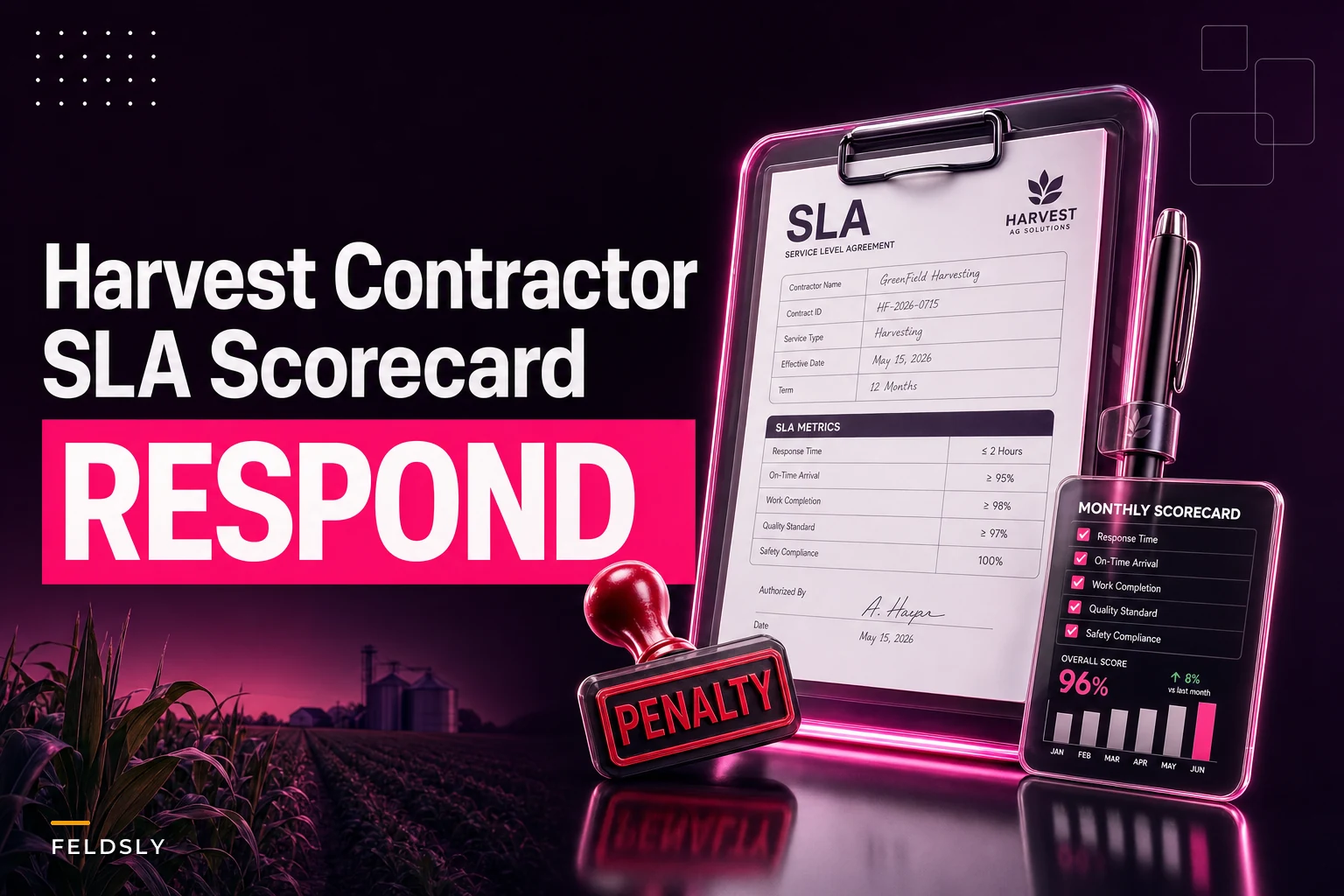

Most harvest contractor agreements fall apart at the exact moment you need them. The contractor shows up two days late, pulls half the promised headcount, or quietly reassigns your best combine operator to a bigger grower down the road. And when you flip through the contract looking for teeth, you find a vague paragraph about "best efforts" and a signature line. That's it.
The fix isn't a 14-page legal document nobody reads. It's a tight, one-page SLA with a monthly scorecard attached — something a field manager can actually fill out on a tailgate and something a contractor understands the first time they read it. Below is how to build it, what to measure, how to write penalty language that doesn't get laughed out of a conversation, and the pre-authorized mitigation rules that keep your harvest moving when things go sideways.
Why most harvest contracts quietly fail
The common failure isn't bad contractors. It's agreements written for the easy months and tested during the hard ones.
A typical harvest agreement describes scope — acres, crop, rough timeline — and payment. What it almost never describes is performance under pressure: what happens when two growers need the same crew during a four-day dry window, who absorbs the cost when a contractor shows up short-staffed, and how fast a replacement has to arrive before it stops being "a replacement" and starts being "a disaster."
In real operations, it usually plays out something like this. You booked a custom harvest crew for corn starting October 8th. Weather cooperates, moisture is right, you're ready. Contractor calls on the 7th: "We're finishing up at the Henderson place, we'll be there the 10th or 11th." Two days doesn't sound like much until you watch a rain system move in on the 12th and realize you just lost your window. Nothing in your contract let you activate a backup. Nothing penalized the delay. You just ate it.
The agreement treated timing as a suggestion and had no mechanism to convert a broken promise into either a correction or compensation.
The structure: one page, three parts
The whole thing fits on a single page because harvest season isn't the time to be reading fine print. Three parts:
Take control of your farm’s productivity.
Feldsly helps you plan, track, and optimize every farming operation with precision.
- Centralized crop scheduling
- Resource & labor management
- Real-time weather alerts
No credit card required
-
The commitment block — scope, peak window, headcount, equipment, and daily throughput expectation.
-
The scorecard reference — the measurable standards you'll grade against monthly (or weekly during peak).
-
The remedies block — emergency replacement rules, pre-authorized mitigations, and penalty language.
The commitment block needs to be specific enough to actually measure. "Provide harvest services for soybean fields" is useless. "Provide two combines and two grain carts, minimum 160 acres/day combined throughput, available within the Sept 20–Oct 15 peak window, crew on-site by 7:30 AM on scheduled days" is something you can score.
What to actually put on the scorecard
A scorecard only works if every line is something a field manager can observe and mark without arguing about interpretation. Vague criteria like "professionalism" produce vague scores and endless disputes. Tie everything to something countable or clearly yes/no.
Here's a scoring structure that holds up well for row-crop operations running custom crews across multiple fields:
| Metric | What you're measuring | Weight | Scoring |
|---|---|---|---|
| On-time arrival | Crew on-site by agreed start on scheduled days | 20% | % of scheduled days met |
| Throughput delivery | Actual acres/day vs. committed acres/day | 25% | actual ÷ committed |
| Headcount & equipment | Promised machines/operators actually showed | 20% | % of committed resources present |
| Loss & quality | Header loss, grain damage, clean-field standard | 15% | pass/partial/fail per field |
| Communication | Advance notice of delays, daily status, reachability | 10% | 1–5 manager rating |
| Safety & compliance | No incidents, equipment in-spec, paperwork current | 10% | pass/fail |
Score it monthly during the shoulder seasons, weekly during peak. The weighting matters: throughput and arrival together are 45% of the grade. During harvest, showing up and moving acres is almost everything. Loss and quality sit at 15% not because they're unimportant but because a contractor who's never there can't deliver on them anyway.
A quick note on the communication line, because it gets underrated. The contractors who blow up your harvest usually aren't the ones who underperform silently — they're the ones who go dark. A crew that calls at 6 AM to say "we're running two hours behind, here's our plan" is a crew you can work with. A crew you can't reach until noon is a crew you need to replace. Score communication honestly and it becomes an early-warning signal weeks before a real failure shows up.
The emergency replacement rule — the part that saves your harvest
This is the clause almost nobody writes, and it's the one that matters most.
> If the contractor fails to field at least 70% of committed throughput capacity for two consecutive scheduled days during the designated peak window, the grower may activate a replacement crew without further notice. The contractor is responsible for the cost difference between contracted rates and documented replacement rates, up to [cap].
Three things make this work:
-
A numeric trigger (70% capacity, two consecutive days) that removes the argument about whether things are "bad enough yet."
-
The peak-window qualifier, so the aggressive remedy only applies when timing is genuinely critical — contractors accept tighter rules when they're scoped to the windows that actually matter.
-
A documented cost pass-through with a cap, so the contractor knows their downside and you know your coverage.
The cap matters for getting the thing signed. A contractor won't agree to unlimited liability, but most will agree to cover the rate delta up to roughly 150% of the affected acreage's contracted value. That's enough to make them take your window seriously without making the agreement un-signable.
Pre-authorized mitigations tuned to peak windows
Emergency replacement is the nuclear option. Most problems are smaller than that, and you want permission to fix them before they escalate — without a phone call, an email chain, or a negotiation while the dew is burning off.
Pre-authorized mitigations are small, pre-approved actions tied to specific triggers. They live right on the SLA so there's no ambiguity about who can do what. A practical set:
-
Partial supplemental crew. If committed throughput drops below 85% for a single day during peak, you may hire supplemental equipment for that day at contractor's cost, capped per day.
-
Overtime authorization. If weather forecasts show the window closing, you may authorize extended hours at agreed premium rates, pre-approved up to a set number of hours.
-
Priority reassignment. During the peak window, your fields hold stated priority over the contractor's non-contracted work. A breach here triggers the scorecard penalty automatically.
-
Direct logistics coordination. If grain-cart or trucking coordination is the bottleneck, you're pre-authorized to insert your own hauling. This dovetails well with how you've already ranked your transport partners — if you've built a resilience-weighted local carrier scorecard, you already know which backup hauler to call without burning an hour figuring it out.
Set daily caps for supplemental crews based on local short-term contract rates so replacements stay affordable.
The whole point is removing decision friction. When a window is closing, the worst thing you can do is spend the morning asking permission.
Sample penalty language that holds up
Penalty clauses fail in two directions. Either they're so soft they mean nothing, or so punitive no contractor signs them. The workable middle is penalties that scale with measured performance and tie to the scorecard you're both looking at.
> Performance adjustment. Monthly payment shall be adjusted based on the composite scorecard score as follows:
-
Score 90–100%
full contracted payment.
-
Score 80–89%
5% reduction on affected period.
-
Score 70–79%
10% reduction, plus mandatory corrective plan within 48 hours.
-
Below 70% during peak window
15% reduction and grower may invoke the emergency replacement rule.
> Window-critical breach. Failure to appear on a scheduled peak-window day without 24-hour notice carries a flat penalty of [amount] per missing machine per day, independent of the composite score.
Two things worth noting here. The composite-score tier and the flat per-day penalty coexist on purpose — the composite handles gradual underperformance, the flat penalty handles acute no-shows, and you want both. The 80–89% band is also deliberately gentle. A good contractor will occasionally land there because of weather or breakdowns outside their control, and a 5% nudge keeps the relationship intact while still making clear the standard is real.
A real scenario
A mid-size operation running soybeans and corn — somewhere around 3,100 acres across a dozen fields — had leaned on the same custom harvest contractor for years on a handshake-plus-one-page-invoice basis. Two seasons in a row, the contractor arrived late during the corn window because a larger grower got priority, and the operation took moisture-related grade dockage on roughly 400 acres each time. The owner estimated the combined dockage and delay cost somewhere in the $14k–$18k range per season, none of it recoverable.
They rebuilt the agreement around the scorecard model above: committed daily throughput of 170 acres, a 70%/two-day replacement trigger scoped to the Oct 1–20 window, and a flat no-show penalty of $2,000 per combine per day. They also lined up a standby contractor in advance so "activate replacement" meant one phone call.
The following season the primary contractor still ran a day behind once, but called at dawn, pulled in an extra machine on their own dime to stay above the 85% mitigation threshold, and avoided triggering anything. The grade dockage effectively disappeared. The owner's take was pretty straightforward: nothing changed about the contractor's capability — what changed was that the contract made their priorities expensive to ignore.
When this makes sense — and when it doesn't
This makes sense when:
-
You rely on custom or contract harvest crews during a tight weather-sensitive window.
-
You run multiple fields and can't personally babysit every crew every day.
-
You've been burned by late arrivals, short crews, or priority-bumping before.
This is overkill when:
-
You own your own harvest equipment and crew end to end.
-
Your contractor is also a close partner you co-plan with, and the volume is small enough that a scorecard adds more friction than value.
-
Your harvest window is genuinely flexible and a few days' slip costs you nothing.
Who should not bother: a grower with one small field and one reliable neighbor doing the custom work. The administrative weight isn't worth it. The scorecard earns its keep when the stakes of a missed window are real money and when you're coordinating more crews and fields than you can track in your head.
Making it run across the season
The SLA is a document, but the scorecard is a rhythm. The managers who get value out of this don't file it after signing — they score it on a set cadence and watch the trend. A contractor drifting from 94% to 86% to 81% over three scoring periods is telling you something a single snapshot never would.
Fold the scoring dates into your broader planning so they don't get forgotten the moment field work starts. If you already maintain an enterprise seasonal operational calendar, the scorecard reviews belong right on it — tied to the peak windows, with the standby-contractor check happening before harvest, not during it.
Keep the scoring sheet physical or on a phone, keep it one page, and keep it in the field manager's hands. The whole value of this system is that it converts a vague frustration ("the crew's always late") into a number both sides agreed to in advance — and a number is a lot harder to argue with than a feeling in late October with rain on the radar.
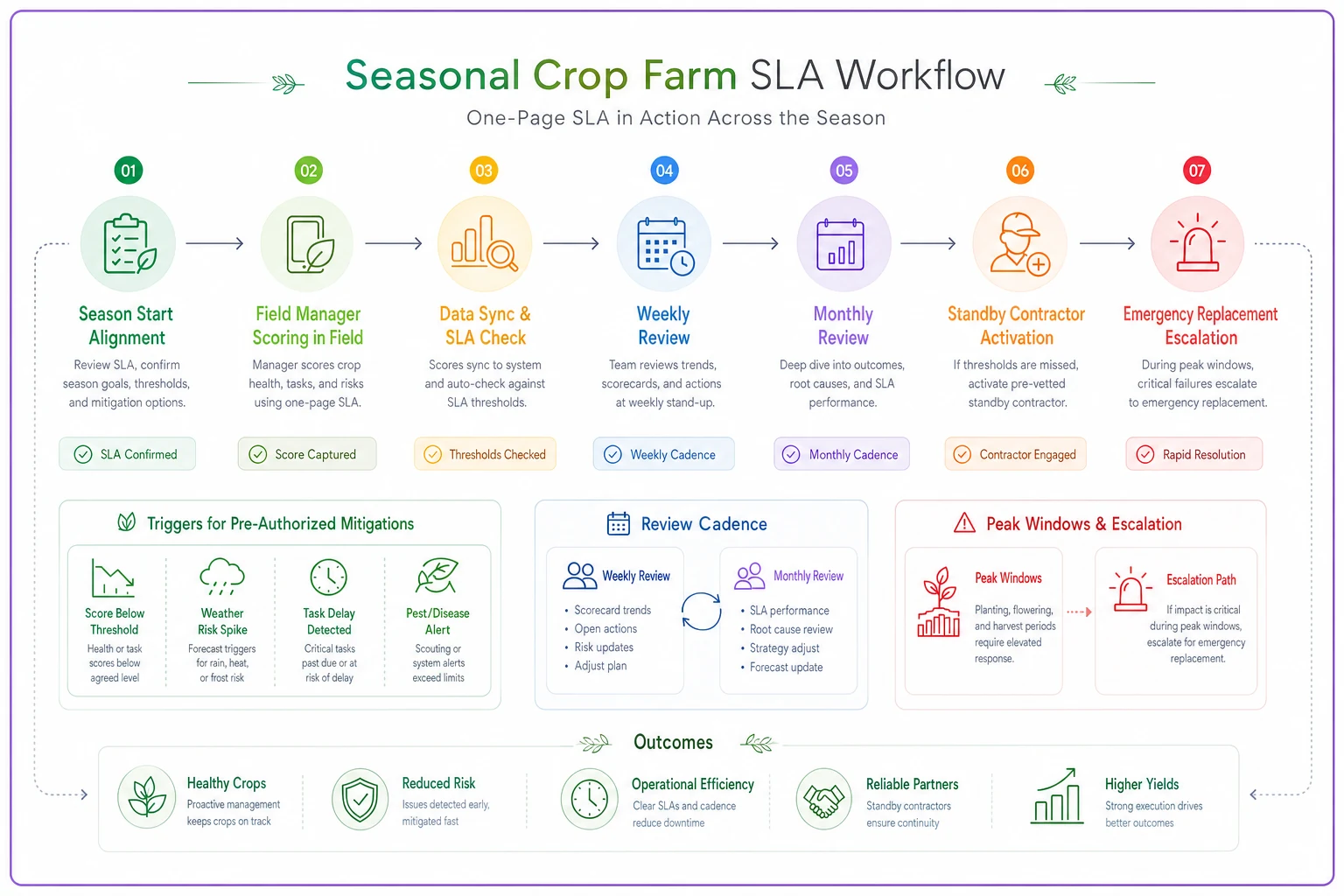
Below is a simple workflow showing how the one-page SLA, scorecard cadence, and replacement activation process interact across a season.
Keep the scoring sheet physical or on a phone, keep it one page, and keep it in the field manager's hands. The whole value of this system is that it converts a vague frustration ("the crew's always late") into a number both sides agreed to in advance — and a number is a lot harder to argue with than a feeling in late October with rain on the radar.
The one-page SLA, the weighted scorecard, the numeric replacement trigger, and the tiered penalties aren't about punishing contractors. They're about making your harvest window the thing everyone takes seriously — because the agreement finally gives them a reason to.
Ready to revolutionize your farm management?
Join 500+ farms using Feldsly to boost yields, reduce waste, and streamline daily farm workflows.