

Most lost premiums show up at the scale house, on a grade ticket. The load tested 0.3% over on foreign material. Protein came in two-fifths under. The non-GMO strip test lit up. The barley sprouted too slowly to pass germination. The ticket says "discount" or "rejected," the truck takes a lower price or goes hunting for a feed buyer, and someone at the office spends an afternoon arguing with the elevator about sampling.
But the ticket isn't where the premium got lost. It got lost in April, when the planter wasn't fully cleaned out between varieties. Or in August, when nobody pulled a pre-harvest protein sample. Or at 11 p.m. in October, when a tired driver dumped into the wrong bin because the right one was full and nobody had told him what to do in that case.
This article treats the whole chain from field to buyer as one operating system. Most farms run it as five disconnected jobs: agronomy, harvest, storage, trucking and marketing. The person who signs the contract is rarely the person whose decisions determine whether it gets fulfilled at full premium. Below you'll find sample QA gates, routing rules, a contract exposure dashboard you can build in a spreadsheet, and worked numbers for sizing commitments and protecting premiums once the crop is in the bin.
Start at the grade ticket and work backward
When a premium load gets discounted, the usual response is to go after the load: retest it, dispute the sample, blame the elevator's probe. Sometimes that's fair. Elevator and farm testing can drift apart, especially on protein and moisture. More often, though, the load did exactly what it was set up to do months earlier.
-
Planting. Wrong seed lot, a contaminated planter box, or a field next to a conventional neighbor with no buffer plan.
-
In-season. Volunteers from last year's crop, an off-label or late application that conflicts with the buyer's spray requirements, or a disease event nobody flagged as a quality risk.
-
Harvest. The combine wasn't cleaned between crops, a grain cart served two fields with different specs, or trucks got reassigned on the fly.
-
Storage. A shared leg or auger, a bin that was "mostly" cleaned, or two field lots put in one bin because space ran out.
-
Shipping. No retained sample, missing paperwork, or a load pulled from the wrong bin.
Very little of this is a skill problem. The combine operator knows how to clean a combine. Nobody told him this field feeds a contract with near-zero tolerance for off-type beans, so cleanout got the same 20-minute blow-down it gets between two commodity corn fields.
On most farms the contract lives in the marketer's email or a folder in the farm office. The crew runs on habit and whatever the owner said in the shop that morning. The two only meet at the scale.
The contract is an operating spec that nobody on the crew has read
A premium contract isn't really a sales document. It's a product specification with a delivery schedule and a list of penalties attached, and every term in it controls something physical on the farm.
Take control of your farm’s productivity.
Feldsly helps you plan, track, and optimize every farming operation with precision.
- Centralized crop scheduling
- Resource & labor management
- Real-time weather alerts
No credit card required
The farms that consistently capture premiums tend to boil each contract down to a one-page "premium capture rule card" before planting. It's written for the people doing the work, not for the bank or the accountant, and it answers four questions:
-
What qualifies a bushel for the premium?
-
What kills the premium outright (rejection, loss of IP status)?
-
What only discounts it (scaled deductions)?
-
What evidence does the buyer require, and when?
The table below maps common contract terms to operations. The "where it gets lost" column reflects patterns that repeat across specialty soy, food-grade corn, malting barley and high-protein wheat programs.
| Contract term | What it actually controls on the farm | Where it typically gets lost | Who should own it |
|---|---|---|---|
| Purity / adventitious presence tolerance (non-GMO, IP varieties) | Seed source, planter cleanout, field isolation, combine/cart/truck/bin cleanout | Shared harvest equipment, border rows next to neighbors, bin legs | Agronomy lead (planting), harvest lead (cleanout) |
| Protein range or scale (wheat, malting barley) | N timing, field selection, harvest segregation, blending decisions | Lots mixed in storage before anyone tests them | Agronomist + storage manager |
| DON / mycotoxin limits | Fungicide timing, harvest order, cleaning/screening | High-risk fields harvested first and mixed into clean bins | Agronomist (flags risk), harvest lead (sequences) |
| Germination / sprout (malting barley) | Harvest timing, drying temps, storage aeration | Over-aggressive drying, rain delay with no re-sampling | Harvest lead + dryer operator |
| Moisture, test weight, FM, damage | Harvest timing, combine settings, drying, cleaning | Night shifts, rushed fields, skipped cleaner | Harvest lead |
| Approved varieties / seed documentation | Seed purchasing, tag retention | Seed tags tossed, substituted variety when supply was short | Whoever orders seed |
| Spray restrictions (specific actives, PHI) | Application records, product choices | Custom applicator substitutes a product | Agronomist + applicator |
| Delivery window and quantity | Bin allocation, trucking schedule, harvest sequence | Bins committed to other crops, trucks booked elsewhere | Marketer + logistics |
| Documentation requirements (affidavits, cleanout logs, field maps) | Recordkeeping at every gate | Logs reconstructed from memory at delivery time | Office/ops admin |
People assume the "owner" of a contract is whoever signed it. That person controls price and quantity. Everyone else in the table controls whether that price actually gets paid.
> Contract SB-2 — food-grade non-GMO soy, Buyer X > Qualifies: approved variety list only, tested below buyer GMO threshold, FM and splits within stated limits, delivered in clean trucks with signed cleanout log. > Kills premium: positive GMO test above threshold, unapproved variety, missing IP paperwork. > Discounts: splits, FM, moisture over base. > Evidence: seed tags, planting records per field, cleanout logs (planter, combine, cart, trucks, bins), retained sample per load. > Fields assigned: 3, 4, 7, 9, 11, 12 (see map). Border 6 rows on field 4 south and east edges = commodity.
Where the chain breaks, stage by stage
It's tempting to call premium protection a harvest problem. Harvest is where the most bushels move in the least time, but the failures are spread across the whole season, and they compound. An unclear isolation plan at planting becomes a harvest question (which rows go where?), which becomes a storage question (which bin is clean?).
Planting is where traceability either starts clean or never does. If you can't say which seed lot went into which field, every later step is guesswork. The most common failure isn't bad seed. It's a planter that ran a conventional or GM variety last, got a quick cleanout, and then went into the IP variety. A few hundred seeds stuck in the meters or the bulk fill can push a load over a strict tolerance, especially from the first passes of the field.
In-season problems are quieter. A field picks up volunteer corn from last year. A custom applicator swaps in a different product because the specified one was backordered. A fusarium event hits during flowering in a barley field and nobody connects it to the DON clause in the malting contract. The agronomist sees the disease, the marketer sees the contract, and nobody puts the two together until the load is rejected.
Harvest is where speed fights quality. When you're two days behind and rain is coming, cleanout is the first thing to get shortened. Harvest days also run 14+ hours, and decisions at hour 13 are worse than decisions at hour 3. That's fatigue, not a character flaw. If your crews are already squeezed by moisture-sensitive windows, avoiding downgrades at harvest with shift templates and assignment maps pairs well with this article. That one covers the people side of the window. This one covers which loads go where.
Storage is the stage farms underestimate most. You can do everything right in the field and still lose it at the bin site, because a leg or auger carried residue from a different crop, or because the "IP bin" got half-filled with commodity beans when the commodity bins backed up. Once two lots are mixed, you generally can't un-mix them.
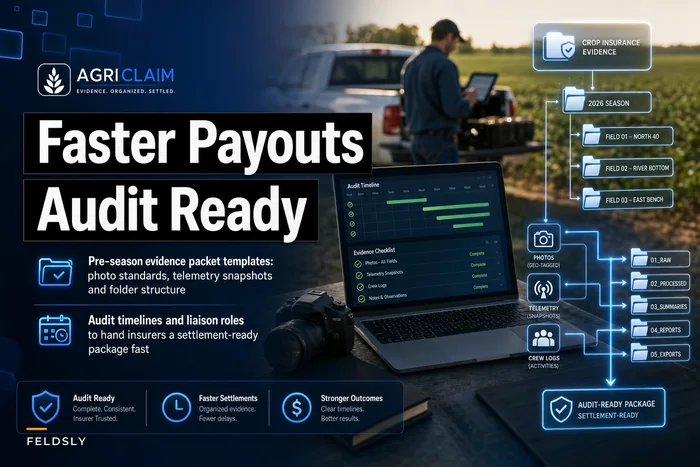
Shipping and delivery is mostly about evidence. In a dispute, the farm with a retained sample from that specific load, a bin ID, a cleanout log and a field-lot trail usually wins, or at least gets a fair retest. The farm without them eats the discount. It's the same logic behind pre-built evidence packets for crop insurance claims. Insurance adjusters and grain buyers both respond to a clean, timestamped trail they don't have to reconstruct.
QA gates that tie directly to contract terms
A QA gate is a checkpoint where something has to be true, and has to be recorded as true, before the crop moves to the next stage. The point isn't bureaucracy. It's to move the moment of discovery earlier, while you still have options.
Gate 0: Seed and planter release (pre-planting)
-
Pass criteria
seed lot matches approved variety list, tags photographed and filed against the field, planter cleanout completed and signed (boxes, meters, bulk fill, vacuum system).
-
Fail action
planter doesn't go into an IP field until cleanout is re-done. If a lot is in question, plant the first few acres as a "flush" and flag those acres as commodity.
-
Evidence
tag photos, cleanout log with time and initials, field assignment.
Gate 1: Isolation and border plan (at planting)
-
Pass criteria
neighbor crops identified on all edges, border rows to be harvested separately are defined in rows or feet, and the map is shared with the harvest lead.
-
Fail action
if a neighbor's crop is unknown, default to treating the border as commodity.
Gate 2: In-season quality risk review (key growth stages)
-
Pass criteria
volunteer pressure scouted, application records checked against contract restrictions, disease events tied to quality clauses (DON, sprouting, damage) logged and flagged to the marketer.
-
Fail action
reclassify the field's routing class (more on classes below) and update exposure.
Gate 3: Pre-harvest field sampling (1–3 weeks before harvest)
-
Pass criteria
hand samples pulled per field or management zone for whatever the contract scales on (protein, DON, GMO strip, moisture trajectory). Results tie back to field-lot ID.
-
Fail action
field moves to a lower routing class, or gets split into zones.
Gate 4: Harvest equipment release (before entering each IP or premium field)
-
Pass criteria
combine, cart and trucks cleaned to the contract's standard and signed. The first bushels after cleanout are diverted to commodity if the contract or your risk tolerance calls for it.
-
Fail action
equipment doesn't enter the field. Yes, even when it's going to rain.
Gate 5: Bin assignment and intake (every load)
-
Pass criteria
destination bin is pre-assigned for that routing class, the bin was cleaned and signed before first fill, and the field-lot ID is recorded with every load into the bin.
-
Fail action
load goes to a hold location (a dedicated bin, wagon or pile) instead of the "closest available" bin.
Gate 6: Pre-ship verification (before each delivery)
-
Pass criteria
probe sample taken and tested to the contract spec with some headroom, a retained sample bagged and labeled, the truck cleanout logged, and paperwork assembled.
-
Fail action
don't ship marginal grain against a premium contract without a plan (blend, clean, or reassign to another contract).
Gate 7: Delivery reconciliation (after each grade ticket)
-
Pass criteria
buyer grade compared to farm test. If the gap is beyond your tolerance, a retest is requested and the retained sample is ready.
-
Fail action
if farm testing consistently reads optimistic, recalibrate and widen your headroom targets.
Almost everyone skips that last gate, and it's the one that makes the system better each year. If your NIR reads protein 0.2–0.3 points higher than the buyer's, every "pass" at Gate 6 is overstated, and you'll keep shipping loads you think are fine.
Routing logic: deciding where every load goes before the combine rolls
Routing is the bridge between QA and the contract. It answers a simple question that gets messy fast: given what we know about this field, which equipment, which bin, which contract?
The cleanest approach is to give every field (or zone, if you split fields) a routing class before harvest starts, based on Gates 0–3:
-
Class A
premium-eligible with headroom.
Passed all gates, and pre-harvest samples show comfortable margin on the contract spec. -
Class B
premium-eligible, thin margin.
Passed, but close to a threshold, like protein right at the base or a DON reading near the limit. -
Class C
commodity.
Doesn't qualify, or isn't assigned to a premium contract. -
Class H
hold.
Unknown status. Maybe there was a missed sample, a spray question, or a border area with an unknown neighbor.
Then write simple routing rules:
-
Class A goes to dedicated premium bins, and those loads are prioritized for delivery against the premium contract.
-
Class B goes to separate bins from Class A, so you can blend B with A later (where blending is allowed) instead of having B drag A down from day one.
-
Class C goes to commodity bins.
-
Class H goes to a hold bin or location until it's tested. It never goes into an A bin.
-
Border rows always follow the border plan, no matter what class the field is.
-
If the assigned bin is full, the load goes to hold, not to the nearest bin.
That last rule probably saves more premium than any other, because "nearest bin" is where commingling happens at 11 p.m.
What a single load's path looks like when this works
The harvest lead starts the day with a run sheet listing fields in order, each with its routing class and assigned bin. Before entering a Class A field, the combine and cart get their Gate 4 cleanout, and someone signs it on a phone or a clipboard by the fuel tank. As the cart fills, the operator tags the load with the field-lot ID, which can be a field number plus a zone letter, nothing elaborate. The truck driver gets the field-lot ID and the destination bin.
At the bin site, whoever runs the leg confirms the bin matches the class, pulls a quick sample if the contract calls for per-load testing, and records load, bin and approximate bushels. That record updates the running "qualified in bin" number for the contract. If anything doesn't match, like the wrong bin, a full bin, or an unexpected wet spot, the load goes to hold and the harvest lead gets a message that day, not three days later.
Label the field-lot ID on the cart, truck and bin record every time to prevent handoff errors during long harvest days.
A simple workflow diagram helps visualize the routing decisions from field sampling through bin assignment to delivery.
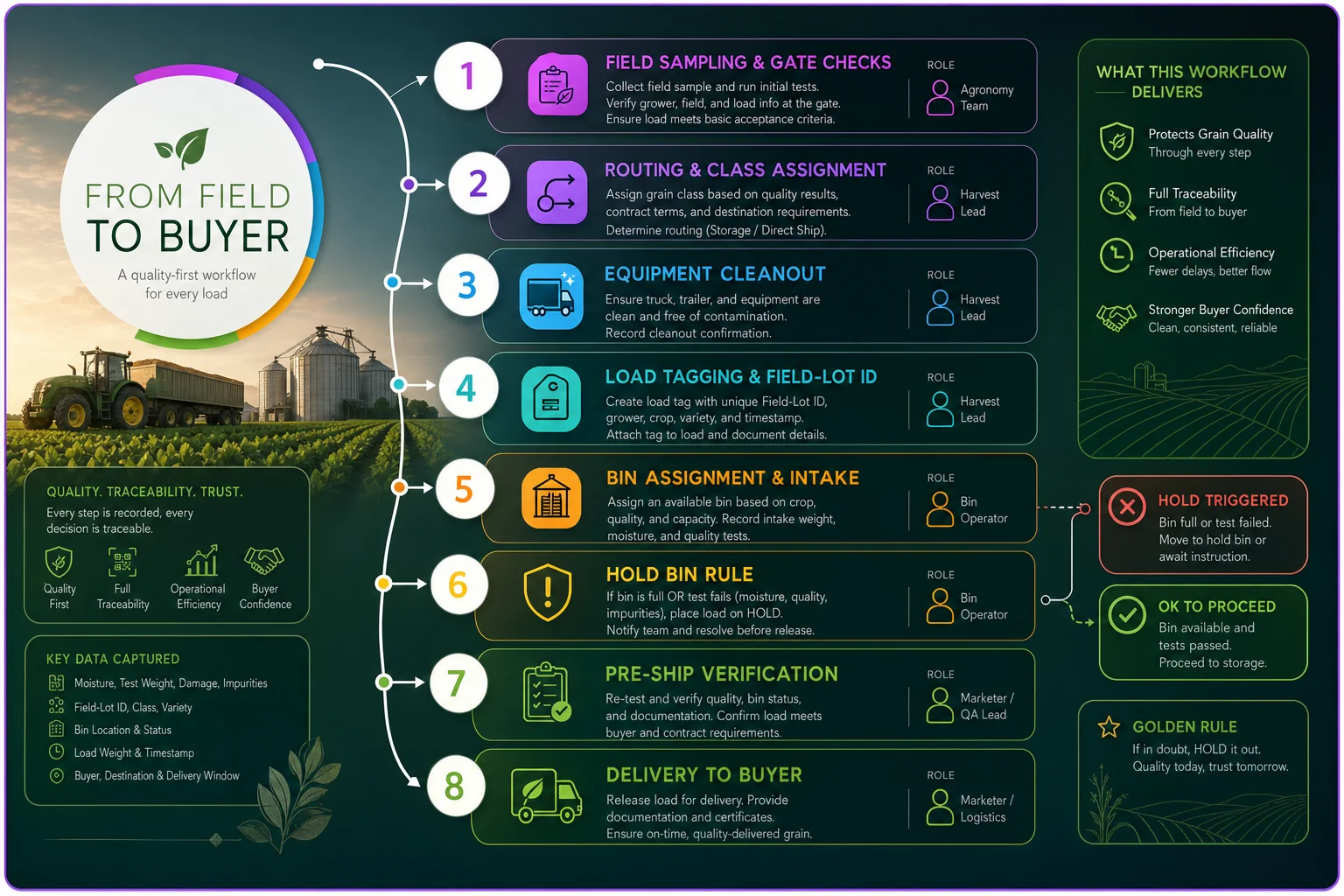
None of this is complicated. It's fragile because it depends on four or five people each doing their piece during the most exhausting week of the year, and every handoff is a place where the field-lot ID can fall off.
The contract exposure dashboard
Most farms track how much grain they've sold. Far fewer track how much grain they can prove qualifies for what they've sold, and that gap is where premium risk lives.
A contract exposure dashboard is a weekly view in season and a daily one during harvest. It shows each premium contract against what you actually have, risk-adjusted. Here's a template you can build in a spreadsheet:
| Contract | Spec summary | Committed (bu) | Delivered (bu) | Qualified in bin (bu) | Field est., risk-adj. (bu) | Gap (bu) | Premium/bu | Premium at risk ($) | Delivery window | Docs complete |
|---|---|---|---|---|---|---|---|---|---|---|
| SB-2 food-grade soy | Non-GMO, approved var. | 26,000 | 0 | 8,400 | 18,900 | +1,300 | ~$1.60 | low | Nov–Jan | 70% |
| WH-1 HRS wheat | Protein base 14.0 | 40,000 | 22,000 | 11,500 | 0 (harvested) | -6,500 | scale | ~$4k–$6k | through Dec | 90% |
| MB-1 malting barley | Protein 11–13, DON low, germ 95%+ | 55,000 | 18,000 | 21,000 | 9,000 | -7,000 | ~$1.90 spread to feed | ~$13k | Oct–Mar | 60% |
The important columns work like this:
Qualified in bin counts only bushels that passed Gate 5 into the correct bin class and, where relevant, tested to spec. Class B grain gets its own row or a note, because it's conditional.
Field est., risk-adj. is estimated yield × acres × a qualification factor for each field. A Class A field might carry 0.95. A Class B field might be 0.70–0.80. A field with a known border issue gets the border acres subtracted entirely.
Gap = (delivered + qualified in bin + risk-adj. field est.) − committed. A negative number means you're short of proven-qualifying grain.
Docs complete is the share of required evidence already filed for that contract. A low number late in the season means a scramble at delivery.
The "premium at risk" column is where marketing and operations finally share one view. When the barley line shows a 7,000-bushel gap with harvest mostly done, that's no longer a harvest problem. It's a marketing decision: buy back, negotiate a substitution, or try cleaning or blending to bring Class B up. The dashboard makes that conversation happen in October instead of March.
One caution. Dashboards like this rot fast if nobody owns the inputs. If bin records get updated every few days from memory, the qualified number is fiction. Three contracts tracked accurately beat ten tracked loosely.
Worked examples: sizing commitments and protecting premiums
Two examples below, one on how much to commit before harvest and one on what blending does to a protein scale. The numbers are illustrative. Swap in your own yields, premiums and buyer scales before you rely on any of it.
Both come down to the same thing: what you can prove qualifies, and how carefully the bins were managed along the way.
Example 1: How much food-grade soy to commit before harvest
A farm plants roughly 640 acres of an approved food-grade non-GMO soybean variety across nine fields. Yields typically run 52–58 bu/ac, so the gross estimate is around 35,000 bushels. The buyer is offering a premium in the $1.50–$1.75 range, and the temptation is to commit most of that 35,000 at signing.
-
Field 4 (about 80 ac) borders a conventional neighbor on two sides. The border plan pulls roughly 6–7 acres' worth of rows into commodity, so subtract around 350 bu.
-
Field 7 had heavy volunteer corn and a planter cleanout that wasn't fully documented at Gate 0. It moves to Class B with a 0.70 factor, which takes about 1,900 bu off a ~6,300 bu estimate.
-
Two other fields are Class B on spray-record questions that should resolve, at 0.85. That's roughly 900 bu off.
-
Everything else is Class A at 0.95, which takes off roughly another 1,100 bu.
The risk-adjusted qualifying estimate lands around 30,000–31,000 bushels, not 35,000.
Say the farm committed 34,000 bushels. That's a shortfall of around 3,500 bushels, and at a ~$1.60 premium it's about $5,600 in lost premium. On top of that, many contracts make the farm cover the buyer's replacement cost on undelivered bushels, often tens of cents per bushel depending on the market. Call it another $1,000–$2,500. That's real money on a contract that was supposed to be the profitable one.
A more defensible rule is to commit something like 80–85% of the risk-adjusted number at signing, so around 24,000–26,000 bushels, then add more once Gate 3 sampling and early harvest confirm quality. Some buyers will take add-on bushels at a similar premium late in the season and some won't, so the tradeoff is real. Under-committing can mean selling qualifying beans as commodity. Still, the downside of over-committing is usually worse than the upside you give up.
Example 2: Protein blending on hard red spring wheat
Say you have two bins of HRS wheat after harvest:
-
Bin A
about 20,000 bu at 15.0% protein
-
Bin B
about 12,000 bu at 13.2% protein
Assume a buyer scale with a 14.0% base, a premium of roughly 3¢ per fifth of a point above base, and a discount of roughly 15¢ per fifth below. Scales are often lopsided like this. Yours will differ, so plug in your own numbers.
Sold separately:
-
Bin A
5 fifths above base × 3¢ = 15¢/bu × 20,000 = about +$3,000
-
Bin B
4 fifths below base × 15¢ = 60¢/bu × 12,000 = about −$7,200
-
Net
roughly −$4,200
Blended:
-
(20,000 × 15.0 + 12,000 × 13.2) ÷ 32,000 ≈ 14.3%
-
One full fifth above base × 3¢ × 32,000 ≈ +$960
That's a swing of a bit over $5,000 just from how the bins were managed. It only exists if Bin A and Bin B were kept separate in the first place. If they'd been dumped together during harvest you'd land in a similar place without ever knowing it, and you'd lose the option of selling Bin A's high protein to a buyer paying a stronger premium.
Notice the blend lands at about 14.3%, not 14.0%. Blending right to the threshold is a classic mistake. Elevator testing variation and uneven blending through the leg can easily cost you a fifth, and on a lopsided scale that's an expensive fifth. Aim for some headroom. How much depends on how closely your Gate 7 reconciliation says your testing matches the buyer's.
Blending isn't allowed in every program. Many IP and malting contracts forbid or restrict it, so check the rule card first.
Real scenario: malting barley and wheat in the northern plains
Business type: Family operation, roughly 2,600 acres, mostly HRS wheat and malting barley with some soybeans. Owner-operated, two full-time hands, seasonal help at harvest, and about a dozen bins across two sites.
The problem: For several seasons, around a third of their malting barley loads were rejected to feed. Causes were a mix of DON, protein over the 13% ceiling, and the occasional germination failure. On roughly 70,000 bushels of barley, with a malt-to-feed spread somewhere in the $1.80–$2.40 range depending on the year, that worked out to something like $40k–$55k a year in premium they'd planned on and didn't get. They also paid for extra trucking every time a rejected load had to be rerouted to a feed buyer.
When they traced it backward, no single big failure showed up. It was a cluster of small ones:
-
No pre-harvest sampling. They found out protein and DON at delivery.
-
Barley fields were harvested in whatever order was convenient, so a couple of fields with fusarium pressure went into the same bins as clean fields early in harvest.
-
The dryer was run hot on wet days to keep up, which hurt germination on some lots.
-
Bin records said "barley" with no field-lot ID, so when a bin failed they couldn't tell which fields caused it.
What changed:
-
Gate 3 pre-harvest samples by field, plus a DON quick test on fields flagged at Gate 2 for disease during flowering.
-
Routing classes. Clean, in-spec fields went first into two dedicated bins. Fields flagged for DON or high protein were harvested later into separate storage.
-
A dryer temperature cap for malting barley lots, written on a card taped to the control panel.
-
Field-lot IDs recorded per load at the bin, and a retained sample per delivery.
Results after two seasons: Rejections dropped to somewhere around 12–15% of loads. Some of the remainder is weather they can't control. In one season a late rain caused sprouting no gate would have stopped. The recovered premium ran roughly $25k–$30k a year. Disputes also got noticeably shorter, because they had a retained sample and a field trail for nearly every load.
What it cost: Two bins effectively dedicated to barley through harvest, a few thousand dollars in testing, and a harvest that ran something like a day to a day and a half longer because of the sequencing and cleanouts. For them the trade was obviously worth it. On a smaller barley acreage it might not have been.
Building the model for one season: the sequence
If you're setting this up from scratch, run it on one or two contracts the first year instead of wiring up everything at once. Here's the order that tends to work.
-
Pick the contracts that matter. Choose the one or two premium contracts where the dollar spread is biggest and the spec is clearest. Ignore the small ones this year.
-
Write the rule cards. One page per contract covering what qualifies, what kills it, what discounts it, and what evidence is needed. Get the marketer and the harvest lead to read them together, in the same room if you can.
-
Assign fields and draw the border plans. Decide which fields feed which contract before planting, and mark border rows and isolation decisions on a map the harvest crew will actually see.
-
Set the gates and their owners. Use the sample gates above as a starting point, cut the ones that don't apply, and put a name next to each gate. A person's name, not a job title.
-
Allocate bins before harvest. Every routing class gets a destination, including a hold location. If you don't have enough bins for clean segregation, figure that out in July, not at the first truck.
-
Run the exposure dashboard weekly from mid-season. Update the risk-adjusted field estimates after Gate 2 and Gate 3, and adjust commitments while you still have room.
-
Run harvest on routing classes, not convenience. Issue a run sheet per day. Full bin means hold. Cleanout gets signed before entering premium fields.
-
Reconcile every grade ticket. Compare buyer grades against farm tests, keep the retained samples, and track the gap. Feed that back into next year's headroom targets.
Step 2 is the one people most want to skip because it feels like paperwork. It's also the step that finally connects crew decisions to contract dollars.
Step 5 is the other one that bites. Bin space is the hard constraint on this whole system, and no amount of good process fixes a farm that has nowhere to put a Class H load.
When this actually makes sense
A field-to-buyer system pays off when the premiums are real and quality is something you can control, not something weather mostly decides. Specialty soybeans, food-grade corn, malting barley, protein-scaled wheat, seed production, organic transition crops and buyer-specific sustainability programs all fit.
It also makes sense once you have more than one premium contract running at the same time, more than one storage site, or harvest crews you don't personally supervise every hour. At that point the information can't live in one person's head anymore, even if that's how it worked fine for years.
When this is a bad idea
If almost all your grain moves as commodity to the local elevator on standard discount schedules, a full gate-and-routing system is overkill. Basic moisture and FM management will cover most of what you'd gain.
It's also a bad idea if the premium is thin relative to the cost of segregation. A 20–30¢ premium on a contract that requires full IP cleanouts can get eaten by slower harvest, dedicated bins and extra trucking. Run the math before you sign, not after.
And don't build the whole system at once, across every contract, in the first year. People will follow two rule cards. They won't follow eight.
Who should NOT do this (yet)
Some operations are better off fixing a few basics first. Three situations come up most:
-
Operations without enough storage to segregate by class. Fix storage capacity, or lean on buyers who take grain at harvest, before investing in gates you can't execute.
-
Farms where nobody can own the bin records during harvest. Without reliable load-to-bin tracking, the dashboard is guesswork.
-
Farms that depend heavily on custom harvesters who won't commit to cleanout standards. Either change the contractor terms or keep premium acres to fields you harvest yourself.
None of these are permanent. They're just the things that make a premium program fail even when everyone has good intentions, so it's cheaper to solve them before the contract is signed.
What changes as the operation grows
At small scale, the owner holds the whole chain in their head. They signed the contract, planted the fields, run the combine and know which bin is clean. That works, and it works pretty well, which is exactly why it's hard to give up.
It starts breaking roughly when one of these happens:
-
Contracts multiply. Three buyers with different specs on the same crop means the same bean variety could be premium for one buyer and commodity for another. Routing has to be contract-aware, not just crop-aware.
-
Sites multiply. A second bin site means a second person making intake decisions, often without seeing what's in the other site's bins.
-
Harvest gets delegated. Hired operators and contractors don't carry the contract knowledge in their heads, so the run sheet and rule cards become the only way that knowledge reaches the field.
-
Marketing gets more active. Someone selling forward through the season needs the qualified-in-bin and risk-adjusted numbers, not just total bushels. Otherwise they overcommit.
Roles have to split along with this. Usually the marketer owns commitments and the dashboard, a harvest lead owns Gates 4–5 and routing, an agronomist or the owner owns Gates 0–3, and an office or ops person owns the documentation and Gate 7. On a smaller farm one person might wear three of those hats. That's fine as long as each hat is explicit.
The cost of a single mistake changes too. One mis-routed load on a 500-acre farm is annoying. On a 5,000-acre farm with several premium programs, one wrong dump into a shared bin can disqualify 15,000–20,000 bushels in one go.
Pre-harvest readiness checklist
Run through this a couple of weeks before harvest starts on any crop with a premium contract. It takes maybe an hour with the harvest lead and the marketer in the same room.
-
Rule cards are printed and posted in the shop, at each bin site, and in the truck cabs if possible
-
Every premium field has a routing class (A, B, C or H) based on current information
-
Gate 3 pre-harvest samples are done and tied to field-lot IDs
-
Border plans are marked on the harvest map
-
Bins are assigned per routing class, including at least one hold location
-
Bins and legs are cleaned and signed before the first fill
-
Combine, cart and truck cleanout standards are written, with a sign-off sheet or phone form ready
-
Custom harvester agreements include cleanout and load-recording requirements
-
The exposure dashboard is updated with risk-adjusted estimates, and commitments are reviewed against it
-
Retained sample bags, labels and storage spot are set up
-
The farm moisture/protein tester has been checked against a lab or buyer sample recently
-
Everyone on the crew knows what "full bin goes to hold" means and who to call
If you can't check most of these off, it's better to find out now than in the second week of harvest. A missing hold location or an untested NIR is a lot cheaper to fix in September.
Where software fits
Most of this can run on paper, spreadsheets and a group text, and plenty of farms start that way. The weak point is that the chain from field-lot ID to load to bin to contract breaks at every handoff when it lives in five different places. A cart operator's notebook, a bin-site clipboard and the marketer's spreadsheet don't talk to each other.
Operational software with AI automation mostly helps with the tedious connecting work. It records loads against field-lot IDs from a phone, keeps bin contents and qualified bushels current without someone retyping clipboard notes at night, flags a load routed to a bin that doesn't match its class, and recalculates contract exposure as yields and test results come in. It can also read grade tickets as they arrive and compare them to farm test results, which is the Gate 7 reconciliation that almost never gets done by hand. None of it replaces the rule cards or the judgment calls. It just keeps the trail from going cold between the field and the buyer.
Wrapping up
The farms that keep capturing premiums year after year usually don't have better agronomy or smarter marketing than their neighbors. They have a tighter connection between the two. Contract terms reach the people running the planter and the combine, and field data reaches whoever decides how many bushels to commit.
If this feels like a lot, start with one contract and three pieces: a rule card, routing classes with a hold bin, and the exposure dashboard updated weekly. That alone tends to surface most of the gaps. Next season you'll know where your trail breaks, and that tells you which gates to add.
Also, keep the retained samples for a while after the last delivery. Disputes and adjustments sometimes surface months later, and the sample you threw away in January is the one you'll wish you had in April.
Ready to revolutionize your farm management?
Join 500+ farms using Feldsly to boost yields, reduce waste, and streamline daily farm workflows.