

Most farms don't have a data problem in the way software vendors describe it. They have a naming problem. The north 40 is "North 40" in the spray log, "N-40" in the agronomist's spreadsheet, "Field 12" in the accounting software, and "the one by the creek" when the crew talks about it on the radio. Same dirt. Four identities. And every one of those identities becomes a small tax you pay every time you try to answer a simple question like what did we actually spend per acre on that block last year?
That's the real shape of farm master data management. It isn't about more dashboards or fancier telemetry. It's about whether the core objects on your operation — fields, seed lots, suppliers, equipment, chemicals — have one agreed-upon identity that every tool and every person points back to. When they don't, the failures don't announce themselves. They leak out slowly as reconciliation headaches, mispriced input orders, and reports nobody quite trusts.
This is a playbook for fixing that at the object level. Not a philosophy piece — an artifact-first approach where the deliverables are actual lists, a schema you can copy, SQL you can adapt, and a sync cadence tied to your season. If you've already read our take on why staged data governance unlocks ROI for AI in mid-size and large farms, think of this as the layer underneath it. Governance tells you how to manage the data. Master data tells you which objects you're managing in the first place.
Why the mess is almost never a technology failure
A farm buys good tools — a farm management platform, a precision ag account, decent accounting software, maybe a grain marketing tool. Each one is fine on its own. The mess appears in the gaps between them, and it appears because each tool asked someone to name things at a different moment, under different pressure.
The agronomist named fields when soil sampling started, using their own convention. The accountant named them when setting up cost centers, using tax parcels. The equipment operator named them off the guidance lines in the monitor. Nobody was wrong. There just was never a canonical list — a single authoritative version — that everyone else defers to.
A typical example: a 3,200-acre corn and soybean operation running four software systems ended up with 61 distinct "field" records for what were actually 38 physical fields. Splits, merges, renamed rentals, a few duplicates from staff turnover. When they tried to build a real per-field profitability view, the analyst spent most of two weeks doing detective work on which record meant which piece of ground. That's not a reporting cost. That's a master data cost showing up disguised as a reporting cost.
The reason this scales so badly is simple: every new tool you add multiplies the number of places an object can be misnamed. Two tools, one reconciliation seam. Five tools, ten seams. And those seams don't fail loudly — they fail as quiet 3% and 5% discrepancies that erode trust until people stop believing any number and go back to gut feel.
Start with canonical lists, not with software
Before you touch integrations or APIs, you write down the truth. The canonical list is the artifact everything else references. It lives somewhere boring and stable — a shared spreadsheet is genuinely fine to start — and it has one rule: every object gets exactly one permanent ID that never changes, even when the human-friendly name does.
Take control of your farm’s productivity.
Feldsly helps you plan, track, and optimize every farming operation with precision.
- Centralized crop scheduling
- Resource & labor management
- Real-time weather alerts
No credit card required
That permanent ID is the whole game. Names change. Rented ground gets a new landlord. A field gets split. A seed variety gets rebranded by the supplier. If your identity depends on the name, every one of those changes breaks your history. If your identity is a stable ID and the name is just an attribute hanging off it, you keep your history intact.
The three lists to build first
Fields. The most abused object on the farm. Your canonical field list needs a permanent ID, the legal parcel reference, tillable acres (measured, not assumed), current crop, and a status flag for active/idle/rented-out.
| field_id | display_name | parcel_ref | tillable_ac | owner_type | status |
|---|---|---|---|---|---|
| FLD-0012 | North 40 | 041-118-003 | 38.6 | owned | active |
| FLD-0013 | Creek East | 041-118-004 | 22.1 | rented | active |
| FLD-0031 | Home Quarter | 041-120-001 | 154.0 | owned | active |
The trick most farms miss: when a field splits or merges, you don't overwrite the old record. You retire it (status → merged) and create new IDs, keeping a note of the parent. That way last year's spray record still resolves to something real, even if that something no longer exists as a farmed unit.
Seed and inputs. This is where money leaks quietly. A canonical seed list ties the supplier's SKU, the variety, the trait package, and the seeding-rate assumptions to one internal ID. When the same hybrid shows up on three invoices under two slightly different SKUs, your cost-per-acre math silently double-counts or splits.
Suppliers. Every farm has "Nutrien," "Nutrien Ag Solutions," "Nutrien - Dealer 14," and a personal cell number for a rep, all treated as separate vendors. Collapse them to one supplier ID with locations and reps as attributes underneath. This one change alone usually cleans up procurement spend analysis more than any new report.
When a field splits, keep the old ID flagged as "merged" and record the parent IDs so historical records always resolve.
The discipline here isn't glamorous. But without these three lists agreed on and owned by one named person, everything downstream inherits the ambiguity.
A minimal sensor schema that won't fight you later
Once your objects have stable IDs, telemetry becomes useful instead of noisy — because a sensor reading is only meaningful if it points at a canonical field. The most common failure with sensor data isn't bad hardware. It's readings that arrive tagged with a device serial number and nothing else, so six months later nobody remembers which field probe 4471 was buried in.
{ "readingid": "rdg2025071444710938", "deviceid": "SOIL-4471", "fieldid": "FLD-0012", "metric": "soilmoisturevwc", "value": 0.284, "unit": "m3/m3", "depthcm": 30, "timestamputc": "2025-07-14T09:38:00Z", "source": "telemetry", "quality_flag": "ok" }
Keep the schema minimal. You don't need 40 fields per reading. You need enough to reconcile the reading back to a place, a time, and a canonical object.
Two things make this schema survive contact with reality. First, field_id uses your canonical ID — not a nickname, not GPS coordinates alone. Second, the source field lets you mix telemetry with manual readings in the same table. When telemetry drops out (and it will), a crew member's manual capture lands in the exact same structure with "source": "manual", so your history has no gaps and your queries don't need special cases.
The quality_flag matters more than most people expect. A field for ok, suspect, calibration, or dropped lets you keep questionable readings without letting them silently poison averages. You filter on it later instead of deleting data you might need to explain.
Reconciliation: where you actually catch the drift
Canonical lists don't stay clean on their own. New records sneak in from every tool. Reconciliation is the recurring check that finds the divergence before it becomes a reporting mess. You don't need a data team for this — you need a handful of queries you run on a schedule.
Find orphaned readings — sensor data pointing at fields that don't exist in your canonical list:
SELECT r.fieldid, COUNT(*) AS readingcount FROM sensorreadings r LEFT JOIN fields f ON r.fieldid = f.fieldid WHERE f.fieldid IS NULL GROUP BY r.fieldid ORDER BY readingcount DESC;
Any rows here mean a device is tagged with an ID that isn't canonical — usually a typo or a retired field that should have been remapped.
Catch suspicious duplicate suppliers by similar names before they fragment your spend:
SELECT LOWER(TRIM(name)) AS norm_name, COUNT() AS variants FROM suppliers GROUP BY LOWER(TRIM(name)) HAVING COUNT() > 1;
Spot acreage drift — where the acres you're planting against don't match the canonical tillable acres, which throws off every per-acre calculation:
SELECT f.fieldid, f.tillableac, a.plantedac, ROUND(a.plantedac - f.tillableac, 1) AS variance FROM fields f JOIN plantingactivity a ON f.fieldid = a.fieldid WHERE ABS(a.plantedac - f.tillableac) > 2.0;
That two-acre tolerance is a judgment call — set it to whatever noise level you can live with. The point isn't perfection. It's surfacing the records where the story doesn't add up, so a human can decide whether it's a split field, a mismeasurement, or a data entry mistake.
One important note: reconciliation queries produce a worklist, not a verdict. The mistake teams make is treating every mismatch as an error to auto-correct. Half of them are legitimate real-world changes that just need to be recorded properly. It's the same trap covered in our piece on why vanity metrics mislead operational decisions — a number that looks like a problem often just needs context before you act on it.
A seasonal sync cadence you can actually maintain
Most master data efforts die because they're treated as a one-time cleanup. Somebody spends three weeks fixing everything in March, it's beautiful, and by August it's drifted again because nothing enforced the discipline through the season. Master data is a rhythm, not a project.
-
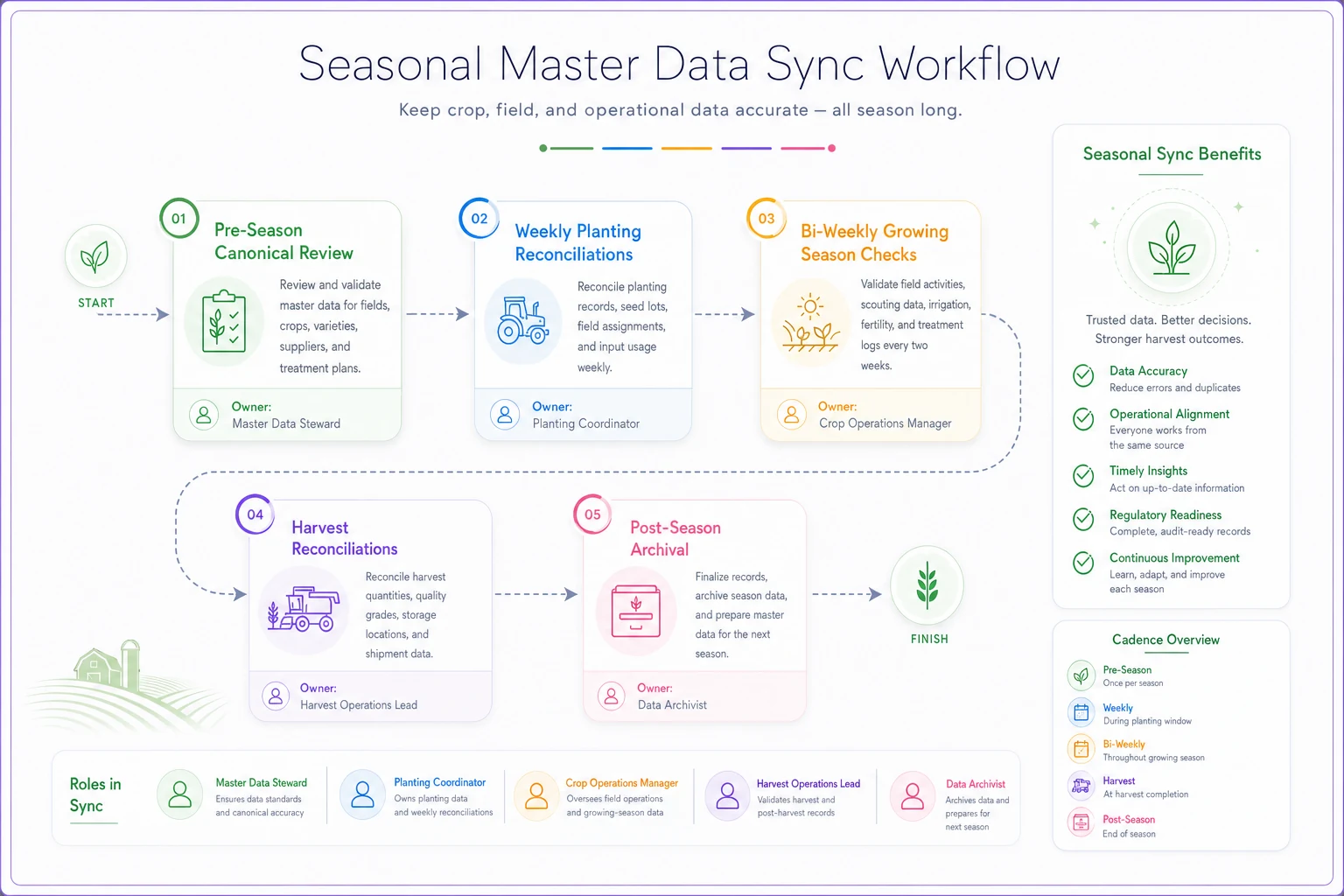
Pre-season (6–8 weeks before planting) Full canonical review. Confirm field list against signed rental agreements. Load the season's seed and input records with proper IDs before the first order goes out. Lock supplier list. This is the heaviest sync of the year.
-
Planting window Weekly orphan-and-variance reconciliation. New records will spawn fast here — as-planted data, field splits, substitute seed lots. Catch them while people still remember the context.
-
Growing season Bi-weekly light check. Mostly sensor and scouting data reconciliation. Verify device-to-field mappings after any probe moves.
-
Harvest Weekly again. Yield data is where field identity confusion does the most damage to your per-field economics. Reconcile as-harvested field IDs against canonical before the numbers get locked into settlements.
-
Post-season (within 30 days of last load) Retire merged/split fields properly, archive the season, and snapshot the canonical lists so next year has a clean parent to reference.
A simple workflow for the seasonal sync looks like this.
The ownership checklist that makes the cadence stick
-
[ ] One named person owns the canonical lists — not a committee, not "the office"
-
[ ] Every tool that creates field/seed/supplier records has an agreed convention documented
-
[ ] Reconciliation worklists go to a real person with authority to fix records
-
[ ] New IDs are only issued by the owner, never improvised in the field
-
[ ] Retired records are flagged, never deleted
-
[ ] Each season is snapshotted before the next one loads
Without an owner, the whole thing decays. The cadence gives you the when; the owner gives you the who. Miss either and you're back to detective work by next fall.
When this level of rigor makes sense — and when it doesn't
When it's worth it: You're running three or more software systems that need to agree, you farm across enough fields that manual memory can't hold every rename, or you're trying to do real per-field profitability and per-acre input analysis. The moment you have more than one person entering data into more than one system, canonical lists start paying for themselves.
When it's overkill: A single-operator farm running everything out of one notebook and one accounting file doesn't need a JSON sensor schema and reconciliation SQL. The overhead would exceed the benefit. Keep the principle — one name per thing — and skip the machinery until you actually have multiple tools disagreeing.
Who should not start here: If your fundamental issue is that crews aren't capturing data at all, master data won't save you — you're solving the wrong layer. Get consistent capture flowing first, then impose canonical structure on it. Structure on top of empty is just tidy emptiness.
A real scenario
A family grain operation running around 4,000 acres across owned and rented ground had four systems that never agreed. Per-field cost reports were built by hand each winter and took close to two weeks, mostly spent reconciling which field record meant what across the tools. Input spend analysis was worse — the same fertilizer supplier appeared under five vendor variants, so procurement couldn't see real annual volume to negotiate against.
They didn't buy new software. They built three canonical lists (fields, seed/inputs, suppliers), assigned the office manager as the single owner, and adopted a seasonal sync cadence with the orphan and duplicate-supplier queries running on a schedule. The pre-season load was painful the first year — several days of untangling — but by the following harvest the per-field report dropped from two weeks to a couple of days. On the procurement side, consolidating the supplier records revealed their true annual volume with that one dealer was well past what any single invoice suggested, which changed how they approached the next input contract. Not a dramatic revenue story — just a farm that finally trusted its own numbers.
The bigger point
Every advanced thing you want to do on a farm — precision input decisions, honest field economics, tighter procurement, eventually any kind of automation layered on top of your data — depends on whether your objects have stable, agreed-upon identities. Sensors, dashboards, and analytics are the visible layer. Canonical lists are the foundation nobody sees until it cracks.
The farms that get this right aren't the ones with the most tools. They're the ones where a field is one thing, a supplier is one thing, and a seed lot is one thing — no matter which screen you're looking at or which crew member you ask.
That consistency is quiet and unglamorous, and it's the difference between data you can act on and data you keep re-checking. Start with the three lists. Give them one owner. Run the reconciliation on a rhythm tied to your season. Everything else you want to build gets easier once the objects underneath it finally agree with each other.
Ready to revolutionize your farm management?
Join 500+ farms using Feldsly to boost yields, reduce waste, and streamline daily farm workflows.