
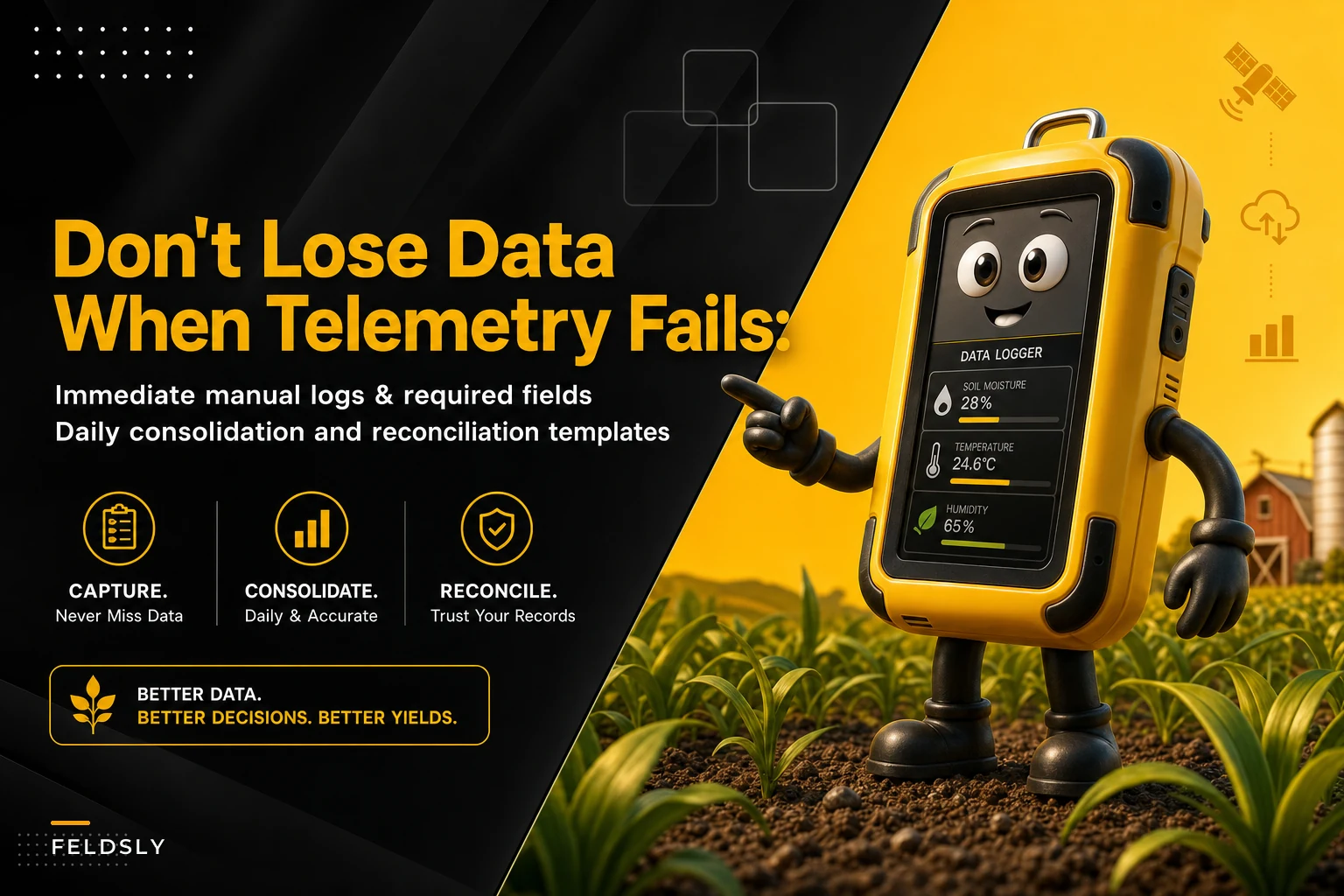

The gap nobody plans for isn't the sensor dying. It's the six or eight hours between when telemetry stops flowing and when someone notices. During that window, work keeps happening. Planters run, tanks empty, irrigation valves open and close, crews move between fields. And none of it gets recorded, because everyone assumes the system is quietly logging in the background like it always does.
When connectivity comes back, you've got a hole in your data. Not a small one. And the worst part is you often can't tell exactly how big the hole is or when it started.
This is about building a fallback that catches that data anyway — the immediate manual logs, the daily consolidation habit, the minimal fields crews actually fill out, and the reconciliation rules that stitch everything back together once the gateway reconnects.
Where the data actually goes missing
Farm telemetry outages rarely announce themselves. A soil moisture node stops reporting and you don't find out until you go looking for a reading. A cellular gateway on the far side of the property loses signal after a storm and just... sits there. The tractor telematics unit buffers locally for a while, then overwrites the oldest records when memory fills.
-
Storms and heavy weather — the same events that knock out power and cell towers are the ones where you desperately need to know what happened in the field
-
Peak season load — more equipment running means more units competing for the same weak signal at the edge of coverage
-
Firmware and battery cycles — nodes that go quiet after an update or a battery dip, and nobody catches it because the dashboard just shows the last good value
The failure mode that actually hurts isn't the total blackout. It's the partial one — where half your nodes report and half don't, so the dashboard looks mostly fine and nobody investigates. If you've dealt with unreliable hardware before, the maintenance and QA side of this is worth reading separately in our breakdown on deploying and maintaining a soil-moisture sensor network. This post assumes the sensors will sometimes fail anyway — and focuses on what your crew does in that moment.
The three tiers, and why you need all of them
A single fallback doesn't hold up, because outages come in different sizes. A dropped node for twenty minutes is not the same problem as a gateway down for a full workday. So the playbook is tiered — each tier kicks in based on how long the gap runs and how much work happened during it.
Take control of your farm’s productivity.
Feldsly helps you plan, track, and optimize every farming operation with precision.
- Centralized crop scheduling
- Resource & labor management
- Real-time weather alerts
No credit card required
| Tier | Trigger | Who acts | Capture method | Reconcile when |
|---|---|---|---|---|
| Tier 1 — Immediate | Any known gap during active work | Crew on site | Phone note / paper card, minimal fields | Same day |
| Tier 2 — Daily consolidation | End of shift, regardless of outages | Field lead | Consolidation sheet, one row per operation | Next morning |
| Tier 3 — Automated reconciliation | Connectivity returns | System + reviewer | Match buffered data to manual logs, flag conflicts | Within 24–48 hrs |
The mistake most operations make is jumping straight to Tier 3 — assuming the system will "catch up" once the connection comes back. It catches up on whatever the equipment buffered locally. It does not catch up on the manual applications, the field observations, the "we skipped row 40 because it was too wet" decisions that only exist in someone's head. Those need Tier 1 and Tier 2 or they're gone.
Tier 1: immediate manual logs
The whole point of Tier 1 is speed and low friction. If capturing a fallback log takes more than thirty seconds, crews won't do it under pressure, and you'll be back to holes in the data.
Keep the required fields brutally short.
Minimal required fields for an immediate log:
-
Timestamp (approximate is fine — "~2
40pm")
-
Field / block ID
-
Operation (planting, spraying, irrigation on/off, observation)
-
One value that matters for that operation (acres done, tank level, valve state, moisture guess, whatever the crew can actually see)
That's it. Everything else is nice-to-have and can be reconstructed later from context. Notice what's not required: exact GPS, precise volumes, machine settings. If the crew happens to know those, there's a free-text line. But never make the free-text line mandatory — the moment you do, capture rate drops.
A useful pattern is a laminated card in each cab and a shared phone note per crew. Paper survives dead batteries and dead signal. The phone note syncs later. Redundancy is the point — during an outage you don't get to be picky about which channel works.
Tier 2: the daily consolidation routine
Tier 1 catches raw fragments. Tier 2 turns them into something usable before memory fades. This is the step operations skip most often, and it's the one that matters most — a scattered pile of half-legible cab notes is nearly worthless a week later.
The consolidation routine is a fixed end-of-day habit. Same time, same person, same sheet. Fifteen minutes, tops. The field lead walks through every operation that ran that day and confirms one of two things: either telemetry captured it cleanly, or there's a manual entry that fills the gap.
Daily consolidation process:
-
Pull the day's operations list (what should have run — planned tasks, irrigation windows, spray jobs)
-
Check each against what telemetry actually recorded
-
For anything missing or flagged, grab the matching Tier 1 log
-
Fill the consolidation sheet — one row per operation, gap or no gap
-
Mark each row
clean, manual-filled, or still-missing
-
Flag every "still-missing" for follow-up before it goes cold
That "still-missing" flag is the quiet hero here. It's an admission that you don't have the data yet — which is far more valuable than pretending the record is complete. A known gap gets chased. An unknown gap becomes a wrong number in your yield analysis six months later.
The consolidation sheet doesn't need to be fancy. One row per operation, columns for field, operation, source (telemetry vs manual), status, and a note. What matters is that it exists every single day, outage or not. Teams that only build the sheet after an outage never build it well.
Tier 3: automated reconciliation when connectivity returns
When the gateway reconnects and buffered data floods back in, you now have two overlapping records for the outage window: whatever the equipment stored locally, and whatever the crew logged manually. Reconciliation is deciding which to trust and where they conflict.
You don't want a human eyeballing thousands of buffered records against handwritten cards. That's exactly where a workflow platform with automated reconciliation rules earns its keep — not by replacing judgment, but by doing the tedious matching and surfacing only the conflicts that need a real decision.
Sensible reconciliation rules look like this:
-
Buffered telemetry wins on precise values (exact acreage, GPS tracks, machine-recorded rates) — the machine measured it, the crew estimated it
-
Manual logs win on decisions and observations (skipped areas, weather calls, why something stopped) — the sensor never saw those
-
Timestamps get aligned to a tolerance window, so a "~2
40pm" manual note matches a 2:37pm buffered record instead of creating a phantom second event
-
Conflicts over a threshold get flagged, not auto-merged — if the crew logged 40 acres and telemetry says 52, a human decides, because that gap usually means something real (a re-run, a wrong field ID, a partial pass)
The dangerous shortcut is auto-merging everything and moving on. That buries the exact discrepancies that reveal real problems — a misreported field, a double-counted pass, a spray job logged twice. Reconciliation should make conflicts louder, not quieter.
A quick workflow visualization:
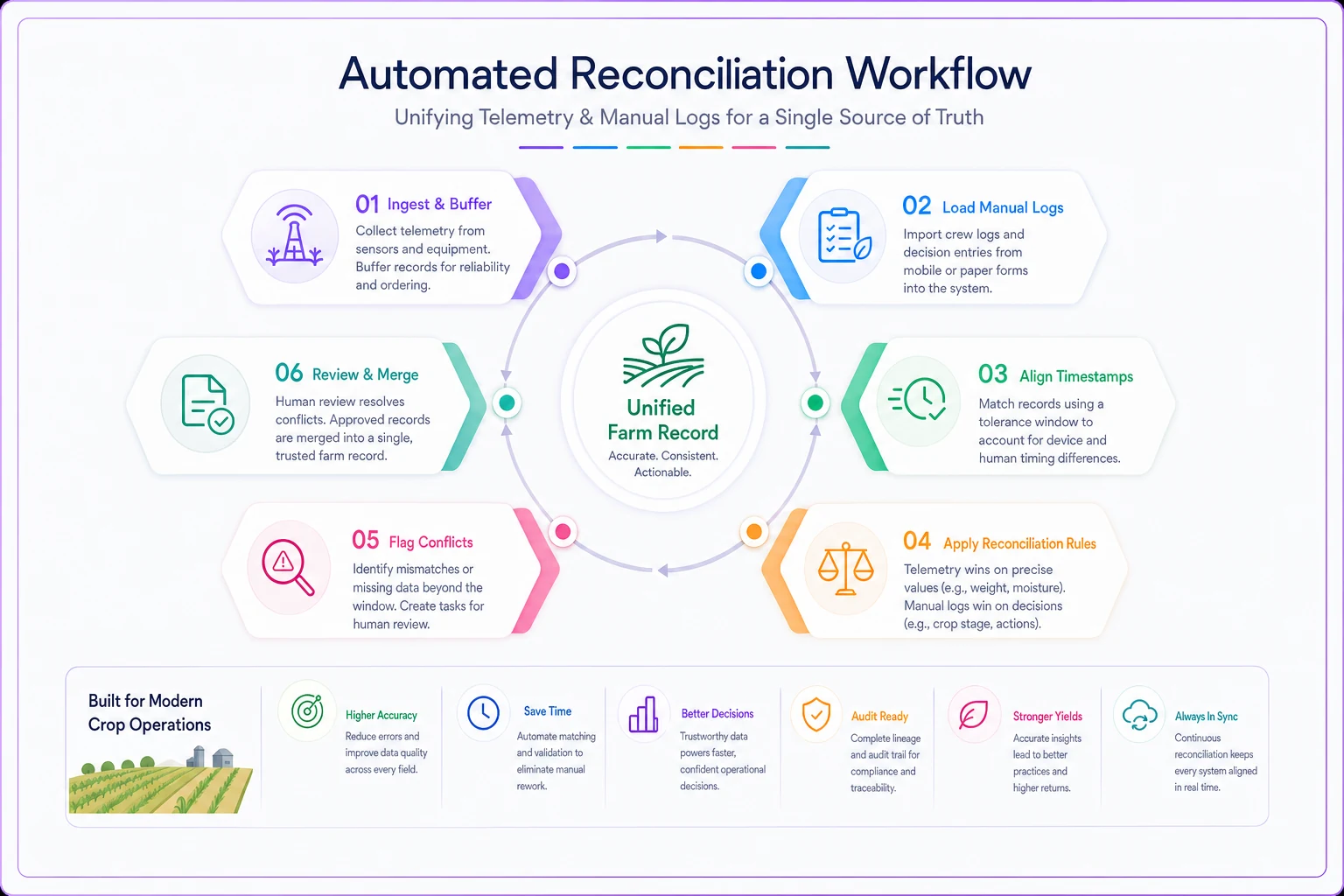
When conflicts surface, have a reviewer triage them within the 24–48 hr window so downstream analysis isn't working from guesswork.
A real scenario
A mid-size row-crop operation running around 3,000 acres kept losing telemetry from three sensor nodes and one tractor unit every time a storm rolled through the northwest quarter — dead zone at the edge of coverage. Before the fallback, those outages meant guesswork. One planting season they realized roughly 200 acres of activity during a two-day connectivity drop had no reliable record at all. They'd been reconstructing it from fuel logs and memory.
After putting the tiered playbook in place — cab cards for Tier 1, a fifteen-minute end-of-shift consolidation for Tier 2, and reconciliation rules that flagged conflicts instead of silently merging — the next major outage was almost a non-event. The gateway went down for most of a day. Crews logged as they worked. That evening's consolidation caught every operation. When the connection returned two days later, reconciliation matched the buffered tractor data to the manual logs and surfaced only a handful of genuine conflicts, all resolved in under an hour.
The number that mattered to them wasn't dramatic. Their season-end acreage-treated records reconciled to within a percent or two, instead of the rough estimates they'd lived with before. That accuracy fed directly into input reconciliation and yield analysis — the downstream work that's only as good as the raw capture underneath it.
When this playbook makes sense — and when it's overkill
When it's worth building:
-
You've got sensor networks or telematics feeding decisions you can't easily reconstruct after the fact
-
Your fields include coverage dead zones or you're in a region with frequent weather-driven outages
-
Multiple crews run operations that need to reconcile into one clean record for compliance, input tracking, or yield analysis
When it's overkill:
-
A small single-field operation where the owner is on every piece of equipment and remembers everything anyway
-
Cases where telemetry is a convenience, not a record of truth, and a missing hour genuinely doesn't affect any decision
If your crew is three people and one of them is you, don't build a three-tier reconciliation system with formal flags and thresholds. A shared phone note and a five-minute end-of-day check does the same job. The tiering matters when you have enough crews and enough acreage that no single person can hold the day in their head.
Building the habit before you need it
The single biggest predictor of whether this works isn't the templates. It's whether the daily consolidation routine already exists before an outage hits. Teams that treat it as a normal end-of-shift step — running it on clean days when there's nothing to reconcile — have the muscle memory ready when the gateway drops. Teams that try to spin it up mid-outage produce a mess.
Same logic applies to what you do with the data once it's clean. A reconciled record is only worth the effort if it flows into your actual decisions — which is the whole argument behind not letting good data sit unused in your operational planning. Capture is step one. The point was never the log itself.
Telemetry will fail. That's not pessimism, it's just what happens with hardware, batteries, storms, and cell coverage at the edge of a property. The operations that don't lose data aren't the ones with better sensors. They're the ones that assumed the sensors would fail and built a quiet, low-friction way to keep recording anyway — then made stitching it back together a routine instead of a scramble.
Ready to revolutionize your farm management?
Join 500+ farms using Feldsly to boost yields, reduce waste, and streamline daily farm workflows.