

The combine goes down at 2:40 in the afternoon on the third day of your soybean window. Weather says rain Friday night into Saturday. You've got maybe 90 acres left that need to come off before that moisture rolls in, and your header just started throwing chunks of chain across the field.
What happens in the next 20 minutes decides whether you lose a few hours or a few days. Most farms handle that first 20 minutes badly — not because the people are bad, but because there's no agreed sequence. Everyone's freelancing. The operator's on the phone with a buddy. Somebody's already driving to the dealer for a part nobody's confirmed is in stock. Meanwhile the second combine keeps running like nothing happened, when it probably should've been repositioned an hour ago.
This is a playbook for exactly that moment. Not maintenance planning — that's a different problem. This is the failure already happened, the clock is running, and you need a decision structure instead of a panic.
The real cost isn't the repair — it's the indecision window
A busted feederhouse chain might be a $600 part and two hours of labor. Annoying, not catastrophic. The catastrophe is the four hours before anyone commits to a plan.
The pattern during critical windows is almost always the same: a breakdown triggers a bunch of parallel guessing. The operator calls one dealer. The farm manager texts a neighbor about borrowing equipment. Somebody starts looking up rental yards. Nobody's coordinating, so you end up with three half-started plans and none of them finished. By the time everyone syncs back up, you've burned the most valuable daylight of the season.
A typical example looks like this. Corn coming off at around 24% moisture, dryer keeping up, two combines running. One goes down mid-morning. If the failure is triaged and a decision locked within 30 minutes, you lose maybe 6–8 acres of throughput and shuffle crews. If it drifts into a two-hour scramble, you're looking at the back half of the day gone on one machine, plus ripple into tomorrow's schedule. On a wet-window crop, that delay can push grain into a lower grade — the exact downgrade problem that shift discipline is supposed to prevent, which we broke down in the harvest shift templates and assignment maps post.
The repair is cheap. The indecision is what costs you.
The 20‑minute triage: what to decide before you touch a wrench
The single biggest fix is having a first-response sequence that's actually practiced, not just written on a laminated card in the shop that nobody reads. Below is the triage flow. It's deliberately short because during a breakdown nobody reads long documents.
Take control of your farm’s productivity.
Feldsly helps you plan, track, and optimize every farming operation with precision.
- Centralized crop scheduling
- Resource & labor management
- Real-time weather alerts
No credit card required
The first-response sequence:
-
Stop the machine safely and call it in. One person — usually the operator — reports the failure to a single point of contact (farm manager or whoever's running the day). Not to three people. One. This kills the parallel-guessing problem immediately.
-
Classify the failure in under 5 minutes. Is this a field fix, a shop fix, or a dead machine? You don't need a perfect diagnosis. You need a category.
-
Estimate the down-time honestly. Under 2 hours? 2–6 hours? Or "not today"? Round up, not down. Optimism here is expensive.
-
The point of contact makes ONE decision and announces it. Repair in place, reassign crews, or pull the rental trigger. Everyone hears the same plan at the same time.
-
Assign tasks out loud, by name. Who's fetching the part. Who's repositioning the second machine. Who's calling the buyer. If it's not assigned to a name, it doesn't happen.
That's it. Five steps, and steps 1 through 3 should take less time than it takes to walk back to the truck.
The insight most farms miss: the classification matters more than the diagnosis. You don't need to know exactly why the hydrostatic drive failed. You need to know whether you're waiting 90 minutes or the machine is done for the day — because those two answers trigger completely different responses.
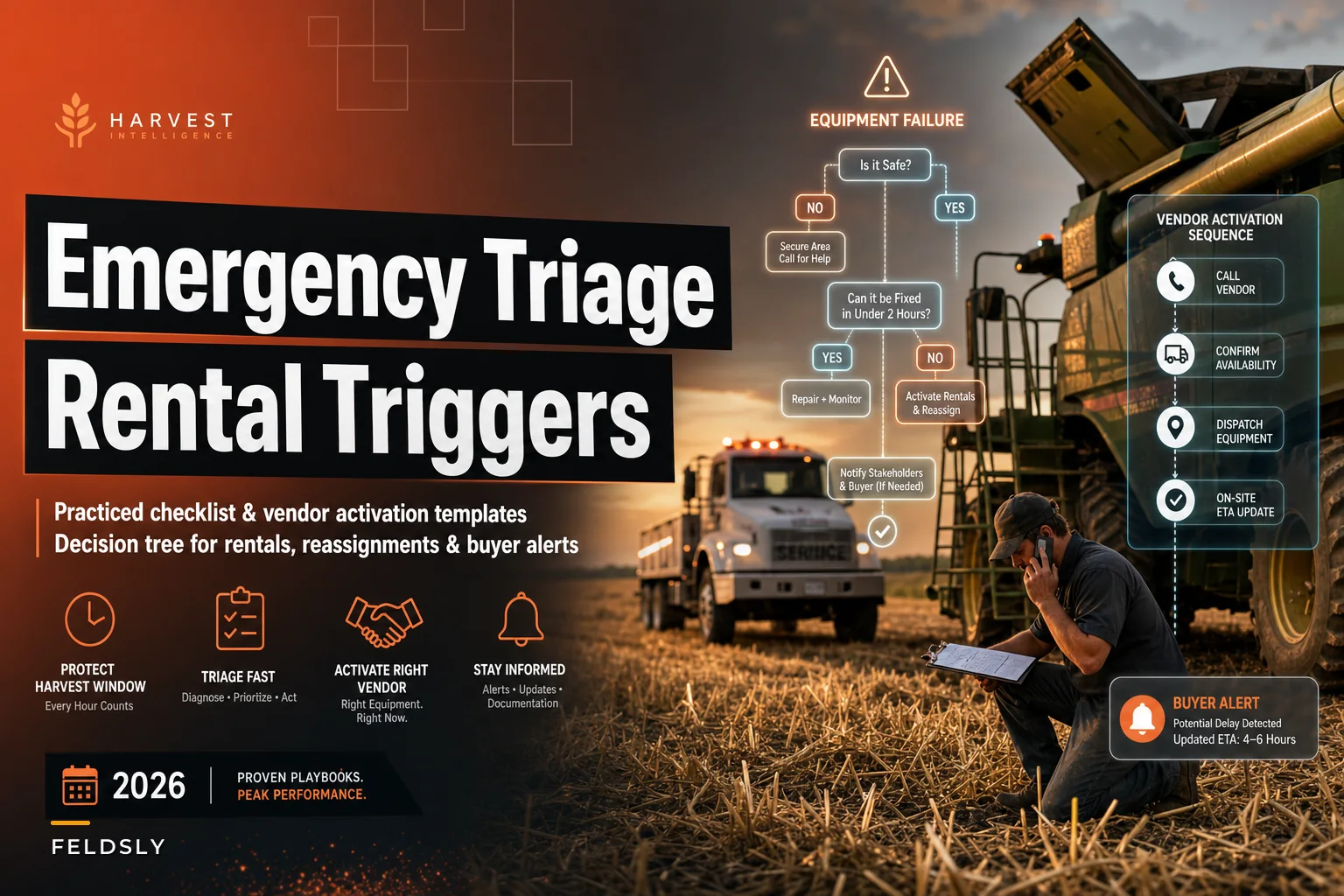
The decision tree: repair, reassign, or rent
Once you've classified the failure, the tree is simple. The trick is deciding the branches ahead of time so you're not litigating them in the moment.
| Down-time estimate | Acres left in window | Weather pressure | Action |
|---|---|---|---|
| Under 2 hrs | Any | Low | Repair in place, keep other machine on plan |
| Under 2 hrs | Any | Rain in 24–48 hrs | Repair + reposition second machine to highest-risk field |
| 2–6 hrs | Manageable with one machine | Low | Repair, single-machine mode, extend the day |
| 2–6 hrs | Too much for one machine | Rain in 24–48 hrs | Pull rental trigger now, repair in parallel |
| Not today | Any | Any pressure | Rental trigger + neighbor equipment + buyer comms |
The mistake that keeps coming up: farms wait to see if the repair works before calling the rental yard. That's backwards during a tight window. If your down-time estimate hits the rental threshold, you call the rental yard first, then work the repair in parallel. If the repair comes together fast, you cancel the rental — most yards won't charge you for a same-day cancellation before pickup. But if you wait and the repair stalls, the rental unit is already spoken for by three other farms who called an hour ahead of you.
Reserve early, cancel free. That asymmetry should drive the whole decision.
Rental triggers: define the threshold before the season, not during the breakdown
A "rental trigger" is a pre-agreed line that, once crossed, means somebody's already dialing the rental yard — no debate, no waiting for the owner to weigh in.
The reason to set these before planting or harvest starts is simple: your judgment during a breakdown is bad. Everybody's is. Adrenaline makes you either over-optimistic ("we'll have it running in an hour") or over-panicked ("season's ruined"). A pre-set threshold takes the emotion out.
-
Any single-machine down-time over ~4 hours during a window with rain forecast inside 48 hours → rental trigger.
-
Both primary machines compromised at once, any window → rental trigger plus neighbor outreach.
-
A dead machine (no field or shop fix same day) with more than roughly a third of the window's acres still standing → rental trigger.
You'll tune these to your own acreage and dryer capacity. The number matters less than the fact that it exists and everyone knows it. During a breakdown, "we hit the trigger" is a much cleaner conversation than "should we rent one."
One more practical note: keep a live short-list of rental sources with current phone numbers, and confirm those numbers before the season. Rental yards, custom harvesters, equipment-sharing neighbors — three tiers. Farms have lost an hour just finding out the number they had for the rental yard was two managers out of date.
Vendor and subcontractor activation: the calls that need to happen in order
When you pull the trigger, the order of calls matters. Do them in sequence, not scattered.
Activation order:
-
Rental yard or custom harvester — the thing that actually replaces the lost capacity. This is first because it's the longest lead time and the most competitive for others to grab.
-
Parts/dealer — for the parallel repair track, even if you're renting. You still want the machine back.
-
Neighbor / equipment-sharing contact — as a bridge if the rental can't be there fast enough. Sometimes a neighbor's spare machine covers the gap between now and when the rental arrives at 6pm.
-
Your buyer / elevator — because if this changes delivery timing or volume, they need to know before it's a surprise.
> "Hi, this is [name] at [farm]. We've got a [machine] down mid-harvest and need [rental unit / part / custom cutting for ~X acres]. Can you have it available [today / by tomorrow AM]? What's your rate and can I reserve it now with a free cancel if our repair comes together?"
That last clause — reserve now, cancel if the repair works — is the whole game. Say it every time.
For the neighbor call, keep it even simpler and specific: "Can you cover about 40 acres of beans off [field] tomorrow morning if we're not back up? I'll return the favor / pay your custom rate." Vague asks get vague answers. Specific acreage and timing get a yes or a no.
Buyer and elevator communication: don't let the surprise travel downstream
The failure that started in your field has a way of becoming the elevator's problem, the trucker's problem, and eventually a contract problem — if nobody says anything.
> "Heads up — we had an equipment issue and our delivery on [contract/date] may run [X hours / a day] behind. We're bringing in a rental to catch up. Wanted you in the loop early in case it affects your intake schedule. Will confirm by [time]."
It doesn't grovel and it doesn't overpromise. It states the situation, states the fix, and gives a next-check time. That's all a buyer actually wants.
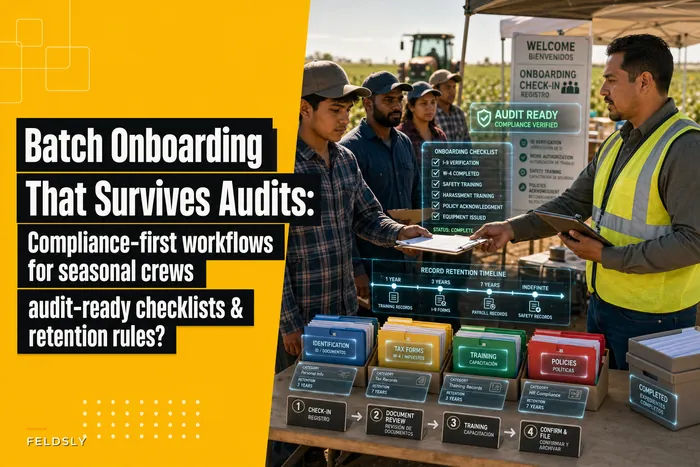
For farms running seasonal or migrant crews during these windows, this same discipline — tell people early, in writing — is exactly what keeps reassignments clean under pressure. The same principle applies to the documentation approach in the compliance-first onboarding workflows piece. When a breakdown forces you to move people between fields and tasks, having that communicated and logged saves you from the "nobody told me" chaos an hour later.
A real scenario: the header failure that stayed a small problem
A roughly 2,200-acre corn-and-bean operation in the eastern Corn Belt. Two combines, one dryer, family plus three seasonal operators during harvest. Rain in the forecast two days out, about 120 acres of beans still standing.
One combine's header drive fails around 11am. In the old way of doing things — the way most farms actually operate — this would've been a two-hour scramble of scattered phone calls and realistically half a day lost on that machine, plus a delay that risked pushing beans into the wet forecast.
Instead they ran the triage. Classified it in about four minutes: shop fix, likely 3–5 hours to source and swap the drive. That crossed their pre-set rental trigger. The manager made one call: rental yard, reserved a combine with a free same-day cancel. Second call: dealer for the part. Third: repositioned the good combine to the field most at risk from the coming rain. The operator whose machine was down got reassigned to run grain carts.
The repair actually came together in about three and a half hours. They cancelled the rental at no cost around 2pm. Net result: they lost roughly 3–4 hours of one machine's capacity instead of a full day, and everything came off ahead of the rain. No downgrade, no missed delivery.
The part cost them a few hundred dollars. The playbook saved them what a delayed, rained-on 120 acres of beans would've cost — several thousand in grade and shrink, easily. Same breakdown, completely different outcome, purely because of the first 20 minutes.
When this playbook matters most — and when it's overkill
When it makes sense: Any operation running tight moisture-sensitive windows, multiple fields, or hard delivery contracts. The more the calendar is squeezing you, the more the triage discipline pays off. If a single day of delay changes your grade or breaks a contract, you need this.
When it's lower priority: Small operations with a single field, generous windows, and no dryer or contract pressure. If losing a day genuinely costs you almost nothing, a rental-trigger system is more structure than you need. Just keep good vendor numbers handy.
Who should NOT over-engineer this: Farms that would spend more time maintaining decision trees than they'd ever save. The point is a short practiced sequence, not a binder. If your playbook is longer than one page, nobody will use it when the combine's actually down. Elaborate procedures get ignored completely during real breakdowns.
Where a shared operational system quietly helps
None of this requires software. A laminated card and a practiced crew will beat a fancy app that nobody opens. But there's one place where an AI-assisted operational platform earns its keep during a breakdown: keeping everyone on the same current information without a round of phone tag.
When the failure gets logged in a shared workflow system — the classification, the down-time estimate, the decision, the reassignments — everyone sees the same plan instantly instead of hearing three different versions. Vendor and rental contacts stay current in one place instead of scattered across people's phones. Buyer notifications go out from a saved template so the heads-up actually happens instead of getting forgotten in the chaos. Automated reminders can nudge someone to confirm or cancel the rental before that "free cancel" window quietly expires because nobody called back.
Here's a simple workflow diagram of that shared system during a breakdown.
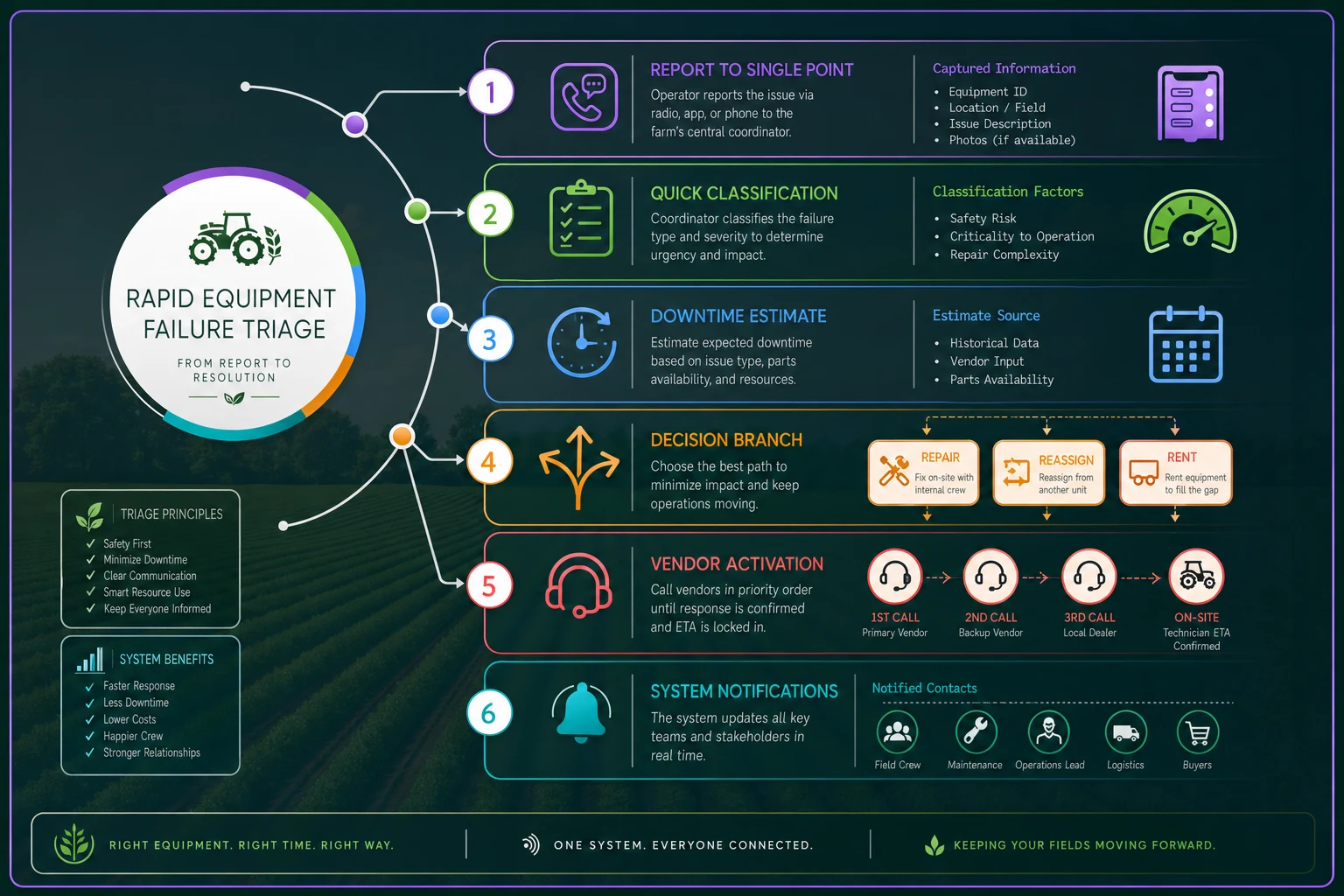
That's the honest role of the tooling here. It reduces the coordination misfires that turn a small mechanical problem into a lost day. It doesn't replace the judgment or the decision tree — it just makes sure the decision, once made, actually reaches everyone and nothing falls through the cracks while five people are running in different directions.
The takeaway
Equipment fails. It always has, and during your most valuable windows it seems to fail more, because that's when everything's running hardest. Planned maintenance reduces it, but it never hits zero.
What you can control is the response. The farms that handle a peak-season breakdown well aren't the ones with the newest machines — they're the ones who decided ahead of time what "down for four hours" triggers, who calls whom in what order, and who's authorized to pull the rental trigger without waiting for a meeting. Get that sequence practiced before the season starts, and the next time a header lets go at 2:40 on a Thursday with rain coming, you'll lose a few hours instead of a few days.
Ready to revolutionize your farm management?
Join 500+ farms using Feldsly to boost yields, reduce waste, and streamline daily farm workflows.