



The worst bottleneck on a lot of grain operations isn't the combine, the trucks, or even the dryer throughput. It's the thirty-minute window when four loads show up at the yard, two of them wet, one of them already contracted for a buyer delivery that afternoon, and nobody has a clean rule for which one goes through the dryer first.
So the yard guy makes a call based on whatever's loudest — the driver who's complaining, or the wagon parked closest. That's how a 24% load sits while a 19% load gets dried first, and that's how you miss a contract window on corn you could've shipped two hours earlier.
This post is a single scoring matrix that combines the four things that should actually drive the decision: penalty risk, the buyer delivery window, your drying capacity, and routing/sequence rules. It's built to be filled out on paper or a whiteboard during a spike, and I'll run real numbers through it so you can copy the math.
Why the "dry the wettest load first" instinct is wrong more than half the time
The gut rule most crews fall back on is simple: dry the wettest grain first because it's at the most risk. That's true for spoilage, but spoilage isn't the only clock running, and it's usually not the fastest one.
A load at 24% moisture is genuinely at risk of heating if it sits for a day — but you're not deciding what sits for a day. You're deciding what goes through the dryer in the next hour. In that hour, the real question is which decision costs you the most money if you get it wrong.
-
The spoilage clock — wet grain degrades if it sits too long in a wagon or wet bin.
-
The contract clock — a buyer window closes at a specific time, and missing it means rejection, rescheduling, or a price haircut.
-
The throughput clock — every load you run inefficiently through the dryer backs up everything behind it.
The instinct to chase moisture only looks at clock one. A good prioritization rule weighs all three at once, which is exactly what a scoring matrix is for. If you've already built out crew assignments for these windows, this pairs naturally with the kind of shift and assignment structure covered in the moisture-sensitive harvest shift templates post — the matrix tells you what to run, the assignment map tells you who.
The four inputs, and how to score each one
The matrix scores every load waiting at the yard on four factors, each on a 1–5 scale. Higher total score runs sooner.
Take control of your farm’s productivity.
Feldsly helps you plan, track, and optimize every farming operation with precision.
- Centralized crop scheduling
- Resource & labor management
- Real-time weather alerts
No credit card required
1. Penalty / downgrade risk (weight: ×3)
This is the dollar exposure if the load doesn't get handled right. It combines moisture-related spoilage risk and grade/quality risk. Score it like this:
| Score | Condition |
|---|---|
| 1 | Dry enough to bin as-is, no quality concern |
| 2 | Slightly above target, low heat risk, several hours of slack |
| 3 | Clearly wet, would heat within ~24h, or borderline grade |
| 4 | High moisture + already warm, or a grade that's one notch from a dock |
| 5 | Active heating risk, or quality that drops a full grade if it sits |
Weight is ×3 because this is where real money leaks. A single downgraded load of corn can cost you more than a half-day of dryer inefficiency.
2. Buyer window urgency (weight: ×3)
How close is this load to a committed delivery or a closing contract window?
| Score | Condition |
|---|---|
| 1 | No committed buyer, going to on-farm storage |
| 2 | Buyer window open, delivery 3+ days out |
| 3 | Delivery due within 48h |
| 4 | Delivery due today, flexible on hour |
| 5 | Hard cutoff today, elevator closes or truck leaves at a set time |
Also weighted ×3. Missing a hard buyer cutoff is often the single most expensive mistake in the yard, and it's the one the "dry the wettest first" rule completely ignores.
3. Drying effort / capacity cost (weight: ×2, inverted)
This one's inverted — a higher drying burden gives a lower priority push, because loads that hog the dryer slow everything behind them. You want to account for how many points of moisture you're pulling and how that ties up capacity.
| Score | Condition |
|---|---|
| 5 | Minimal drying needed (1–2 points), fast pass |
| 4 | Moderate (3–4 points) |
| 3 | Standard (5–6 points) |
| 2 | Heavy (7–9 points), long dwell time |
| 1 | Very heavy (10+ points), ties up dryer a long time |
Weight ×2. If two loads are close on penalty and buyer urgency, run the one that clears the dryer faster so the queue keeps moving.
4. Routing / sequence fit (weight: ×1)
Is this load physically and logistically easy to run next? Right bin available, right dryer settings already dialed in, truck positioned?
| Score | Condition |
|---|---|
| 5 | Everything staged, same crop/settings as current run |
| 3 | Minor repositioning or setting change |
| 1 | Requires moving equipment, swapping settings, or waiting on a bin |
Weight ×1 — it's a tiebreaker, not a driver. The same routing logic that governs refill sequencing in the field applies here; if you want the deeper version of that thinking, the planter refill routing plan breaks down the heuristics for load-cycle sequencing in a way that translates directly to yard staging.
The formula
For each load:
Priority Score = (Penalty × 3) + (Buyer × 3) + (Drying × 2) + (Routing × 1)
Max possible: (5×3) + (5×3) + (5×2) + (5×1) = 50. Highest score runs first. Re-score every time a new load arrives or a window changes.
Worked example: four loads, one dryer, same afternoon
Say it's mid-October, corn harvest, and four loads hit the yard within forty minutes. One dryer. The trucks for your afternoon contract leave at 3:00 PM sharp.
Load A — 23.5% moisture, no buyer committed, going to on-farm storage. Slightly warm.
Load B — 18.5% moisture, contracted, truck leaves at 3:00 PM hard cutoff. Needs maybe 3 points pulled.
Load C — 20% moisture, delivery due tomorrow, standard dry.
Load D — 16% moisture, dry enough to bin, no buyer pressure.
| Load | Penalty (×3) | Buyer (×3) | Drying (×2) | Routing (×1) | **Total** |
|---|---|---|---|---|---|
| A | 4 → 12 | 1 → 3 | 2 → 4 | 3 → 3 | 22 |
| B | 2 → 6 | 5 → 15 | 4 → 8 | 5 → 5 | 34 |
| C | 3 → 9 | 3 → 9 | 3 → 6 | 3 → 3 | 27 |
| D | 1 → 3 | 1 → 3 | 5 → 10 | 5 → 5 | 21 |
Run order: B → C → A → D.
Notice what happened. Load A is the wettest and slightly warm — the gut call runs it first. The matrix runs it third. Load B is only moderately wet but has a hard 3:00 cutoff and clears the dryer fast at just 3 points to pull. Running B first protects the contract and keeps the queue moving. Load A is at risk, sure, but "risk of heating over the next day" is a slower clock than "truck leaves in two hours." A can wait an hour and still get handled well before it becomes a real spoilage problem.
That's the whole point — it stops the loudest or wettest load from hijacking a decision that should be driven by which mistake costs the most.
When a wet load *should* jump the queue anyway
The matrix isn't a dictator. One override worth building in: if a load's penalty score hits a true 5 — active heating, grain you can smell going off — it jumps to the front regardless of total. Spoilage that's already in motion isn't a priority tradeoff anymore; it's damage control.
Set that as a hard rule so crews don't have to argue it at 9 PM. Penalty = 5 runs next, full stop. Everything else uses the total.
The fillable version crews can actually use during a spike
You don't want crews doing weighted math in their heads when wagons are stacking up. Pre-build the sheet so they only fill in raw 1–5 scores and the weights are already printed.
-
Columns Load ID | Moisture % | Penalty (1–5) | Buyer (1–5) | Drying (1–5) | Routing (1–5) | Total | Run Order
-
Pre-printed weight reminders under each header (×3, ×3, ×2, ×1)
-
A small scoring key for each factor taped beside it, so a new crew member scores it the same way as your yard veteran
-
An override box "Penalty = 5? → Run NEXT"
Walk it like this during a spike:
-
New load arrives → write it in, assign four raw scores using the key
-
Multiply mentally or use the printed weights, write the total
-
Re-rank the open loads, update Run Order
-
When a load clears the dryer, cross it off and re-check whether any buyer window changed the picture
Keep it honest: a quick checklist before you trust the order
-
- [ ] Did you re-score when the last new load came in, or are you running a stale ranking?
-
- [ ] Has any buyer window moved up since you last scored? (A truck arriving early changes everything.)
-
- [ ] Is anyone sitting on a Penalty = 5 load that should've jumped the queue?
-
- [ ] Are drying scores reflecting actual points to pull, not just raw moisture?
-
- [ ] Did the current dryer settings match the next load, or did routing just drop?
Laminate the sheet and tape the scoring keys where the yard lead can see them.
Here's a simple visual of the flow crews follow when a spike hits:
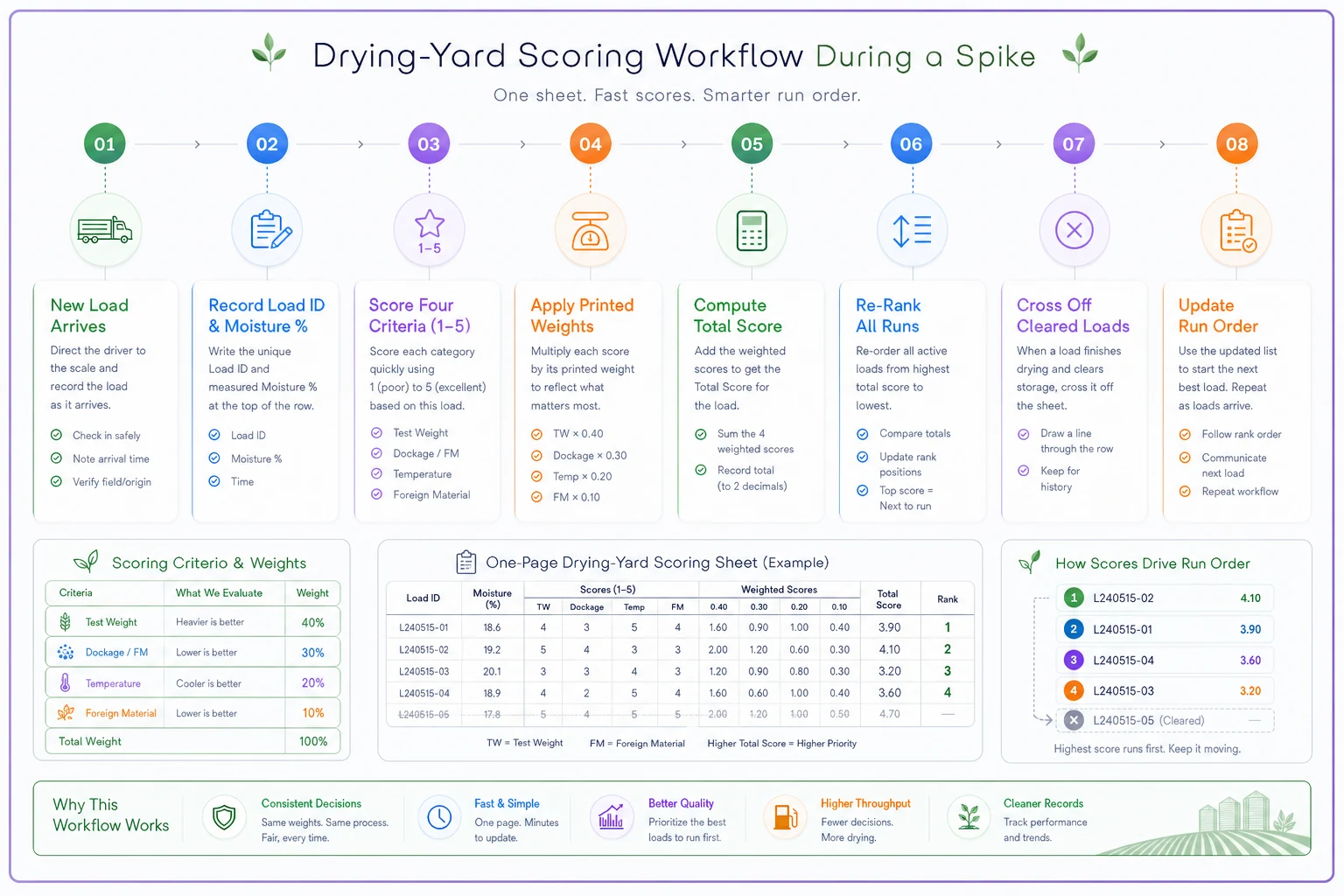
The sheet is only as good as the last time someone re-ranked it.
A quick real scenario
A family corn-soy operation running around 2,400 acres kept losing the tail end of afternoon contract deliveries during peak week. Their yard default was wettest-first, every time. On a heavy day they'd dump a 24% load that tied the dryer up for the better part of an hour, and the 18% contract corn that needed a quick pass would just sit — and twice that season the elevator cutoff closed before the truck got loaded.
Cost of those two missed windows: rescheduled hauling, a price adjustment on one load, and a chunk of a day's logistics eaten. Somewhere in the $1,800–$2,400 range across the two misses, not counting the aggravation.
The fix wasn't new equipment. They printed the scoring sheet, taped the keys next to the dryer, and made the yard lead re-rank every time a load came in. Same dryer, same crew. Over the back half of harvest they didn't miss another contract cutoff. The wet loads still got handled — they just stopped jumping ahead of time-sensitive grain that cleared the dryer in a fraction of the time.
When this matrix is overkill
If your dryer capacity outruns your harvest pace and loads never really queue, you don't need this. The matrix earns its keep specifically in the spike window — when demand on the dryer exceeds throughput for a few hours and you're forced to sequence.
It's also not the tool for single-buyer operations with one storage destination and no hard delivery cutoffs. If everything goes to the same bin on the same timeline, moisture-first is fine and the four-factor weighting is just extra paperwork.
Where it pays off is the mixed-moisture, multiple-buyer, capacity-constrained yard — which is exactly the situation most mid-size grain operations hit for three or four of the hottest harvest days every year. Those are the days that make or break the downgrade line, and a one-page scoring sheet is a cheap way to stop making the expensive call by feel.
Build it before you need it
The mistake is waiting until the spike to figure out your rule. By then the loads are stacked, somebody's shouting, and whatever gets dried first is just whatever was easiest to reach.
Score the four factors now, agree on the weights with the people who actually run the yard, laminate the sheet, and tape the scoring keys where the yard lead can see them.
The matrix doesn't need software or a perfect forecast.
It needs a shared rule everyone trusts, re-checked every time the yard changes — so the most expensive mistake of the day gets priority, not the loudest wagon.
Ready to revolutionize your farm management?
Join 500+ farms using Feldsly to boost yields, reduce waste, and streamline daily farm workflows.