

The gap between farms that walk away clean from a drift complaint and farms that get buried isn't luck. It's the first 120 minutes.
When a neighbor calls saying their organic beans are curling, or an applicator downwind reports a burn line along a fence row, most crews freeze. They call the boss, maybe snap a couple blurry phone pictures, and wait. By the time anyone thinks about documentation, the wind has shifted, the plants have recovered enough to hide the worst of it, and the timestamp on the only useful photo says 6 p.m. — three hours after the event. Now it's your word against theirs, and the state ag department inspector shows up with a clipboard.
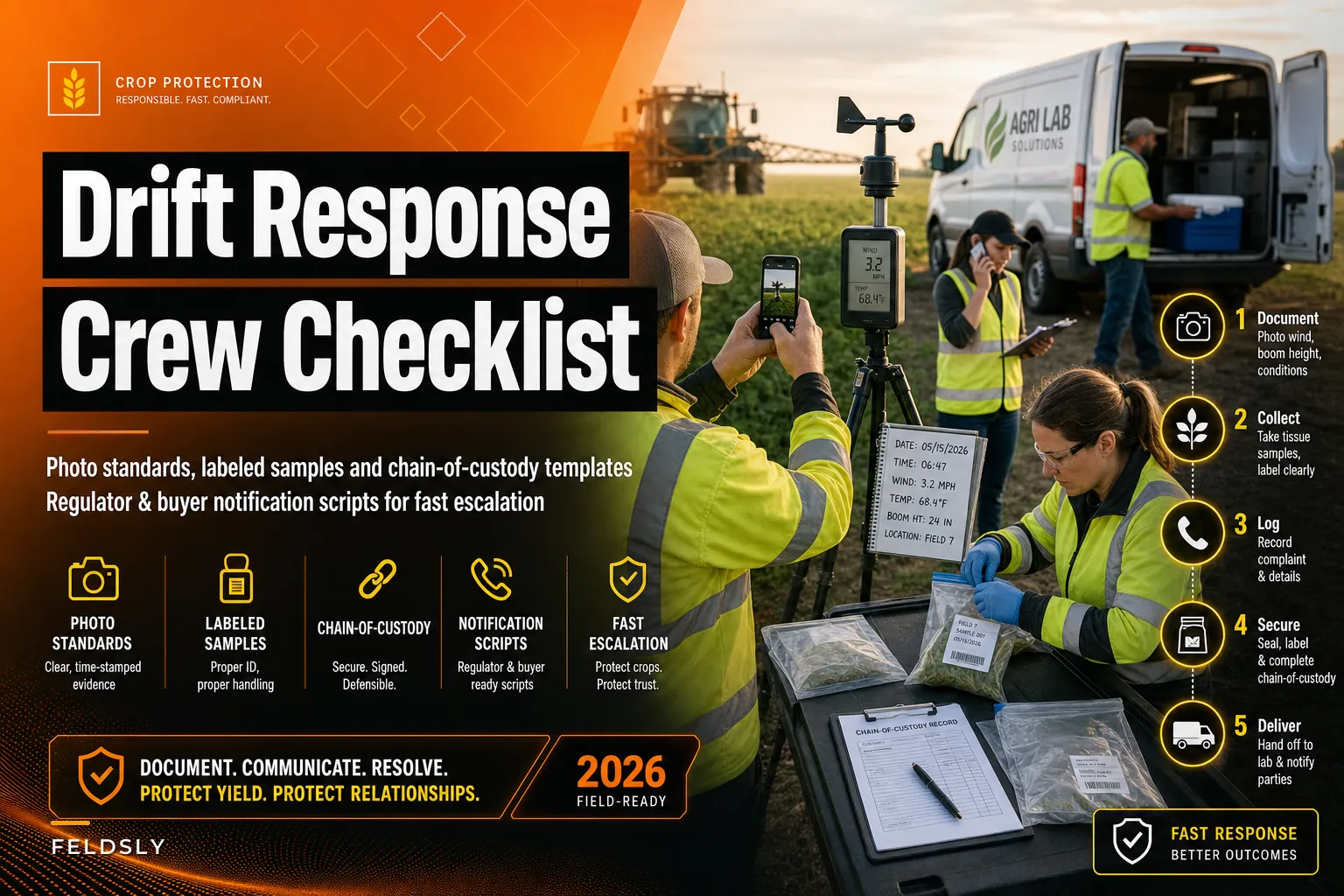
This checklist is for the people actually standing in the field. Not the compliance binder nobody reads. The laminated card in the sprayer cab, the pinned note in the crew chat, the thing a 22‑year‑old seasonal operator can follow at 5:45 a.m. without calling anyone.
Why drift incidents go sideways so fast
Two things make chemical drift different from almost every other on‑farm incident.
First, the evidence degrades on a clock you don't control. Volatile herbicides like dicamba and 2,4‑D can keep moving hours after application, and visible symptoms — cupping, epinasty, chlorosis — show up 3 to 14 days later, not immediately. The physical proof of when and where is gone long before the damage is visible. If you didn't capture wind, temperature, nozzle setup, and boom height at the time of application, you're reconstructing it from memory during a deposition.
Second, drift almost always involves a third party. A neighbor, an adjacent grower, a beekeeper, sometimes a buyer whose crop got contaminated. That means the same event triggers three separate clocks: the regulator's reporting window, the buyer's contract notification requirement, and the statute of limitations on a civil claim. Miss any one and you convert a defensible incident into an admission of negligence.
What shows up again and again across application operations is that documentation failures aren't from laziness — it's that nobody actually assigned the task. The applicator assumes the manager will handle paperwork. The manager assumes the applicator captured field conditions. Nobody owns the first hour, so the first hour disappears.
The core problem: your records were built for you, not for a regulator
Most farms already keep spray records. Product, rate, field, date. Those satisfy label recordkeeping. They do almost nothing in a drift dispute.
Take control of your farm’s productivity.
Feldsly helps you plan, track, and optimize every farming operation with precision.
- Centralized crop scheduling
- Resource & labor management
- Real-time weather alerts
No credit card required
A drift‑ready record answers a different set of questions:
-
What were the exact wind speed and direction at the nozzle, not at the airport 14 miles away?
-
What was the temperature inversion status at start and finish?
-
What was the boom height, ground speed, nozzle type, and pressure?
-
Who was downwind, and how far?
-
When did you first learn of the complaint, from whom, and what did you do in the next hour?
Your standard spray log doesn't have fields for most of that. And when an inspector asks and you don't have it, silence reads as guilt.
The on‑field checklist (hand this to the crew)
This is the part that lives in the cab. Two versions — one for the applicator during any spray of a drift‑prone product, one for whoever gets the complaint call.
Applicator pre‑ and post‑spray capture (every drift‑prone application):
-
[ ] Photo the weather meter reading (wind speed + direction) at the field edge before starting
-
[ ] Note inversion check
smoke/dust behavior, temperature trend
-
[ ] Record boom height, ground speed, nozzle model, pressure, and droplet setting
-
[ ] Photo the tank mix label and any drift‑reduction adjuvant used
-
[ ] Note buffer distances to nearest sensitive area (organic field, water, dwellings, specialty crops)
-
[ ] Repeat wind reading at spray completion, photographed
-
[ ] Log start and stop time to the minute
Quick visual of the on-field steps.
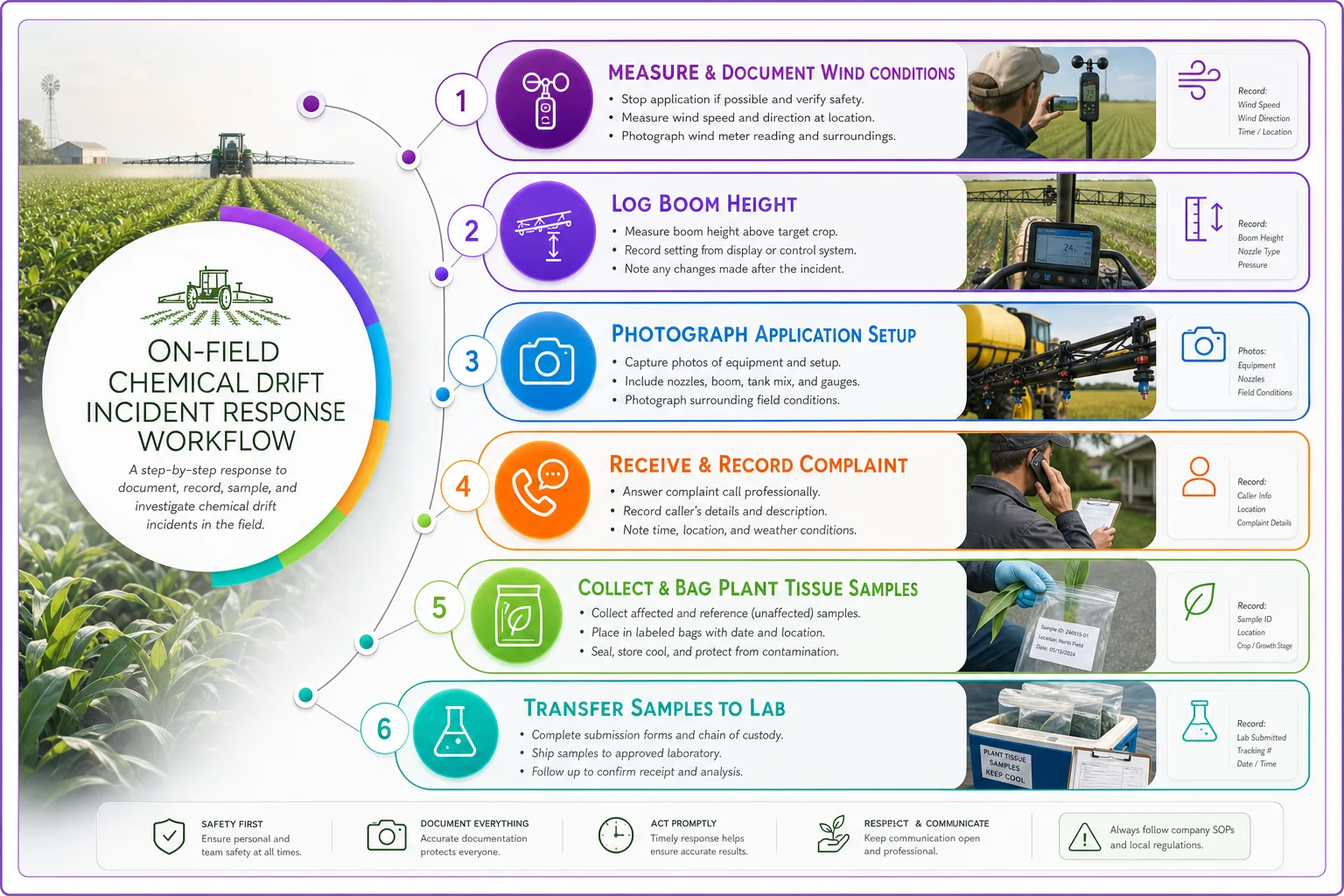
Complaint‑response capture (whoever takes the call):
-
Write the exact time and date the complaint came in and who called.
-
Do not admit fault, do not deny — say "We'll document conditions and get back to you today." Nothing more.
-
Pull the application record for the field in question immediately.
-
Photograph the suspected drift pattern within the affected area if you have access — wide shot, mid shot, close‑up of symptomatic tissue.
-
Note current wind and weather at the moment of the complaint.
-
Preserve the original spray records — do not edit, do not "clean up."
-
Notify the owner/manager within the hour.
The single biggest mistake here is the crew trying to be nice and reassuring on the phone. "Yeah, we sprayed dicamba over there yesterday, sorry about that" is a sentence that costs money. Neutral acknowledgment, then documentation.
Photo standards that actually hold up
Blurry, undated, unlabeled photos are worthless. Worse than worthless — they look like you tried and failed, which invites more scrutiny.
A drift photo set needs to be readable by someone who's never seen your farm. Here's the standard:
| Photo type | What it must show | Common failure |
|---|---|---|
| Establishing shot | Whole affected area + a landmark (road, building, tree line) | Cropped so tight no one can tell where it is |
| Boundary shot | The line between damaged and healthy plants | Only shows damage, no comparison |
| Symptom close‑up | Leaf cupping/burn with a ruler or coin for scale | No scale reference, can't judge severity |
| Application setup | Nozzles, boom, tank label from the day of spray | Never taken — reconstructed later |
| Weather meter | The device reading, on‑site | Screenshot of a weather app instead |
Every photo needs a real timestamp and, ideally, GPS coordinates baked into the metadata. Most phones do this automatically if location is on — check that before the season, not after an incident. Don't screenshot photos (it strips metadata). Don't send them through apps that compress and re‑encode. Keep the originals.
Check phone location settings before the season so photos retain GPS metadata.
One thing worth flagging: the establishing‑and‑boundary combination is what wins disputes. A close‑up of a cupped leaf proves nothing on its own — cupping has a dozen causes. The boundary shot showing a clean line of damage running perpendicular to the wind direction, right next to healthy plants, is the photo that tells the story.
Chain of custody: the part everyone skips
If you pull tissue or soil samples for lab analysis — and for any serious complaint you should — the samples are only as good as the paper trail behind them. A defense attorney's first move is to argue the sample was contaminated, mislabeled, or swapped.
-
Sample ID (unique, written on the bag before collection)
-
Date, time, GPS location of collection
-
Who collected it, printed name and signature
-
What it is (species, tissue type, soil depth)
-
Photo of the sample bagged and labeled in the field
-
Every person who handled it, with date/time of transfer
-
Storage conditions (refrigerated, frozen, ambient)
-
Date shipped, carrier, tracking number
-
Lab receipt confirmation
A minimal sample transfer log looks like this:
| Field | Entry |
|---|---|
| Sample ID | N‑Field7‑2024‑0611‑A |
| Collected by | J. Reyes (signature) |
| Date/time | 06/11 07:42 |
| Location | 40.4xxx, ‑88.9xxx |
| Material | Soybean foliage, upper canopy |
| Transferred to | Cooler, farm office 06/11 08:20 |
| Shipped | UPS 06/11 15:10, tracking # |
| Lab received | 06/12 09:05 |
The mistake that comes up most: sampling three days after the complaint, from a spot the crew "thinks" was the worst hit, with no location record. That sample can't be tied to anything. If you're going to sample, do it early, geotag it, and log every handoff.
The notification scripts
Speed here isn't about panic — it's about control. Getting ahead of the notification means you frame the incident on the record before someone else does. Waiting means the neighbor's version becomes the official version.
Regulator notification (when a report is required or advisable). Keep it factual, dated, and free of speculation about cause:
> "This is [name] from [farm]. On [date] we applied [product] to [field] under conditions we documented. On [date] we received a complaint from an adjacent party regarding possible off‑target movement. We are reporting this proactively, have preserved our application records and field conditions, and are conducting our own assessment. We'd like to coordinate on any inspection."
Buyer notification (when a contract crop may be affected — yours or a customer's). Many grain and specialty‑crop contracts require notice within a set window if there's a contamination risk. Miss it and you can breach the contract independent of the drift itself:
> "Notifying you per our contract of a possible off‑target chemical event on [date] affecting [crop/lot]. We are assessing scope and preserving records and samples. We'll provide a status update by [specific date]. Flagging now to stay within notification terms."
Affected‑party acknowledgment (the neighbor). This is the one crews handle worst. The goal is to acknowledge without conceding:
> "Thanks for letting us know. We're taking it seriously, documenting the conditions from that day, and we'll follow up with you by [date]. If you're collecting anything, we'd suggest photos with dates."
Suggesting they document sounds counterintuitive, but a well‑documented incident on both sides usually resolves faster and cheaper than a he‑said‑she‑said that drags into litigation.
A real scenario
A mid‑size corn and soybean operation running around 3,800 acres, three sprayers, mostly seasonal operators. A neighbor with a small organic vegetable plot called claiming drift from a post‑emerge dicamba pass. Two years earlier the same farm had eaten a settlement somewhere in the $40k–$55k range once you counted the claim, legal time, and a strained buyer relationship — largely because their only evidence was a spray log with no field conditions and four photos taken a week late.
This time they had a cab card and a phone‑capture routine. The operator had photographed the wind meter (7 mph, away from the neighbor's plot), logged boom height and a low‑drift nozzle, and shot the completion reading. When the complaint came in, the manager pulled the record inside 20 minutes, sent the neutral acknowledgment, and geotagged tissue photos showing the symptom pattern was inconsistent with their spray direction.
The state inspection closed without a violation. The neighbor's symptoms turned out to trace to a different source. Total time spent: maybe a day of the manager's attention versus the multi‑month grind of the earlier claim. The documentation didn't just win the argument — it ended it before it became one.
When this level of documentation actually makes sense
Not every application needs the full treatment. Spraying glyphosate on your own back forty with no sensitive neighbors for a mile? A standard spray log is fine.
-
You're applying volatile or drift‑prone chemistry (dicamba, 2,4‑D, growth regulators)
-
There's a sensitive neighbor within realistic drift distance — organic fields, orchards, vineyards, dwellings, water
-
You're near marginal weather conditions where an inspector might second‑guess your judgment
-
You're operating under a buyer contract with contamination clauses
Who should not overthink this: a small owner‑operator with no adjacent sensitive crops and no contract exposure. Building forensic chain‑of‑custody for every glyphosate pass is wasted effort. Match the rigor to the risk.
Making the checklist survive the season
A checklist only works if crews actually use it under pressure, which means it has to be faster than the workaround. Laminated cab cards help. But the real durability problem is that these records get scattered — some in a spray log app, some in the operator's camera roll, some in a text thread that gets deleted when the phone gets wiped at the end of the season.
The farms that hold up best keep incident capture in the same system they already use for daily field records, so photos, weather readings, and application data live together and stay searchable a year later when a claim surfaces. Standardized digital capture forms — the same phone‑first approach that works for routine crew observation and ticketing — remove the "who was supposed to save this" problem. And tying application decisions to logged conditions is easier when you're already treating weather as an operational input rather than a guess, the way a weather‑risk framework forces you to record the call you made and why.
The point isn't the software. It's that scattered records fail exactly when you need them, and centralized ones don't.
Bottom line
Drift incidents aren't won in the courtroom or the inspector's office. They're won in the first hour, by whoever's standing in the field with a phone and a clear routine.
Build the cab card. Set photo standards before the season. Write the three scripts now, while nobody's angry. And decide today who owns the first hour — because during an actual incident, "someone will handle it" means no one did.
Ready to revolutionize your farm management?
Join 500+ farms using Feldsly to boost yields, reduce waste, and streamline daily farm workflows.