

The sprayer pad is where small mistakes get expensive fast. Not because people don't know the rules, but because the rules live in a 60-page product manual sitting in the shop office while the guy mixing at 5:40 AM has his gloves half-on and a tank filling behind him.
This is about one thing: building a mixing and loading system that lives in the cab and on the pad, catches problems before they happen, captures evidence when something goes sideways, and tells a crew member exactly who to call in the first 90 seconds. Not a regulatory refresher. A working system.
## Where mixing goes wrong (and it's almost never the label reading)
Most people assume chemical incidents on the pad come from someone ignoring the label. In real operations, that's rarely the root cause. The failures cluster around a few predictable spots:
-
Sequence errors. Someone dumps a dry product and a liquid in the wrong order and gets a gel ball that clogs screens. Tank's now a $900 cleanout and a lost spray window.
-
Compatibility surprises. Two products that are each fine alone curdle together because nobody ran a jar test, and the pattern on the field shows up as streaking three days later.
-
PPE drift. The crew is careful in April. By July, in 95-degree heat, the respirator "slows them down" and the face shield fogs, so it comes off. Nobody decided to skip PPE — it just erodes.
-
Loading-area confusion. A new seasonal hire doesn't know where the eyewash is, doesn't know the shutoff, and doesn't know who to call. He knows how to run the pump. Those are different skills.
The pattern underneath all of these: the knowledge needed in the moment isn't present in the moment. It's stored somewhere else — a binder, a label, someone's memory, a text thread. The fix isn't more training. It's putting the right 6–10 pieces of information physically where the hands are working.
## The one-page cab card: what actually belongs on it
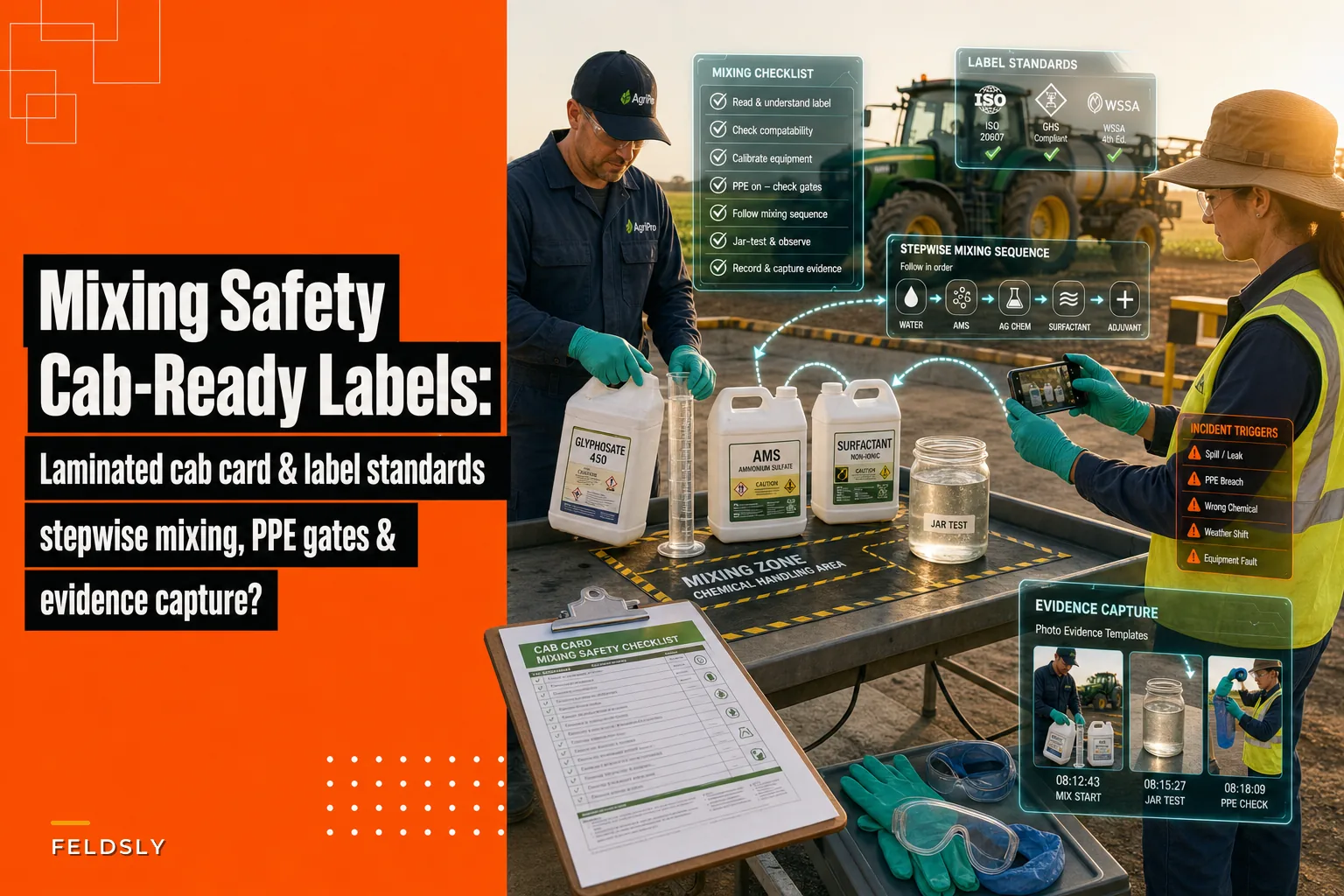
A cab card is not a safety data sheet. SDS sheets are reference documents — important, but useless when you've got product on your forearm and 30 seconds to act. The cab card is the action layer. It should be laminated, clipped in the cab and posted at the mix station, and short enough to read in one breath.
Take control of your farm’s productivity.
Feldsly helps you plan, track, and optimize every farming operation with precision.
- Centralized crop scheduling
- Resource & labor management
- Real-time weather alerts
No credit card required
Here's what earns a spot on the card and what doesn't:
| Belongs on the cab card | Belongs in the binder/SDS (not the card) |
|---|---|
| Mixing sequence for the day's tank mix | Full chemical composition |
| Required PPE for this job | Toxicological data |
| Emergency shutoff location | Disposal regulations |
| Spill-first-step (contain, don't chase) | Transport classification details |
| Eyewash / water source location | Environmental fate studies |
| Escalation call order (3 names + numbers) | Manufacturer warranty language |
The discipline here is ruthless subtraction. The moment the card has 20 items, nobody reads it. A good card has the five or six things a stressed, early-morning crew member needs and nothing else.
One thing people consistently miss: the card is per-job, not per-product. A corn pre-emerge tank mix with three products needs its own card showing that sequence, not three separate product cards the crew is supposed to mentally combine at 5:30 AM. If your mixes change weekly, your cards change weekly. That sounds like a burden until you price out one botched tank.
## The mixing sequence, as a checklist that lives on the pad
Sequence is where the technical knowledge has to be dead simple. The industry shorthand — the "WAM-LES-DES" style orderings — is fine for an agronomist but means nothing to a 22-year-old on week two. Translate it into plain steps on the card:
-
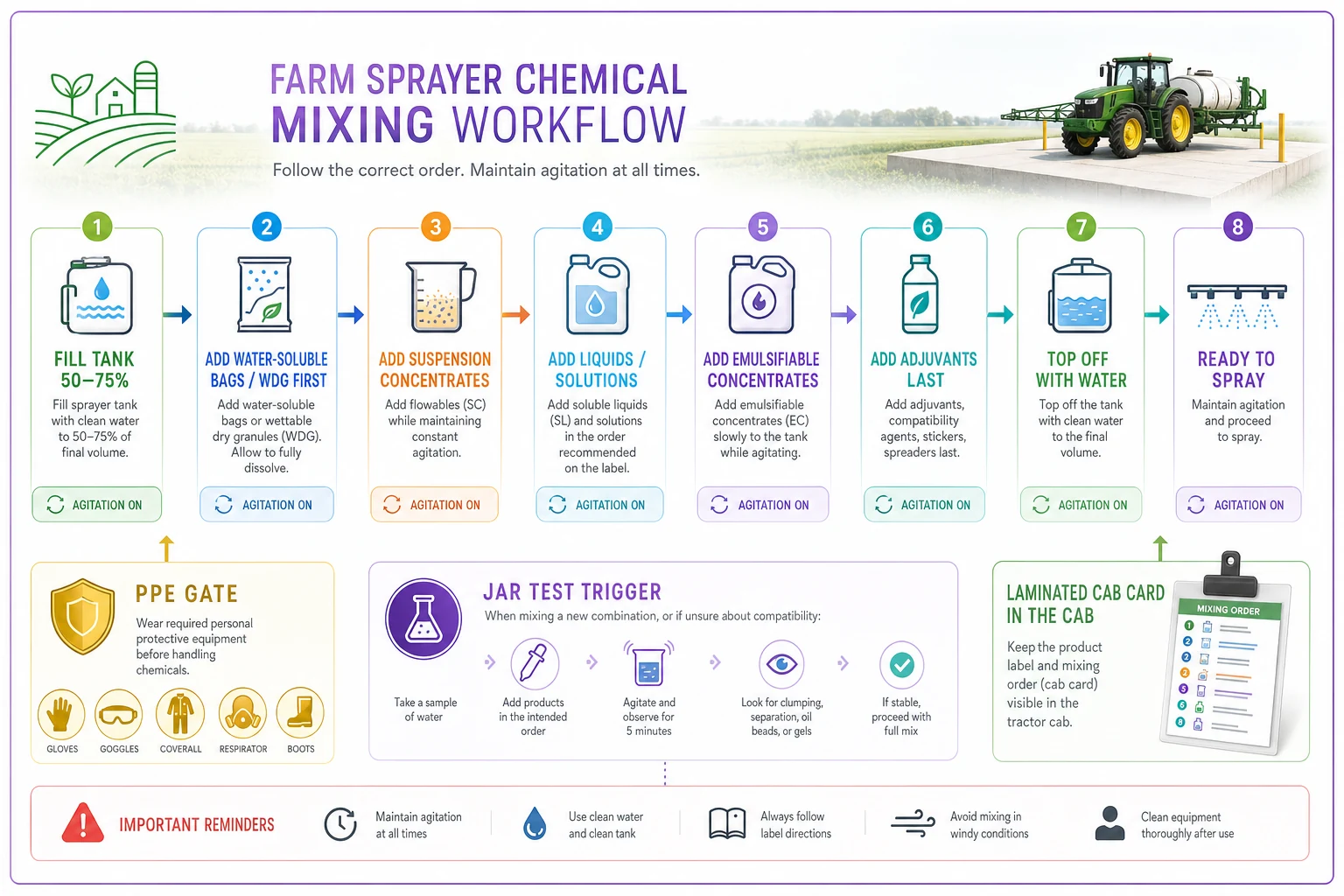
Fill tank 50–75% with clean water, agitation on.
-
Add water-soluble bags / water-dispersible granules first, let them fully disperse before the next product.
-
Add suspension concentrates (the thick flowables), give agitation time.
-
Add liquids / solutions.
-
Add emulsifiable concentrates next.
-
Add adjuvants, surfactants, and drift agents last.
-
Top off with remaining water, keep agitating until spraying.
The single highest-value addition to this list is a jar test trigger: any time two products haven't been mixed together on this farm before, run a small jar test before the full tank. Ten minutes with a mason jar versus a curdled 1,200-gallon tank is the easiest math on the farm. Put that rule in bold on the card.
Any time two products haven't been mixed together on this farm before, run a small jar test before the full tank.
A simple visual can make the order of actions obvious at a glance.
Farms that write the sequence as verbs the crew can do ("dump the bag, wait for it to dissolve") get far better compliance than farms that write chemistry ("add WDG prior to SC"). The crew isn't lazy — they just can't act on abstraction while a pump is running.
## PPE checks: making them a gate, not a suggestion
PPE drift is a July problem, not an April problem. The checklist has to account for the fact that compliance decays with heat, fatigue, and familiarity. The way to fight that is to make PPE a gate in the workflow — a step that has to be completed before the next step unlocks — rather than a general reminder.
-
Chemical-resistant gloves on — inspected for tears before each loading session, not reused if torn.
-
Eye protection matched to the product — goggles or face shield per the card, not "whatever's nearby."
-
Respirator fit confirmed where required — and a stated rule that a fogged or failing respirator means stop, not push through.
-
Apron / coveralls for products the card flags.
-
Backup set staged — one spare pair of gloves and a spare shield within arm's reach so a failure doesn't become an excuse to continue bare-handed.
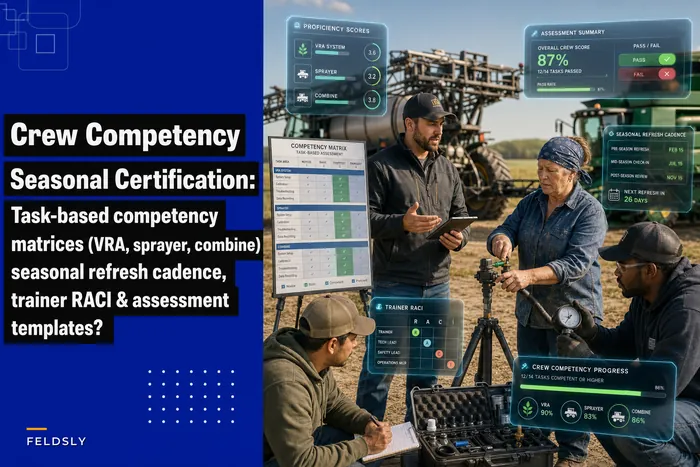
The staging detail matters more than it looks. Most PPE lapses aren't decisions — they're a torn glove with no replacement nearby and a tank that's still filling. Remove the friction and the lapse disappears. Tie PPE responsibility directly to your crew competency matrix and seasonal certification program so the person running the mix is someone who's actually been checked out on it, not whoever was free that morning.
## Escalation scripts: the first 90 seconds
When something does go wrong — a splash in the eyes, a spill heading toward a ditch, product on skin — the difference between a minor event and a reportable incident is usually what happens in the first minute and a half. That's exactly when people freeze, or make it worse by trying to clean up before protecting themselves.
Eye/skin exposure: > "Stop. Flush at eyewash/water for 15 minutes before anything else. Call [Supervisor name/number]. Have the cab card and product name ready for Poison Control: 1-800-222-1222."
Spill heading toward water or a drain: > "Don't chase it downstream. Contain uphill first — berm, soil, absorbent. Shut off the source. Call [Supervisor], then [Spill response contact]. Note the time."
Fire / vapor / anything you can't control: > "Leave the area upwind. Account for everyone. Call 911. Tell them it's an agricultural chemical and read the product name off the card."
Notice the ordering: protect the person, contain the hazard, then make calls. Crews told to "call the boss first" often delay flushing an eye to find a phone — exactly backwards. The script fixes the order so nobody has to think their way through a bad moment.
## Evidence capture, without turning the crew into investigators
Prevention is the goal, but when an incident happens, the evidence you capture in the first hour protects the farm on every downstream front — insurance, buyer questions, regulatory follow-up. The challenge is keeping the capture simple enough that a rattled crew member will actually do it.
-
Photos — the spill or exposure site, the containers involved with labels visible, the PPE in use, and the containment steps taken.
-
Time log — when it happened, when flushing or containment started, when calls were made.
-
What was in the tank — the day's mix, pulled straight from the per-job card.
-
Who was present — names, roles.
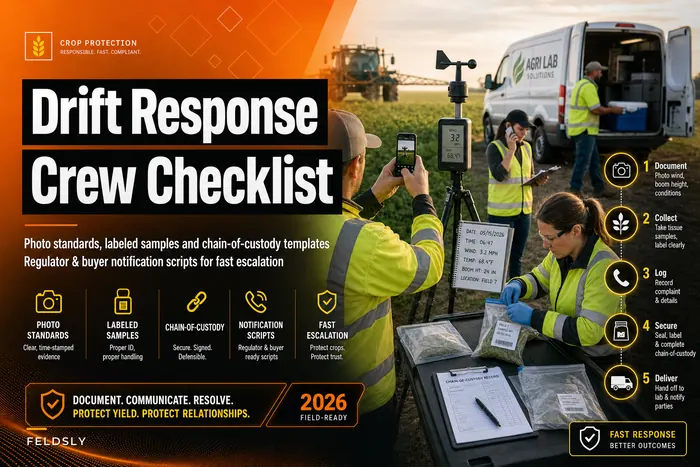
This is deliberately lighter than a full incident file. If the event escalates into a drift complaint or an off-target situation, you move into a more rigorous process — the kind laid out in the chemical‑drift incident checklist with photo standards and chain‑of‑custody.
The pad-level capture is the on-ramp to that process, not a replacement for it. Its only job is making sure the first hour's evidence isn't lost while everyone's dealing with the immediate problem.
## A real scenario
A mid-size corn-and-soy operation — roughly 2,800 acres, two sprayers, a rotating seasonal crew — kept losing spray mornings to clogged screens and the occasional streaky field. Nothing catastrophic, but a recurring cost. Over a season they tracked somewhere around four or five botched or partially botched tanks, each running $600–$1,000 once you added cleanout time, wasted product, and re-spray.
The fix wasn't a new sprayer or a safety seminar. They built per-job cab cards: one laminated card per tank mix, showing the day's sequence in plain verbs, the PPE for that job, shutoff and eyewash locations, and three escalation scripts on the back. The agronomist signed off on each mix the night before; the mix lead pulled the matching card each morning.
Sequence errors dropped to near zero within a few weeks — mostly because the jar-test trigger caught two incompatible combos before they hit the tank. PPE compliance held through July for the first time anyone remembered, because the gloves-and-shield check became a step you couldn't skip to get to the pump. By the end of the season they figured the cards had saved somewhere around $3k in avoided cleanouts and re-sprays, plus a couple of spray windows they'd otherwise have lost. The owner's actual takeaway wasn't really about money though. It was that his newest seasonal hire knew exactly what to do the morning a hose coupler let go and sprayed the pad — contained it, flushed, called, no panic.
## When this system makes sense (and when it's overkill)
This makes sense when: you run tank mixes that change through the season, you rely on seasonal or rotating crews, or you've had even one near-miss on the pad. The more your crew changes, the more the knowledge needs to live on the card instead of in someone's head.
This is lighter than you need when: you're a one-person operation spraying the same single product every pass, you mix it yourself, and you've done it for fifteen years. You still want the escalation scripts posted — a solo operator having a splash incident with nobody around is exactly the case where a script by the eyewash matters — but the per-job card machinery is probably more than you need.
Who should not lean on this instead of training: cards are the action layer, not the education. They work because the crew already understands why the sequence matters. Hand a card to someone who's never been walked through mixing and you've built a false sense of safety. The card and the certification program go together — one is the knowledge, the other is the reminder at the moment of action.
## Getting this into the field this week
You don't need a project for this. Pick your three most common tank mixes. Write each one as a one-page card — sequence in plain verbs, PPE for that job, shutoff and eyewash locations, escalation scripts on the back. Laminate them. Clip one in each cab and post copies at the mix station. Have your agronomist or whoever signs off on mixes confirm the sequence on each.
Then watch what the crew actually does with them for a week and fix the wording on anything they stumble over. The best cab card isn't the most complete one — it's the one that gets read at 5:40 AM with gloves half-on and a tank filling behind you. Build for that moment, and most of the expensive mistakes on the pad stop happening before they start.
Then watch what the crew actually does with them for a week and fix the wording on anything they stumble over. The best cab card isn't the most complete one — it's the one that gets read at 5:40 AM with gloves half-on and a tank filling behind you. Build for that moment, and most of the expensive mistakes on the pad stop happening before they start.
Ready to revolutionize your farm management?
Join 500+ farms using Feldsly to boost yields, reduce waste, and streamline daily farm workflows.