

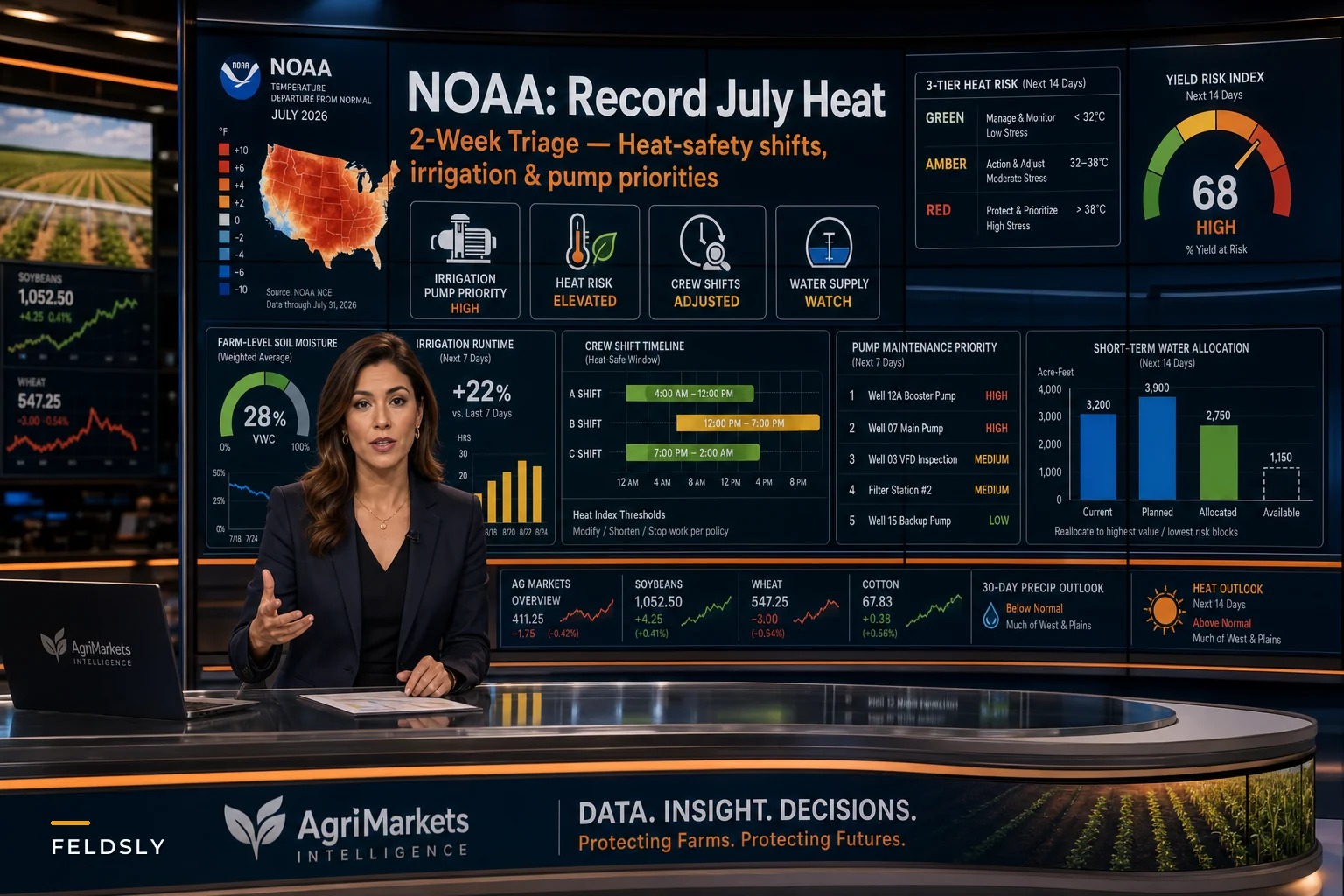

July 2026 didn't just run warm. According to NOAA's national climate summary, the contiguous U.S. averaged 76.9°F, making it the hottest month ever recorded for the lower 48. The part that matters most operationally isn't the daytime highs — it's that the nighttime lows stayed historically warm too.
If you run a crop farm, that second detail changes almost everything about how you schedule crews, run pumps, and time field work through the rest of this season. Warm nights mean crops don't get their recovery window. Soil stays warmer. Pests move faster. And your crew never fully cools down between shifts, which quietly raises your heat-illness risk even when the thermometer reads "only" 88°F at 6 a.m.
This isn't a piece about climate. It's about the operational tradeoffs record heat is forcing on you right now — and how to make those calls without burning through labor budget, overwatering fields you can't afford to overwater, or losing a harvest window because your schedule wasn't built for this.
Start with the constraint that's easiest to underestimate: warm nights
Most heat playbooks are built around the afternoon. Shift crews earlier, stop work at 1 p.m., add water breaks. All reasonable. But the operational surprise this summer is coming from the overnight window.
When lows sit in the mid-70s to low-80s, three things happen at once:
-
Irrigation efficiency drops because evapotranspiration doesn't slow down overnight the way it normally would — so the water you applied at dusk isn't buying you as much next-morning soil moisture.
-
Grain and produce that you'd normally let cool overnight before handling doesn't cool, which pushes moisture and quality problems into your morning operations.
-
Crews starting at 5 a.m. are already working in conditions that used to only exist at 11 a.m.
The pattern on multi-field operations is that managers optimize the afternoon aggressively and then get blindsided when their "cool" morning start isn't actually cool anymore. A crew lead who's been doing this for 20 years will tell you the mornings "feel wrong" — and they're right. The recovery window collapsed.
Practical move: pull your overnight low forecasts, not just the highs, and build your shift start times off the nighttime trend line. If lows aren't breaking 78°F, a 5 a.m. start isn't the safety buffer you think it is.
Check the last three-night trend for lows before locking crew start times — a single cool night doesn't reset the pattern.
A crew lead who's been doing this for 20 years will tell you the mornings "feel wrong" — and they're right. The recovery window collapsed.
Reprioritize in this order, not the order that feels urgent
When heat hits, the instinct is to react to whatever's screaming loudest — usually a wilting field or a crew complaint. That's how you end up making six small decisions that contradict each other.
Take control of your farm’s productivity.
Feldsly helps you plan, track, and optimize every farming operation with precision.
- Centralized crop scheduling
- Resource & labor management
- Real-time weather alerts
No credit card required
Here's the priority order that holds up across most row-crop and specialty operations:
-
People first, and not as a slogan. Heat illness on a crew doesn't just hurt someone — it takes out a worker, triggers a stop, and can pull a supervisor off the field for the rest of the day. One incident can cost you more labor-hours than a full week of schedule adjustments.
-
Protect the crop stages that can't be recovered. Pollination, grain fill, fruit set. A stressed vegetative-stage field usually bounces back. A field that got cooked during pollination doesn't. Water and shade-cloth decisions should flow toward irreversible-damage windows first.
-
Preserve equipment uptime during the compressed work windows. When you've only got a productive window from 5–10 a.m., a pump or planter failure costs you the entire day, not a few hours.
-
Everything else. Scouting, maintenance-that-can-wait, non-critical field prep.
The mistake is treating irrigation as the top priority by default. It usually isn't. Water is recoverable and adjustable. A pollination window and a crew member's health are not.
Irrigation: run the math on runtime cost before you just add hours
The reflex during a heat spike is to add irrigation runtime everywhere. But pump runtime is where heat quietly eats margin, especially if you're on electric pumps hitting peak-demand pricing in the afternoon.
Here's a rough breakdown of how the same "add more water" decision plays out differently depending on timing:
| Irrigation timing | Water efficiency | Energy cost exposure | Crew/oversight need |
|---|---|---|---|
| Midday (10 a.m.–4 p.m.) | Poor — high evaporative loss | Highest — peak demand pricing | Low |
| Late evening (after 8 p.m.) | Moderate — warm nights reduce gains | Moderate | Low, but check overnight |
| Pre-dawn (2–6 a.m.) | Best available this summer | Often off-peak | Requires reliable scheduling |
Pre-dawn irrigation is doing the most work per gallon and per dollar this summer — but it only works if you can trust your scheduling and your moisture readings. If you're relying on manual valve checks or a crew member who might not show, pre-dawn becomes a gamble.
This is also where local water restrictions collide with your plan. NOAA's summary and the AP coverage through PBS NewsHour both flag expanding drought — which means restrictions can land on short notice. Build a "restricted-water" version of your irrigation plan now, ranking which fields get water first if you're suddenly capped at 60% of normal allocation. Deciding that under pressure is how good managers make bad calls.
The labor scheduling problem heat actually exposes
Heat doesn't create a scheduling problem — it exposes one that was already there. Most farm schedules assume a full, predictable workday. Record heat compresses that into a partial, shifting window, and suddenly the whole structure falls apart.
In real operations, this shows up as a cascade. The morning window gets shortened because of the warm-night issue. You lose a couple of productive hours. Work spills into the dangerous midday, or gets pushed to tomorrow — which is already fully booked. Now you're running overtime, reshuffling crews between fields, and paying premium hours for work you'd planned to do in a normal block.
A mid-size vegetable operation running three crews can easily see this add up to an extra $4k–$7k a month in overtime and reshuffling friction during a sustained heat stretch — not from any single bad decision, but from the schedule constantly fighting reality.
The fix isn't heroics. It's building your schedule around three realistic daily scenarios instead of one:
-
Green day full window available, standard schedule.
-
Compressed day productive window is 5–10 a.m. only; pre-assign which tasks get done and which slide.
-
Red day heat-safety stop by mid-morning; only critical irrigation and equipment checks proceed.
The teams that handle heat well aren't the ones with the toughest crews. They're the ones who decided in advance what a compressed day looks like, so nobody's improvising a labor plan at 9 a.m. with the temperature already climbing.
Where forecasts stop being wall art and start driving decisions
Every farm gets the same weather data. The difference between operations that handle a record-heat month and ones that scramble through it comes down to whether that forecast actually changes what crews do.
The failure mode is familiar: the forecast says brutal heat Thursday through Sunday, everyone nods, and then Thursday's schedule looks exactly like a normal Thursday because nobody translated the forecast into specific task and crew reassignments. The information sat there unused.
Below is a simple workflow to turn overnight-low forecasts into operational triggers.
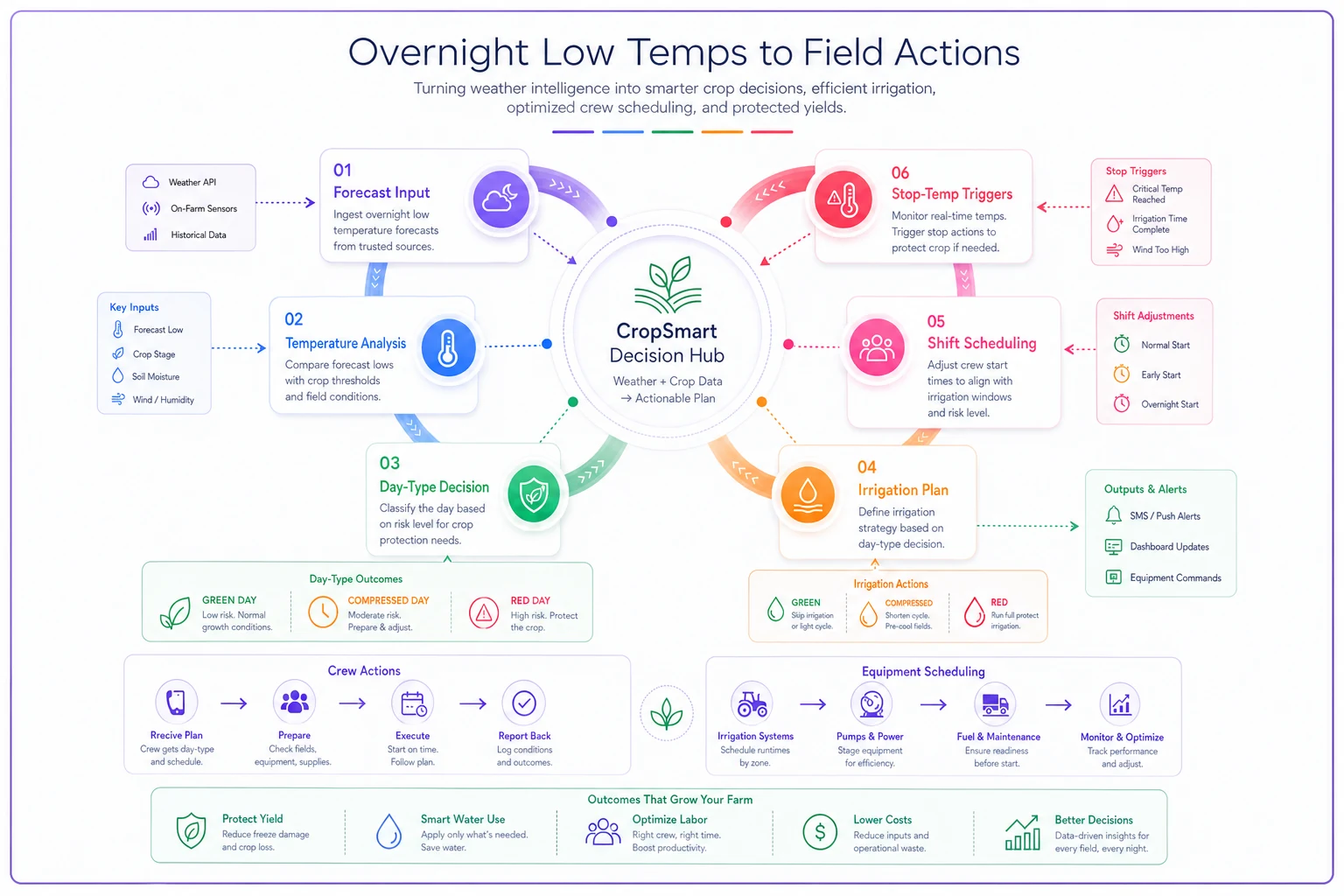
Turning forecasts into pre-committed operational triggers — shift starts, irrigation timing, task priority, stop thresholds — is the whole game during a heat event. We've written a full framework on exactly this in Don't let forecasts sit unused: an operational weather-risk framework for resource and labor allocation, and it's worth reading alongside this piece. A heat playbook is really just a weather-risk framework applied to one specific, intense condition.
The core idea: your forecast should map to decisions, not awareness. "Lows above 78°F for three consecutive nights" should automatically trigger your compressed-day labor plan — not a conversation about whether to trigger it.
A short pre-shift checklist for compressed heat days
Keep this at the crew-lead level. It should take under five minutes each morning:
-
Check the overnight low trend, not just today's high, and confirm which day-type (green/compressed/red) you're running.
-
Confirm pre-dawn irrigation actually ran and moisture readings match expectation before releasing crews.
-
Assign work to the coldest available hours first, hardest physical tasks earliest.
-
Pre-stage water and shade at each field before crews arrive, not after.
-
Identify the single equipment failure that would kill the day, and confirm a backup plan for it.
-
Set an explicit stop-time and stop-temperature, and name who has authority to call it.
-
Note which non-critical tasks slide to a green day so nothing gets silently dropped.
The checklist matters less than the habit. A five-minute alignment at dawn prevents the mid-morning chaos that quietly costs the most.
Pests and disease: the second-order cost people forget
Warm nights accelerate a lot of pest life cycles and create disease pressure you'd normally not see until later in the season. The operational trap is that scouting cadences were probably built for normal conditions — so you're checking fields on a schedule that's now too slow for how fast problems develop.
If crews are working compressed windows, scouting is usually the first thing that gets dropped, which is exactly backward during a heat event. A pattern worth acting on: bump scouting frequency on your highest-value and most-vulnerable-stage fields even as you shorten crew hours elsewhere. Catching an accelerating pest problem three days earlier can be the difference between a spot treatment and a field-wide response.
Where the right tools quietly earn their keep
None of this requires sophisticated technology to decide. But executing across multiple fields, shifting shift times, pre-dawn irrigation schedules, and day-type triggers gets very hard to coordinate on a whiteboard once you're running several crews under stress.
That's the practical case for operational software that centralizes the moving pieces — pulling forecast and overnight-low data, tying it to pre-set day-type triggers, tracking which fields got irrigated and when, and pushing the right compressed-day task list to each crew lead automatically. The value isn't automation for its own sake. It's that a manager under heat pressure stops holding twelve variables in their head and re-deriving the plan every morning. The system holds the plan so the humans can focus on the field.
The farms that struggle most during heat events aren't short on effort. They're short on coordination — the same schedule information living in five heads and three text threads, none of them current.
A quick real scenario
A roughly 900-acre mixed row-crop and vegetable operation in a hot inland valley went into a two-week heat stretch running their normal single-schedule plan. First few days: crews spilling into midday, two near heat-illness incidents, one full afternoon lost to a pump failure during peak demand, and irrigation runtime way up on electric pumps during the priciest hours.
Midway through, they switched to a three-tier day-type plan, moved most irrigation to pre-dawn, and set hard stop-triggers based on overnight lows. Nothing complicated. Over the back half of the stretch, overtime dropped noticeably, they had zero heat incidents, and their irrigation energy cost came down meaningfully just from shifting runtime off peak hours — a swing that mattered more to the month's margin than the extra water they used.
The difference wasn't tougher crews or better weather. It was deciding the plan before the heat forced the decision.
Record heat strips out the slack you didn't know you were relying on — the cool mornings, the recovery nights, the full workday, the flexible schedule. What's left is a set of tighter tradeoffs that reward the operations that pre-committed their decisions and punish the ones improvising in the field.
Build your day-types now. Reprioritize people and irreversible crop stages over everything else. Move irrigation to where each gallon and dollar does the most. And make sure the forecast on the screen is actually driving what your crews do at 5 a.m. — because for the rest of this season, that forecast is your operating condition, not a warning about one.
Ready to revolutionize your farm management?
Join 500+ farms using Feldsly to boost yields, reduce waste, and streamline daily farm workflows.