

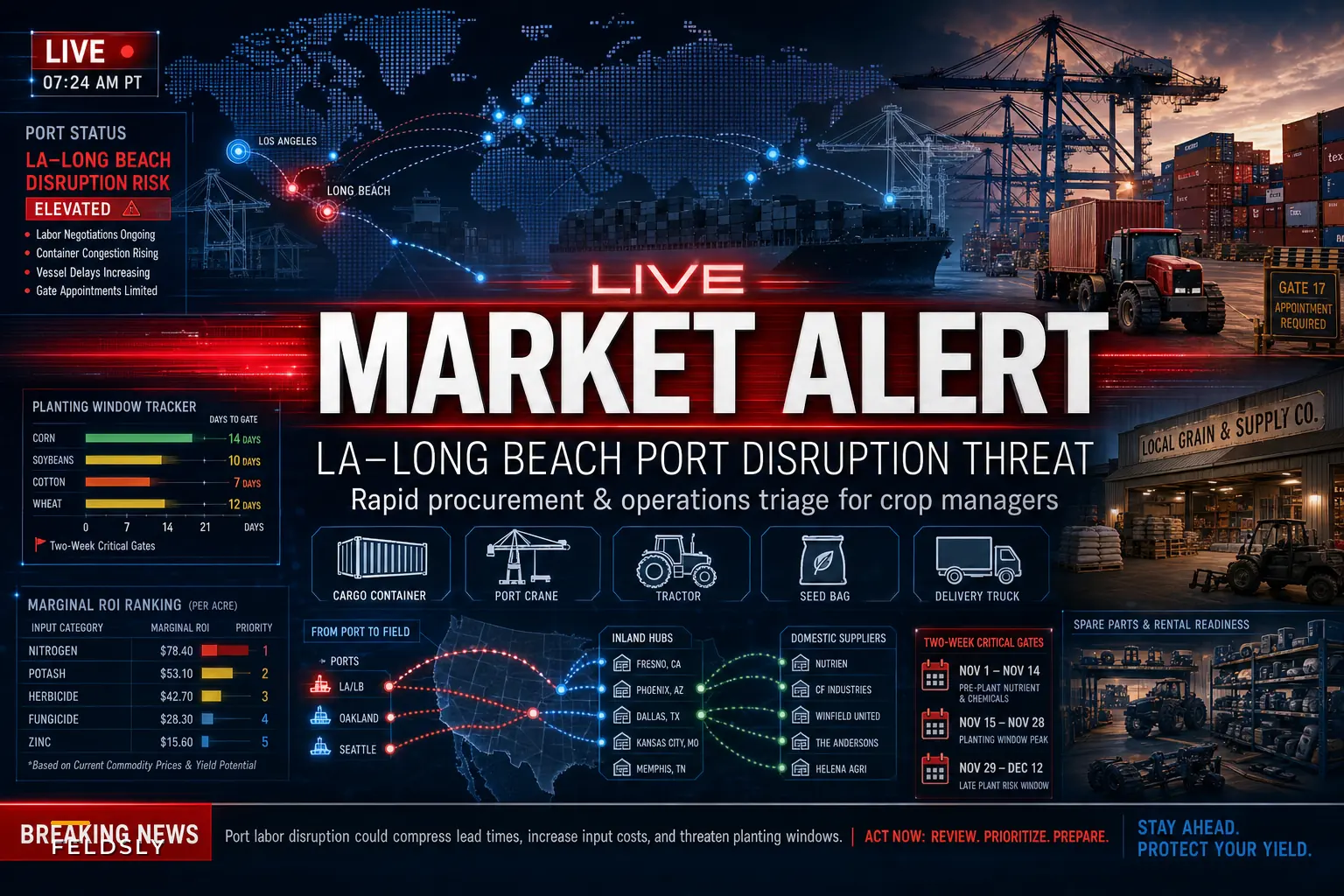
The maritime watchmen situation at Los Angeles–Long Beach is one of those risks that looks minor on paper until it isn't. The Pacific Maritime Association and ILWU Local 26 pushed their deadline to November 4 after a strike authorization covering roughly 250 security workers. Tiny headcount relative to the tens of thousands of jobs tied to those terminals — but as a gCaptain report on the extended talks noted, watchmen are gate-level. If they walk, terminals can't safely operate, and the whole complex slows or stops.
For crop managers, the real headline isn't "labor dispute." It's that the container holding your planter parts, your treated seed, or your specialty fertilizer might sit offshore for two to three extra weeks — and the replacement freight is going to cost more than you budgeted. That's the actual exposure, and it lands at a rough time: ahead of winter planting prep, stacked on top of holiday-peak logistics demand.
This isn't about whether a strike happens. It's about what even a short extension exposes in how most farms handle imported inputs, and what you can actually do in the next few weeks to triage it.
Why a 250-person dispute can hit your planting window
Farms rarely track which inputs actually touch an ocean port. They think in terms of "my local co-op has it" or "my dealer orders it." But a lot of what moves through a dealer started as a container at LA–Long Beach or one of the adjacent complexes.
-
Crop protection actives and formulated products — a large share of technical-grade material and some finished chemistries route through Asia-Pacific shipping lanes.
-
Equipment parts and electronics — planter meters, sensors, hydraulic components, controller boards. High-margin, low-weight stuff that ships containerized.
-
Micronutrients and specialty fertilizers — not your bulk N, but specialty blends and chelated products.
-
Treated and specialty seed packaging, coatings, and additives.
A FreightWaves report on the strike threat noted the complex was already running record monthly TEU volumes with congestion. That matters because congestion eats your buffer. When a port is running at 70% capacity and a disruption hits, the system absorbs it. When it's running flat-out and something slows the gates, vessels bunch up, chassis get stuck, and demurrage clocks start ticking on everyone at once.
Operations that got burned by past port slowdowns will tell you: the direct delay is annoying, but the second-order cost is worse. Spot freight rates on alternate routing spike. Expedited air freight on a $400 controller board can run $900–$1,400 when everyone's scrambling for the same parts at the same time. Demurrage and detention fees pile on for containers you can't pick up.
The deeper problem this exposes: nobody mapped the dependency
The strike threat is the trigger. The actual weakness is that most farms can't answer a simple question: "Which of my critical planting inputs have ocean-import exposure, and what's my fallback for each one?"
Take control of your farm’s productivity.
Feldsly helps you plan, track, and optimize every farming operation with precision.
- Centralized crop scheduling
- Resource & labor management
- Real-time weather alerts
No credit card required
This usually happens because procurement gets organized around suppliers, not around supply paths. You know your three fertilizer vendors and your two equipment dealers. You don't know that two of those vendors source the same micronutrient from the same overseas manufacturer shipping through the same congested terminal. So when disruption hits, your "diversified" supplier base collapses into a single chokepoint you never saw coming.
A typical example: a mid-size operation thinks it has redundancy because it buys seed treatment from two different dealers. Both dealers restock from the same regional distributor. That distributor's inventory is sitting in containers offshore. Two suppliers, one actual chokepoint. The farm finds out when both dealers call the same week saying they're backordered.
This is the gap between supplier diversity and supply-path diversity. Port disruptions are exactly what reveals the difference.
A rapid triage you can run before November 4
You don't need a perfect risk model right now. You need a fast, rough-cut triage that tells you where to focus. Here's a workable sequence.
-
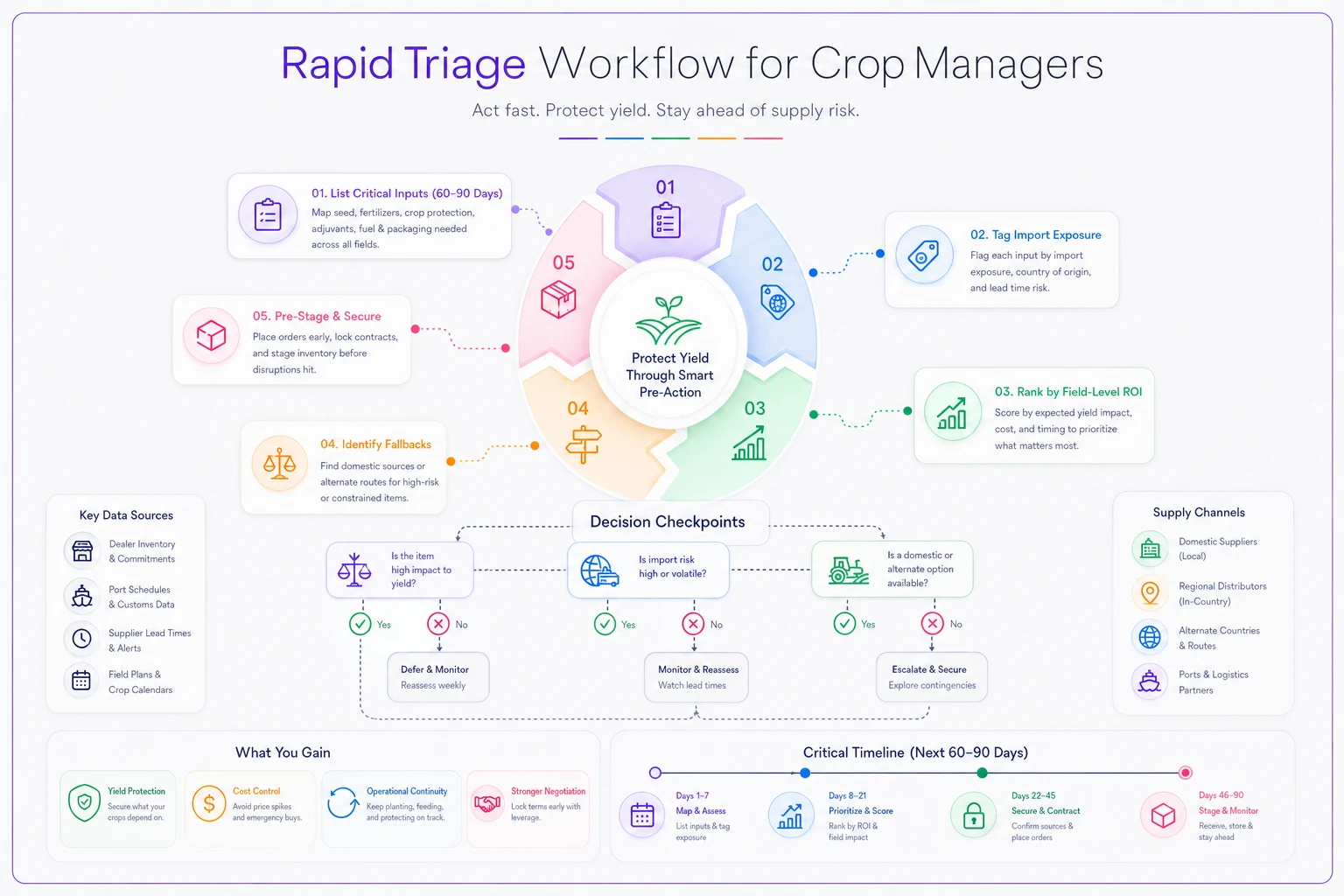
List your next 60–90 days of critical inputs. Not everything — just what blocks planting, repairs, or early-season applications. If a delay on that item stops a crew or delays a field, it's on the list.
-
Tag each item with import exposure. Three buckets
clearly imported, probably domestic, unknown. Call your dealer for the unknowns and ask directly: "Is this a domestically stocked item or does it route through a port?" Most dealers will tell you if you ask.
-
Rank by field-level ROI, not by dollar value. A $280 sensor that strands a planter is more urgent than a $9,000 bulk order you don't need for six weeks. Prioritize by what the delay costs you in the field, not by invoice size.
-
Identify a domestic or alternate-route fallback for your top 5–8 items. You won't have time for all of them. Focus on the handful that carry the most downside risk — that's where you lock in a Plan B now.
-
Pre-stage the orders you can. For anything high-risk and affordable to hold, pull the trigger early. Carrying cost on a few critical parts beats a stalled crew during a tight window.
Quick exposure matrix
Use something like this to sort your list fast:
| Input | Import exposure | Field-ROI impact if delayed | Fallback available? | Action |
|---|---|---|---|---|
| Planter meter electronics | High | High (stops planting) | Limited | Pre-order / source domestic now |
| Chelated micronutrient | High | Medium | Yes (regional supplier) | Confirm fallback stock |
| Bulk N | Low | High | Yes | Monitor only |
| Specialty seed coating | Medium | Medium | Unknown | Call dealer this week |
| Hydraulic components | High | High | Rental bridge possible | Identify rental source |
The point isn't precision. It's forcing you to separate "scary but not actually exposed" from "quiet item that will wreck a window." Once you've got the list sorted, the decisions mostly make themselves.
A quick visual workflow for this triage can help teams move faster.
Call your dealer and ask if an item routes through a port — most dealers will tell you, and it quickly removes "unknown" from your list.
Once you've got the list sorted, the decisions mostly make themselves.
When pre-buying makes sense — and when it doesn't
When it makes sense: the item is high-ROI-at-risk, has real import exposure, is affordable to carry, and doesn't degrade in storage. Controller boards, sensors, specific repair parts — pull these forward.
When it's a bad idea: the item is bulky, perishable, capital-heavy, or has a domestic fallback that's genuinely reliable. Loading up on bulk product you could get locally in two days just ties up cash and yard space. Port risk doesn't mean buy everything early — it means buy the right things early.
Who should probably sit tight: operations with strong domestic sourcing and no port-exposed critical items. If your triage comes back mostly low exposure, the smart move is to document that and not panic-buy alongside everyone else — which is exactly when prices are worst.
The buffer logic that should outlast this one dispute
This port threat will resolve one way or another. The underlying lesson shouldn't disappear with it.
The farms that handle these shocks well aren't the ones with the biggest warehouses — they're the ones that tied their planting calendar to buffer formulas and real supplier scorecards before the disruption hit. That connection between when you actually need something in the field and how much lead-time cushion each input requires is the whole game. We walked through that framework in the seasonal input procurement playbook, and it's worth revisiting now while the risk is concrete rather than hypothetical.
The practical version: every critical input should have a buffer sized to its lead-time volatility, not a flat "order two weeks early" rule. Import-exposed items need bigger buffers because their lead times blow out further and faster when something like this hits. Domestic items need less. Treating them the same is how you end up overstocked on the safe stuff and short on the risky stuff.
This is also where keeping procurement, carrier, and field-timing data in one place — instead of split across a spreadsheet, a dealer's email thread, and someone's memory — pays off. When you can see "this input, this lead time, this field, this planting date" together, the triage above takes an afternoon instead of a frantic week. Operational platforms that centralize that procurement and scheduling picture, and flag which orders are drifting past their safe reorder point, turn a scramble into a routine check. The tool matters less than the habit of connecting the data.
A short real scenario
A specialty vegetable operation running a few thousand acres had early-season planting leaning on an imported seed coating additive and a batch of imported planter sensors. During a prior West Coast slowdown, both landed late. The sensors showed up roughly 18 days behind schedule, and the coating additive was backordered through a distributor also waiting on a stuck container.
The cost wasn't just the delay. They air-freighted a partial sensor order at close to triple the normal landed cost — somewhere around an extra $2,600 across the shipment — and still lost about a week on two fields because the coating wasn't available in time to treat seed on schedule.
The following season they changed one thing: they ran a dependency map before planting, flagged those two items as high-exposure/high-impact, and pre-staged the sensors while lining up a domestic coating fallback. When the next hiccup came, it was a non-event. Same inputs, same vendors — different preparation.
The difference wasn't money spent on inventory. It was knowing which two items mattered before the disruption started.
Bottom line for the next few weeks
The November 4 extension buys a little time, but as the Reuters brief on the deadline extension framed it, this is a short runway at the busiest complex in the country during peak season. You can't control whether a deal gets signed. You can control whether your critical planting and repair inputs have a mapped fallback before the deadline arrives.
Run the triage. Tag your import exposure. Rank by field impact, not dollar value. Pre-stage the handful of items that would actually stall a crew, and leave the safe, domestically-sourced stuff alone. Do that, and whatever happens at the port, your planting window stays yours.
Ready to revolutionize your farm management?
Join 500+ farms using Feldsly to boost yields, reduce waste, and streamline daily farm workflows.