

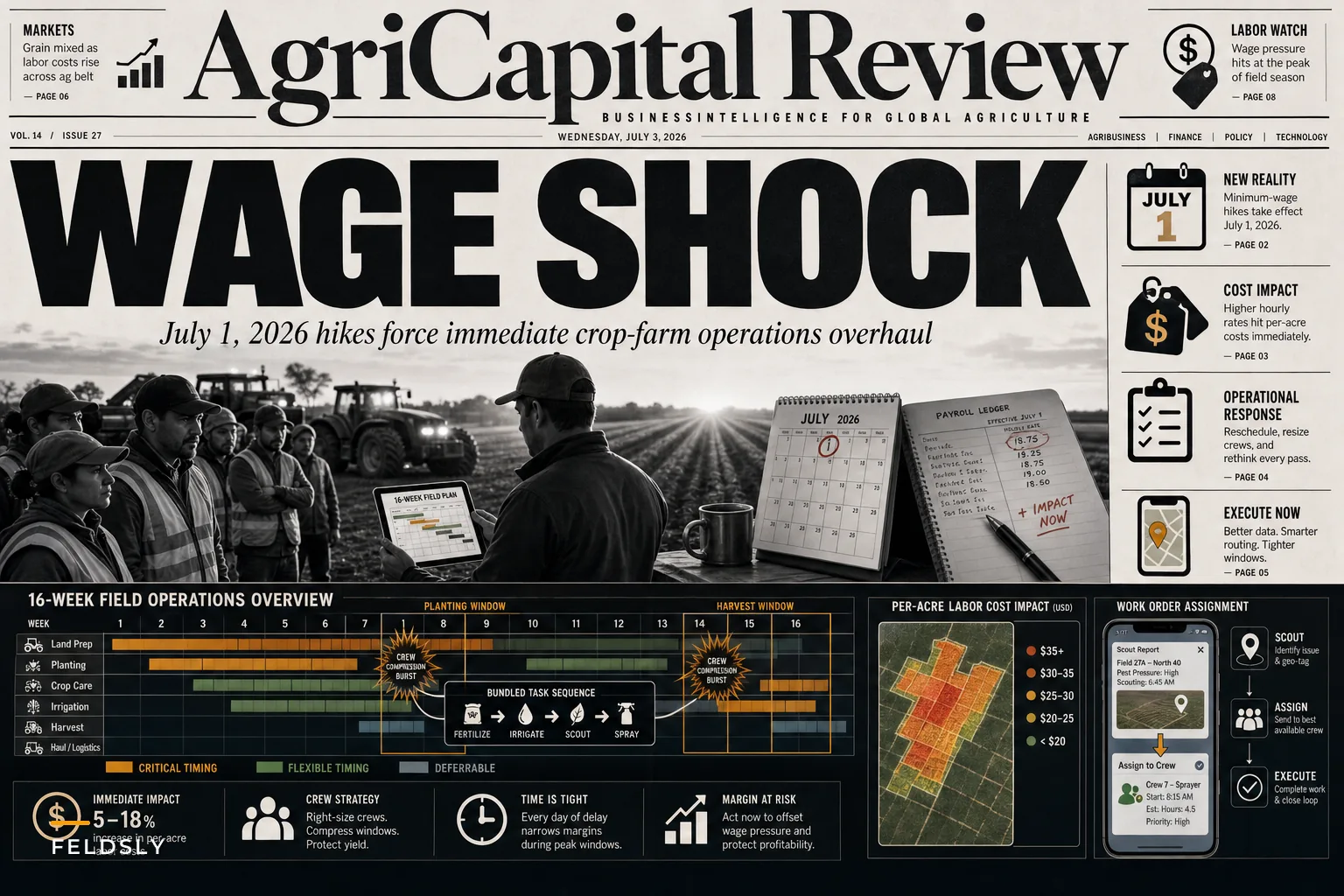

You planned your labor budget in December, locked in crew sizes in March, and now multiple states just raised minimum wages right as you're heading into peak season. Chicago jumped to $17.05, DC hit $18.40, and Oregon's tiered system means different rates depending on which county your fields sit in. The timing is rough.
What's happening beyond the immediate payroll hit is that these July 2026 minimum wage increases are exposing an operational crack that's been forming for years. Most crop operations still run labor planning like it's 1995—static crew sizes, fixed shift templates, the same labor allocation formulas regardless of what's happening with input costs, commodity prices, or wage pressures.
The farms that get through this aren't the ones scrambling to cut hours or rushing H-2A applications. They're the ones who already built flexibility into their labor model and can adjust crew deployment without breaking everything else.
Why midyear wage bumps hit differently than January increases
January increases you can plan for. You adjust enterprise budgets, maybe plant fewer acres of labor-intensive crops, negotiate different terms with buyers. July? That's a different situation.
Your corn's already in the ground. Vegetable contracts are signed. Your seasonal crew is halfway through their H-2A term or local hiring agreements. You can't switch from sweet corn to soybeans, and you can't renegotiate that grocery chain contract you signed in February.
What makes this particularly painful is the cascade. A $2.50/hour increase sounds manageable until you multiply it across 40 workers, 50 hours a week, for 16 weeks. That's an extra $80,000 hitting your books with no corresponding revenue increase. For a 2,000-acre vegetable operation running on 8% margins, that single change just wiped out profit on roughly 250 acres.
The real damage shows up in your field supervision structure. Most farms pay crew leaders as a multiple of base wages—1.3x or 1.5x the standard rate. When minimum wage jumps from $14 to $17, your crew leader cost automatically moves from $18.20 to $22.10. That's not just a line item change; it's a restructuring of your supervision ratios and field management approach.
The three labor models that break first
Fixed crew assignments
Take control of your farm’s productivity.
Feldsly helps you plan, track, and optimize every farming operation with precision.
- Centralized crop scheduling
- Resource & labor management
- Real-time weather alerts
No credit card required
The traditional model—8 people assigned to Field A, 12 to Field B, rotating through the same pattern weekly. This breaks fast when labor costs spike because you're paying for presence, not productivity.
A 3,000-acre grain operation in Illinois tried to maintain their fixed 6-person harvest crew after the wage bump. They burned through $14,000 extra in three weeks before realizing half their crew time was spent waiting for trucks or moving between fields. Running 4 people with tighter scheduling would've saved around $8,400 monthly.
Time-based task allocation
"It takes 20 hours to cultivate 10 acres" becomes a dangerous assumption when those 20 hours now cost 22% more. Farms still using static formulas are essentially betting that labor productivity will rise to match wage increases. It won't.
Uniform pay structures
Paying everyone the same rate regardless of task complexity made sense when you had more pricing flexibility. But when minimum wage approaches $18/hour, you can't afford to pay someone that rate to move irrigation pipes when they could be operating precision equipment.
Smarter operations are already moving to task-based pay differentials. Tractor work at one rate, hand harvest at another, packing shed at a third. Yes, it's more complex to manage, but the alternative is bleeding cash on low-skill tasks while underpaying for critical work.
Building a surge-responsive labor model
Most advice on this would tell you to "optimize your workforce" or "leverage technology." What actually works when you're staring at a 20% labor cost increase with crops already in the ground is more specific than that.
Start by segmenting your operations by labor elasticity. Some tasks are time-critical no matter what—hand harvesting strawberries, for example. Others have flexibility: cultivation timing, fertilizer application windows, equipment maintenance schedules.
When mapping tasks, use three color codes on a shared calendar so dispatchers can quickly consolidate flexible work into single trips.
Map every field operation for the next 16 weeks. Not just the major stuff—everything. Scouting routes, irrigation adjustments, equipment moves, supply runs. Then mark each task with one of three codes:
-
Critical timing (must happen within 24–48 hours)
-
Flexible timing (3–7 day window)
-
Deferrable (can wait 2+ weeks or skip entirely)
A Nebraska corn operation found that around 35% of their July–August labor hours fell into the flexible or deferrable categories. By consolidating those tasks into concentrated work periods, they cut overtime by roughly 60 hours per week—saving over $20,000 monthly even after the wage increase.
Here's a simple visualization that helps planners and dispatchers see compression opportunities and task bundling at a glance.
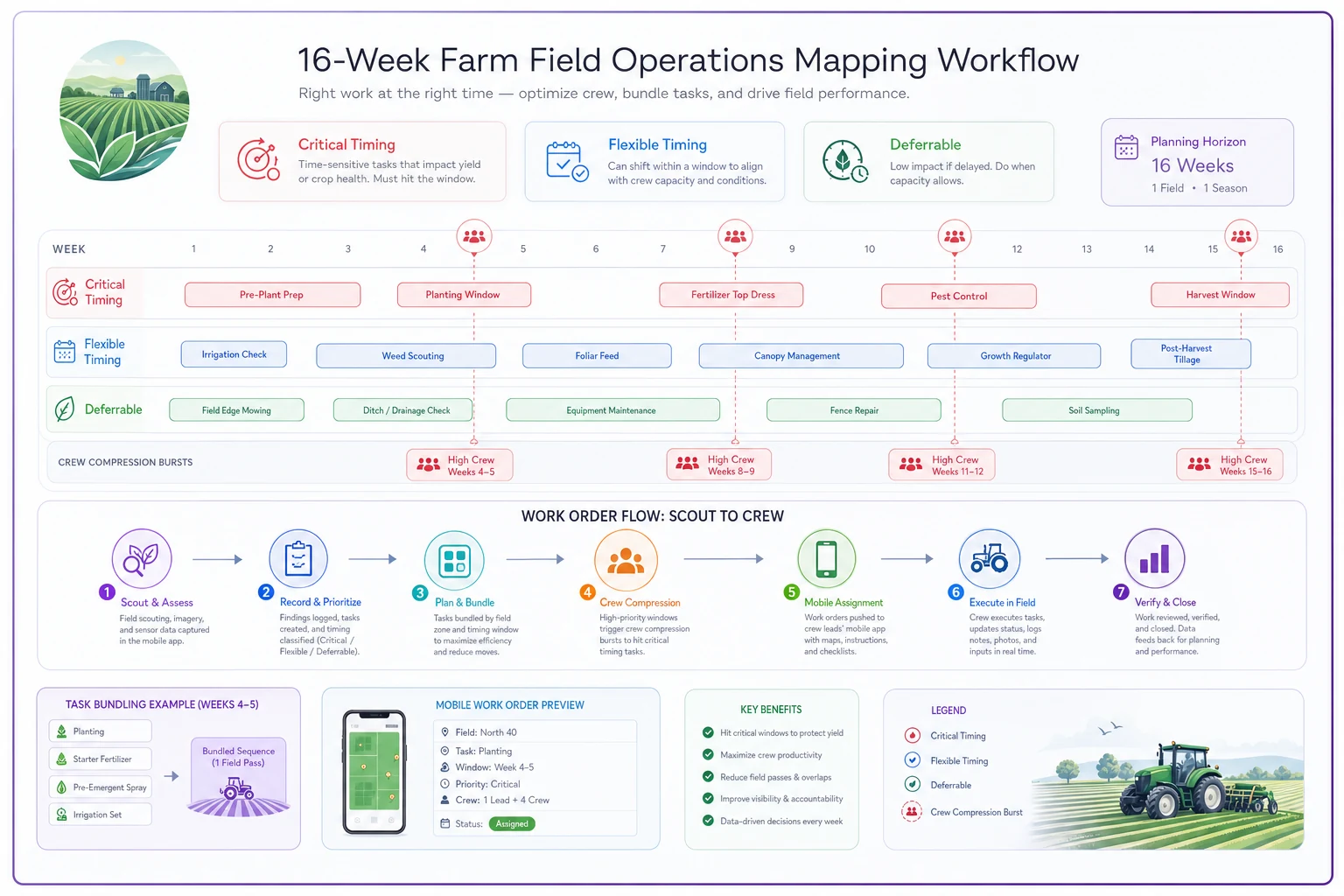
The second move is crew compression. Instead of steady 40-hour weeks for everyone, you run intensive 50–60 hour bursts with fewer people, then scale back during slow periods. Yes, you pay overtime, but overtime on 5 workers costs less than straight time on 8, especially when you factor in workers' comp, transportation, and supervision overhead.
Task bundling strategies that actually reduce hours
Traditional scheduling assigns one task per crew per day. The irrigation crew handles irrigation. The cultivation crew handles cultivation. Clean and simple. That made sense when labor was cheap and coordination was the expensive part.
When you're paying $17+ per hour, every minute of windshield time or equipment setup becomes a profit leak. The fix isn't working people harder—it's restructuring task sequences to eliminate dead time.
A mixed vegetable operation near Chicago had this standard Tuesday routine:
-
Crew 1
Scout tomatoes (3 hours) → lunch → move to peppers (2 hours) → done
-
Crew 2
Cultivate beans (4 hours) → move equipment → cultivate squash (2 hours)
-
Crew 3
Harvest lettuce (6 hours)
Total: 17 hours × 3 workers = 51 labor hours
After restructuring with task bundling:
-
Combined crew
Harvest lettuce (4 people, 4 hours) → split to scout tomatoes and peppers simultaneously (2 people each, 2 hours) → reconvene for cultivation with pre-positioned equipment (4 people, 3 hours)
Total: 36 labor hours
| Scenario | Labor hours | Daily saving | Season saving |
|---|---|---|---|
| Before (standard routine) | 51 | ||
| After (task bundling) | 36 | $255 | $25,500 over 100 days |
That's 15 hours saved per day—roughly $255 daily at the new minimum wage. Over a 100-day season, that's $25,500 recovered.
The key is treating your farm like a factory floor where setup time, travel time, and transition time all count against productivity. Every time someone drives back to the shop for supplies, waits on equipment, or stands around while decisions get made, you're burning money at the new higher rate.
Compliance complexity with midyear changes
The Department of Labor's state wage database shows different effective dates, different rates, and different exemptions across states. Illinois has separate rates for Chicago and Cook County. Oregon has three different zones. Some states exempt agricultural workers; others don't.
The real complexity comes from existing workforce documentation. Those I-9s processed in March, the wage notices posted in April, the payroll systems configured for the season—everything needs updating, and one missed detail becomes an audit target.
This connects directly to the batch onboarding workflows we covered earlier. Farms that built proper documentation systems can push updates through quickly. The ones running on paper and spreadsheets are looking at weeks of administrative work right when they need every hand in the field.
A vegetable grower with fields spanning two counties told me their HR person spent 40 hours just recalculating and re-documenting pay rates for 60 workers. Different fields, different counties, different rates, all needing proper documentation to survive a potential wage audit. Without standardized templates and digital records, it becomes a serious problem.
The mechanization calculation nobody wants to do
Every wage increase triggers the same conversation: should we mechanize? Most farms do this math wrong. They compare the cost of a $400,000 harvester against current labor costs and conclude it'll take 5 years to pay off.
The real math factors in:
-
Wage increases compound—this year's $3 increase becomes next year's baseline
-
Worker availability tightens as wages rise, because other industries become more competitive
-
Compliance costs escalate with workforce size
-
Supervision costs scale with headcount, not acres
When you factor all of that in, a 5-year payback can look more like 3 years. Add the flexibility to harvest at optimal timing without crew constraints, and mechanization starts making sense for some operations as small as 500 acres depending on the crop.
But partial mechanization often costs more than going all-in. A lettuce operation bought a $180,000 harvest aid platform expecting to cut labor needs by 50%. Instead, they still needed the same crew size plus a skilled operator, maintenance support, and backup plans for breakdowns. Per-unit cost actually increased 15%.
The operations that succeed with mechanization pick one task, mechanize it completely, then redeploy those workers elsewhere. Don't try to mechanize everything at once, and don't buy equipment that still requires significant manual labor to function.
Restructuring contractor agreements mid-season
Most custom harvesting and labor contractor agreements include force majeure clauses for weather and disasters, but few address regulatory changes. If you're locked into a fixed-price custom harvesting agreement signed in January, you might assume you're protected from the wage increase.
Read the contract again.
Many contractors include automatic adjustment clauses tied to minimum wage changes, buried in the fine print. Others will walk away from unprofitable contracts, leaving you scrambling for crews in August. The smart move is proactive renegotiation now, before everyone fully realizes the implications.
Hybrid pricing models: Move from pure hourly or per-acre pricing to a hybrid that shares the wage risk. A base per-acre rate plus hourly overage for weather delays or difficult conditions.
Volume commitments: Lock in your contractor by guaranteeing more acres or seasons in exchange for holding current rates through harvest.
Performance bonuses: Instead of higher hourly rates, offer completion bonuses for hitting quality and timing targets. This shifts focus from hours worked to outcomes delivered.
A 1,200-acre sweet corn operation renegotiated their harvest contract in July to include a $0.50/hour wage adjustment subsidy from them, but added performance metrics that ended up reducing total cost by around 8% through improved efficiency and fewer quality claims.
Technology integration that actually saves labor hours
The real opportunity with AI-powered operational software isn't full automation—it's cutting coordination time, reducing errors, and eliminating duplicate work. Targeted tools that solve specific problems.
Field scouting apps that generate work orders automatically. Most scouting still involves walking fields, taking notes, driving back to the office, writing up reports, then separately creating work orders. Total time: around 2 hours per field.
With properly configured operational software, the same scout captures issues digitally, the system generates prioritized work orders based on thresholds you've already set, and crews get assignments on their phones. Time saved: roughly 45 minutes per field. Across 40 fields weekly, that's 30 hours eliminated.
Inventory management that prevents unplanned supply runs. A Midwest grain operation tracked this: their crews made 3–4 unplanned trips daily for supplies, parts, or tools. Each averaged 45 minutes. With basic inventory tracking and morning load lists generated by their operational system, unplanned trips dropped to less than one daily. Annual savings at the new wage rate: around $42,000.
Timesheet automation sounds basic, but manual timecard processing for 50 workers takes 8–10 hours weekly. Add corrections, disputes, and reconciliation, and you're at 15 hours of administrative time. Digital timekeeping with GPS verification and automatic syncing cuts that to under 2 hours.
The pattern is consistent: every manual handoff, every paper form, every phone call to clarify instructions costs more when wages go up. The farms building digital workflows now will have real advantages as labor costs keep climbing.
Critical decisions for the next 30 days
The July 2026 minimum wage increase is done—you can't change it. But how you respond over the next month determines whether you're profitable in October or explaining losses to your lender.
Start with a labor audit this week. Not a general review—a task-by-task breakdown of where every hour goes. You're looking for three things:
-
Tasks that don't directly contribute to yield or quality
-
Duplicate efforts across crews or days
-
Wait time and transit time between productive activities
Then pick your battles. You can't restructure everything at once. Choose either your highest-labor operation or your most frequent operation and redesign it completely. Test the new approach for two weeks, refine it, then move to the next one.
Don't overlook your existing crew. They're watching these wage increases too, and the experienced ones know their value just went up. The cost of losing a skilled equipment operator or crew leader far exceeds paying them properly. Build retention bonuses or skill-based pay adjustments into your revised budget now, before they start fielding offers from other farms.
And document everything. Every schedule change, every new procedure, every adjusted pay rate needs clear records. When the Department of Labor asks questions—and in this environment, they will—you need to show intentional, compliant responses to the wage changes, not panicked reactions.
The farms that hold up despite these pressures aren't necessarily the biggest or most mechanized. They're the ones willing to challenge assumptions about how farm work gets scheduled, organized, and completed. Sometimes a 20% cost increase forces the 30% efficiency improvement you should've made years ago.
July 2026 is an inflection point for agricultural labor. The old model of abundant, cheap seasonal workers filling static roles is winding down. The new model needs fewer, better-paid workers using better tools and systems to hit the same or better output. The sooner you start building toward that, the better positioned you'll be when the next wage increase comes—and it will come.
Ready to revolutionize your farm management?
Join 500+ farms using Feldsly to boost yields, reduce waste, and streamline daily farm workflows.