



The Federal Trade Commission just announced they're investigating the fertilizer price spike that's been hammering crop producers since early this year. Reuters reported the probe extends industry-wide, examining potential anti-competitive practices among major suppliers.
For crop managers currently scrambling through planting season, this investigation matters less for its regulatory implications and more for what it reveals about the operational reality we're facing: procurement has become a strategic weakness that most farms simply aren't equipped to handle.
The immediate pain is obvious. Input costs jumped 40-60% in some regions, completely blowing up the budgets most operations set back in December. But the real killer isn't just the price increases. It's the complete uncertainty around whether you can even get product when you need it.
The procurement blind spot that's costing farms millions
Most mid-size crop operations run procurement like they did twenty years ago. Someone calls three suppliers, maybe checks a spreadsheet from last year, and places an order based on whoever answers the phone first with decent pricing.
This worked fine when fertilizer markets were stable and regional suppliers carried consistent inventory. Now? When your primary supplier suddenly limits orders to 70% of last year's volume, or spot prices jump $200/ton between Tuesday and Thursday, you're screwed.
A 4,000-acre corn operation in Illinois lost roughly $145,000 in margin this spring because they had no visibility into alternative suppliers beyond their usual three contacts. Their procurement "system" was essentially the farm manager's cell phone contact list and a folder of old invoices.
When their main nitrogen supplier announced allocation limits in March, they spent two weeks calling around, finally securing product at a 35% premium over what competitors paid—competitors who had already mapped out secondary and tertiary supplier relationships months earlier.
This isn't about predicting price spikes. Nobody saw this exact scenario coming. It's about running procurement without any systematic approach to supplier diversification, price tracking, or inventory planning beyond "we'll order when we need it."
Building a resilient procurement operation (without a crystal ball)
The farms weathering this crisis best aren't necessarily the biggest ones with the most buying power. They're the ones that treat procurement as an actual operational function rather than an afterthought.
Take control of your farm’s productivity.
Feldsly helps you plan, track, and optimize every farming operation with precision.
- Centralized crop scheduling
- Resource & labor management
- Real-time weather alerts
No credit card required
Start with supplier mapping that goes beyond your regular contacts. A properly managed procurement operation maintains active relationships with at least 8-10 potential suppliers, even if you only regularly buy from 2-3. This means:
-
Tracking their typical inventory levels
-
Understanding their supply chains (who supplies them?)
-
Monitoring their allocation policies during shortages
-
Recording actual delivery performance, not just promises
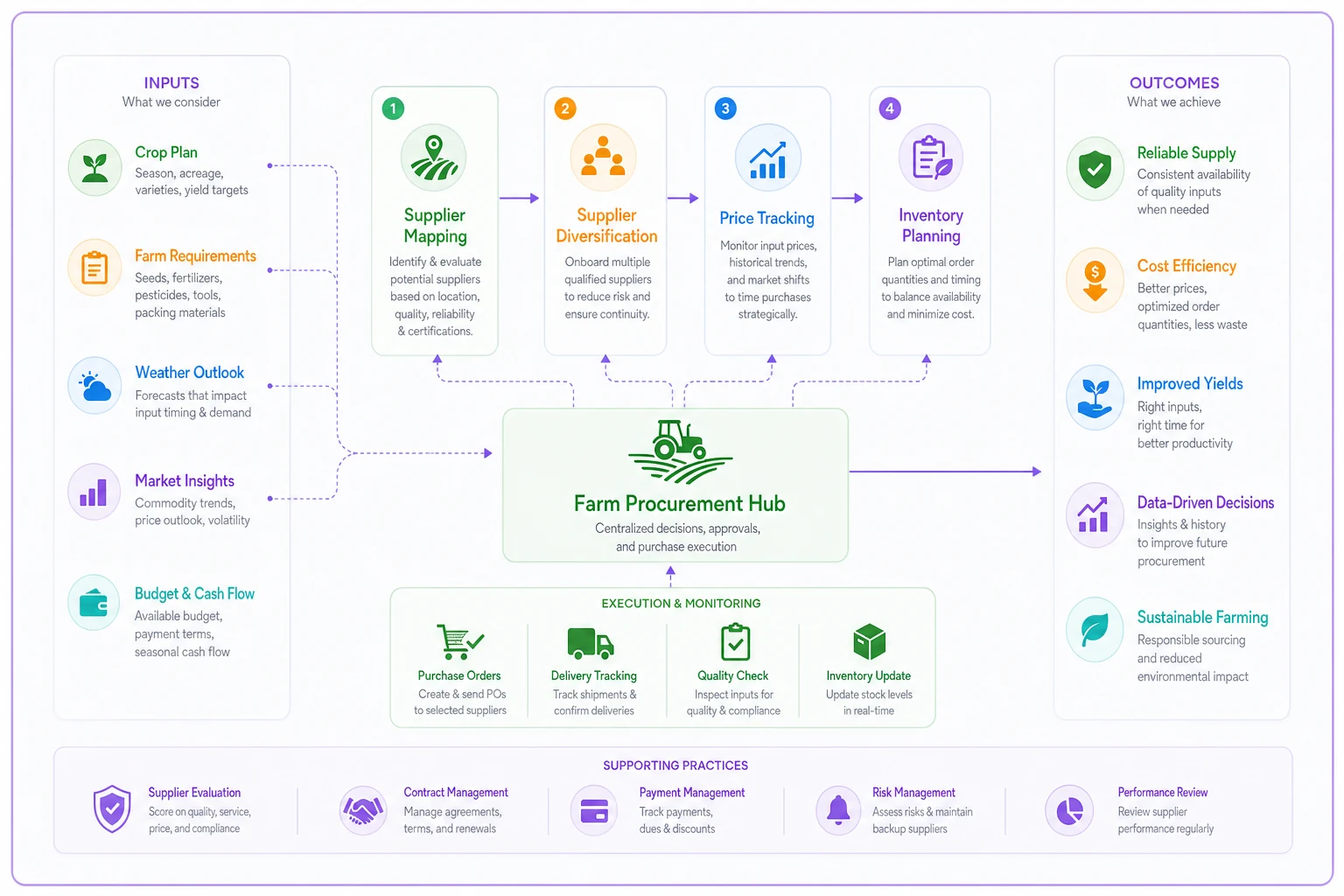
One Kansas wheat operation I work with maintains what they call a "supplier scorecard"—nothing fancy, just a spreadsheet tracking response times, actual vs. quoted prices, and delivery reliability for every supplier interaction. During this year's shortage, they knew exactly which suppliers would actually deliver on promises versus those who consistently over-commit.
Result? They secured 85% of their nitrogen needs at roughly 15% over last year's prices, while neighbors who relied on spot purchasing faced 40-50% increases—if they could find product at all.
The working capital trap nobody talks about
The real destroyer of farm economics during these price spikes: complete disruption to cashflow planning when input costs suddenly jump while your crop prices are locked in through forward contracts.
Picture a 2,500-acre soybean operation that forward-contracted 60% of expected production back in January at $14/bushel. Solid price, decent margin based on expected input costs. Then fertilizer prices spike, adding roughly $80,000 in unexpected costs. But the revenue side is already locked.
The working capital requirement just exploded, but most farms don't have operational systems to quickly model these scenarios and adjust. They're flying blind until the accountant runs quarterly reports—way too late to make operational adjustments.
Smart operations now run weekly cashflow projections during planting season. Not complicated financial models—just basic tracking of:
-
Committed input costs (locked in)
-
Estimated input costs (not yet purchased)
-
Forward contract commitments
-
Expected spot sales revenue
-
Operating line of credit usage
This visibility lets you make rapid decisions about whether to reduce planted acres, adjust fertilizer application rates, or renegotiate credit terms before you're in crisis mode.
Allocation decisions when every pound counts
When fertilizer becomes both expensive and scarce, allocation becomes critical. Which fields get full rates? Which get reduced applications? How do you make these decisions without destroying next year's soil health?
Most operations still make these calls based on gut feel or simple rules like "corn fields get priority." When you're looking at a 40% cost increase, gut feel leaves massive money on the table.
The operations handling this crisis best use actual yield response data to drive allocation. Our recent deep-dive into marginal response prioritization breaks down the full framework, but the core principle is straightforward: allocate based on economic return per dollar of input, not tradition.
-
Pulled three years of yield maps
-
Identified fields with highest response rates to phosphorus
-
Maintained full rates on the top 40% of responsive acres
-
Cut rates by 50% on the bottom 30% (historically low response)
-
Applied moderate reductions to the middle tier
Result: roughly 8% total yield impact versus an estimated 18% loss from across-the-board cuts. That's about $425,000 in preserved revenue.
The technology gap that's widening fast
The uncomfortable truth about this crisis is that farms running modern operational software are navigating it far better than those still managing everything through spreadsheets and phone calls.
I'm not talking about fancy AI predictions or complex analytics. Just basic operational visibility: knowing your real costs, tracking supplier relationships, monitoring inventory levels, and running simple scenarios.
A North Carolina operation with 3,200 acres recently showed me their procurement dashboard—nothing revolutionary, just automated tracking of:
-
Current supplier quotes (updated daily)
-
Historical pricing trends
-
Inventory on hand
-
Upcoming application schedules
-
Alternative product options
When prices spiked in March, they could immediately see that switching 30% of their program to a different nitrogen formulation would save roughly $67,000 while maintaining similar yield expectations. The math took minutes, not days.
Meanwhile, their neighbor spent two weeks calling suppliers, building spreadsheets, and still ended up paying about $45/acre more for essentially the same nutrient program. One operation treats procurement as a systematic process, the other treats it as a last-minute scramble.
Contract management in volatile markets
The current investigation might lead to regulatory changes, but farms can't wait for government fixes. The immediate need is better contract management—and most operations are terrible at this.
Standard fertilizer contracts often include clauses about "force majeure" or "allocation rights" that suppliers invoke during shortages. But when's the last time you actually read these terms? Or more importantly, negotiated them?
A large Iowa corn operation learned this lesson painfully when their supplier invoked allocation rights, cutting their contracted volume by 35% despite having a "firm" commitment. The contract technically allowed this during "industry-wide shortage conditions"—language they'd never bothered to negotiate.
Compare this to a Wisconsin operation that specifically negotiates:
-
Maximum allocation reduction percentages
-
Price protection within defined ranges
-
Substitution rights for equivalent products
-
Penalty clauses for non-delivery
They still faced challenges during the spike, but their contractual protections saved them approximately $180,000 versus spot market purchases.
Information asymmetry is killing smaller operations
The real tragedy of this fertilizer crisis is watching smaller farms get absolutely destroyed by information gaps. Large operations have procurement specialists, market intelligence, and established supplier relationships. The 800-acre family farm has the owner trying to manage procurement between equipment repairs and field work.
The information disadvantage is staggering. By the time smaller operations hear about price increases or supply constraints, larger farms have already locked in their needs. It's not about market power—it's about operational awareness.
Shared procurement intelligence becomes critical here. Several Midwest co-ops are now running WhatsApp groups where members share real-time pricing and availability info. Nothing formal, just "FYI, [supplier] has urea at $680/ton, taking orders until Thursday."
One Illinois group with about 40 members estimates they've collectively saved around $2.8 million this season through information sharing. Not because they're getting special deals—just because they're eliminating the information lag that usually costs smaller operations big money.
Practical steps for immediate implementation
Forget complex strategies. Here's what you can actually do this week to improve your procurement operation:
Supplier Intelligence Gathering Start calling suppliers you've never used. Not to buy—just to understand their operation. Ask about their supply sources, typical inventory levels, and allocation policies. Build relationships before you desperately need them.
Document Everything Every quote, every conversation, every delivery. Use whatever system works—spreadsheet, notebook, phone apps. The documentation becomes invaluable when you need to quickly compare options or dispute charges.
Create Triggers, Not Schedules Instead of "we buy in March," establish triggers: "when price drops below $X" or "when inventory hits Y weeks of supply." This shifts you from reactive to strategic purchasing.
Run Simple Scenarios What if prices jump another 20%? What if you can only get 60% of needed volume? Basic scenario planning takes an hour but prevents panic decisions that cost thousands.
| Step | Details |
|---|---|
| Supplier Intelligence Gathering | Start calling suppliers you've never used. Not to buy—just to understand their operation. Ask about their supply sources, typical inventory levels, and allocation policies. Build relationships before you desperately need them. |
| Document Everything | Every quote, every conversation, every delivery. Use whatever system works—spreadsheet, notebook, phone apps. The documentation becomes invaluable when you need to quickly compare options or dispute charges. |
| Create Triggers, Not Schedules | Instead of "we buy in March," establish triggers: "when price drops below $X" or "when inventory hits Y weeks of supply." This shifts you from reactive to strategic purchasing. |
| Run Simple Scenarios | What if prices jump another 20%? What if you can only get 60% of needed volume? Basic scenario planning takes an hour but prevents panic decisions that cost thousands. |
Basic scenario planning takes an hour but prevents panic decisions that cost thousands.
The path forward
The FTC investigation might eventually address anti-competitive practices, but regulatory changes won't help with this year's crop. Even if prices stabilize, the underlying problem remains: agricultural procurement systems haven't evolved to handle modern supply chain complexity.
The operations surviving this crisis are the ones that stopped treating procurement like an afterthought. They're building systematic approaches to supplier management, implementing basic operational software to track costs and inventory, and making allocation decisions based on data rather than tradition.
This isn't about becoming a commodities trader or trying to time markets. It's about basic operational discipline: knowing your costs, managing supplier relationships, and maintaining enough visibility to make rapid adjustments when markets shift.
The fertilizer price spike exposed how fragile most agricultural procurement operations really are. The farms that learn from this crisis and build more resilient systems will have a massive advantage—not just in the next crisis, but in day-to-day margin management.
Because whether prices spike or crash, the farms with better operational systems always come out ahead. The current crisis just makes the advantage impossible to ignore.
Ready to revolutionize your farm management?
Join 500+ farms using Feldsly to boost yields, reduce waste, and streamline daily farm workflows.