

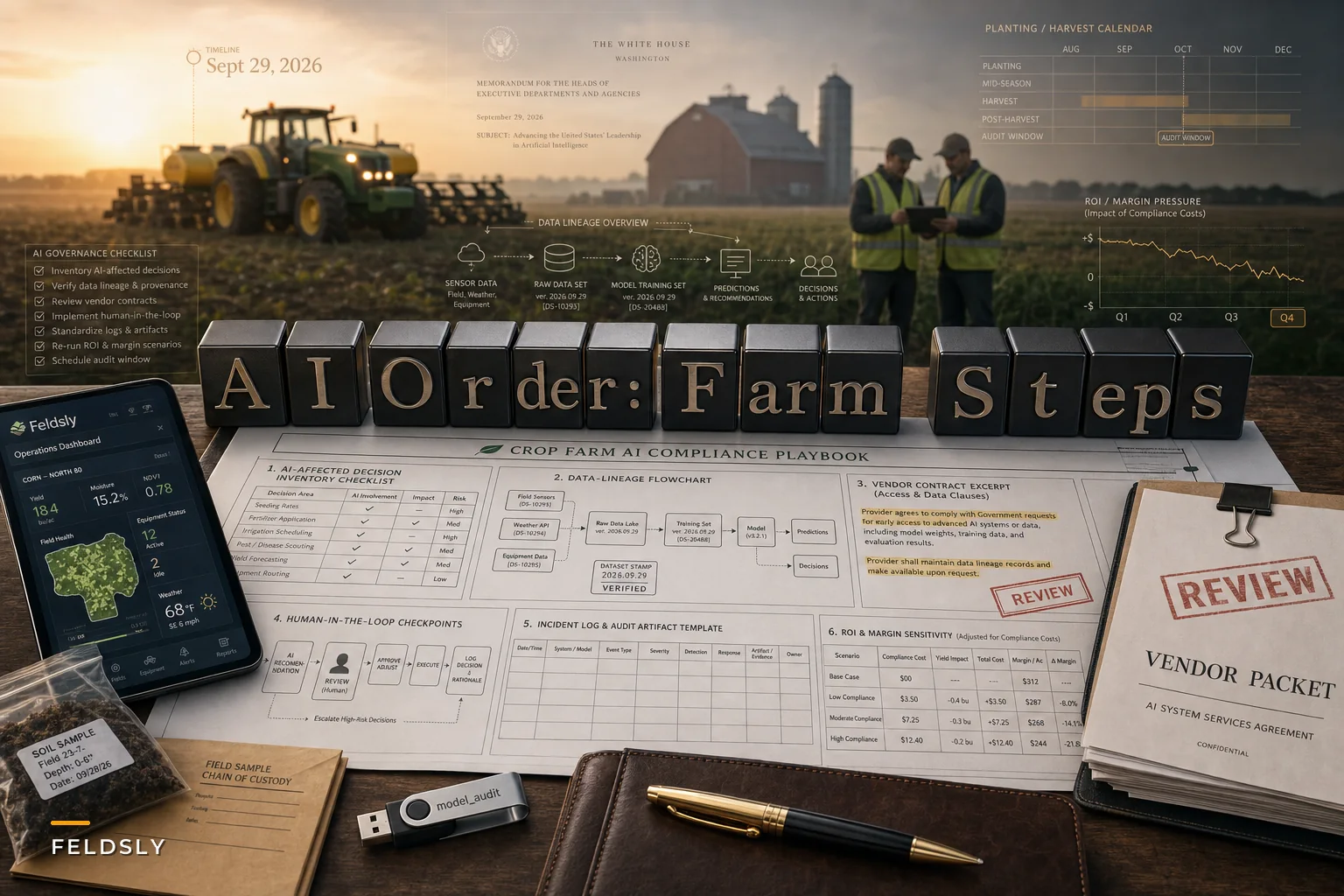

On September 29, 2026, the White House signed an executive order titled "Inaugurating the Era of Super Intelligence", directing federal agencies to formally label advanced AI systems as "Super Intelligence," launching a new government portal, and rolling out a voluntary industry accord with major AI firms around safety and early-access commitments. As CNBC reported, the move signals sharper federal attention on frontier-model capability and the companies building on top of it.
For most crop farms, the headline itself doesn't change tomorrow morning's irrigation schedule. But the downstream effect is where it gets real: the SaaS vendors you rely on — your variable-rate platform, your yield-prediction tool, your telemetry dashboard — are going to inherit new documentation, auditing, and data-access expectations. And when vendors scramble to comply, that friction usually lands on you, at the worst possible time.
This isn't a legal briefing. It's an operational one. Below is what farm managers should actually tighten up before the compliance language starts showing up in renewal contracts and vendor questionnaires.
Why this lands on farms harder than people expect
Most managers underestimate this: your farm is already running on AI-derived decisions, you just don't call it that. Prescription maps, moisture-based irrigation triggers, disease-pressure alerts, auto-generated input recommendations — a lot of that is model output you're acting on without a clear record of why the model said what it said.
When governance expectations tighten, the question shifts from "does the tool work?" to "can you explain and defend what the tool told you to do?" That's a completely different operational muscle, and most farms haven't built it.
The pattern that shows up repeatedly: a farm adopts three or four AI-enhanced platforms over a few seasons, each with its own data silo, its own export format, and its own black-box logic. Nobody owns the connective tissue. Then a buyer, an insurer, or a sustainability-program auditor asks for the lineage behind a nitrogen-reduction claim — and the farm realizes it can't reconstruct the decision trail.
AI governance for farms isn't about regulating robots. It's about being able to answer three questions quickly:
-
What data went into this decision?
-
Which system or model produced the recommendation?
-
Who reviewed it before it got executed in the field?
If you can't answer those for your top five AI-driven workflows, the federal push toward auditing and documentation is going to expose that gap whether you're ready or not.
The 7 steps, in the order that actually matters
Most governance checklists are written by people who've never had to pull a crew off a planter to track down a missing data export. These are sequenced by operational urgency, not by what looks clean on a slide.
Take control of your farm’s productivity.
Feldsly helps you plan, track, and optimize every farming operation with precision.
- Centralized crop scheduling
- Resource & labor management
- Real-time weather alerts
No credit card required
Below is a simple operational flow to follow when you start tightening governance.
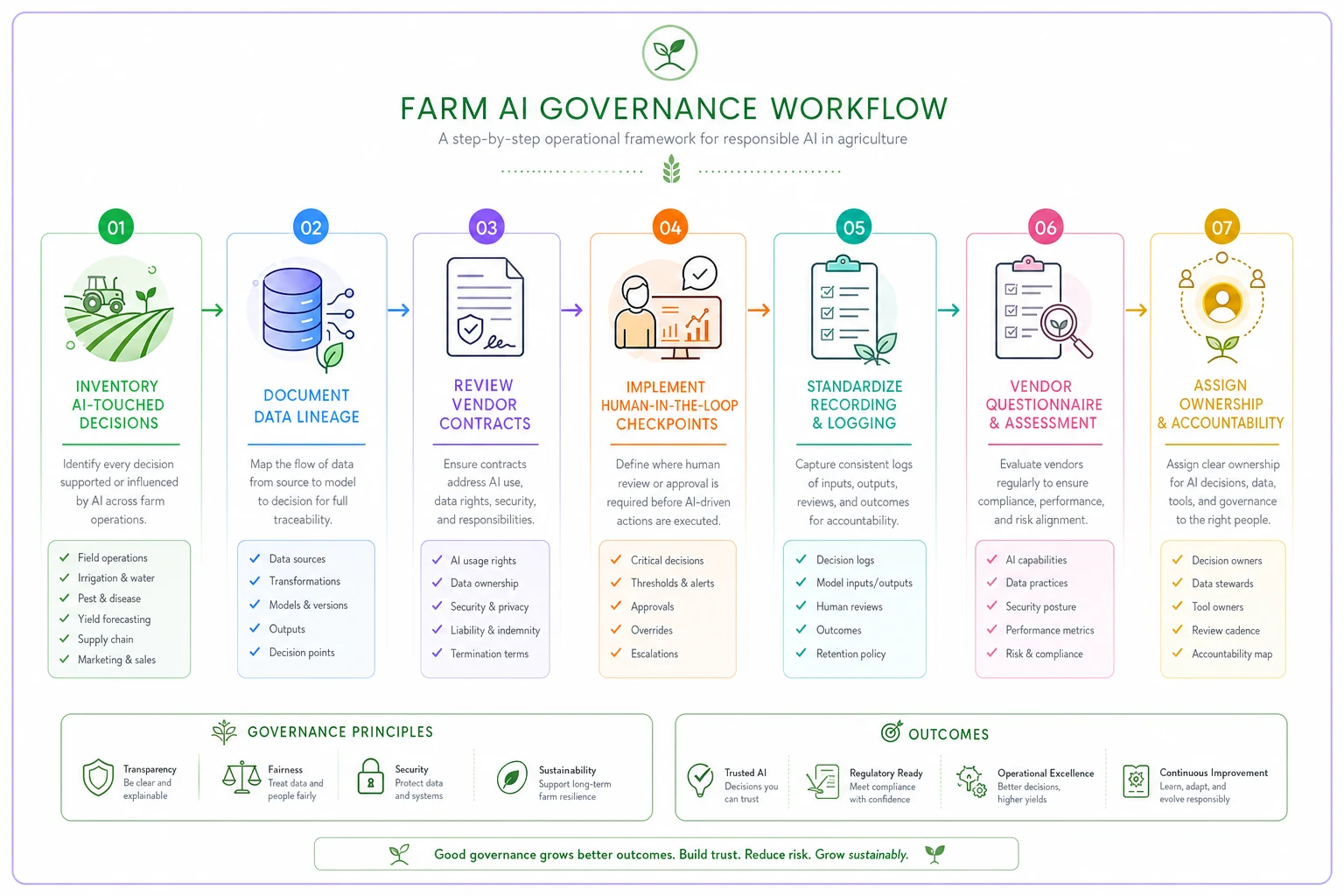
A compact flowchart like this helps teams follow the sequence when things get busy.
1. Inventory every AI-touched decision before you touch anything else
You can't govern what you haven't mapped. Start with a simple list of every place a model, algorithm, or "smart" recommendation influences a real decision on your operation.
A typical mid-size grain farm's list looks something like:
| AI-touched workflow | Vendor/source | Human review today? | Data exportable? |
|---|---|---|---|
| Variable-rate seeding maps | Equipment OEM platform | Agronomist signs off | Yes, proprietary format |
| Irrigation scheduling | Sensor + weather SaaS | Mostly automated | Partial |
| Disease/pest alerts | Scouting app | Crew lead reviews | Screenshots only |
| Yield prediction | Standalone analytics tool | Rarely reviewed | CSV export |
| Input procurement suggestions | Supplier portal | Manager eyeballs | No |
Start by listing the five AI-influenced decisions that affect your P&L the most and expand from there.
The first time most managers fill this out, two things jump out: how many decisions have no real human checkpoint, and how many systems you genuinely cannot export clean data from. Those two columns are your actual risk map.
2. Nail down data lineage for your highest-stakes workflows
You don't need lineage on everything. You need it on the decisions that cost real money or create liability — nutrient application, chemical decisions, and anything tied to a buyer or sustainability claim.
For each of those, document where the input data originates (which sensor, which field pass, which upload), how it's transformed, and where the output gets stored. In real operations, this breaks down the moment data hops between a telemetry feed and a spreadsheet someone keyboards by hand. That handoff is almost always the weakest, least documented link — and it's exactly what an audit request zeroes in on.
This connects directly to something we've written about before: why staged data governance unlocks ROI for AI in mid-size and large farms. The farms that treated data governance as a phased build-out — rather than a one-time cleanup — are the ones now able to respond to vendor questionnaires in an afternoon instead of three frantic weeks.
3. Re-read your vendor contracts with new eyes
Pull your SaaS agreements and look specifically for:
-
Data ownership — does the vendor claim rights to your field data or model-training usage?
-
Export guarantees — can you get your data out in a usable format if you leave, or if they fold?
-
Audit cooperation — will they support you if a buyer or regulator asks for model documentation?
-
Model-change notification — do they have to tell you when they swap or retrain the model driving your recommendations?
That last one is quietly critical. Prescription logic can change between seasons with zero notice, and a farm won't catch it until yields drift in a way that makes no agronomic sense. If a model updates silently and your outcomes shift, you need a contractual breadcrumb trail.
4. Build a human-in-the-loop checkpoint for consequential decisions
Not every recommendation needs a human. But high-consequence ones — chemical applications, large nutrient swings, irrigation during a drought window — should never execute purely on autopilot without a named reviewer.
-
Does the recommendation affect regulated inputs (chemicals, nutrients) or a buyer-facing claim? → Mandatory human sign-off.
-
Does it commit more than a set dollar threshold (say, $5k–$8k in inputs)? → Manager review.
-
Is it routine and low-stakes (standard irrigation top-up)? → Automated, logged, spot-checked weekly.
-
Everything else → Automated with a monthly audit sample.
The point isn't to slow your operation down. It's to make sure that when someone asks "who approved this?", the answer isn't silence.
5. Standardize how AI decisions get recorded
The farms that struggle most during any audit aren't the ones with bad decisions — they're the ones with undocumented ones. A perfectly reasonable nutrient call is worthless as evidence if the record is a blurry phone screenshot and a crew member's memory.
Pick a consistent capture standard: the recommendation, the source, the data behind it, the reviewer, the date, and the actual action taken. It doesn't have to be fancy. It has to be consistent. Governance-ready operational platforms with AI automation help here because they log this trail automatically as decisions flow through — but even a disciplined shared log beats scattered screenshots, as long as everyone actually uses it.
6. Pressure-test your vendors with a short questionnaire
Before the formal compliance language hits, get ahead of it. Send your core AI vendors a brief set of questions:
-
Where are your models trained, and on what data?
-
How do you handle explainability requests?
-
What's your process if a customer needs an audit trail?
-
How and when do you notify customers of model changes?
-
What happens to our data if we leave or you're acquired?
A vendor that can't answer these clearly is a vendor that will become a problem when expectations tighten. The quality of the answer tells you a lot — the strong ones respond like they've thought about it; the weak ones go quiet or get defensive.
7. Assign ownership before you need it
Governance fails when it belongs to everyone, which means it belongs to no one. Name a single person — often the operations manager — responsible for the AI decision inventory, the vendor documentation, and the audit-response process. Give them a quarterly 90-minute review to keep the inventory current as you add or drop tools.
This is the step farms skip most often, and it's the one that determines whether all the earlier work actually holds up by next season.
A real scenario: what this looks like in practice
Consider a roughly 4,000-acre corn and soybean operation running four AI-enhanced platforms across seeding, irrigation, scouting, and procurement. Last season a grain buyer tied to a sustainability premium asked them to document the data behind a reduced-nitrogen claim on about 900 acres.
The problem: the nitrogen recommendations came from one platform, the actual application records lived in the equipment OEM's system, and the field sampling that justified it was in a different app entirely. Reconstructing the trail took the operations manager parts of three weeks during a busy stretch — pulling exports, matching timestamps, filling gaps from memory. They kept the premium, but barely.
After building a decision inventory and standardizing their capture process over the following off-season, the same type of request this year took under two days. Nothing about their farming changed. What changed was that the decisions were now traceable.
When tightening governance makes sense — and when it doesn't
Worth doing now if: you run multiple AI-driven platforms, you sell into any buyer or program with sustainability or traceability requirements, or you've already had an audit or documentation request go sideways.
You can move slower if: you're a small single-operator farm using one simple tool, with no buyer-facing claims and no near-term plan to expand your tech stack. Don't build a governance bureaucracy for a one-app operation.
Don't over-engineer this. The mistake on the other end is treating every soil-moisture ping like it needs a signed approval. Governance should scale with consequence. Low-stakes, reversible, cheap decisions can stay automated and lightly sampled. Reserve your real rigor for the handful of calls that move money or create liability.
The underlying problem this moment exposes
Federal attention on frontier AI is really just forcing a question farms should have been asking anyway: do you control your AI-driven operations, or do your vendors?
For years the pitch was "trust the tool, it's smarter than guessing." That was often true. But trust without traceability is fragile — the moment anyone outside your operation asks you to show your work, undocumented trust becomes a liability. The order and its accompanying industry accord simply pull that reckoning forward.
The farms that will handle this smoothly aren't the ones with the fanciest software. They're the ones who can explain their decisions, reproduce their data trail, and point to who approved what. Build that capability during the slow season, on your own terms — because doing it reactively, mid-harvest, with a buyer or auditor waiting, is where real operational damage happens.
Ready to revolutionize your farm management?
Join 500+ farms using Feldsly to boost yields, reduce waste, and streamline daily farm workflows.