

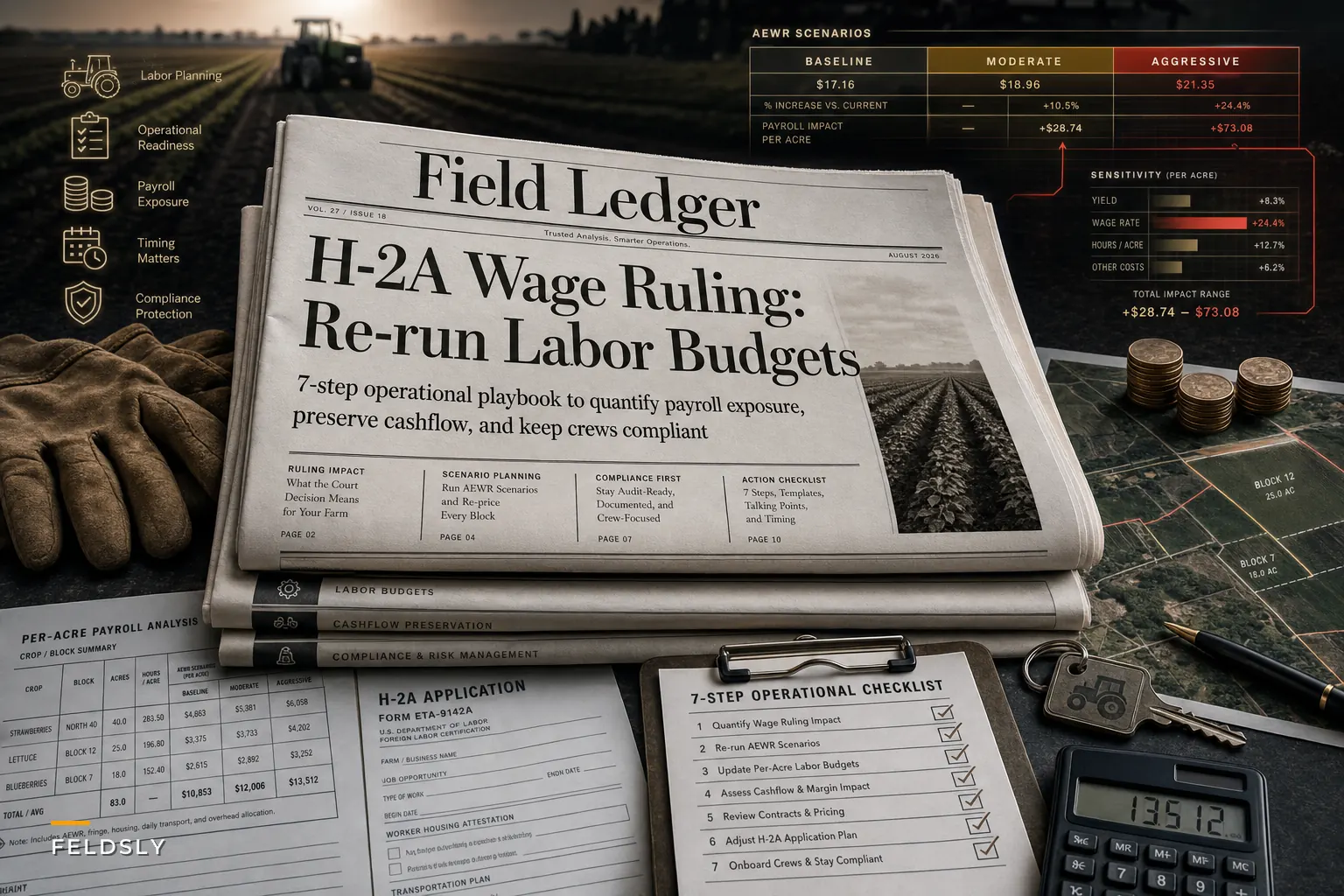

On August 27, 2026, a federal judge vacated the Department of Labor's methodology for calculating Adverse Effect Wage Rates and told the agency to build a replacement. If you run seasonal or H‑2A crews, that ruling just knocked your labor-cost assumptions loose right before fall hiring and harvest. Reuters reported the court ordered the administration to redo the changes, and DOL has since started signaling next steps through its OFLC AEWR process update.
The uncomfortable part: the ruling itself isn't the problem. The problem is that most crop operations budgeted a single AEWR number into their per-acre models and built their whole season around it. When that number becomes uncertain, everything downstream — payroll, contractor pricing, application timing, the mechanization conversation you've been putting off — starts wobbling at once.
This isn't a legal explainer. It's what to actually do in the next two to four weeks so you're not caught flat-footed on payroll or an audit.
First, understand what's genuinely at risk (it's not just the hourly rate)
The wage rate is the visible thing. The hidden exposure is worse.
When a methodology gets vacated and replaced, there's real potential for rate adjustments that don't line up neatly with your pay periods. If a corrected rate lands higher than what you paid, retroactive liability becomes a live question — and that's not something you want to discover during an audit. That's a number you want modeled before you sign your next labor-provider contract.
What tends to happen in operations that rely heavily on H‑2A: the farm treats the AEWR like a fixed input, similar to diesel price on a given day, when it should be treated more like a range with scenario branches. The ones who get burned aren't necessarily paying the wrong rate — they're the ones who never built a second scenario, so when things shift they're re-doing every spreadsheet from scratch during the busiest month of the year.
Three exposure buckets worth separating right now:
-
Forward cost exposure — what your per-acre labor cost looks like under a higher replacement rate
-
Retroactive exposure — potential backpay if a corrected rate applies to work already performed
-
Timing exposure — H‑2A application windows and paperwork deadlines that don't pause just because the rule is in flux
Most farms only model the first one. The second two are where the surprises tend to live.
Step 1 — Re-run labor budgets under three AEWR scenarios, not one
Don't try to guess the exact replacement number. You'll be wrong, and it doesn't matter anyway. What matters is knowing your break-even sensitivity.
Take control of your farm’s productivity.
Feldsly helps you plan, track, and optimize every farming operation with precision.
- Centralized crop scheduling
- Resource & labor management
- Real-time weather alerts
No credit card required
Build three columns: your current assumed rate, a moderate increase, and an aggressive increase. Run each through your per-acre labor cost for every crop and every field block. The output you're after is simple — at what rate does a given field stop being worth hand-labor?
| Scenario | Assumed AEWR | Labor cost/acre (example lettuce block) | Margin impact |
|---|---|---|---|
| Baseline | current rate | ~$1,180 | planned margin |
| Moderate | +6–9% | ~$1,255–$1,285 | tightens noticeably |
| Aggressive | +12–15% | ~$1,320–$1,360 | flips marginal fields |
Those numbers are illustrative — plug your own in. A 12% swing on a labor-heavy block can be the difference between a field you harvest by hand and one you mechanize or walk away from entirely.
A short visual of the re-run process can help align finance, operations, and contracting on the same steps.
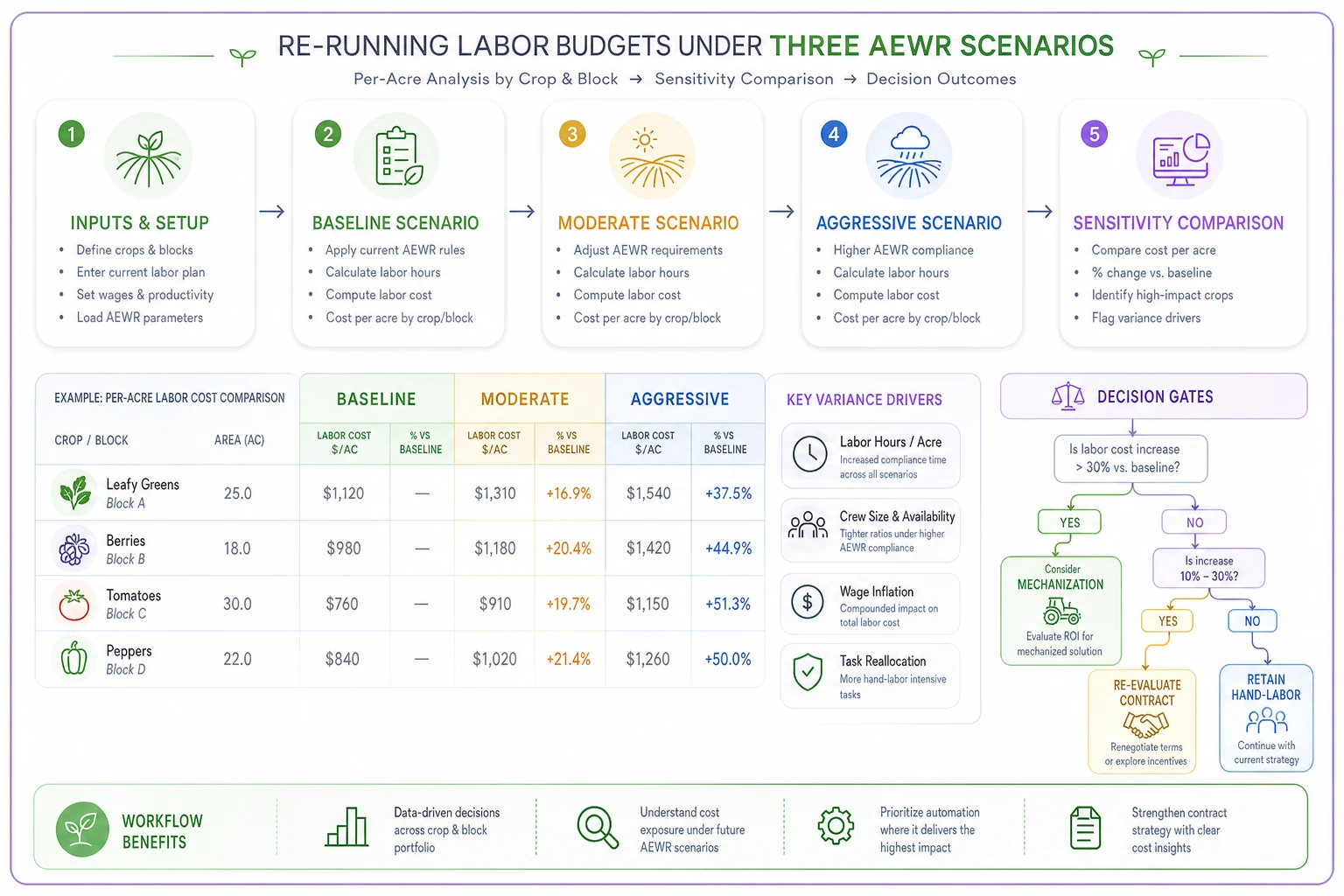
Use the outputs to set clear trigger points for mechanization or contract negotiations.
Step 2 — Freeze and re-verify your H‑2A application timing
Application windows don't care about regulatory uncertainty. If you push paperwork late waiting for clarity, you can miss your need-by date and lose the crew.
The safer posture during flux: file to your existing timeline, document your rate assumptions in writing, and keep a note in the file explaining which methodology you relied on and when. If rates change later, you want a clean paper trail showing you acted in good faith on the information available at filing.
Step 3 — Stress-test contractor and labor-provider contracts for rate pass-through
Pull every labor-provider agreement and find the clause that handles wage changes. A lot of them are silent or vague on this, which means in a dispute you're negotiating from zero.
Before you renew anything this fall, get explicit language on:
-
Who absorbs a mid-season rate correction
-
How retroactive adjustments (if any) get split
-
What documentation the provider owes you for audit purposes
The contract renegotiation is often where farms recover the most ground — not from the wage math itself, but from refusing to sign open-ended pass-through language they'd have accepted six months ago.
Step 4 — Pull the mechanization-vs-labor analysis forward
You probably have a someday list of tasks you'd automate if labor got expensive enough. That someday just moved up.
You don't need to buy a harvester this week. You need to know your trigger points. For each labor-heavy operation, write down the wage rate at which mechanization or a rental unit actually pencils out. When those thresholds are documented, a rate change becomes a decision you already made instead of a panic you're managing.
A practical example: a mid-size vegetable operation running around 40–50 seasonal workers on harvest found that at a moderate rate increase, two of their crop blocks crossed into "rent the mechanical harvester" territory, while the higher-value blocks still favored hand-picking. Knowing that in advance meant they could reserve equipment early instead of fighting for it at peak season.
Step 5 — Rebuild your per-acre margin gates around the new sensitivity
Once you know which fields flip under which scenario, turn that into decision gates. Simple rules written down: "If the replacement rate lands above X, block C shifts to mechanical harvest and block D drops from the hand-thinning plan."
Written gates beat live debates every time. When the number finally lands, you execute — you don't hold a meeting.
Step 6 — Tighten payroll documentation so retroactive risk is quantifiable
If a corrected rate ends up applying backward, the farms that get through it cleanly are the ones who can produce exact hours, exact rates paid, and exact pay periods per worker in minutes, not days.
Centralize hours in one digital record so retroactive exposure can be calculated quickly.
Ask yourself honestly: if DOL published a new number tomorrow with a retroactive component, could you calculate your exposure by Friday? For a lot of operations the honest answer is no, because the hours live in three places — a foreman's notebook, a spreadsheet, and someone's memory.
Step 7 — Make onboarding and compliance audit-ready before the replacement rule lands
Regulatory change periods are exactly when audits get more attention, not less. The farms that stay calm are the ones whose crew files were already clean going in.
If every seasonal and H‑2A hire moves through a consistent, documented intake — right paperwork, right timestamps, right rate disclosures — you're not scrambling to reconstruct anything. We covered how to build this end-to-end in the guide on batch onboarding that survives audits, and it's worth revisiting now specifically because a rate change is the kind of event that surfaces every gap in a sloppy intake process.
Operations using AI-powered workflow software tend to handle this better than most, not because the software knows labor law, but because it forces a consistent intake process from day one. When every hire flows through the same documented steps, pulling records for an audit or recalculating retroactive exposure stops being a fire drill.
When aggressive mechanization actually makes sense — and when it's a trap
Not every farm should react to this by buying equipment. Some should. Here's the honest split.
It makes sense when:
-
Your labor-heavy blocks are already marginal at the current rate
-
The task is mechanizable without wrecking quality or grade
-
You have the field geometry and volume to justify the capital
It's a bad idea when:
-
You're chasing it out of fear rather than a documented threshold
-
Your crop's quality premium depends on hand selection
-
You'd be leveraging up on equipment right before commodity prices you can't predict
The mistake that shows up repeatedly: farms treating mechanization as an all-or-nothing switch. The smarter move is usually block-by-block. Mechanize the two fields where the math clearly flips and keep hand-labor where it still wins.
A short real scenario
A mid-size stone-fruit and vegetable grower running around 60 H‑2A workers had built their entire season on one assumed AEWR. When the ruling hit, their controller estimated that a moderate replacement rate would add somewhere between $85k–$110k to seasonal labor cost, and they had no idea how much retroactive exposure they were facing because hours were scattered across foreman notebooks.
They did three things in ten days: rebuilt the budget under three scenarios, moved two vegetable blocks to mechanical harvest under their moderate-case gate, and consolidated payroll hours into one clean source so retroactive exposure could be calculated on demand. Labor cost still went up — nobody dodges that. But they went from "we'd need a week to even estimate our exposure" to "we know our number under every scenario." That's the difference between managing a change and getting blindsided by one.
The underlying problem this ruling exposed
Strip away the specifics and the real lesson is this: most crop operations run labor planning on single-point assumptions. One wage rate, one hiring timeline, one budget. That works fine until a court ruling, a rule change, or a market shock moves the point — then the whole plan has to be rebuilt by hand during the worst possible week.
The farms that handle this well aren't necessarily smarter about labor law. They just built their planning around ranges and documented triggers instead of fixed numbers, and they keep crew and payroll records somewhere they can actually query. When the replacement AEWR methodology finally arrives, they'll plug in the number and execute a decision they already made. Everyone else will be starting a spreadsheet.
Handle the seven steps now, while you still have room to think. The number will come. Your response shouldn't have to be invented on the spot.
Ready to revolutionize your farm management?
Join 500+ farms using Feldsly to boost yields, reduce waste, and streamline daily farm workflows.